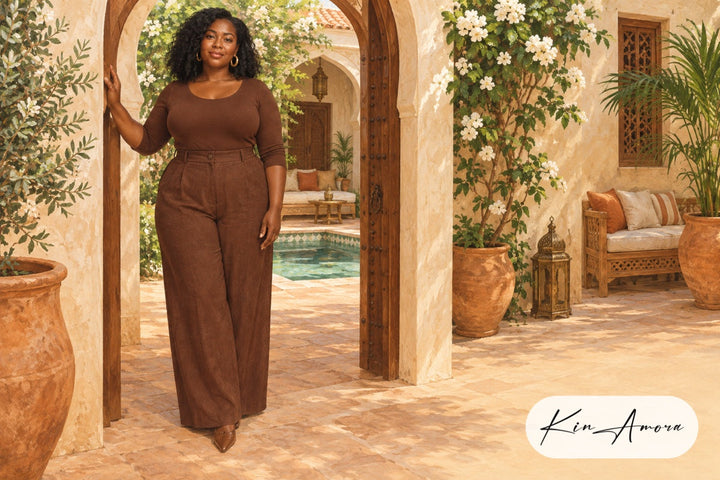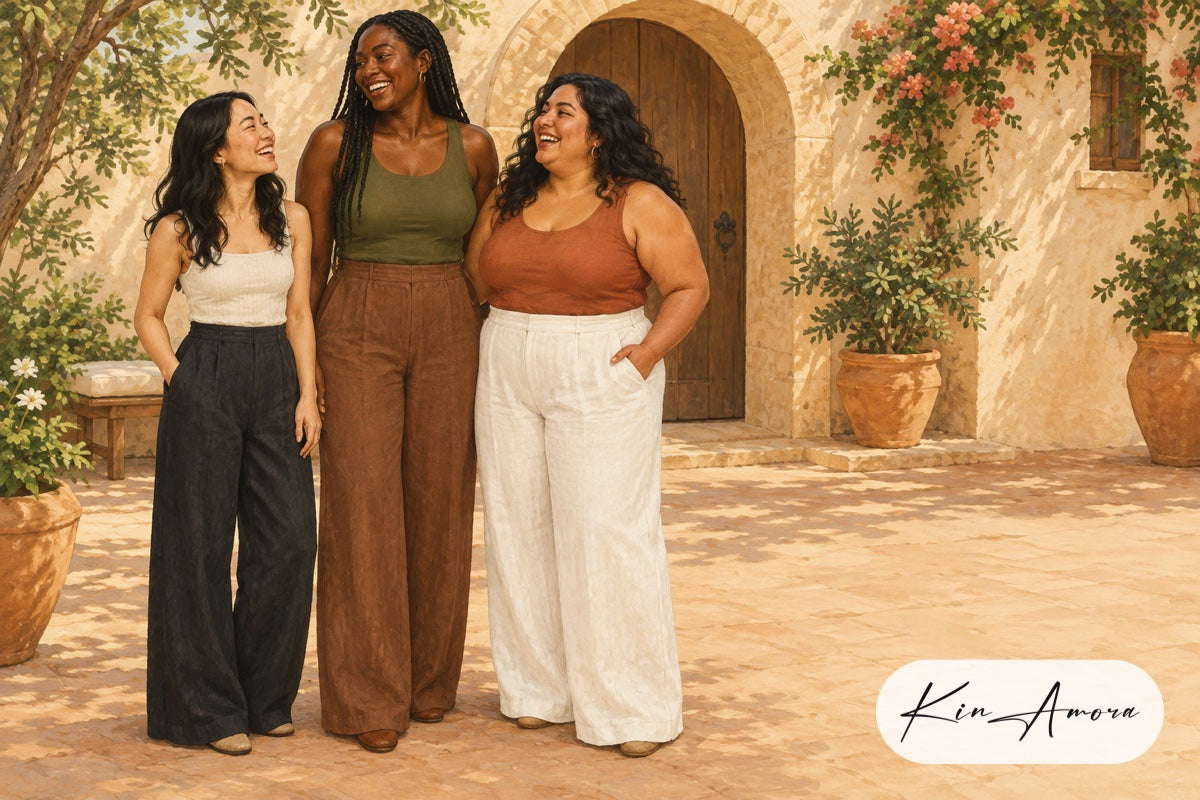

Do wide leg pants suit every body shape and height?
Yes, wide leg pants suit every body shape and height when the rise, hem and fabric match the wearer, because the cut hangs the same straight column of fabric over any leg. The hem sets where the leg line ends, the rise sets where it starts, and the fabric decides whether the width falls or stands out. Amy Verner, style reporter for The Globe and Mail, answered this reader question in 2014 by calling the wide-leg look "a question of proportion," with thinness and curves beside the point.
A slim leg shows the outline of the leg underneath it, while a wide leg shows the outline of the pants. That difference is why one cut works across frames.
Which 4 fit attributes decide whether wide leg pants suit you?
Wide leg pants suit a wearer when the rise, leg width, hem length and fabric line up with the body and the shoes. The table below shows what works and what goes wrong for each attribute.
| Attribute | What works | What goes wrong |
|---|---|---|
| Rise | A high or mid rise at the natural waist | A low rise under a long top, which moves the start of the leg line down to the hip |
| Leg width | A hem about as wide as the knee, 18 to 24 in (46 to 61 cm) around | A leg so full that the hem flares far past the hip line |
| Hem length | About ½ in (1.3 cm) above the floor in the chosen shoes, or a deliberate crop | A hem that stops halfway between the ankle and the floor |
| Fabric | A fluid woven with weight, such as a cotton-rayon blend or wool crepe | A stiff fabric that stands out, or a very light one that clings |
The rise and the hem matter most, because they fix where the leg line starts and ends. Leg width and fabric decide how much volume sits between those 2 points, and the guide to how wide the leg runs shows how to measure a pair before buying.
Where should the rise of wide leg pants sit?
The rise of wide leg pants should sit at or near the natural waist for most wearers. A high rise lets a tucked or cropped top show the waist, and the leg line then starts above the hip. A mid rise works under a top that ends at the hip bone. An elastic waist that rolls or slides down needs tailoring, not a bigger size.
How long should wide leg pants be to suit you?
Wide leg pants should be long enough to graze the shoe, with the back of the hem about ½ inch (1.3 cm) above the floor, or cut to a clear crop. A cropped wide leg works at a deliberate point, such as mid-calf or just above the ankle bone. Hem every pair in the shoes worn most, because each heel height moves the hem.
Which fabric helps wide leg pants suit more frames?
A fluid woven with some weight helps wide leg pants suit more frames, because it falls straight from the hip instead of standing away from it. A 60% cotton, 40% rayon blend, wool crepe and soft crepe all hang close to the body. Rigid denim holds its own shape, so the leg looks wider than the hem measures.
Who should not wear wide leg pants?
No body type should avoid wide leg pants, and the wearers who do better in another cut are people in 4 settings where an open hem gets in the way.
- Cyclists on a chain-drive bike, because a hem 18 to 24 inches around catches in the chain unless it is rolled or clipped.
- Walkers on wet or muddy ground, because a full-length hem picks up water and dirt at the back.
- Office workers under a suiting dress code, when the only pair on hand is a casual pull-on fabric.
- Wearers who dislike fabric moving around the ankle, because the open hem swings with every step.
Each case is about the setting, not the body. A wearer who still dislikes the look usually has one fit attribute out of line.
Why don't wide leg pants look good on me?
Wide leg pants don't look good on a wearer when one of 5 fit problems throws off the proportion, and each problem has a direct fix.
- A hem that stops between the ankle and the floor. Lengthen it to graze the shoe or crop it to mid-calf.
- A low rise under a long, loose top. Move to a high rise and tuck the front of the top.
- Two loose halves, with a wide top over a wide leg. Swap in a fitted tank, tee or bodysuit.
- A stiff fabric that holds its shape away from the leg. Choose a fluid cotton-rayon or crepe.
- Front pleats or patch pockets that open at the hip. Pick a flat front panel or slant pockets that lie flat.
Most wearers fix the look with one change, and the hem and the top are the cheapest to test first.
How do you wear wide leg pants so they suit you?
To wear wide leg pants so they suit your frame, set the rise, the hem and the top in 5 steps.
- Choose a high or mid rise that sits at your natural waist.
- Hem the pants in your most-worn shoes so the back clears the floor by about ½ inch (1.3 cm).
- Pair a fitted or cropped top, or front-tuck a looser one.
- Pick shoes with a defined toe, such as a pointed flat, a loafer or a low sneaker.
- Check the side view in a mirror, then sit and walk to confirm the hem stays clear of the floor.
Step 2 does the most work, so fix the hem before judging the top or the shoes. Flat shoes work too, and wide leg pants with flats look easiest with a cropped hem.
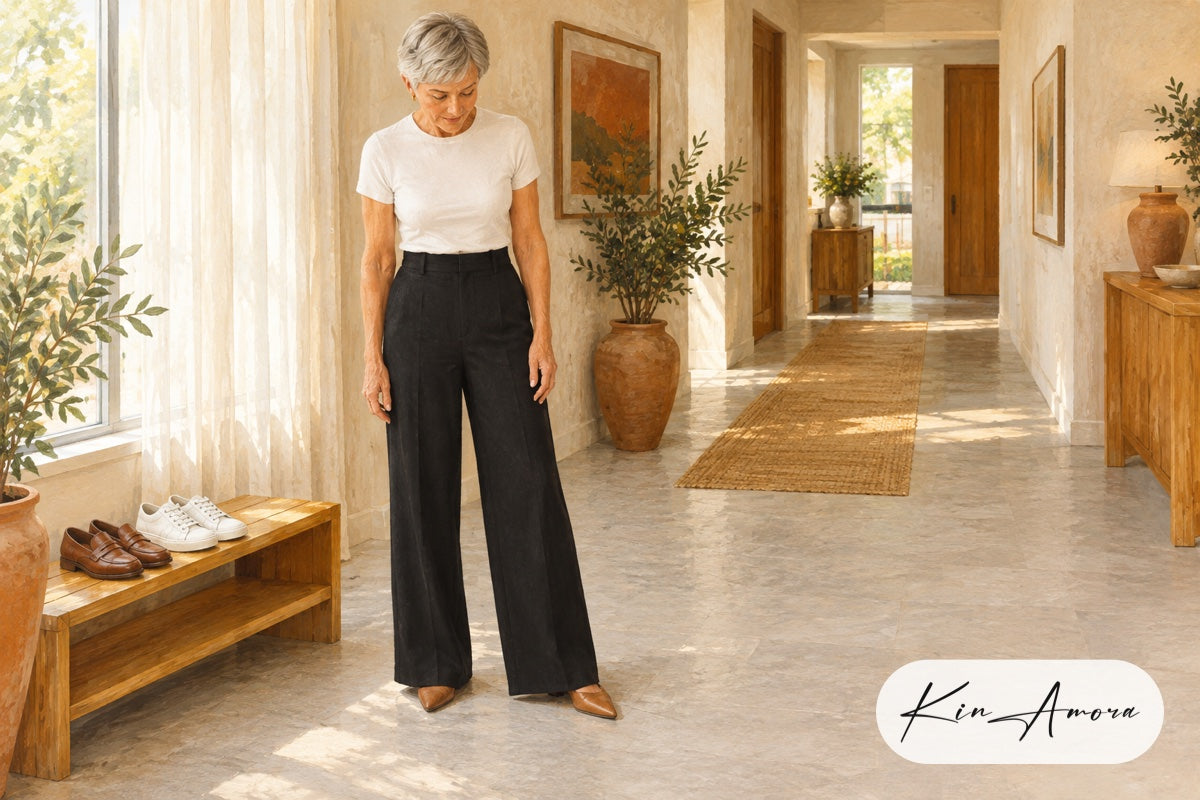
Do wide leg jeans and wide leg trousers suit everyone too?
Yes, wide leg jeans and wide leg trousers suit every frame on the same 4 rules, with fabric as the main difference. Wide-leg jeans in rigid denim stand away from the leg, so a washed, softer denim keeps the line straighter. Wide-leg trousers in wool crepe or gabardine hold a pressed crease, which draws one vertical line from the waist to the hem. Both fabrics look heavier than a cotton-rayon pull-on, so the top above them should stay fitted.
Can pear and apple shapes wear wide leg pants?
Yes, pear and apple shapes can wear wide leg pants, and the waist finish matters more than the leg. A pear shape, with hips wider than the shoulders, suits a wide leg that falls straight from the widest point of the hip in a fluid fabric, with a top that adds a little structure at the shoulder. An apple shape, with more width through the middle, suits a mid or high rise with a flat front panel, a top that skims the waist and a full-length hem. The guide to dressing a pear body shape balances the shoulder, the waist and the hip.
How do wide leg pants suit petite, tall and plus-size wearers?
Wide leg pants suit each of these wearers with one or two small changes.
For petite wearers. Petite sizing usually covers women 5 ft 4 in (163 cm) and under, and the average US woman stands 63.5 inches (161 cm) tall, according to the National Center for Health Statistics' body measurements for 2021 to 2023. A high rise, a soft fabric and a hem that grazes a small heel or a pointed flat keep the leg line long. A moderate leg width, close to the hip line, keeps the fabric in scale with a shorter leg.
For tall wearers. A standard inseam often stops above the ankle on a tall wearer, and an open hem that falls short looks outgrown. Choose a long inseam for a full-length pair, or a deliberate crop worn with flats.
For plus-size wearers. A drapey cotton-rayon or crepe falls straight from the hip and keeps the leg one even column. A flat front panel with an elastic back lies smoothly under a tucked top. Deep pleats and stiff denim add width at the hip, and the page on wide legs and visual width sorts the details that widen the line from those that lengthen it.
Wide leg pants for most frames at Kin Amora, the Stella Wide Leg
The Stella Wide Leg is Kin Amora's wide leg pant, priced at $165, in 5 colors (Black, White, Cacao, Classic Striped and Tobacco) and sizes Small, Medium and Large. The Stella Wide Leg pairs a front panel with an elastic back, which gives a flat front under a tucked top and a pull-on waist behind it. The pant has pockets and is cut from a 60% cotton, 40% rayon blend, handmade by local artisans in Morocco. Special tailoring requests go in the order notes.
The Stella Wide Leg suits wearers who want a flat front panel and a fabric that drapes. The Stella Wide Leg does not suit a wearer who needs a size above Large in the current size options, or an office that asks for pressed suiting trousers. The product page lists no inseam or leg-opening measurement, so ask Kin Amora for both and compare them with a pair you own before ordering.