
How do you dry a cotton-rayon blend without shrinking it?
You dry a cotton-rayon blend without shrinking it by pressing out the water, reshaping the piece by hand and letting it air dry flat or on a wide hanger. Ohio State University Extension's rayon fact sheet by Joyce A. Smith advises supporting wet rayon, rolling it in a towel instead of wringing, and smoothing and shaping it before laying it flat to dry.
Dry a cotton-rayon piece in 7 steps.
- Read the sewn-in care label first, since the FTC requires the label to say whether a garment dries by machine or by another method.
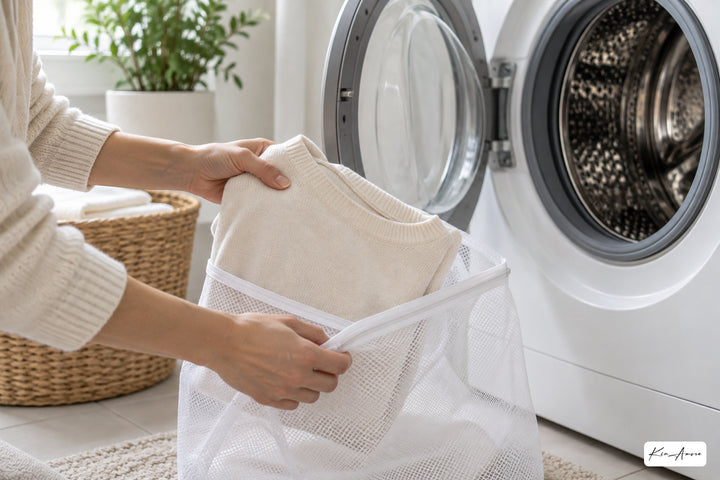
- Lift the wet piece out of the drum in one bundle, with both arms under its weight.
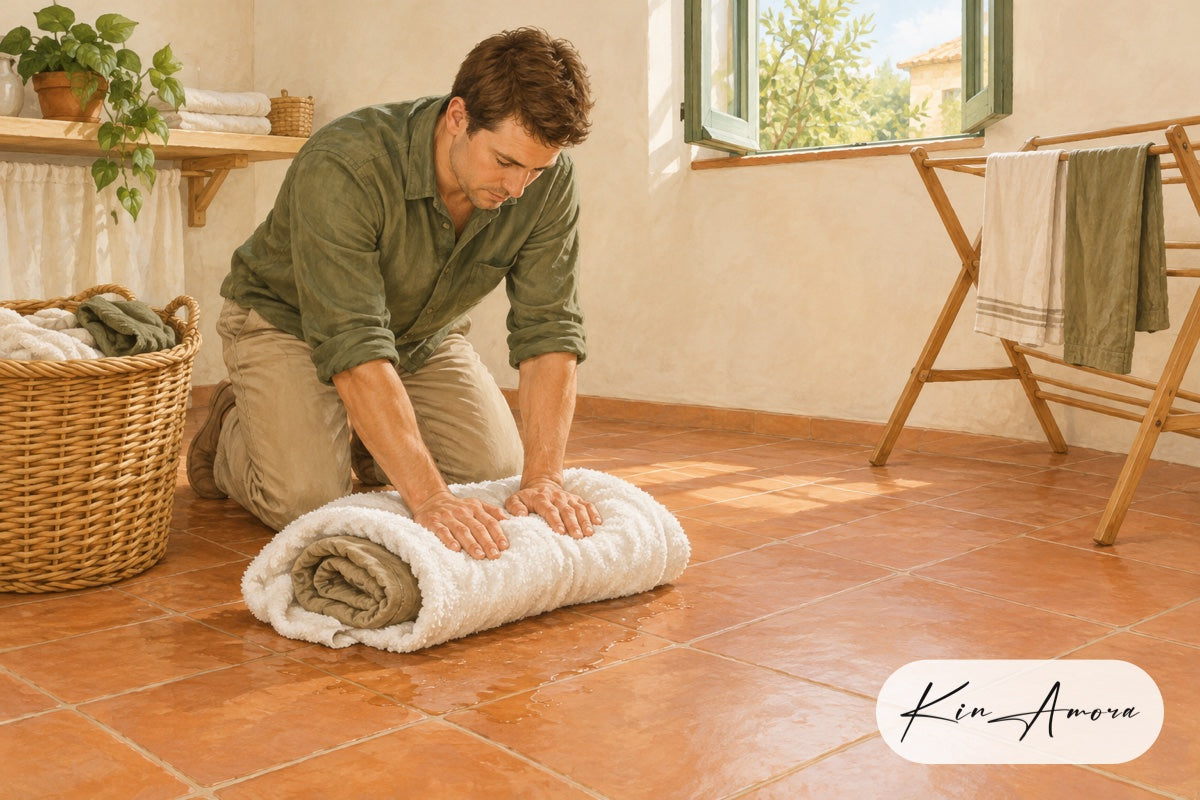
- Roll the piece in a dry towel and press down, without wringing or twisting.
- Shake the piece out once, then smooth the seams, hems and pocket edges flat with your hands.
- Pull the hems and side seams back to their dry shape, matching the two legs or the two sleeves.
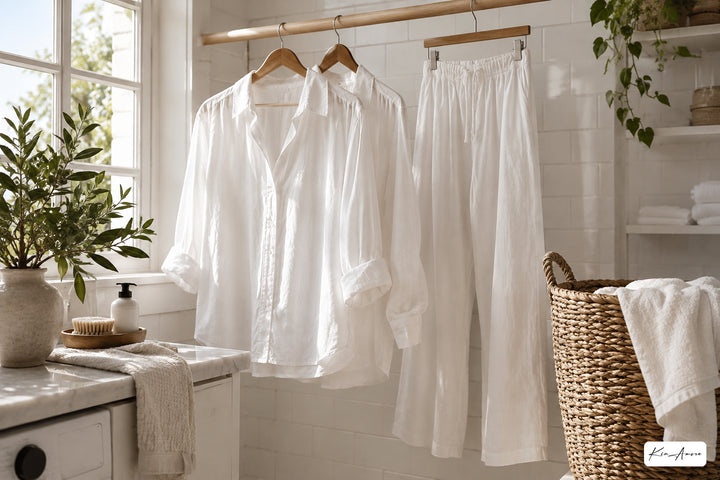
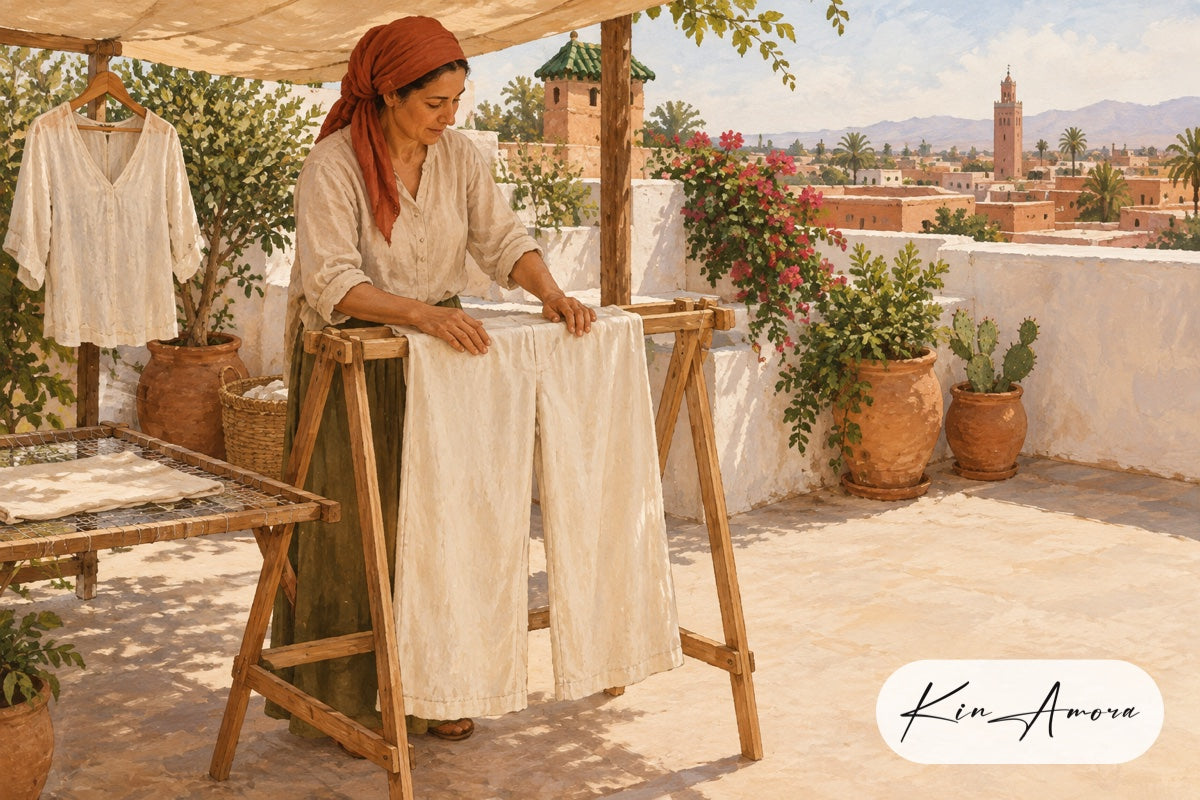
- Lay the piece flat on a mesh rack, or hang a light piece on a wide, non-rusting hanger.
- Turn the piece once halfway through, and take it down as soon as the thickest seam feels dry.
The thick parts dry last. Waistbands, pockets and double-layer panels hold water longest, because rayon absorbs more moisture than cotton and is slow to dry once wet, according to Cornell Cooperative Extension's Fiber Facts booklet by Frances Kozen. Check those spots before you fold anything away.
Why does a dryer shrink clothes?
A dryer shrinks clothes mainly through tumbling while the fabric is damp, with heat mostly deciding how fast it happens. Cotton Incorporated tumbled a 100% cotton interlock knit in a dryer with no heat source, and the fabric shrank more than 20% after 45 minutes, as Textile World reported in 2005. Loads dried at 150°F and 200°F showed the same shrinkage in less time, so temperature changed the drying time but not the amount of shrinkage.
A 2003 study in the International Journal of Clothing Science and Technology by Higgins, Anand, Hall and Holmes reached the same conclusion. The authors found that the tumbling action has the greatest influence on the dimensional stability of cotton knits. Shrinkage in single jersey and lacoste knits rose sharply once the fabric's moisture content fell below about 30%. Similar patterns appeared with and without heat.
Both studies tested cotton knits, and a woven cotton-rayon blend was not part of either. Rayon adds its own weak point. Ohio State University Extension describes the low wet strength of regular rayon, and untreated regular rayon can shrink as much as 10% in a machine wash. That figure, the causes behind it and the soak that sometimes reverses it are covered in the guide to how much rayon shrinks. For drying, the lesson is simple. Keep the damp cloth still, because motion compacts the fibers as they dry.
Does low heat stop clothes from shrinking in the dryer?
No, low heat alone does not stop clothes from shrinking in the dryer, because the drum keeps tumbling the damp fibers. Low heat lengthens the cycle, so the cloth spends longer tumbling through its last, critical stage of drying. Low heat still matters for rayon, which is more heat-sensitive than cotton. The safer setting pairs low heat with a short cycle. Don Bailey of Cotton Incorporated recommended tumbling for no more than 5 minutes to remove wrinkles, then hanging the garment to dry.
What do care-label drying terms mean?
Care-label drying terms are standard phrases defined in the FTC's Care Labeling Rule glossary, so "tumble dry low" means the same thing on every US label. A plain "tumble dry" with no setting allows a hot dryer, because the FTC's business guide says a label need not name a temperature unless regular high heat would harm the garment.
| Label term | FTC meaning | What to do with a cotton-rayon blend |
|---|---|---|
| Tumble dry | Use a machine dryer, and a hot setting may be used | Choose low anyway, and keep the cycle short |
| Tumble dry, low | Set the dryer at low heat | Run about 5 minutes, then finish on a rack |
| Tumble dry, no heat | Run the dryer without heat | Use for fluffing only, since tumbling still shrinks |
| Remove promptly | Take items out as soon as they are dry | Pull the piece out slightly damp instead |
| Drip dry | Hang dripping wet, with or without hand shaping | Suits light tops, not heavy pants |
| Line dry | Hang damp from a line or bar, indoors or out | Use a wide hanger or drape over a bar |
| Line dry in shade | Dry away from sun | Dry indoors or in shade to protect color |
| Line dry away from heat | Dry away from heat | Keep the rack off radiators and heaters |
| Dry flat | Lay out horizontally to dry | The default for heavy or fringed pieces |
| Block to dry | Reshape to original dimensions while drying | Pull hems and seams to their dry shape |
| Smooth by hand | Remove wrinkles and straighten seams and facings while wet | Do this before every air dry |
Kin Amora's published care lines fall inside this table, from "tumble dry low" to "tumble dry or air-dry". The sewn-in label outranks a product page. The water temperature, cycle and detergent that come before drying are set out in the cotton-rayon wash routine, so this page starts where the wash ends.
Is air drying or tumble drying better for a cotton-rayon blend?
Air drying is better for a cotton-rayon blend, because it removes the tumbling that drives most dryer shrinkage. A short, low tumble is the second choice, for pieces whose label allows it.
| Attribute | Air drying | Tumble drying on low |
|---|---|---|
| Shrink risk | Lowest, with no tumbling | Rises with every minute in the drum |
| Wrinkles | Some creasing, less after smoothing by hand | Fewer, when removed promptly |
| Drying time | Slower, with seams drying last | Faster |
| Fringe and trims | Stay straight | Tangle in the drum |
| Color | Protected when dried in shade | Protected from sun |
| Best for | Pants, dresses, fringe and double-layer pieces | Light pieces labeled "tumble dry low" |
Choose air drying for every cotton-rayon piece by default. Choose a 5-minute low tumble when the label allows it and you want the creases out, then move the piece to a rack while it is still damp.
How do you air dry clothes at home?
You air dry clothes at home by spreading each piece with space around it, out of direct heat and sun, with air moving past it. A drying rack by an open window or a fan dries cotton-rayon faster than a crowded line, since each piece needs air on both faces. Silk, wool knits and other nice clothes that skip the dryer follow the same air drying idea, with silk hung indoors and wool knits laid flat.
Should you dry clothes flat or on a hanger?
You should dry heavy pieces flat and light pieces on a hanger, because the wet weight decides how far the cloth stretches. Ohio State University Extension advises hanging rayon garments on a non-rusting hanger only when they are not too heavy when wet. Cornell Cooperative Extension adds that heavy rayon items should be well supported to avoid stretching or loss of shape.
- Tops and light dresses hang on a wide hanger at the shoulders.
- Pants drape over a rack bar at mid-thigh, so the weight splits between the two halves.
- Heavy, double-layer and fringed pieces lie flat on a mesh rack.
- Knits lie flat, because their loops stretch under their own wet weight.
A thin wire hanger concentrates the weight in two points at the shoulder. A wide or padded hanger spreads it.
Can you dry a cotton-rayon blend in the sun?
Yes, you can dry a cotton-rayon blend in the sun for a short spell, though shade is safer for color and fiber. The FTC's "line dry in shade" term exists for exactly this reason. Cornell's Fiber Facts notes that cotton yellows and degrades with prolonged sunlight, and that prolonged ultraviolet exposure damages rayon. Turn dark pieces inside out on an outdoor line, and bring them in once dry.
How do you dry clothes without wrinkles?
You dry clothes without wrinkles by smoothing them by hand while wet and taking them off the rack or out of the drum before they dry hard. Cornell's Fiber Facts advises removing high-wet-modulus rayon from the dryer while slightly damp, smoothing it and hanging it to reduce wrinkling.
Use 4 habits for a smooth finish.
- Shake each piece out hard once before it goes on the rack.
- Run your hands down every seam, placket and hem while the cloth is wet.
- Hang shirts and dresses by the shoulders, buttoned at the top.
- Pull a tumbled piece out after about 5 minutes and finish it on a rack.
A cotton-rayon blend creases more than polyester, so expect soft creases even with good habits. The next section covers how to lift them.
Once dry, how do you smooth and store the piece so it keeps its drape?
You smooth a dry cotton-rayon piece with steam or a low-to-medium iron on the inside, then store it only when it is completely dry. Rayon creases when crushed and holds those creases until it is steamed or pressed. Press it inside out while slightly damp, so the face does not turn shiny.
Storage keeps the drape you dried in. Cornell's Fiber Facts notes that rayon will mildew when kept in damp conditions, so a piece that feels cool at the waistband goes back on the rack for another hour. Fold heavy pants over a padded hanger bar or onto a shelf, and hang light tops and dresses. A crowded closet presses new creases into a fluid cloth.
What if a cotton-rayon piece has already shrunk?
A shrunk cotton-rayon piece can sometimes be eased back with a lukewarm soak, a towel roll and a gentle stretch, then a flat dry. The rayon shrinkage guide linked above sets out each step and the limits of the method. Measure the piece first, so you know how far to stretch it.
How do drying routines change for different people?
The routine stays the same everywhere, and the notes below adjust it for three common situations.
For travelers. Roll the washed piece in a hotel towel and stand on the roll to press the water out. Hang tops on a hanger in the bathroom, and drape pants over the shower rail at mid-thigh.
For humid climates and winters indoors. Air moves slowly in damp rooms, so run a fan or a dehumidifier near the rack. Keep the rack off radiators and heaters, as the FTC's "line dry away from heat" term advises.
For shared and laundromat dryers. Skip the dryer for cotton-rayon pieces altogether. Carry them home damp in a mesh bag and finish them on a rack.
Cotton-rayon pants at Kin Amora and how to dry them
Kin Amora's pants use a 60% cotton, 40% rayon blend, handmade by local artisans in Morocco, so every pair dries best with the air-dry routine above. The pant product pages list no care line, so follow the sewn-in label first.
- The Stella Wide Leg ($165) has a front panel, an elastic back and pockets, in Small, Medium and Large.
- The Gypsy Flare Pant ($120) is Kin Amora's take on the wide leg, with pockets and an elastic waistband, in Small to XLarge and 12 colors.
- The Marrakesh Harem Pant ($145) is the harem cut, with pockets and an elastic waistband, in One Size Fits Most.
- The Womens Santorini Pant ($120) is the tapered leg, with pockets and an elastic waistband, in Small to XL.
- The Men's Santorini Pant ($120) carries the same tapered leg in Small to XXXL.
Each pant offers tailoring on request through the order notes. Measure the inseam before the first wash and after the first dry, so any change shows before a tailor touches the hem. These pants suit anyone who wants a relaxed cut that drapes and is happy to dry it on a rack. The same pants do not suit anyone who wants a pair for a hot dryer every week. Compare every cut and color in Kin Amora's cotton-rayon pants, and add your waist measurement in the order notes for a tailored fit.