
How do you know what size you are in relaxed and one size clothing?
You know what size you are in relaxed and one size clothing by measuring your body, then matching the measurement that controls the garment to the brand's chart. A size label alone tells you little, because each brand sets its own numbers. Follow 6 steps.
- Measure your bust or chest, waist, hip, inseam and height with a soft tape, as the next section describes.
- Write the figures in inches and centimeters, so any brand's chart can be read.
- Find the measurement that controls the garment, the hip for pull-on pants, the bust or chest for tops, and the shoulders and length for kimonos and dusters.
- Read that figure against the brand's chart and note the size it falls in.
- Check the other figures against the same size, since a relaxed cut forgives some and not others.
- Compare the garment's length or inseam with a piece you already own that fits.
Step 3 matters most, because a loose cut forgives the waist in many styles while a pull-on pant still has to pass over the hip.
How do you take your body measurements?
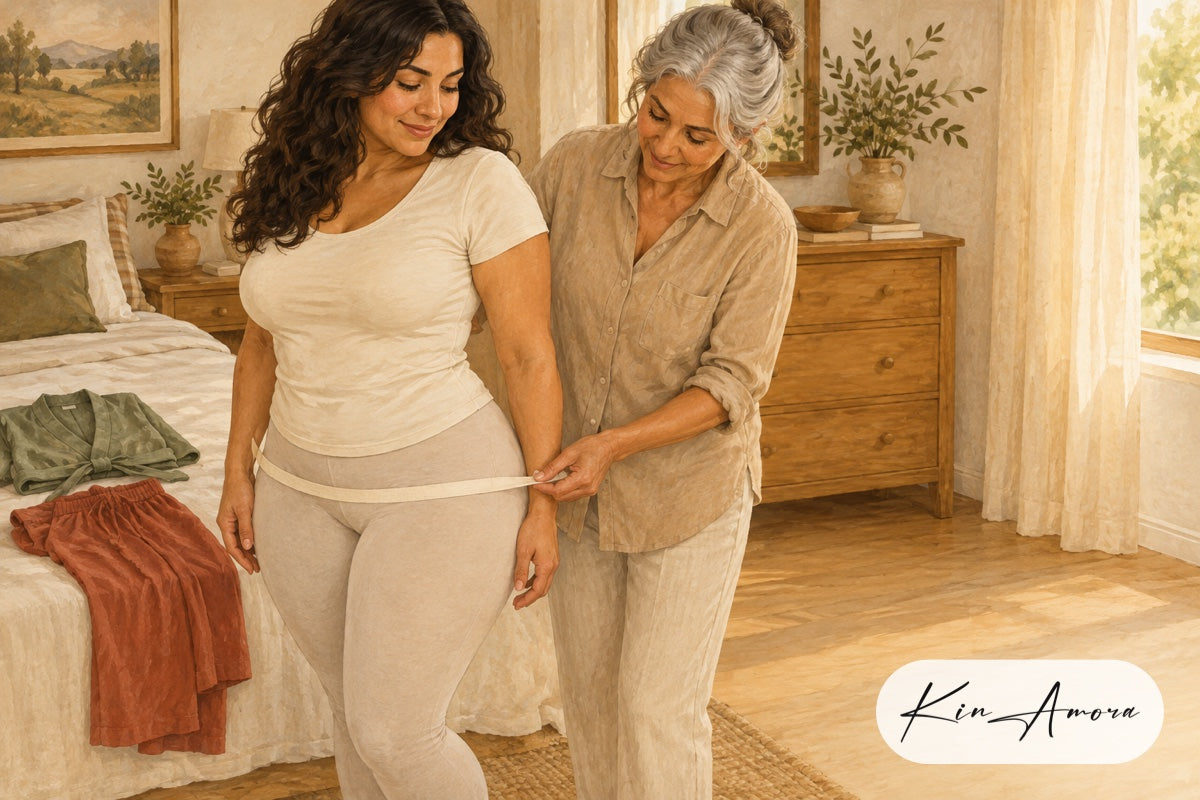
To take your body measurements, stand in your normal posture over thin, well-fitting underclothes while someone else holds the tape. New Mexico State University Extension's guide C-220 asks for a tape that does not stretch, measurements snug but not tight, and the tape kept parallel to the floor for circumferences.
The table gives the 7 measurements that cover relaxed and one size clothing.
| Measurement | Where to measure | Used for |
|---|---|---|
| Bust or chest | Around the fullest point, under the arms | Tops, dresses, gowns |
| Waist | Snugly where a belt sits, the smallest part of the waist | Waistbands, wrap dresses, belts |
| High hip | About 2 to 3 inches below the waist | Pants with a front panel or yoke |
| Full hip | Around the fullest part of the hips | Pull-on pants, skirts, fitted dresses |
| Thigh | Around the leg just below the crotch | Tapered and slim pants |
| Inseam | Inner leg, from the crotch to the ankle bone | Pant length |
| Height | Standing straight, without shoes | Dress, gown and duster length |
NMSU Extension places the full hip usually 6 to 10 inches below the waist and adds one rule worth keeping. When you are unsure whether your hips or thighs are fuller, measure both and use the larger figure.
How do you read a size chart?
To read a size chart, first check whether the chart lists body measurements or garment measurements, because the two need different math. A body chart lists the bust, waist and hip a size is made for, so your own figures go straight into it. A garment chart lists the finished garment, which includes ease, the extra room beyond the body.
On a garment chart, subtract your body measurement from the garment's figure to see the ease. NMSU Extension's C-209 sets at least 2 to 4 inches of hip ease for fitted pants, so a garment hip only 1 inch over your own hip will feel tight. A relaxed garment carries more than that. A chart that lists a measurement taken flat, across the garment laid on a table, needs doubling to give the circumference.
One-size charts work differently, as the table shows.
| Label type | What the chart gives | What to measure |
|---|---|---|
| Letter sizes, Small to XL | Body or garment figures per letter | The controlling measurement, then the rest |
| Paired sizes, S/M and M/L | 2 letter ranges per size | Bust or chest |
| One Size Fits Many or Most | Often a range or a cap, such as up to size 10 | The measurement the cap names |
| One Size Fits All with limits | Stated limits on bust, waist and height | Each limit, such as Kin Amora's Desert Dweller Dress at waist 24 to 32 inches and height 5'2" to 6' |
| Plus option | A second, larger one-size cut | Hip and bust against the plus range |
The guide to one size fits most ranges explains what each one-size label promises and lists the stated limits on Kin Amora's one-size pieces.
What do you do when you fall between two sizes?
Choose the size that fits the controlling measurement, then fix the rest by tailoring. A pant that fits the hip and gapes at the waist takes a waist alteration. A top that fits the bust and runs long takes a hem. In relaxed clothing, the smaller of two sizes often still has room, because the cut already adds ease through the seat, thigh and chest.
What size am I in pants?
Your pants size comes from your waist and full hip for the fit, and your inseam for the length. Women's numbered pant sizes change by brand, so read the waist and hip figures on each chart rather than carrying one number from store to store. Men's pants are often labeled waist by inseam, such as 32 x 30, with both figures in inches.
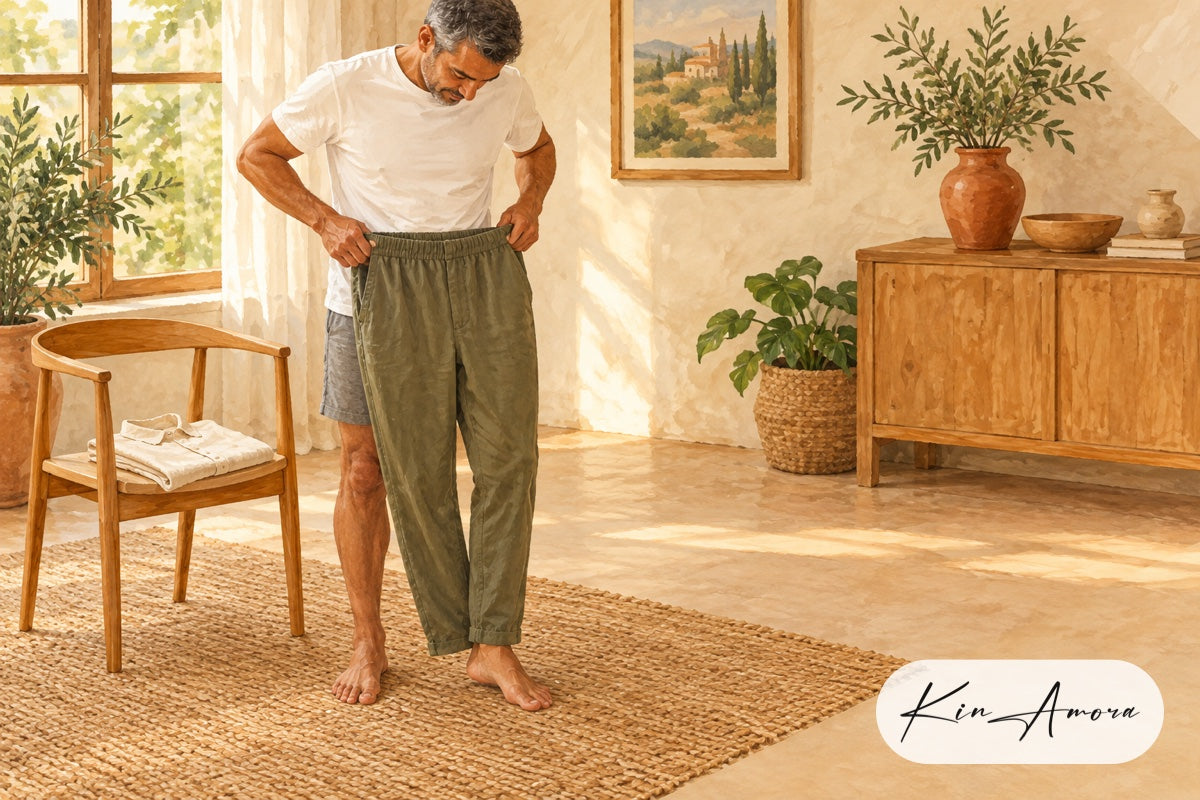
Pull-on relaxed pants follow 3 checks.
- Hip: the stretched waistband has to open wider than your full hip.
- Waist: the relaxed band should rest at your waist without rolling or sliding.
- Length: the inseam or full length should end where the style intends, at the ankle bone for a gathered cuff or near the floor for a wide leg.
What size am I based on height and weight?
Height and weight alone cannot tell you your clothing size, because brands size clothes by circumference, the bust, waist and hip, rather than by weight. NMSU Extension's guide C-205 says height and back-waist length decide the figure type, while circumference measurements decide the size within it. Two people of the same height and weight can wear different sizes when their weight sits differently.
A 1941 US Department of Agriculture publication by Ruth O'Brien and William Chastain Shelton proposed a combination of stature and weight as the best basis for classifying women's body types. Size charts today list bust, waist and hip instead, so a tape measure gives a closer answer than a scale. Height still matters for length, which is why petite and tall wearers check the inseam and hem first.
Why does your size change from brand to brand?
Your size changes from brand to brand because the US has no mandatory clothing size standard, so each brand draws its own chart. TIME's Laura Stampler reported in 2014 that the USDA measured about 15,000 women from 1939, that a commercial size standard followed in 1958, and that the Department of Commerce withdrew it in 1983. ASTM International began publishing its own sizing tables in 1995, and stores now size by their own preferences.
The same article describes vanity sizing, the practice of labeling larger garments with smaller numbers. Your measurements stay the same across brands, which is why the tape beats the label.
Do you need a different size for relaxed clothing?
No, you do not need a different size for relaxed clothing, because relaxed cuts add ease without changing the body measurements a size is made for. Measure the same way and read the same controlling figure. The added room sits in the seat, thigh, chest and shoulders, and the comparison of relaxed fit vs regular fit shows where each cut places it.
How often should you re-measure?
Re-measure every few months and before any order you plan to have tailored. NMSU Extension notes that a figure can change enough in a matter of months to change the size needed.
How does sizing work for different wearers?
Sizing works the same way for every body once the controlling measurement is clear. The notes below give one practical angle for each kind of wearer.
For men. Measure the chest under the arms and the waist where the pants sit, which is often below the natural waist. NMSU Extension notes that men's sewing patterns are drafted for an average build about 5'10" tall, so check sleeve and leg length when you are much shorter or taller.
For petite wearers. Check the inseam and the garment length before the width. A one-size piece often fits the body and runs long, and a hem alteration fixes that.
For plus-size wearers. Compare the stretched waistband with your full hip, and look for a Plus option before sizing up in a regular one-size cut.
Finding your size at Kin Amora, For You and For Him
Kin Amora's men's and unisex collection uses 4 sizing systems, so each piece needs a different measurement. Each piece below is a 60% cotton, 40% rayon blend, handmade in Morocco.
- Men's Santorini Pant ($120), a tapered leg with pockets and an elastic waistband, in Small to XXXL. Measure your full hip and inseam, and note your waist in the order notes for tailoring on request.
- Men's Monaco Tank ($145), in S/M and M/L. Measure your chest.
- Men's Classic Kimono ($210), an oversized, loose fit in One Size Fits Many or Plus. Check the Plus option against your chest and upper arm.
- Men's Royal Duster ($330), in One Size Fits All. Compare the length with your height, since a duster's hem is its least forgiving point.
The pieces in For You and For Him suit anyone who wants relaxed, pull-on or open clothing and is happy to measure first. The collection does not suit a buyer who needs a published numeric chart for every letter size, so send your measurements to Kin Amora before ordering when a product page lists no figures.