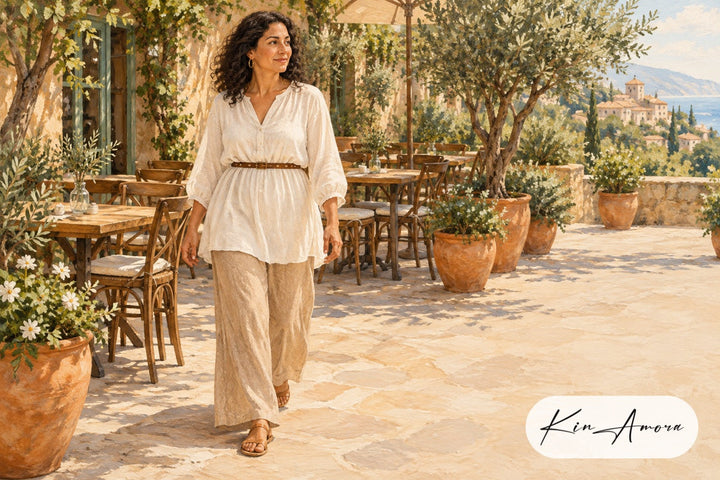
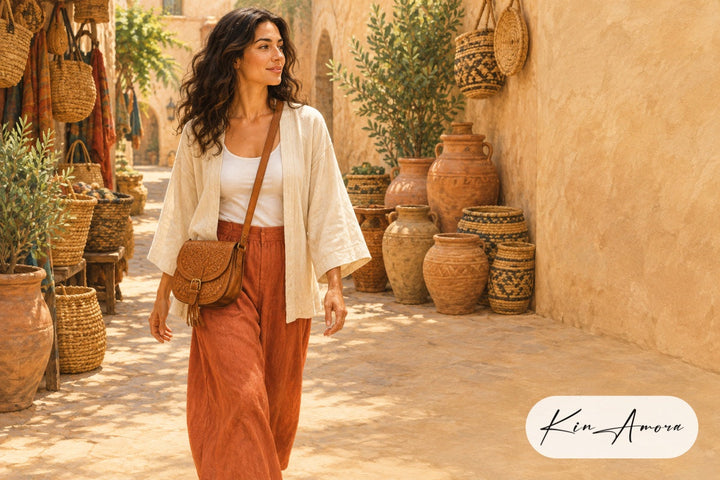
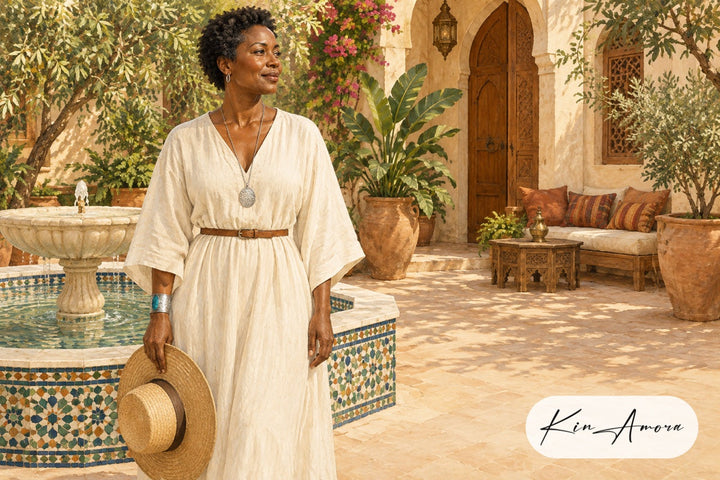
What are the types of western belts?
Western belts come in 8 common types, each defined by how the leather is worked or what metal sits on it. A western belt is a leather belt from the dress of the American West, usually with a decorative strap and a metal buckle. The 8 types are listed below.
- Tooled belts carry carved and stamped floral, scroll or basket-weave patterns on the strap.
- Ranger belts narrow into slimmer leather billets at the buckle and the tip, fastened with a matched buckle set.
- Concho belts carry round or oval silver plates along the strap.
- Trophy buckle belts pair a plain strap with a large engraved plate at the front.
- Studded belts carry rows of metal domes or nailheads along the strap.
- Stone-set belts carry turquoise or cabochon stones on the strap or the buckle.
- Braided belts weave strips of leather into one strap.
- Cartridge belts carry stitched loops for cartridges and often a holster.
Most belts mix 2 of these features, such as a tooled strap with a ranger buckle set. The sections below give the facts that set each type apart.
What is a tooled western belt?
A tooled western belt is a leather strap carved and stamped with a raised pattern, most often flowers, scrolls or a basket weave. The best-known American pattern is the Sheridan Style of Sheridan, Wyoming. The National Endowment for the Arts describes Sheridan Style as fine tooling of delicate flowers and intricate swirls, and credits saddlemaker Don King, a 1991 National Heritage Fellow, as key to its development. Art of Manliness author Antonio Centeno (2018) notes that tooled belts work with simple outfits, such as jeans and a plain button-down.
What is a ranger belt?
A ranger belt is a western belt whose wide body is stitched to narrower leather ends, called billets, that pass through the buckle and keepers. The Texas Prison Museum's guide to ranger belts names 5 parts, which are the buckle head, the emblem area on the buckle, the keepers, the tip and the leather billet. According to the same guide, billets come in widths of 3/4 inch, 1 inch and 1 1/4 inches (1.9, 2.5 and 3.2 cm), and most billets have 5 holes, with up to 7 on request.
What are concho, trophy and cartridge belts?
Concho, trophy and cartridge belts are the heavy end of the western family, each carrying large metal pieces. The Detroit Institute of Arts holds a Navajo concha belt from 1920 in silver, leather and turquoise that measures 37 1/2 inches long and 3 7/8 inches wide (95.3 by 9.8 cm). Trophy buckles grew out of rodeo. Cassandra Day of the Buffalo Bill Center of the West wrote in 2025 that rodeo winners began receiving trophy buckles in place of ribbons or medals as rodeo culture rose in the 1920s. Cartridge belts, or gun belts, carry ammunition loops and often a holster. The Horniman Museum holds an American cartridge belt and pistol holster in dark brown leather, lightly tooled with scrollwork and fitted with 35 stitched cartridge loops.
Which western belts suit soft fabric?
Slim, light western belts suit soft fabric best, namely stone-set, braided, slim tooled and ranger belts, because they shape cotton, rayon and linen without dragging it down. Heavy belts work on soft fabric only on the hips, where the body carries the weight. The table rates the 8 types for soft, loose clothes.
| Belt type | Weight on the fabric | Best soft garment | Where it sits |
|---|---|---|---|
| Stone-set belt | Light to medium | Cotton-rayon maxi dress | Natural waist |
| Braided belt | Light | Linen shirt dress or tunic | Natural waist |
| Ranger belt | Light at the buckle | Long tunic or wide-leg pants with loops | Natural waist |
| Slim tooled belt | Medium | Kaftan top over wide pants | Natural waist or high hip |
| Studded belt | Medium | Loose tunic or peasant blouse | Natural waist |
| Concho belt | Heavy | Ankle-length dress or skirt | Hips |
| Trophy buckle belt | Heavy at the front | Jeans rather than soft fabric | Through belt loops |
| Cartridge belt | Heaviest | Stage and costume wear only | Low on the hips |
The weight column decides most choices. A heavy buckle on a thin cotton-rayon dress pulls the front into a V, while a slim strap lets the fabric fall in even folds. Braided belts add one more advantage, since Centeno notes that a braided belt with a frame buckle takes the prong in any gap of the braid, so the belt adjusts to the bulk of a loose layer.
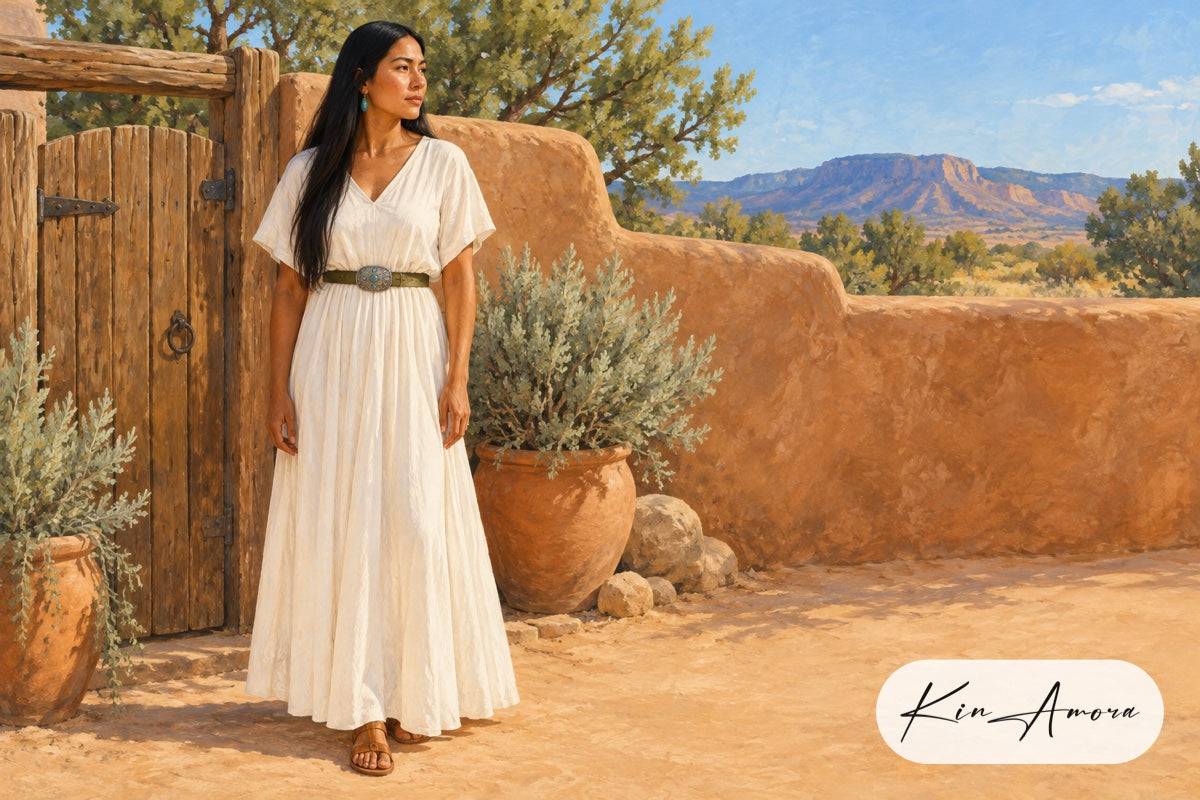
How wide are western belts?
Western belts run from about 3/4 inch to nearly 4 inches wide, depending on the type. Ranger billets sit at 3/4 to 1 1/4 inches (1.9 to 3.2 cm) at the buckle, according to the Texas Prison Museum. Art of Manliness puts casual belts at 1.5 to 1.75 inches (3.8 to 4.4 cm). Concho belts run widest, and the Detroit Institute of Arts' 1920 Navajo concha belt measures 3 7/8 inches (9.8 cm) across.
Soft fabric favors the narrow end. A belt of 1 to 1.5 inches (2.5 to 3.8 cm) fits jean loops and sits neatly at the waist of a loose dress. A wide concho belt suits the hips over an ankle-length skirt, where its width has room.
What are the types of western belt buckles?
Western belts use 3 common types of buckles, which are buckle sets, trophy buckles and concho buckles. A buckle set matches the buckle, keepers and tip in one engraved design. A trophy buckle is a large plate that marks a win. A concho buckle is a round silver plate worn at the center front.
The buckle's history explains its size. According to Cassandra Day of the Buffalo Bill Center of the West (2025), plain metal buckles reached the American West with the cavalry, and early cowboys used simple, practical ones. Western films of the 1920s and 1930s then added engraved silver buckles, hand-tooled leather and oversized designs to costumes. That screen look turned a plain work buckle into a fashion piece.
Where does a western belt stay western and where does it turn boho?
A western belt stays western with a tooled strap, a buckle set and jeans or a pearl-snap shirt, and turns boho with a concho or stone buckle slung over a loose dress, tunic or wide pants. The belt changes less than the clothes around it. The guide to western belt placement and fit shows how waist and hip positions change a dress, a skirt and loose pants.
Among the 8 types, ranger, trophy and cartridge belts sit at the western end. Stone-set, braided and concho belts cross most easily to boho, because their texture and stones suit loose cotton and linen.
Is a studded belt a western belt?
Yes, a studded belt counts as western when the studs are nailheads or domes on brown leather with a western buckle. Pyramids, cones and spikes on black leather belong to punk and metal instead. The guide to studded belt stud shapes sorts 6 stud types by how western, rock or boho each one reads.
How do women and men choose a type of western belt?
Women, men and plus-size wearers choose western belts by where the belt will sit.
For women. Choose a stone-set, braided or slim tooled belt for the waist of a loose dress, and a concho belt for the hips over a long skirt. Women's western belts often go over clothes rather than through loops, so a belt with many holes or a long tail adjusts to each outfit.
For men. Choose a tooled or ranger belt about 1.5 inches (3.8 cm) wide for jeans, with a buckle set or a modest trophy plate. Keep large conchos and cartridge belts for rodeo, stage and costume nights.
For plus-size wearers. Measure the waist or hips over the outfit, and choose a braided belt or a belt with a long run of holes. A belt sold by length in inches fits more reliably than one sold as small, medium or large.
Western belts for soft fabric at Kin Amora, the Taos Olive Belt
The Taos Olive Belt is Kin Amora's western buckle-set belt at $65, built from a wide olive green genuine leather strap with contrast stitching. The antiqued silver-tone buckle carries an Aztec and geometric engraving, with a matching engraved keeper loop and tip. Six red cabochon stones set the belt in the stone-set family, and a single prong buckle closes on multiple adjustment holes. Kin Amora lists the style as bohemian, western and southwestern.
The Taos Olive Belt suits wearers who want a buckle set with stones over loose dresses, tunics and wide-leg pants. Kin Amora cuts most of its clothing from a 60% cotton, 40% rayon blend, handmade by local artisans in Morocco, and a belted waist gives that drape a shape. The belt does not suit wearers who want a narrow belt for slim jean loops or a large concho slung on the hips, and Kin Amora's Rockstar Belt ($62) covers the concho hip look. The product page gives no length or width, so measure over the outfit and ask Kin Amora before ordering. See the engraved buckle and stones on the Taos Olive Belt page.