
How do you take in a loose pants waist without sewing?
To take in a loose pants waist without sewing, measure the gap, then close it with a belt, a clip, safety pins, a button pin or elastic, in 6 steps. Steps 2 and 3 leave the pants unchanged, while steps 4 to 6 leave small pin holes or snips inside the waistband.
- Measure the gap. Put the pants on, pinch the extra at the center back of the waistband and measure the fold.
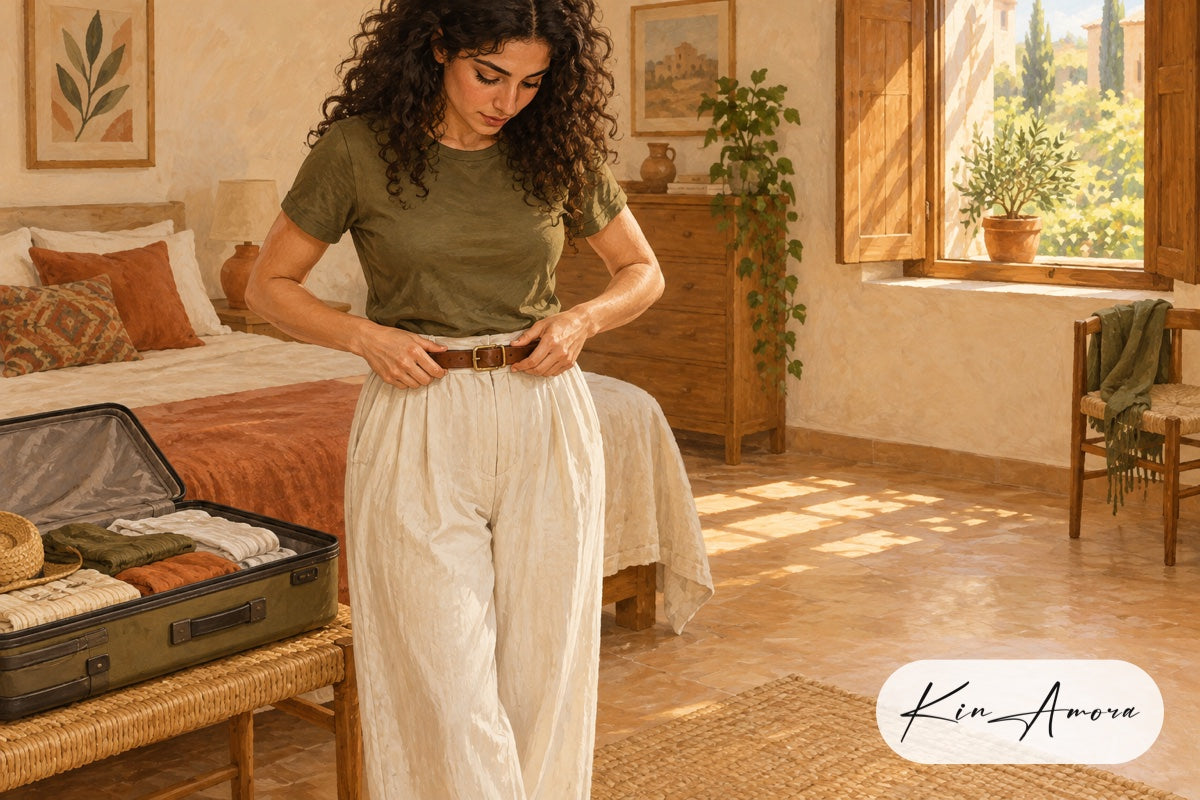
- Belt the waist. Thread a belt through the loops, buckle it snug and push the gathers toward the sides and back so the front lies flat.
- Clip the back for the day. Fold the extra into one pleat at the center back and hold it with a binder clip under a top that covers the waistband.
- Pin a tuck at each side. Fold the extra into 2 equal tucks, one on each side of the back, and close a safety pin through the inner layer of the waistband only.
- Move the button. Push a no-sew button pin through the waistband farther in from the old button, and fasten the pants on the new button.
- Pin elastic inside the back waistband. Snip the inner layer of the waistband at 2 points, thread a strip of elastic a little shorter than the gap between the snips, and pin each end just outside a snip.
Step 6 is the method iFixit's repair guide uses for downsizing jeans without sewing, and the guide warns against pushing the safety pin all the way through the jeans. The same rule applies to every pinned fix.
How do you take in pants with safety pins?
To take in pants with safety pins, fold the extra waist into 2 equal tucks at the back and pin each tuck through the inner layer of the waistband. Two tucks spread the gathers, while one large tuck pulls the back pockets toward each other. Lay each pin flat along the band, so the pin head points sideways instead of down. Take the pins out before every wash, because a pin left in can catch the fabric in the drum.
How do you take in elastic waist pants without sewing?
To take in elastic waist pants without sewing, fold a deep band over once, cinch it with a belt, or pin a small tuck of elastic at each side seam. Folding a deep, yoga-style band shortens the rise by the depth of the fold. A safety pin through a small tuck of elastic at each side seam holds for a day, and shortening the elastic makes the change permanent.
Which no-sew fix suits which pants?
Each no-sew fix suits a different waistband and fabric. The table matches the 6 fixes with the pants they suit and the marks they leave.
| Fix | Works on | Leaves a mark? | How to undo it |
|---|---|---|---|
| Belt | Pants with belt loops and pull-on elastic waists | No | Unbuckle |
| Binder clip | Any waistband hidden under a long top | No | Unclip |
| Safety-pin tucks | Cotton, linen, denim and cotton-rayon | Small pin holes | Unpin and steam the band |
| No-sew button pin | Denim and heavy twill with a button closure | One hole where the pin enters | Pull the pin out |
| Pinned elastic strip | Jeans and trousers with a sewn waistband | 2 snips inside the band | Remove the strip, the snips stay |
| Folded band | Deep knit and elastic bands | No | Unfold |
The pinned elastic strip lasts longest, but its 2 snips stay in the waistband after the strip comes out.
What is the easiest way to take in pants that are too big?
The easiest way to take in pants that are too big is a belt, because it pulls in the whole waist at once and comes off in seconds. A belt gathers the extra width evenly around the body.
A belt fixes the waist only. Pants that are too big by a full size sit loose at the hips, seat and thighs, and no waist fix reaches those areas. New Mexico State University Extension's 2021 pants-fitting guide gives pants up to 1 inch (2.5 cm) of ease at the waist and at least 2 to 4 inches (5 to 10 cm) at the hip. Pants with much more room than that at the hip still sag at the seat after the waist is closed.
How do you take up pants without sewing?
To take up pants without sewing, fold the hem to the new length and bond it with fusible web in 4 steps.
- Put on the pants with the shoes you plan to wear and pin the fold at the new length.
- Press the fold with an iron to set a crease.
- Slide a strip of fusible web ¾ to 1 inch (1.9 to 2.5 cm) wide inside the fold.
- Press the fold until the web melts and bonds, following the timing on the web's package.
New Mexico State University Extension's hem guide, revised in 2019, calls fusible web the quickest way to secure a hem and gives the ¾ to 1 inch strip width for light and medium fabrics. The same guide says fusible web is not satisfactory with sheer fabrics and laces. Rayon may scorch, according to University of Georgia Extension, so test a cotton-rayon pair on the inside of the hem first. Safety pins and fashion tape hold a temporary hem without heat, and the guide to no-sew maxi hem fixes compares those methods on long dresses.
How do you take in flared pants without sewing?
To take in flared pants without sewing, close the waist with a belt or pinned tucks and leave the flare alone, because a flare can only be narrowed at its seams. Hem a flare that runs long with a narrow fold. NMSU Extension gives flared and circular edges a hem of ½ to 1 inch (1.3 to 2.5 cm), since a deep fold on a widening leg holds more fabric at its edge than at the fold line and ripples.
When does a no-sew fix stop working and need a tailor?
A no-sew fix stops working when the pants are loose through the seat and thighs as well as the waist. A loose waist calls for a tailor in 4 cases.
- The seat sags or the thighs hang loose once the waist is closed.
- The tucks pull the back pockets toward each other.
- The fabric shows pin holes, as satin, silk and thin crepe do.
- The pants are worn every week, so the pins would be redone at every wear.
A tailor takes in the side seams, the center back seam and the inseam together, as the guide to seat and leg alterations explains.
Can you take in a pants waist by hand without a sewing machine?
Yes, you can take in a pants waist by hand without a sewing machine, by stitching a wedge at the center back. Pinch the extra at the center back while wearing the pants, mark both sides of the pinch, then backstitch along the marks through the waistband and a few inches of the seam below. A center back belt loop has to come off first and go back on after.
How do no-sew fixes suit different wearers?
No-sew fixes suit most wearers as a stopgap, and the best fix changes with the trip, the frame and the cut.
For travelers. A belt and 4 safety pins weigh almost nothing and fix a loose waist in a hotel room. Pack a pair of pull-on pants as well, because an elastic band adjusts to the day without any fix.
For petite wearers. A loose waist often comes with a long rise. Folding a deep band over shortens both at once, and on a fixed waistband a belt worn at the natural waist keeps the extra rise in soft folds below it.
For plus-size wearers. Check that the pants pass over the hips before you close the waist, because a pinned waist cannot open wider again. A belt over a wide elastic band holds better than pins through a narrow one.
Taking in pants at Kin Amora, through the order notes
The fix that needs no pins is a waist tailored before the pants arrive, and Kin Amora offers tailoring on request through the order notes on its pull-on pants. Each pair below has pockets, is cut from a 60% cotton, 40% rayon blend and is handmade by local artisans in Morocco.
- Classic Capri (from $98), with a front yoke panel, in One Size Fits Many and Plus.
- Gypsy Flare Pant ($120), a wide leg with an elastic waistband, in Small to XL.
- Womens Santorini Pant ($120), a tapered leg with an elastic waistband, in Small to XL.
- Marrakesh Harem Pant ($145), a harem cut with an elastic waistband, in One Size Fits Most.
- Stella Wide Leg ($165), a wide leg with a front panel and an elastic back, in Small, Medium and Large.
The 5 pants suit wearers who sit between sizes and want an elastic band set to their waist rather than pinned. The 5 pants do not suit a buyer who wants a zip-fly trouser, or who needs a published waist measurement, because the product pages list none. Browse the pull-on pants at Kin Amora and add your snug waist measurement in the order notes.