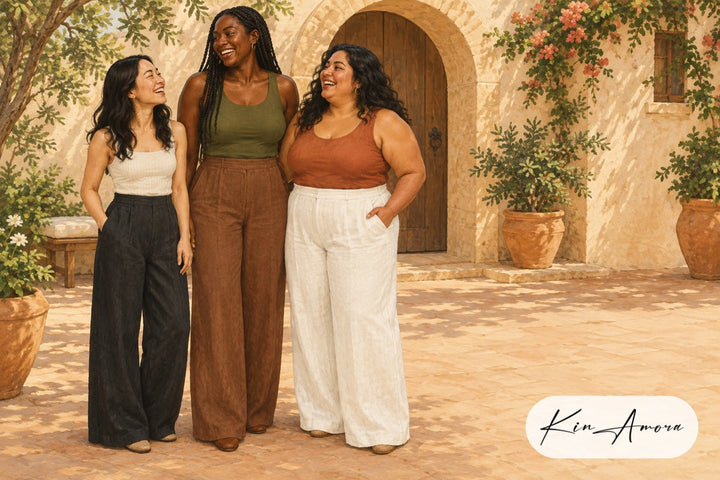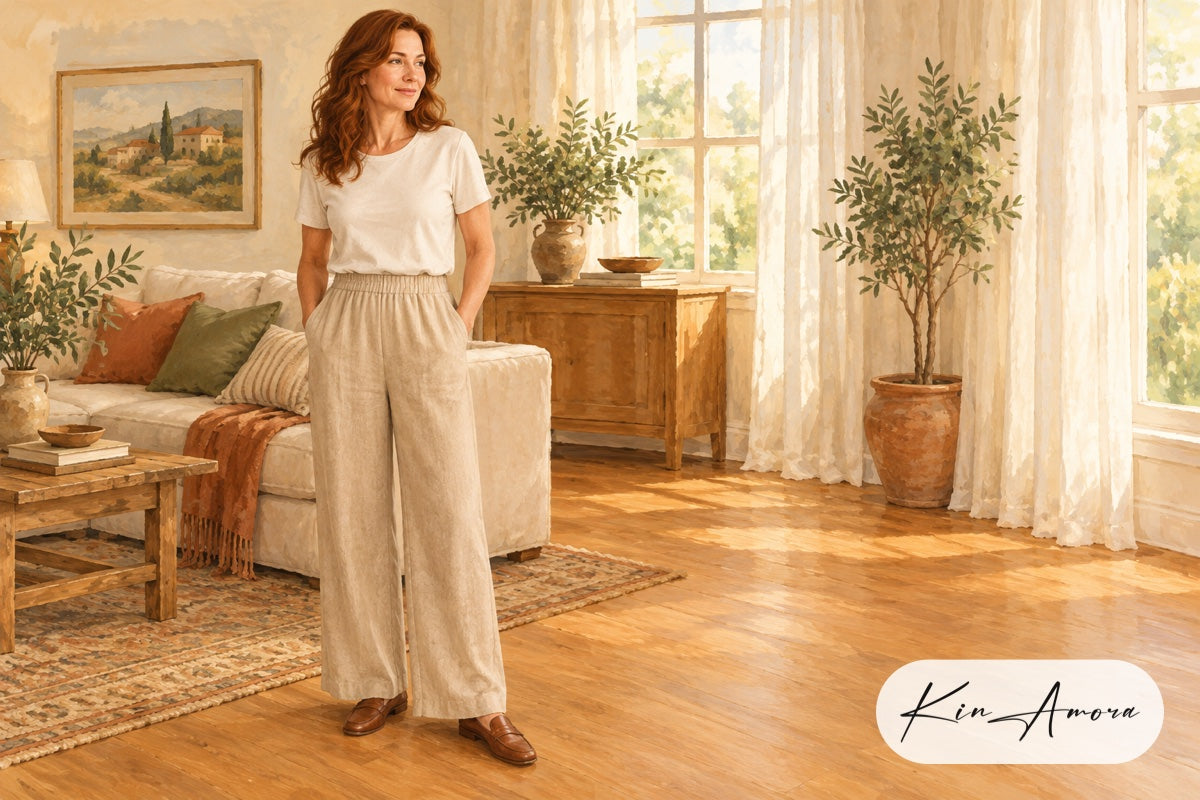

How do you wear elastic waist pants so they look made to measure?
You wear elastic waist pants so they look made to measure by fitting the band to your natural waist, setting the hem for your shoes and finishing the waist with a tuck, a belt or a hip-length top. A tailored trouser looks custom because its waist, seat and hem sit exactly where the body needs them. An elastic waist pant reaches the same result with 3 checks instead of a fitting room.
First, the band should lie flat at the smallest part of the waist without rolling or leaving a red line. Second, the rise should leave room to sit without the seam pulling, and no more room than the design calls for. Third, the hem should end where the cut intends, just above the floor in flat shoes on a full-length pair or on the ankle bone on a gathered cuff. The sections below take each check in turn, then cover styling by cut.
What are elastic waist pants?
Elastic waist pants are trousers held up by a stretch band sewn into or onto the waist, with no zip, button or hook needed to close them. The elastic stretches to pass over the hips, then pulls back to grip the waist. Elastic waist pants for women and for men use the same construction, and the band style changes how dressed-up a pair looks.
Elastic waist pants come in 5 waistband styles.
| Waistband style | How it looks | Where it works best |
|---|---|---|
| Full elastic | Even gathers all the way around | Lounge, travel, yoga and harem cuts |
| Flat front with elastic back | A smooth front like a tailored trouser, gathers only at the back | Office and dinner |
| Drawstring and elastic | Gathers plus a tie at the front | Linen, beach and weekend pants |
| Wide yoga-style band | A deep, flat band that can fold over | Capris, joggers and knit pants |
| Paperbag | A ruffle of fabric above a tied or belted waist | Dressier wide legs and culottes |
The flat front with an elastic back looks the most like a made-to-measure trouser, because the front of the waist shows no gathers. A full elastic waist looks the most relaxed and fits the widest range of waist sizes.
How should elastic waist pants fit?
Elastic waist pants should fit snug at the natural waist, easy through the hip and seat, and finished at the length the design intends. Fit starts with 2 body measurements, the smallest part of the waist and the fullest part of the hips. New Mexico State University Extension's 2021 pants-fitting guide sets out both measurements and the ease to add to each.
Where should the waistband of elastic waist pants sit?
The waistband of elastic waist pants should sit at the smallest part of your waist and lie flat without rolling. NMSU Extension allows up to 1 inch (2.5 cm) of ease at the waist on fitted pants, and a relaxed elastic band should rest within that range. A red line on the skin after an hour of sitting means the band is too tight. A band that slides when the pockets hold a phone is too loose. One-size pants state their waist limits in different ways, and the guide to real one-size measurements shows how to read those limits against your body.
How much hip room do elastic waist pants need?
Elastic waist pants need enough hip room for the band to pass over the fullest part of the hips, because a pull-on pant has no opening. NMSU Extension gives at least 2 to 4 inches (5 to 10 cm) of ease at the hip for pants. Stretch the band by hand before you try the pants on and check that it opens wider than your hip measurement.
How long should elastic waist pants be?
Full-length elastic waist pants should end about ½ inch (1.3 cm) above the floor in flat shoes. Gathered-cuff and harem styles should end on the ankle bone, so the hem neither pools nor rides up the calf. Capris end between the calf and the ankle by design. A deep, wide band folded over once shortens both the rise and the length by the depth of the fold, which is a quick fix for a pair that runs long.
How do you style elastic waist pants?
To style elastic waist pants so the waist looks finished, cover, tuck or belt the gathers in 6 steps.
- Choose a top that ends at the hip, just past the waistband, when the gathers run all the way around.
- Front-tuck a tee or a thin knit into a flat-front waist, and leave the back loose.
- Tuck a fitted tank or bodysuit all the way in when the pants are wide or palazzo-cut, so the waist reads clearly.
- Add a soft belt or a sash over a wide band to flatten the gathers.
- Match the top and the pants in one color, so the band disappears into a single line.
- Finish with one structured layer, such as a blazer, an open kimono or a denim jacket.
Step 1 hides the gathers and step 3 shows them on purpose. Both work when the choice looks intended rather than accidental.
Should you tuck a shirt into elastic waist pants?
Yes, you can tuck a shirt into elastic waist pants, and a front tuck looks neatest on most pairs. A full tuck works on a flat-front waist or a wide, smooth band. A full tuck into dense gathers adds bulk at the waist, so leave that top out or tuck only the front few inches.
Can you wear a belt with elastic waist pants?
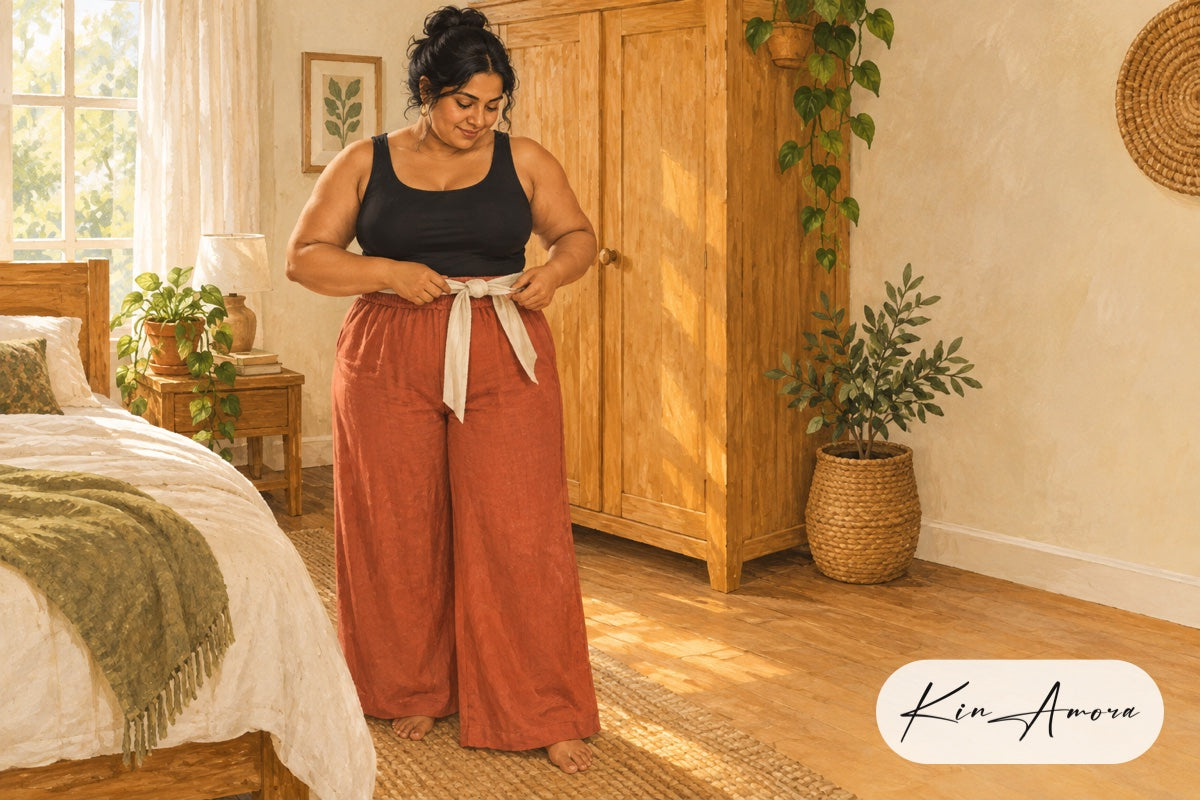
Yes, you can wear a belt with elastic waist pants, either through belt loops or over the band itself. A thin leather belt or a fabric sash flattens the gathers and gives the waist a defined line. Wear the belt at the same height as the band, because a belt above or below it splits the waist into two lines.
How do you wear elastic waist pants by cut?
Elastic waist pants are worn differently by cut, because the leg shape sets how much volume the top can add. The table pairs 7 common cuts with a top and a shoe.
| Cut | Top | Shoes |
|---|---|---|
| Wide leg | Fitted tank, bodysuit or tucked tee | Flat sandals, loafers or a block heel |
| Harem or drop crotch | Fitted tee or tank that ends at the hip | Flat sandals, slides or slim ankle boots |
| Tapered | Tunic, longer tee or loose knit | Sneakers, loafers or ankle boots |
| Capri | Loose tee, cowl neck or tank | Sandals or ballet flats |
| Linen drawstring | Linen shirt worn open over a tank | Espadrilles or slides |
| Elastic waist jeans | Tucked tee or short jacket | Sneakers or ankle boots |
| Elastic waist trousers | Fine knit or blouse with a blazer | Loafers, pointed flats or heels |
The rule behind every row is one loose zone per outfit. A wide or harem leg takes a close top, and a tapered leg can carry a looser one because the outfit still ends in a slim ankle. Relaxed cuts add room through the seat, thigh and rise, and the comparison of relaxed versus modern fit shows how much that room changes the line of a pant.
How do you wear wide leg elastic waist pants?
Wear wide leg elastic waist pants with a top tucked in or cropped at the waistband, so the band marks where the wide leg starts. A wide leg already carries the volume of the outfit. A long, loose top over a wide leg turns the whole outfit into one block from shoulder to floor.
How do you wear elastic waist jeans?
Wear elastic waist jeans like any pair of jeans, with a top that covers the band or a front tuck into a smooth one. Elastic waist jeans often hide the band under a flat front with belt loops, so they look like a zip-fly jean from the front. Ankle boots or sneakers suit the heavier denim better than thin sandals.
Can you wear elastic waist pants to work?
Yes, you can wear elastic waist pants to work in a flat-front or back-elastic style, a solid dark color and a fabric that holds its shape. The front of the waist is what colleagues see, so a smooth front panel reads as a tailored trouser. Pair the pants with a fine knit or a button-down and a blazer, and keep gathered harem and drawstring styles for travel days and weekends.
Which care steps keep an elastic waistband from wearing out?
Cold water, no chlorine bleach and little or no dryer heat keep an elastic waistband from wearing out, because heat and chlorine break down stretch fibers. Spandex, the stretch fiber in many elastic bands, is damaged by chlorine bleach and heat and melts at relatively low heat, according to University of Georgia Extension. An elastic waistband lasts longer with 5 care steps.
- Wash in cold water, which the FTC's care-label rules define as up to 86°F (30°C) for a machine wash.
- Skip chlorine bleach, and treat stains on cotton and rayon with a dry oxygen bleach, which UGA Extension lists as safe for both fibers.
- Air-dry the pants, or tumble them on low heat for about 10 minutes when the label allows it, the short cycle UGA Extension gives for spandex.
- Dry the pants flat or folded over a rack, never pinned up by the waistband while soaking wet.
- Store the pants folded rather than hung from clips that stretch one spot of the band.
Step 4 matters most for cotton-rayon pants. Rayon fabrics lose strength when wet, according to UGA Extension, so a soaked pair hung by its band stretches both the elastic and the seat. Elastic that ripples and no longer springs back has worn out and needs replacing.
Can elastic waist pants be tailored?
Yes, elastic waist pants can be tailored at the waist, by shortening the elastic or taking in the side seams. A tailor opens the casing, cuts the elastic to the new length, joins the ends and closes the casing again. Taking in the side seams narrows the waist and hip together and suits pants that are loose everywhere, not only at the band. Hems shorten the same way as on any trouser.
How do you make elastic waist pants smaller without sewing?
To make elastic waist pants smaller without sewing, cinch the band with a belt, fold a deep band over once or pin a small tuck inside the band. A belt over the band gathers the extra width evenly around the waist. Folding a deep yoga-style band shortens the rise by the depth of the fold. A safety pin through a small tuck of elastic at each side seam holds for a day, and a tailor makes the change permanent.
How do elastic waist pants suit different wearers?
Elastic waist pants suit most wearers once the waist, rise and hem are right. Older wearers gain the most from the pull-on design, and elastic waist pants for seniors work best with a soft, wide band in a woven fabric that washes cold. The notes below give one practical angle for each kind of wearer.
For petite wearers. Check the rise before the waist size. A long rise on a short torso sits up near the ribs or bunches under the band, so fold a deep band once or have a tailor shorten the rise from the top.
For plus-size wearers. Compare the stretched band with your hip measurement, not only the relaxed band with your waist. A wide, flat band stays smoother under a fitted top than a narrow, cord-like elastic does.
For men. A flat-front pant with elastic at the back looks like a chino from the front. A drawstring adds a fixed tie point when the waist and hip measurements differ by a wide margin.
Elastic waist pants at Kin Amora, the pants collection
Kin Amora's pants collection includes 6 elastic waist styles from $82 to $165, each cut from a 60% cotton, 40% rayon blend and handmade in Morocco. Every one of the 6 product pages offers waist tailoring on request through the order notes, which is the closest a pull-on pant gets to made to measure.
- Malibu Pant ($82), a loose fit that reaches the ankle, with a thick elastic band, in Small, Medium and Large.
- Classic Capri (from $98), with a front yoke panel, an elastic waistband, pockets and a 3-button side opening, in regular and plus.
- Gypsy Flare Pant ($120), a wide leg with pockets and an elastic waistband, in Small to XL.
- Womens Santorini Pant ($120), a tapered leg with pockets and an elastic waistband, in Small to XL.
- Marrakesh Harem Pant ($145), a harem cut with pockets and an elastic waistband, in One Size Fits Most.
- Stella Wide Leg ($165), a wide leg with a front panel, an elastic back and pockets, in Small, Medium and Large.
These pants suit wearers who want a woven, pull-on pant that can be tailored at the waist for travel, yoga, warm days and relaxed workdays. The Stella Wide Leg, with its flat front panel, comes closest to a tailored trouser. These pants do not suit a buyer who needs a zip-fly suit trouser, a stretch knit legging or a published rise measurement before ordering. Browse the Kin Amora pants collection and send your waist measurement in the order notes when you want the band tailored.