
What does matching set mean in clothing?
In clothing, a matching set means a top and a bottom made to be worn together as one outfit. The 2 pieces share one fabric and one color or print, and the designer cuts them as a pair. Spanx defines a matching set as any coordinated outfit of 2 or more pieces designed to be worn together, so a set can grow to 3 pieces with a jacket or a kimono.
The matching set is a planned outfit. A white tee with white jeans is a tonal outfit, while a white tee and white pants cut from the same cotton by the same maker form a set. Dictionary.com defines coordinates, the root of the British "co-ord", as articles of clothing harmonizing in color, material or style.
Outside clothing, "matching set" names furniture, bedding and jewelry sold together. This page covers the clothing meaning only.
What counts as a matching set?
A top and a bottom count as a matching set when they meet 3 conditions at once.
- Same fabric: both pieces use one cloth, such as a cotton-rayon weave, a linen or a rib knit.
- Same color or print: both pieces share one dye or one printed pattern, cut so the pattern lines up.
- Same design intent: the maker cut and sold the pieces as a pair, either together or as named separates.
A piece that fails one test turns the outfit into coordinated separates. A cream linen shirt over cream cotton pants is a coordinated outfit, not a set, because the 2 fabrics age, wrinkle and fade differently.
When did matching sets start?
Matching sets started long before the word. The tailored suit pairs a jacket and trousers cut from one cloth, and the twinset pairs a cardigan with a short-sleeved sweater in one knit. The Victoria and Albert Museum notes that Otto Weisz, the Austrian-born knitwear designer at Pringle of Scotland, has been credited with introducing the twinset in the 1930s. The soft, loose set followed, as lounge, travel and resort sets in cotton, rayon and linen.
What are the types of matching sets?
Matching sets come in 9 common types, sorted by the bottom half and by where the set is worn. The table names the usual top, bottom and fabric for each type.
| Set type | Usual top | Usual bottom | Typical fabric | Best for |
|---|---|---|---|---|
| Wide-leg pant set | Tank, camisole or loose tee | Wide-leg or palazzo pants | Cotton-rayon, linen, rayon | Travel, resort days, casual work |
| Harem pant set | Loose top or cowl neck | Harem pants with a dropped crotch | Cotton-rayon, rayon jersey | Yoga, lounging, flights |
| Long skirt set | Tank or fitted tee | Ankle-length or maxi skirt | Cotton, rayon, cotton-rayon | Dinners, warm-weather events |
| Midi or mini skirt set | Crop top or shirt | Midi or mini skirt | Linen, cotton, satin | Brunch, going out |
| Short set | Shirt, tank or crop top | Shorts | Linen, cotton poplin, knit | Hot days, beach towns |
| Shirt set | Button-front shirt | Matching pants or shorts | Linen, cotton, silk | Vacations, men's resortwear |
| Knit lounge set | Sweatshirt or rib top | Joggers or knit pants | French terry, rib knit, fleece | Home, errands, cold weather |
| Workout set | Sports bra or fitted top | Leggings or bike shorts | Nylon and spandex blends | Gym and studio |
| Three-piece set | Top plus a jacket, kimono or duster | Pants or a skirt | Cotton-rayon, linen, wool | Travel, offices, cooler evenings |
The pant set is the most common shape for loungewear and travel. The skirt set reads dressier with the same comfort, because a long skirt moves like a dress while the top stays separate. The workout set stands apart, since its stretch synthetics are built for sweat rather than drape.
How should the two halves of a matching set fit?
The two halves of a matching set should fit as 2 garments sized to 2 different parts of the body, then meet at the waist without a gap or a bunch. The top fits the shoulders and bust. The bottom fits the waist, hips and leg length. A set looks planned when both halves fit on their own terms and share one line at the waist.
To check the fit of a matching set, try both halves on together in 5 steps.
- Measure your bust, waist and hips separately, since a set's halves often follow different size charts.
- Size the top to your shoulders and bust, so the armholes sit flat and the neckline stays put.
- Size the bottom to your waist and hips, then check the inseam or skirt length in your shoes.
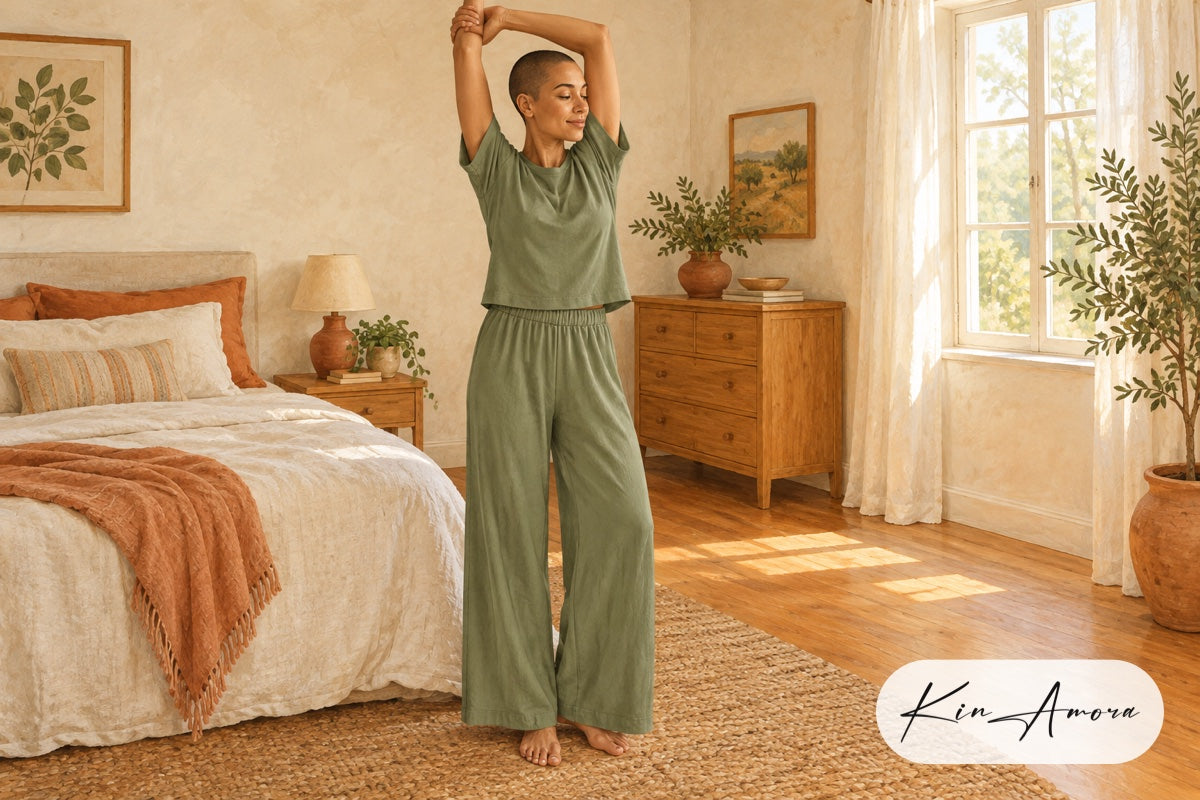
- Raise both arms overhead to see where the top's hem lands against the waistband.
- Sit, bend and walk a few steps to check that nothing pulls, rides up or gaps.
A set fails the fit check when one half fits and the other only nearly fits. The eye reads the 2 pieces as one outfit, so a tight top over loose pants looks like a mistake, not a choice. For a set with top and pants, the 2 lines to check are the top's hem at or just over the waistband and the pant hem just clear of the floor.
Should both halves of a set be the same size?
No, both halves of a set do not need to be the same size, and many bodies need different sizes on top and bottom. The top and pants in one set are not always cut to the same size range, so read the size notes for each half. Buy separates in 2 sizes when the brand sells them apart. One-size sets cover the gap through elastic waists, tie backs and loose cuts, and some list a separate fit limit for each half.
Where should the top end on the bottom?
The top should end at the waistband or a few inches over it, unless the set is designed as a crop top and high-rise bottom. A top that stops just above the waistband shows a strip of skin when you move, which reads as a misfit rather than a crop. A long top worn over wide pants or a long skirt can stay out, while a short or tucked top suits a high, elastic waist.
How loose should a matching set be?
A matching set should be loose enough to sit cross-legged and raise your arms without the seams pulling, when the set is a relaxed or lounge set. Tailored and knit going-out sets fit closer, and workout sets fit close to the skin. The rule across all types is one shared level of ease. Two loose halves in a fluid fabric look intentional, while a fitted top over a very wide leg needs the waist defined to hold the outfit together.
What fabrics are matching sets made in?
Matching sets are made mostly in woven cotton, linen, rayon and cotton-rayon blends for warm weather, and soft knits for cool weather. Fabric sets the formality of a set more than the cut does.
| Fabric | Feel | Best season | Typical set |
|---|---|---|---|
| Cotton-rayon blend | Soft body with fluid drape | Spring to fall | Wide-leg, harem and skirt sets |
| Linen | Crisp, airy, wrinkles easily | Hot months | Shirt sets and short sets |
| Rayon (viscose) | Smooth, cool, drapes well | Warm months | Lounge and resort sets |
| Cotton poplin | Crisp and smooth | Spring and summer | Shirt sets and short sets |
| Rib knit | Stretchy, close-fitting | All year | Going-out and lounge sets |
| French terry and fleece | Thick, warm, brushed | Cool months | Sweat sets |
| Satin or silk | Smooth, light sheen | Evenings | Going-out and sleep sets |
A 60% cotton, 40% rayon blend gives a set cotton's body and rayon's swing, so wide pants and long skirts fall instead of standing out. Rayon is a fiber regenerated from plant cellulose, usually wood pulp, and it is more heat-sensitive than cotton.
How is a two-piece set different from a co-ord and a matching set?
A two-piece set, a co-ord and a matching set describe the same idea at 3 levels of strictness. A two-piece set counts the garments, a co-ord promises that the pieces coordinate, and a matching set promises that they share one fabric and color.
| Attribute | Two-piece set | Co-ord | Matching set |
|---|---|---|---|
| What the name stresses | The number of pieces, exactly 2 | Pieces that harmonize | Pieces that match exactly |
| Fabric | Usually shared | Shared, or similar in color or style | Shared |
| Color or print | Usually shared | Shared or complementary | Shared |
| Number of pieces | 2 | 2 or more | 2 or more |
| Sold as | One outfit | Separates or one outfit | One outfit or named separates |
| Where the term is common | US and UK shops, swimwear | UK shops and fashion press | US shops |
Co-ord is short for coordinates. A co-ord can pair a striped shirt with solid pants in the stripe's color, which a strict matching set would not. The term two-piece covers swimwear and tailored suits, so "two-piece set" is the clearest search term for a top-and-bottom outfit.
Choose the term by what you want to buy. Search "matching set" for one fabric head to toe, and search "co-ord" for pieces that work together but can differ in color or texture.
Is a matching set loungewear?
Yes, a matching set counts as loungewear when it is cut loose in a soft fabric and closes with an elastic or drawstring waist. A tailored linen suit or a satin going-out set is a matching set but not loungewear. The difference sits in the cut and the waist, and the guide to loungewear examples and fabrics lists matching sets first among 12 loungewear pieces.
Do matching sets look like pajamas?
No, matching sets do not look like pajamas when the fabric is a woven, a linen or a rib knit rather than flannel or sleep satin. Pajama sets carry piping, sleep prints and button-front tops in thin cotton. A day set has finished hems, structured shoes and one accessory, such as a belt or a bag, which moves it from the bedroom to the street.
Can you wear a matching set separately?
Yes, you can wear a matching set separately, and each half works with neutral pieces you already own. A set of 2 pieces gives at least 3 outfits, the full set plus each half worn with something else. The guide to matching set remixes shows 5 ways to split and restyle one set.
Are matching sets still in style?
Yes, matching sets are still in style as loungewear, travel and resort clothing. Relaxed sets in natural and cellulose fabrics date more slowly than logo sweat sets or bright trend prints.
How do you wash a matching set so both halves stay matched?
Wash both halves of a matching set together, on the same cold, gentle cycle, so they fade and soften at the same rate. The FTC's care labeling rule defines a cold machine wash as water up to 86°F (30°C). Turn both pieces inside out, use a mild detergent, and hang or lay both pieces to dry. Washing only the bottom half more often, which is common with pants, leaves the 2 halves in slightly different shades over time.
How do matching sets suit different wearers?
Matching sets suit most bodies once each half fits on its own. The notes below give one practical angle for each kind of wearer.
For tall women. Check the inseam and the skirt length before anything else, since one-size and standard sets often stop above the ankle on a tall frame. Long skirt sets and harem pant sets with a gathered ankle hide a short length better than straight wide legs.
For plus-size wearers. Buy the halves in 2 sizes where a brand sells them apart, and choose elastic waists and tie-back tops in one-size sets. A long top over the waistband smooths the meeting point.
For travelers. A set in cotton-rayon or linen packs as 3 outfits in the space of 2 pieces, and it covers flights, sightseeing and dinners with a change of shoes. Roll the pieces rather than folding them to limit creases.
For men. Men wear matching shirt and short sets or shirt and pant sets in linen and cotton, often on vacation. A relaxed set with an open collar and sandals reads as resortwear rather than as pajamas.
Matching sets at Kin Amora, the Zaza Tank x Maeve Skirt
Kin Amora's sets collection pairs tops with matching pants and skirts in 60% cotton, 40% rayon, made in Morocco. The Zaza Tank x Maeve Skirt ($215) is the skirt set, in One Size Fits Many, in Black, White or Sand.
The Zaza Tank x Maeve Skirt shows why each half needs its own fit note. The Zaza Tank has a detailed round neckline and a corset tie in the back that adjusts the fit, and it fits comfortably up to a 34C bust. The Maeve Skirt is ankle-length, with side pockets and small slits on each side, and it fits up to size 12. Waist tailoring for the skirt can be requested in the order notes.
The Zaza Tank x Maeve Skirt suits wearers within both fit limits who want a long skirt set for dinners, travel and warm evenings. The set does not suit wearers above a 34C bust or a size 12 waist and hip, or anyone who wants a pant set. Compare every top-and-bottom pairing in Kin Amora's cotton-rayon matching sets.