
If you're choosing between harem pants and other relaxed cuts, start with our relaxed pant comparison.
Where did harem pants come from?
Harem pants come from loose, gathered trousers worn for centuries across North Africa, the Middle East and South Asia, including the sarouel (sirwal) and the shalwar. The name sirwal traces back to the Persian shalwar, and Ottoman Turkish carried a version, şalvar, into the Balkans. Paris couture took up the silhouette in the 1910s, though American dress reformers had already borrowed Turkish-style trousers for the "bloomer" costume around 1851.
Museum collections show how much cloth these trousers used. A man's shalwar from Sindh, made around 1855 and now in the Victoria and Albert Museum, is a wide-cut pair in red and white striped silk with a waist circumference of 205 cm (about 81 inches) and a waist-to-ankle length of 113.5 cm (about 45 inches). No waist is 81 inches around; that width was gathered in at the top, and the fullness drops through the hip and seat.
Women wore the shape too. The V&A notes that a 19th-century indigo dress from Kohat, in today's Pakistan, would have been worn over wide, gathered shalwar.
In Morocco the same family of trousers goes by sarouel or şarwāl. The Zay Initiative, a dress-history charity, describes the şarwāl of 19th- and 20th-century urban Moroccan menswear as voluminous and gathered at the ankle. Loose trousers are still at the heart of the jabador, a tunic worn with matching pants that Morocco World News lists among Eid outfits. The word itself is Persian in origin, as Wikipedia's entry on the sirwal sets out with its dictionary sources.
Paris arrived late. According to the ASU FIDM Museum, couturier Paul Poiret introduced jupe-culottes in 1911: full trousers worn under a tunic that hung almost like a skirt.
Why are they called harem pants?
The name came from Western fashion, not from the people who had worn the trousers for generations. When Paris designers sold the shape to European women around 1911, they framed it with fantasies of the harem, the women's quarters of a household, and the fashion press called the look the "Persian silhouette."
The Arabic root, ḥarīm, refers to a sacred, protected place and to the women of a family, as Wikipedia's harem entry records from Wehr's Arabic dictionary. European painters and writers turned that private space into an imagined world of secluded women on display. Poiret's marketing leaned on sultans and harems, imagery that fashion historians now class as Orientalism (Wikipedia, citing Adam Geczy).
That's why the term is contested. It attaches everyday clothing, worn by men and women in many countries, to a European fantasy about other people's private lives.
Even museums handle it with care. The V&A holds a 1960s to 1970s outfit by Moroccan designer Zina Guessous, who opened her first boutique in Casablanca in 1964, and catalogues it as a bolero with 'harem pants', quotation marks included.
You don't have to drop the term; most shops still use it. If you'd rather avoid it, "sarouel pants" names the shape after one of its sources.
How should harem pants fit?
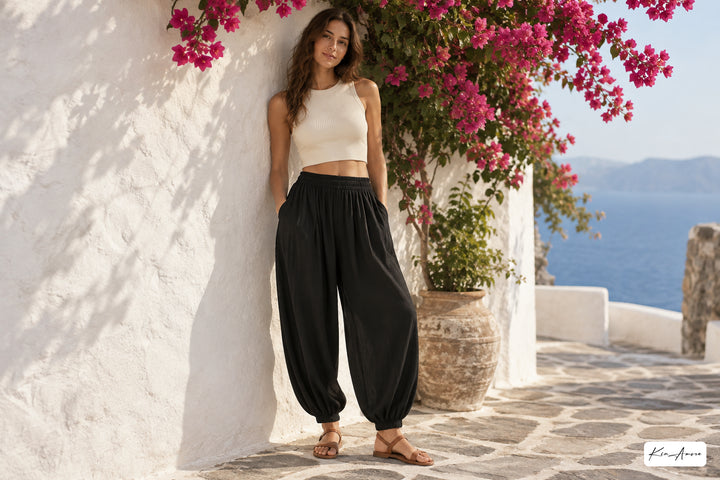
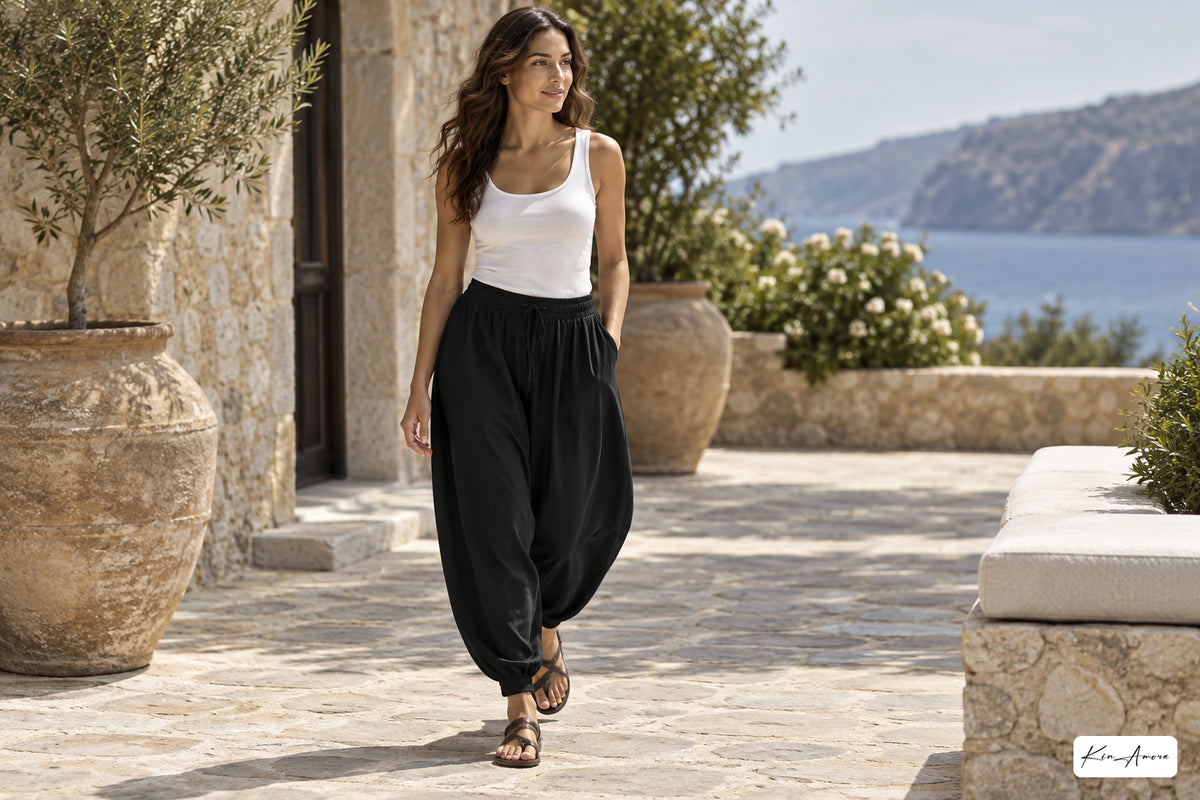
Harem pants should sit securely at your waist, hang loose through the hip and seat, drop at the crotch without catching your stride, and gather at or just above the ankle bone. A quick test: sit cross-legged, then take the stairs two at a time. If nothing pulls, rides up or drags, the fit is right.

Waist and rise
Most pairs hold up on an elastic waistband, sometimes with a drawstring. The elastic should stay put without digging in. A red line after an hour of sitting means it's too tight; pants that slide when your pockets are full mean it's too loose. Rise, the distance from the crotch seam to the waistband, runs long on this cut by design, so judge the waist where it actually sits rather than where a jean would.
Kin Amora's one-size pieces use relaxed cuts and elastic waists to fit a range of sizes, and many styles can have the waist tailored on request. The Marrakesh Harem Pant with pockets is a good example: it's listed at $145 as One Size Fits Most, with an elastic waistband, and you can ask for a tailored waist by adding your measurement in the order notes.
Crotch drop
The drop is the defining feature. A modest drop, a few inches below your own crotch, looks relaxed and walks easily all day. A deep drop toward mid-thigh looks more dramatic but can catch on long strides. Step forward into a lunge: the fabric between your legs should move with you, not pull tight across both thighs.
Ankle cuff
The cuff should land on the ankle bone or slightly above it. Sitting there, the fabric above it falls in soft folds and the hem stays off the floor. A cuff that slips down over your heel usually means the pants are too long for you.
Fabric
Drape decides whether the volume falls or puffs out. Kin Amora pieces are made from a 60% cotton, 40% rayon blend and are handmade by local artisans in Morocco. Rayon is a fiber regenerated from plant cellulose, usually wood pulp; it is soft and drapey but more heat-sensitive than cotton. A stiff fabric holds the extra width out at the hip like a balloon, while a fluid one, such as a cotton-rayon blend, lets it settle toward the cuff.
White pairs
White harem pants need one extra check. Pale cloth shows what's underneath, so try them in daylight with the underwear you'll actually wear. White is also a common choice for kundalini yoga classes, though many teachers treat it as optional.
Drop-crotch vs harem pants, what's the difference?
Drop-crotch describes one feature, a crotch seam set lower than your body's own. Harem pants describe a whole silhouette: that low crotch plus a full hip and thigh and a hem that gathers or tapers at the ankle. So every harem pant is a drop-crotch pant, but plenty of drop-crotch pants aren't harem pants.
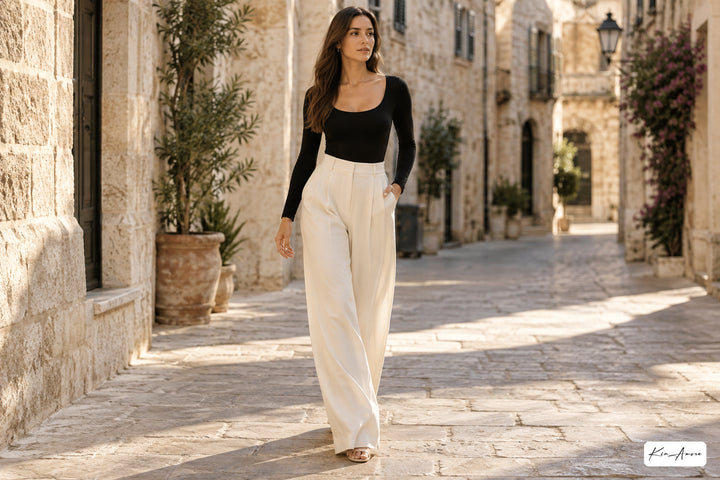
For contrast, the table also includes wide-leg pants. Wide-leg pants fall straight and loose from the hip to a wide hem, with no taper at the ankle.
| Style | Crotch | Hip and thigh | Ankle |
|---|---|---|---|
| Harem pants | Dropped | Full and loose | Gathered or tapered |
| Drop-crotch joggers | Dropped | Slim to moderate | Ribbed knit cuff |
| Shalwar or sarouel (traditional) | Varies by region | Very full, gathered at the waist | Gathered at the ankle |
| Wide-leg pants | At or near the body | Loose | Wide, open hem |
Want the look without the volume? A drop-crotch jogger is the gentler step. Want air around your legs and room to sit on the floor? Go full harem.
How do people wear harem pants today?
Today harem pants are everyday wear for travel, lounging, yoga and warm-weather days, worn by women and men alike. The easy waist and roomy seat make long flights and floor-sitting comfortable, and a fitted top keeps the whole outfit from looking oversized.

For outfit ideas, women can start with how to style harem pants, and men with men's harem pants.
If you remember one thing, make it the stair test. A good pair lets you climb, sit cross-legged and walk all day without a tug at the waist or a drag at the hem. Sort the waist first, because elastic that's wrong spoils everything below it.
Shop Related Products
Explore the pieces, colours and sizing on the Kin Amora store.
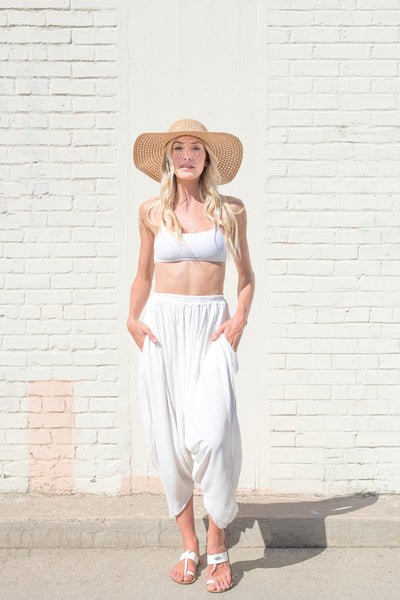
Marrakesh Harem Pant
$145.00 USD
View product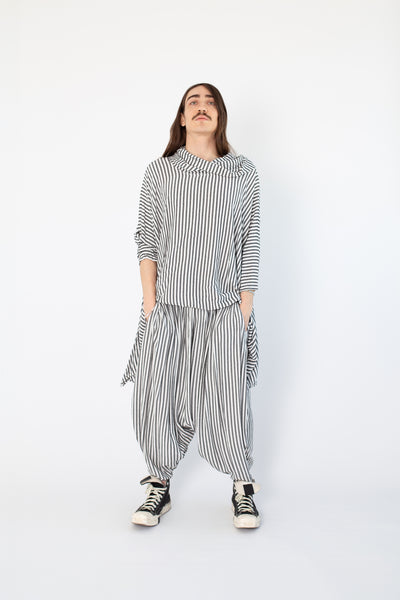
Mens Marrakesh Harem Pant
$155.00 USD
View product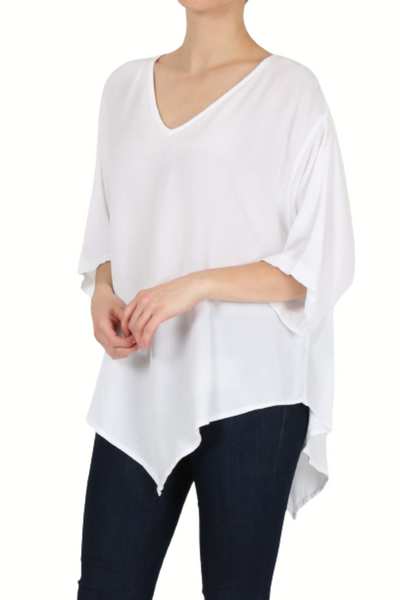
Lisbon Top
$110.00 USD
View productFrequently Asked Questions
Are harem pants the same as Aladdin or genie pants?
Yes, in practice. Many shops sell the same dropped-crotch, ankle-gathered shape as "Aladdin pants" or "genie pants," names that point to the Arabian Nights. Those names carry the same baggage as "harem."
Is it disrespectful to wear harem pants?
Much of the criticism targets the name and the Orientalist fantasy behind it, and some fashion historians, such as Adam Geczy, also describe Paris's 1911 adoption of the trousers as cultural appropriation. Loose gathered trousers remain everyday wear for men and women in many countries. If the label bothers you, call them sarouel or drop-crotch pants.
Can harem pants be shortened?
Yes, but not by cutting the hem like a regular trouser, because the ankle cuff holds the shape. A tailor usually takes the length out above the cuff and reattaches it, so the gather stays the same.
What fabric works best for harem pants?
Harem pants hang better in a soft, drapey fabric, such as a cotton-rayon blend, than in a stiff one, because drape decides whether the extra volume falls or puffs out. A stiff fabric holds the extra width out at the hip like a balloon, while a drapey one lets it settle toward the cuff. Kin Amora pieces are made from a 60% cotton, 40% rayon blend.
What should you check before buying white harem pants?
Before buying white harem pants, try them on in daylight with the underwear you plan to wear, because pale cloth shows what's underneath. Then run the quick fit test: sit cross-legged and take the stairs two at a time to check that nothing pulls, rides up or drags. White is a common choice for kundalini yoga classes, though many teachers treat it as optional.
Kin Amora also makes a men's version, the Mens Marrakesh Harem Pant, handmade by local artisans in Morocco.