
What is a boho dress?
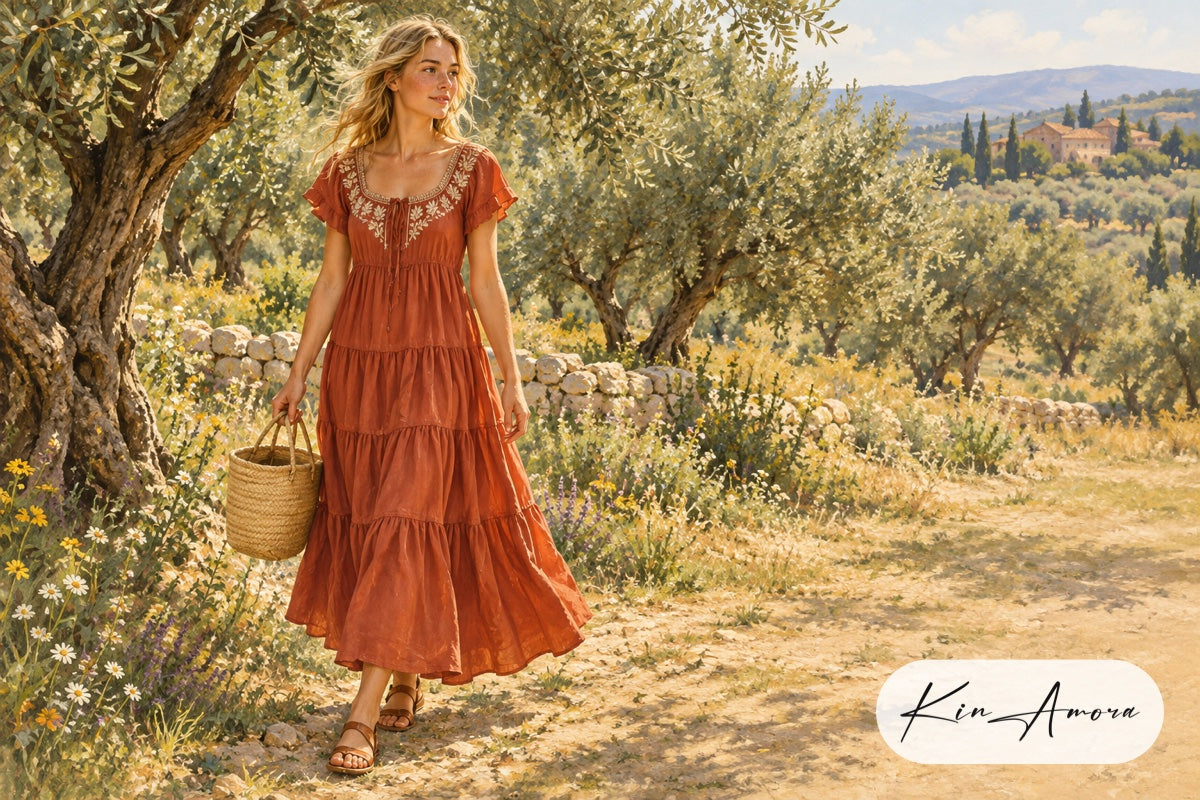
A boho dress is a relaxed dress that joins a flowing cut, a natural fabric and visible handwork. The body of a boho dress skims rather than grips, the fabric breathes, and the surface carries texture through embroidery, smocking, lace, crochet, tiers or fringe. Length and sleeve style vary, so the look comes from those 3 traits together.
Boho is short for bohemian. In 19th-century Paris, "bohemian" described artists and writers who lived outside middle-class conventions, and fashion later borrowed that free-spirited image.
Where does the boho dress style come from?
The boho dress style comes from the hippie and folk dressing of the late 1960s and early 1970s. According to the FIDM Museum, the San Francisco label Gunne Sax hired Jessica McClintock as its designer in 1969, and a typical early-1970s Gunne Sax dress had a banded empire waist, a long maxi skirt, lace trim and small calico florals. The Victoria and Albert Museum holds a 1970 Thea Porter kaftan pieced from satin and printed chiffon, a sign of how much Middle Eastern dress fed the look. Photographer Patrick Lichfield shot Talitha Getty on a Marrakesh rooftop in 1969, and fashion writers still use that image as shorthand for the luxe bohemian look.
The style returned in the 2000s. Sienna Miller's appearance at the Glastonbury Festival in 2004 put floaty skirts, coin belts and embroidered tunics back into British high-street shops, and by spring 2005 the look was close to everywhere in parts of London.
What makes a dress boho?
A dress is boho when it combines a relaxed cut, a natural fabric and at least one handwork detail. One trait alone is not enough. A plain cotton shift is a summer dress, and a lace sheath is a cocktail dress. Boho dresses share 6 features.
- Relaxed silhouette: an A-line, empire, tiered or straight body that moves away from the hips.
- Breathable fabric: cotton, linen, rayon, a cotton-rayon blend, gauze or crochet.
- Handwork detail: embroidery, smocking, lace insets, crochet panels, tassels or fringe.
- Print or pattern: small florals, paisley, stripes, patchwork or tie-dye.
- Earthy color: cream, rust, olive, sand, dusty rose or washed black.
- Soft neckline and sleeve: a peasant neckline, a tie at the throat, a bell or flutter sleeve.
The more of these features a dress shows, the stronger it reads as boho. A dress with 2 of them usually needs a belt, a layer or jewelry to finish the look. The dress follows the wider rules of boho style clothing, a loose cut, a natural fabric and visible handwork.
What is the difference between a boho dress and a maxi dress?
The main difference between a boho dress and a maxi dress is that boho names a style, while maxi names a length. A maxi dress is any dress whose hem reaches the ankle or the floor, in any fabric or cut. A boho dress is any dress with a relaxed cut, natural fabric and handwork, at any length.
| Attribute | Boho dress | Maxi dress |
|---|---|---|
| Defined by | Style (relaxed cut, natural fabric, handwork) | Length (hem at the ankle or the floor) |
| Length | Mini, midi or maxi | Ankle or floor only |
| Fit | Loose, with shaping at one point | Fitted or loose |
| Typical fabric | Cotton, gauze, linen, rayon, crochet | Any, from jersey to silk |
| Typical details | Embroidery, smocking, tiers, lace, fringe | None required |
| Formality | Casual to semi-formal | Casual to formal |
A dress can be both at once. A boho maxi dress has the ankle-length hem of a maxi and the cut, fabric and trims of a boho dress, and the tiered maxi is the most common example. A black jersey maxi with no trim is a maxi but not a boho dress. A smocked cotton minidress with embroidery is a boho dress but not a maxi.
Choose a boho dress when you want texture and a relaxed, artisan feel at any length. Choose a plain maxi dress when you want coverage and a long line without decoration. Hem heights, maxi styles and fit checks sit in the guide to maxi dress length and fit, which covers the maxi side of this comparison.
What are the types of boho dresses?
Boho dresses come in 8 common types, such as the tiered maxi, the peasant dress and the smocked sundress. Each type is named for the feature that gives it shape.
| Boho dress type | Defining feature | Usual length | Best for |
|---|---|---|---|
| Tiered maxi | Horizontal panels that widen toward the hem | Ankle or floor | Beach days, festivals, resort dinners |
| Peasant dress | Gathered neckline with a drawstring or ties, full sleeves | Midi or maxi | Daytime, travel |
| Prairie dress | High neck, long sleeves, small florals, ruffled hem | Midi or maxi | Cool days, layering with boots |
| Smocked sundress | Elastic smocking across the bodice or waist | Mini or midi | Hot weather, casual errands |
| Caftan dress | Loose, straight body with wide sleeves cut in one | Knee to ankle | Lounging, beach cover-up, resort evenings |
| Crochet or lace dress | Open crochet or lace panels over a slip | Mini to maxi | Summer parties, beach weddings |
| Embroidered tunic dress | A straight body with embroidery at the neck and cuffs | Knee or midi | Day wear with sandals |
| Wrap dress | A crossover front tied at the waist | Midi or maxi | Travel and dinners, since the waist adjusts |
The tiered maxi and the caftan dress are the 2 types most often sold as boho maxi dresses. The peasant and prairie dresses carry the strongest 1970s link, through labels such as Gunne Sax. Hem length also decides the shoe, and shoes for boho dresses run from flat leather sandals and espadrilles to ankle boots and low block heels.
What fabrics are boho dresses made of?
Boho dresses are made mostly from breathable natural and cellulose fabrics, such as cotton gauze, linen, rayon and cotton-rayon blends. Fabric decides how the dress drapes, and drape decides whether tiers and gathers fall softly or stand out stiffly.
Boho dresses use 7 common fabrics.
- Cotton gauze and voile: light, slightly crinkled cotton that breathes in heat.
- Linen: a crisp flax fabric that softens with washing and wrinkles easily.
- Rayon: a fiber regenerated from plant cellulose, usually wood pulp, with a fluid, swinging drape.
- Cotton-rayon blend: cotton body with rayon drape, such as a 60% cotton, 40% rayon cloth.
- Crochet and lace: open textures worn over a slip or a lining.
- Chiffon: a sheer, floaty weave for evening and wedding-guest boho dresses.
- Denim and chambray: sturdy cotton weaves for prairie and shirt-style boho dresses.
Natural fibers were never the whole story. The FIDM Museum notes that most Gunne Sax dresses were made from cotton or from synthetics such as polyester, acetate, nylon or rayon. Today, cotton, linen and cotton-rayon read as the most authentic boho choices, because their matte surface and soft creases match the handmade look.
What colors and prints define the boho dress aesthetic?
The boho dress aesthetic rests on earth tones, washed whites and small or busy prints. Color carries much of the style. A plain white cotton dress with embroidery reads as boho, while the same dress in neon reads as beachwear.
The boho palette has 3 color families.
- Neutrals: white, cream, sand, oatmeal and washed black.
- Earth tones: rust, terracotta, olive, dark green, mustard and tobacco.
- Soft brights: dusty rose, berry, turquoise and faded indigo.
Boho prints follow the same rule of softness. Small florals descend from the calico house dresses that the FIDM Museum names as a Gunne Sax source. Paisley, patchwork and block-printed motifs point to the Middle Eastern, North African and South Asian textiles that 1970s designers borrowed. Stripes in muted colors read as boho when the fabric is woven rather than printed on a slick synthetic.
How should a boho dress fit?
A boho dress should fit close at one point and loose everywhere else. That one point is usually the shoulders, the bust or the waist. The rest of the dress skims the body and leaves room to walk, sit on the ground and lift your arms.
Check 5 fit points when you try on a boho dress.
- Check the shoulders, where the seams or the elastic neckline should stay put without slipping.
- Check the shaping point, where smocking, a tie or a seam should sit at the bust or natural waist.
- Check the hips, where the fabric should fall past without horizontal pull lines.
- Check the hem, which should clear the floor in the shoes you plan to wear.
- Check the stride, by taking a long step and climbing a stair.
Relaxed does not mean oversized. A boho dress that is loose at every point hides the body and looks like a sack, which is why so many boho outfits add a belt. One-size boho dresses rely on elastic, ties or a loose cut to fit a range of bodies, so the shoulder seam and the length matter more than the bust and hip numbers.
What separates a true boho dress from a generic summer dress?
A true boho dress shows texture and handwork that a generic summer dress leaves out. Both dresses can be loose, long and cotton. The difference sits in the surface and the finish.
Run 5 tests to sort the two.
- Fabric test: a boho dress uses a matte natural or cellulose fiber, while a generic dress often uses slick polyester.
- Detail test: a boho dress carries embroidery, smocking, lace, crochet, tiers or fringe, while a generic dress has a plain surface.
- Cut test: a boho dress has gathers, tiers or a peasant neckline, while a generic dress has a flat, simple body.
- Color test: a boho dress sits in earth tones, neutrals or soft prints, while a generic dress can be any bright solid.
- Layer test: a boho dress looks complete with a belt and a kimono, while a generic dress looks like the same dress plus extras.
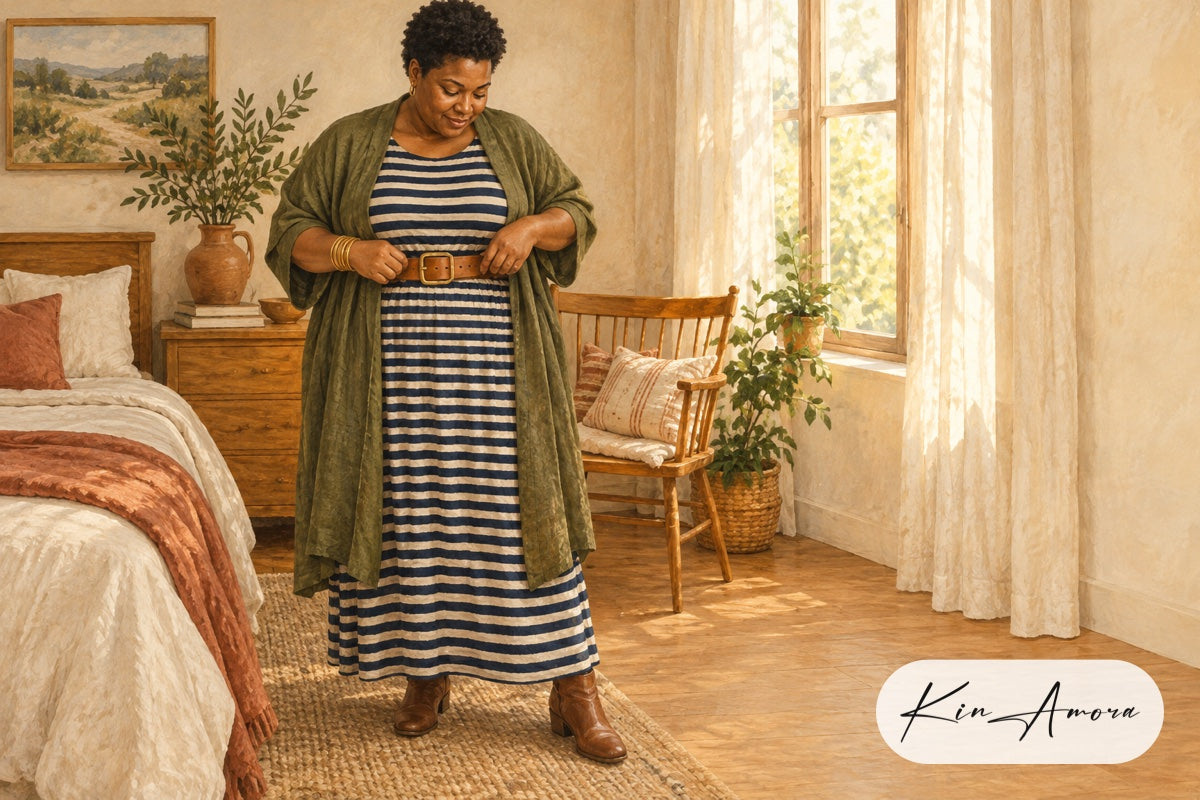
A plain dress can move toward boho through accessories. A wide leather belt, layered jewelry and an open kimono add the texture the dress lacks.
How do you style a boho dress?
To style a boho dress, add one textured accessory, one flat shoe and, on cool days, one long layer, in 4 steps.
- Add a belt at the natural waist or low on the hips to shape a loose body.
- Choose flat sandals, ankle boots or Western boots in a leather tone that repeats the belt.
- Layer an open kimono, a duster, a cropped denim jacket or a long cardigan.
- Finish with one focal jewelry piece, such as stacked bangles or a long pendant.
The belt does the most work. A fringe, concho or studded belt pulls a straight boho dress into a waist and repeats the dress's handmade feel, and the guide to boho belt styles sorts them by material and by the garments each suits. Smocked and tiered dresses need no belt, because the smocking or the top tier already shapes the waist.
Are boho dresses still in style?
Yes, boho dresses are still in style, because the look has returned in waves since the late 1960s instead of fading out. The style grew out of late-1960s hippie dress, and Karina Reddy's 2021 entry in the Fashion Institute of Technology's Fashion History Timeline says Sienna Miller epitomized its return in the early and mid-2000s. Woman and Home expected ruffles, frills and floral prints to return for spring and summer 2025. A boho dress in a natural fabric and a muted color dates more slowly than one in a trend print.
Can you wear a boho dress to a wedding?
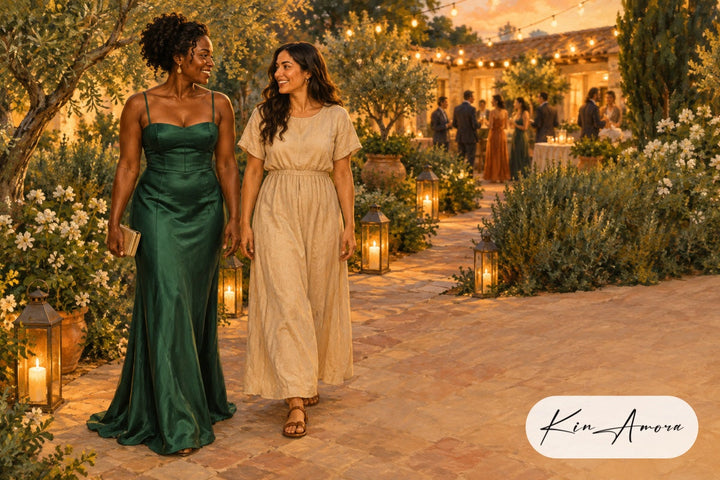
Yes, you can wear a boho dress to a wedding when the dress code is casual, garden, beach or semi-formal. A floor-length boho dress in chiffon, silk or fine lace suits an evening ceremony. A cotton tiered maxi suits a daytime beach or barn wedding. Guests should avoid white and cream boho dresses, which can read as bridal, and save heavy fringe for festivals. Guests at a boho wedding do best in a flowing midi or maxi with one handmade detail.
How do boho dresses suit different wearers?
Boho dresses suit most bodies once the shaping point and the length are right. The notes below give one practical angle for each kind of wearer.
For petite wearers. Pick a boho dress with an empire or natural waist and a hem at the ankle bone. Deep tiers and a dropped waist cut a short frame into sections, while one color from neckline to hem keeps a long line.
For plus-size wearers. Choose a boho dress with smocking, a wrap tie or a defined empire seam, so the dress shapes at one point and falls freely from there. A V-neck or a tie neckline opens the top, and a wide belt at the natural waist works better than a thin one.
For travelers. A cotton or cotton-rayon boho maxi covers shoulders and knees when it has sleeves, rolls small in a bag, and changes from day to dinner with a belt and different shoes. Crinkled gauze hides packing creases better than smooth rayon.
A boho maxi dress at Kin Amora, the Mojave Dress
The Mojave Dress is a full-length, one-size Kin Amora dress at $165, and it works as the plain base of a boho outfit. The Mojave Dress has a cold-shoulder shape with short sleeves, a full-length body and pockets. Kin Amora cuts the Mojave Dress from 60% cotton, 40% rayon, handmade in Morocco, in One Size Fits Most with a Plus size available.
The Mojave Dress comes in 10 colors, which are Black, White, Classic Striped, Orange, Magenta Striped, Plum Striped, Mint Striped, Red Striped, Navy and Cacao. The care line reads machine wash cold, tumble dry low, and dry clean friendly. The striped colors and the cotton-rayon drape give the dress its boho character, and a wide leather belt such as Kin Amora's Rockstar Belt ($62) adds the waist and texture.
The Mojave Dress suits travelers and warm-weather wearers who want an easy full-length dress that belts well. The Mojave Dress does not suit readers who want embroidery, tiers or lace built into the dress, or who need covered shoulders for religious sites. See the colors and sizing of the Mojave full-length dress on its product page.