

What is a boho top?
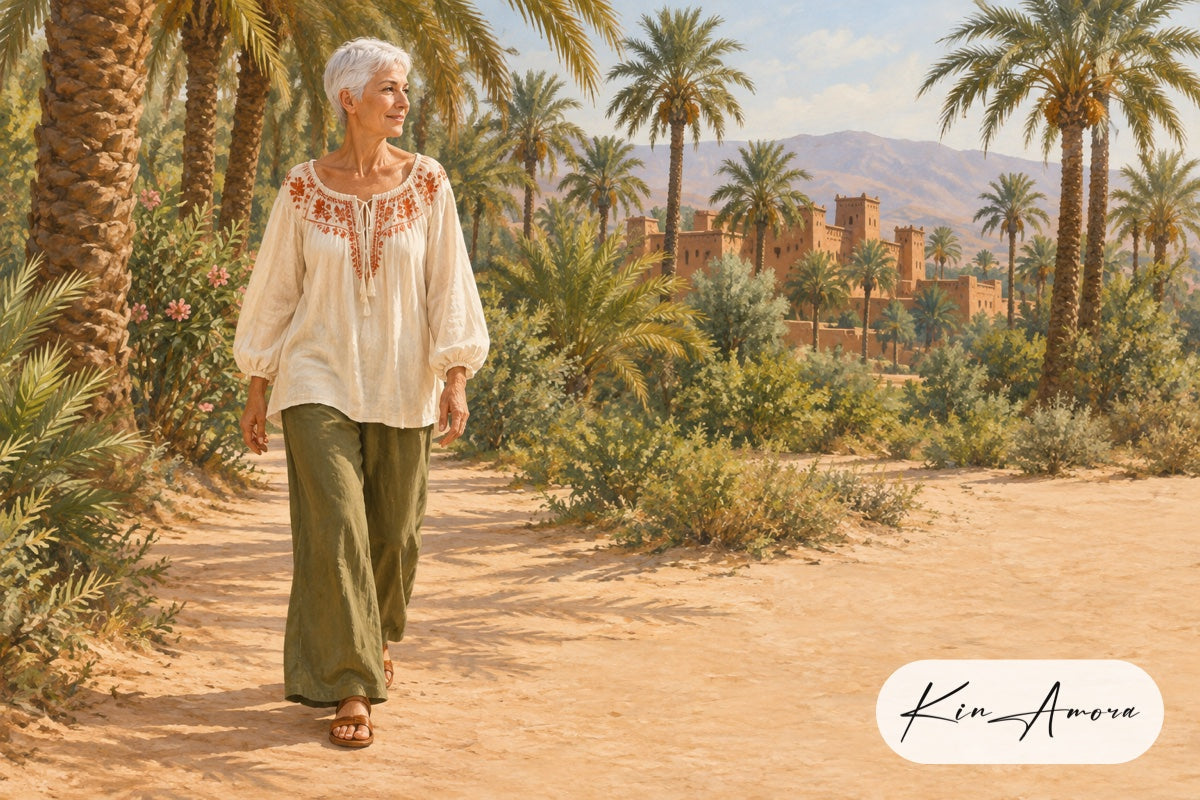
A boho top is a relaxed top that joins a loose cut, a natural fabric and visible handwork. The body of a boho top skims rather than grips, the fabric breathes, and the surface carries texture through embroidery, smocking, lace, crochet, tassels or fringe. Necklines and sleeves vary, so the boho look comes from those 3 traits together rather than from one detail.
Boho is short for bohemian. Merriam-Webster dates the first known use of "boho" to 1958 and ties it to the sense of bohemian that means a writer or artist living an unconventional life, usually in a community with others. According to Britannica, the word "bohemian" took that artistic meaning in 19th-century Paris, where the bohemian way of life took hold in the 1830s.
What is a boho top for women?
A boho top for women is usually a peasant blouse, an embroidered tunic, a crochet or lace top, or a loose tank in a natural fabric. Women wear boho tops over jeans, wide-leg pants, shorts and long skirts, and the top sets the mood of the whole outfit.
Where does the boho top come from?
The boho top comes from the peasant blouse, the kaftan and folk embroidery that artists, and later hippies, adopted as everyday wear. Linda M. Welters writes in the Encyclopedia of Clothing and Fashion that artists, writers and activists in New York's Greenwich Village adopted peasant blouses and farmer's smocks after 1910, and that embroidered blouses became almost a uniform for bohemian women. Karina Reddy's 2019 entry on the 1960s in the Fashion Institute of Technology's Fashion History Timeline lists kaftans among the non-Western pieces that the late-1960s hippie style took up.
Welters records that peasant looks merged with ethnic looks in the 1970s to form the folklore look, and that Yves Saint Laurent's Russian collection of 1976 to 1977 featured rich peasant looks. The embroidered peasant blouse came back as the fashion press's "look of the moment" in spring 2002. Reddy's 2021 Fashion History Timeline entry on the 2000s says Sienna Miller epitomized the boho look in the early and mid-2000s.
What makes a boho top sit loose?
A boho top sits loose because the cut fixes the top at the shoulders and neckline and lets the rest of the cloth fall. Boho tops use 6 construction features to do that, and most tops combine 2 or 3 of them.
- A sleeve cut in one with the body. Merriam-Webster defines the kimono sleeve as a sleeve cut in one piece with the bodice, so the top has no tight armhole seam to pull across the chest.
- A dolman sleeve. Merriam-Webster describes the dolman sleeve as very wide at the armhole and tight at the wrist, often cut in one piece with the bodice, which adds room under the arm.
- A dropped shoulder. The shoulder seam sits below the edge of the shoulder, so the sleeve starts on the upper arm and the top hangs from a wider base.
- A gathered neckline. A drawstring, elastic channel or smocked band pulls a wide neckline into soft folds, which is the defining feature of the peasant blouse.
- A yoke with gathers below it. A flat panel across the chest or back holds the shape, and gathered fabric falls loose from its lower edge.
- A body wider at the hem than at the bust. An A-line or trapeze body, a tiered body or side slits let the top swing past the hips.
Merriam-Webster defines smocking as decorative embroidery or shirring made by gathering cloth in regularly spaced round tucks. Smocking lets a neckline stretch over the head and spring back, so a smocked top stays in place without buttons.
Fabric decides how much of that width shows. A peasant blouse cut in stiff cotton poplin stands away from the body like a box, while the same pattern in rayon gauze falls into folds below the gathers.
What are the types of boho tops?
Boho tops come in 9 common types, such as the peasant blouse, the kaftan top and the crochet top. Each type is named for the feature that gives it shape, and the table lists the usual sleeve and an easy bottom for each.
| Boho top type | Defining feature | Usual sleeve | Easy bottom |
|---|---|---|---|
| Peasant blouse | Wide neckline gathered with a drawstring or elastic | Full, gathered at the elbow or wrist | Flared jeans, wide-leg pants |
| Embroidered blouse | Embroidery at the neck, yoke or cuffs | Long or three-quarter | Straight jeans, a midi skirt |
| Kaftan top | Loose straight body with sleeves cut in one | Wide, from elbow to wrist | Slim pants, swimwear |
| Tunic | Long body that ends at the hip or lower | Any length | Tapered pants, leggings |
| Crochet or lace top | Open crochet or lace panels | Short or none | High-waist pants over a camisole |
| Off-the-shoulder top | Elastic neckline worn below the shoulders | Short, flutter or bell | A long skirt |
| Cold-shoulder top | Cutouts that bare the top of the shoulder | Short or long | Wide-leg or capri pants |
| Smocked top | Rows of smocking across the bodice | Short, puff or none | Shorts, a tiered skirt |
| Cowl neck top | Fabric draped in folds below the throat | Short, long or none | Tapered or harem pants |
Merriam-Webster defines a tunic as a hip-length or longer blouse or jacket, which is why the tunic sits between the boho top and the boho dress. Merriam-Webster defines the caftan as a usually cotton or silk ankle-length garment with long sleeves, common throughout the Middle East, and the kaftan top is the hip-length version of that shape.
The peasant blouse and the embroidered blouse carry the strongest link to folk dress, while the kaftan, cold-shoulder and cowl neck tops rely on drape rather than trim.
What fabrics are boho tops made of?
Boho tops are made mostly from breathable natural and cellulose fabrics, such as cotton gauze, linen, rayon and cotton-rayon blends. Fabric controls drape, and drape decides whether gathers fall into folds or stand out stiffly. Boho tops use 6 common fabrics.
- Cotton gauze and voile are light, slightly crinkled cottons that breathe in heat and hide packing creases.
- Linen is a crisp flax fabric that softens with washing and wrinkles easily.
- Rayon is a fluid fiber that the FTC's textile rules define as a manufactured fiber composed of regenerated cellulose.
- Cotton-rayon blends join cotton's body with rayon's drape, such as a 60% cotton, 40% rayon cloth.
- Crochet and lace are open textures worn over a camisole or a slip.
- Silk and chiffon are sheer, floaty weaves for evening boho tops.
A matte surface reads as more handmade than a shiny one. Polyester chiffon drapes well but breathes less than cotton or rayon, so a summer boho top works harder in cotton, linen or a cotton-rayon blend.
How should a boho top fit?
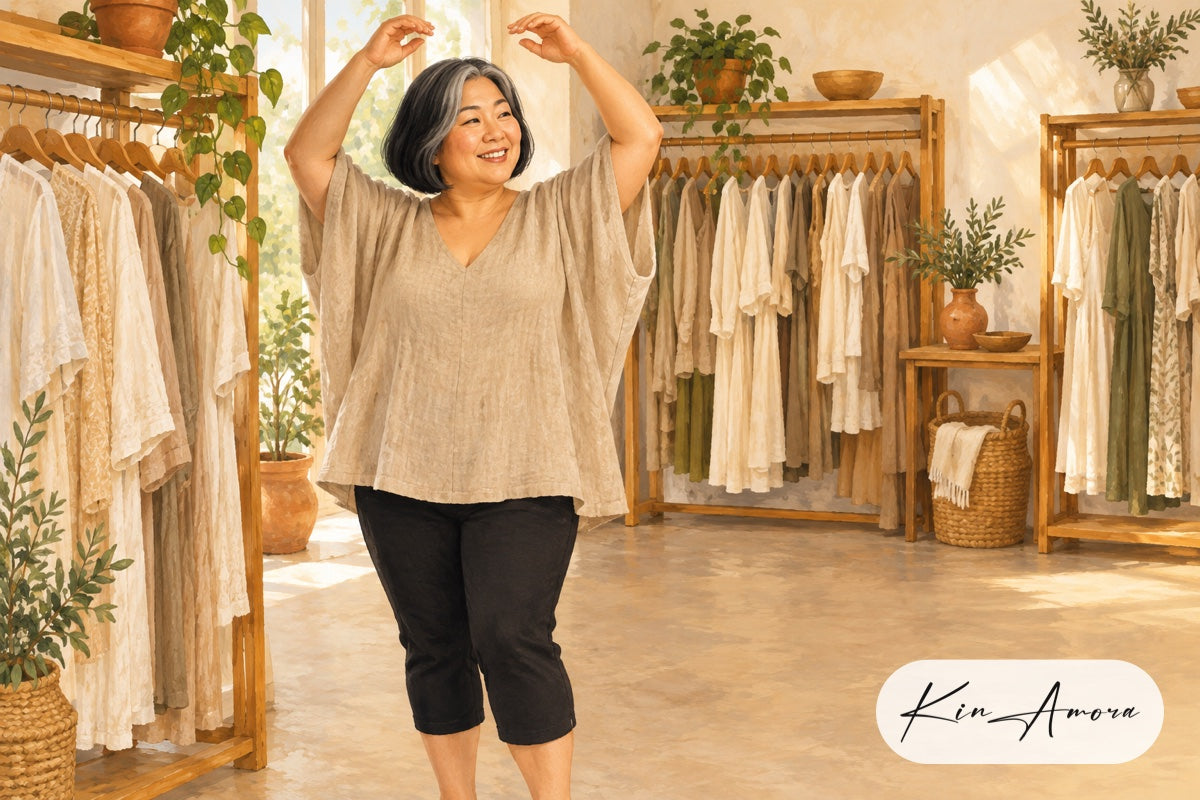
A boho top should fit at the shoulders and neckline, then fall loose over the bust and stop at or below the hip. The fitting point is high on the body, so the shoulder seam and the neckline matter more than the bust measurement.
Check 5 fit points when you try on a boho top.
- Lift both arms overhead and check that the neckline and shoulders stay put.
- Check the neckline, where gathers or elastic should lie flat without digging in or sliding off the shoulder.
- Check the bust, where the fabric should skim without pull lines running from the armhole.
- Check the hem, which should land at the hip bone when worn loose or reach well past the waistband when tucked.
- Check the sleeve, which should clear the wrist bone or sit still at the elbow without twisting.
Relaxed does not mean oversized. A boho top that is loose at the shoulders as well as the body slides back on the neck and hangs like a smock, so the shoulder fit decides whether a one-size top works on you.
How is a boho top different from a boho dress?
A boho top and a boho dress share the same 3 traits, a relaxed cut, a natural fabric and handwork, and differ in length and in where they shape the body. The table compares them on 5 attributes.
| Attribute | Boho top | Boho dress |
|---|---|---|
| Hem | Waist, hip or upper thigh | Thigh, calf or ankle |
| Shaping point | Shoulders and neckline | Shoulders, bust or waist |
| Needs a bottom | Yes | No |
| Common types | Peasant blouse, kaftan top, tunic | Tiered maxi, peasant dress, caftan dress |
| Main styling tool | The bottom and the tuck | The belt and the shoes |
Choose a boho top when you want to change the outfit's mood by swapping the bottom. Choose a boho dress when you want one piece that carries the whole look. The cut, fabric and trim tests in the guide to what makes a dress boho work the same way on a top, with a shorter hem.
Which bottoms and belts turn a flowy top into a complete outfit?
A flowy top becomes a complete outfit with one bottom that balances its volume and one belt or tuck that marks the waist. The balance rule is simple. A loose top goes over a slimmer bottom, and a fitted or cropped top goes over a loose bottom.
Flowy tops pair with 5 kinds of bottoms.
- Boho pants in harem, palazzo, wide-leg or flare cuts, with the top tucked, knotted or cropped.
- Flared or straight jeans, which give a peasant blouse a firm base.
- Tapered pants and capris, which show the ankle under a long tunic or kaftan top.
- Long skirts, which suit off-the-shoulder, smocked and crochet tops.
- Denim or linen shorts, which suit short kaftan tops and smocked tops in hot weather.
Loose on loose works when the 2 pieces share one fabric or one color, because the eye then reads one column instead of 2 volumes. The family of cuts boho pants cover runs from the dropped crotch of a harem pant to the open hem of a palazzo, and each cut takes a different top length.
A belt finishes a flowy top when the top covers the hips. A wide leather belt at the natural waist pulls a tunic or kaftan top into shape, while a concho, fringe or studded belt worn low adds texture to a plain cotton top. Peasant blouses and smocked tops rarely need a belt, because the gathers already shape them.
Are boho tops still in style?
Yes, boho tops are still in style, because the look has returned in waves since the late 1960s rather than fading out. The folklore look of the 1970s, the peasant blouse of spring 2002 and the boho wave of the early and mid-2000s each brought the boho top back. A boho top in a natural fabric and a solid or striped color dates more slowly than one built on a trend print.
How do you wash a cotton-rayon boho top?
Wash a cotton-rayon boho top in cold water on a gentle cycle, then hang it or lay it flat to dry. The FTC's care labeling glossary defines a cold machine wash as initial water up to 86°F (30°C). Turn embroidered, crochet and smocked tops inside out so the threads rub less against the drum. Reshape the gathers and the neckline while the top is damp, and follow the sewn-in care label first.
How do boho tops suit different wearers?
Boho tops suit most bodies once the shoulder fit and the hem length are right. The notes below give one practical angle for each kind of wearer.
For petite wearers. Pick a boho top that ends at the hip bone or a cropped peasant blouse, and keep the volume in the sleeves rather than the body. A long tunic over wide pants cuts a short frame in half, while a short top over a high waist keeps the leg line long.
For plus-size wearers. Choose a boho top with a V-neck, a cowl or a gathered neckline that sits on the shoulders, and let the body fall from there. A cold-shoulder or kimono-sleeve top gives room at the upper arm, and a front tuck or a wide belt marks the waist without a fitted seam.
For travelers. A cotton-rayon or gauze boho top packs small, hides creases and covers the shoulders for religious sites when it has sleeves. One loose top changes from beach to dinner with a switch from shorts to wide pants.
Boho tops at Kin Amora, from the Lisbon Top to the Gaia Top
Kin Amora's tops collection holds loose tops made in Morocco, most of them in a soft cotton and rayon blend, and 3 of them show the loose cuts described above. Each of the 3 uses 60% cotton, 40% rayon, handmade by local artisans in Morocco.
- The Lisbon Top ($110) takes the casual T-shirt shape with longer sleeves, a V neckline, points at the front and back hem and a loose look, in S/M or M/L and 11 colors such as White, Black, Sand and Classic Striped.
- The Gaia Top ($239) is a take on the cold shoulder with an open square shape, short sleeves and side pockets, in Small to XL and in Black, White or Blush.
- The Marra Cowl Neck Top ($155) has a cowl neck and asymmetrical draping that lets it work as a top or a short dress, in One Size Fits Many or Plus and 9 colors.
Kin Amora pairs the Lisbon Top and the Marra Cowl Neck Top with the Classic Capri, Santorini Pant or Gypsy Flare Pant, which follow the loose-top, slimmer-bottom rule. The Lisbon, Gaia and Marra Cowl Neck tops suit wearers who want drape, a loose cut and a matte cotton-rayon cloth. The 3 tops do not suit readers who want embroidery, lace or crochet built into the top, since these 3 tops rely on cut and fabric rather than handwork, or anyone who wants a fitted blouse. See every cut and color in Kin Amora's handmade cotton-rayon tops collection.



