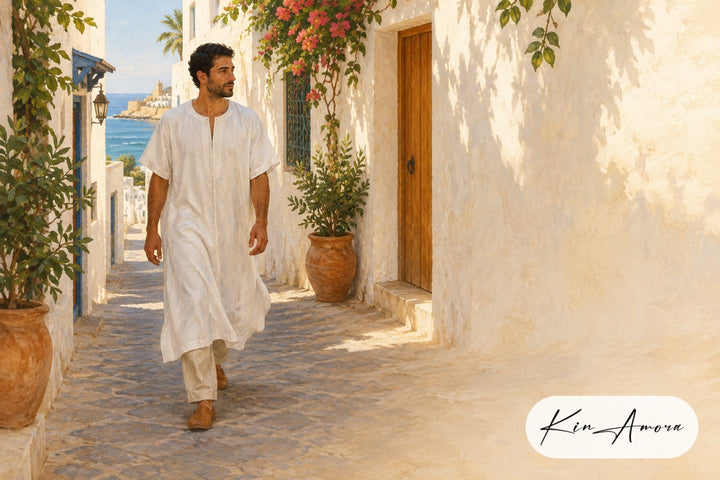
What should men buy in Marrakech?
Men should buy Moroccan clothes and leather slippers first, since the city's old market quarter still holds the trades that make them. The Medina of Marrakech spreads across 700 hectares of lanes, souks, fondouks, artisanal workshops and traditional trades, according to UNESCO. The medina joined the World Heritage list in 1985, Britannica notes.
These 7 buys cover a man's Moroccan wardrobe from head to foot.
- Djellaba, a long, loose robe with full sleeves and a pointed hood, worn over everyday clothes.
- Gandora, a lighter tunic in the djellaba's shape but without the hood, for hot days.
- Jabador, a tunic with matching trousers, sometimes with a vest, for Eid and family celebrations.
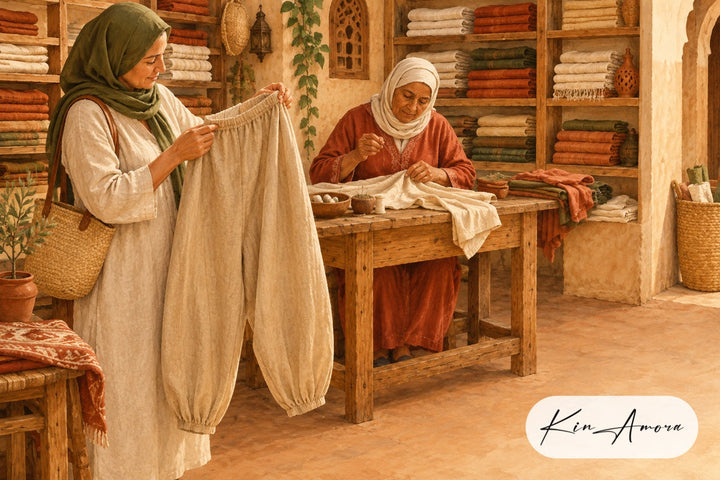
- Sarouel, full, loose trousers drawn in at the waist and often gathered near the ankle.
- Babouche, a heelless leather slipper of Moroccan origin, sold in the classic yellow for prayers and holidays.
- Tarbouche, the brimless red felt cap known abroad as the fez.
- Cotton scarf, a plain or indigo wrap for sun and dust on desert trips.
The first 4 are garments, and the last 3 finish an outfit. The next section sets out when Moroccan men wear each one.
Which Moroccan dress styles suit men?
Moroccan dress styles for men come down to 6 garments, each tied to a season or an occasion. The table pairs each garment with its moment and the one check to make before you pay.
| Garment | What it is | When Moroccan men wear it | Check before you buy |
|---|---|---|---|
| Djellaba | Long hooded robe, often white, beige, grey or brown | Over everyday clothes in cool weather, at prayers and holidays | Hem near the ankle, sleeves to the wrist |
| Gandora | Lighter, hoodless tunic | Warm days and relaxed occasions | Light cotton with room through the shoulders |
| Jabador | Tunic with matching trousers, sometimes a vest | Eid and family celebrations | Same cloth and trim on both pieces |
| Sarouel | Full, loose trousers drawn in at the waist | Under a jabador or tunic | A waist that holds without digging in |
| Belgha (babouche) | Soft, heelless leather slipper, classically yellow | With a djellaba or jabador at prayers, Eid and weddings | Leather upper and sole, not fabric |
| Tarbouche (fez) | Brimless red felt cap | Weddings, religious celebrations, royal court dress | Firm felt that holds its shape |
The full set of white djellaba, red tarbouche and yellow belgha marks a holiday or a wedding. Buy the pieces you'll wear on ordinary days first, and add the ceremonial ones for a specific event.
What is the best Moroccan dress for men?
The best Moroccan dress for men is the djellaba, because it is the traditional piece Moroccan men and women wear most and it goes over the clothes you already own. The Encyclopedia of Clothing and Fashion (Gale) describes the jillaba as the long, hooded robe worn as an outer garment by both sexes in Morocco. Men favor white or light djellabas and jabadors for the Eid morning prayer, Africanews reported in 2025.
How do you choose a djellaba in the souk?
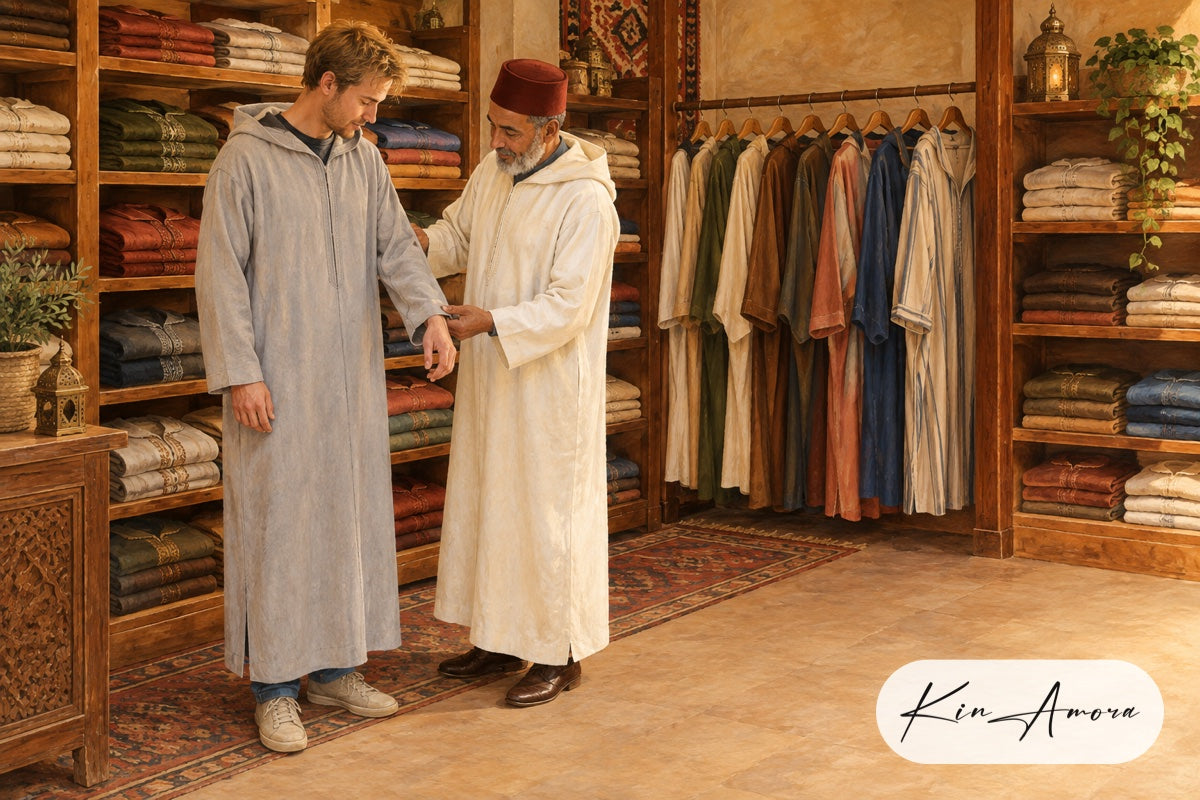
You choose a djellaba in the souk by length, sleeve, fabric and hood, in 4 checks.
- Length, with the hem near the ankle and clear of your shoes.
- Sleeves, reaching the wrist with room to push up the forearm.
- Fabric, in cotton for summer and wool for winter, since the cloth weight changes with the season, according to the Metropolitan Museum of Art.
- Hood, lying flat between the shoulder blades when it is down.
Try the djellaba on over the clothes you'll wear underneath, because it is cut to slip over a full outfit.
How do you choose babouche slippers?
You choose babouche slippers in real leather, with a leather sole and a snug fit across the toes, because the slipper has no heel to hold the foot. Merriam-Webster defines a babouche as a slipper of a style that originated in Morocco and that lacks a heel or quarters, and dates the English word to 1695, borrowed through French from Arabic and Persian. Babouches should be leather, not fabric, a 2019 Lonely Planet guide warns.
How much should you pay in the Marrakech souks?
Prices in the Marrakech souks are set by haggling, so the first price is an opening bid. Sellers often open high, sometimes in euros, a 2019 Lonely Planet guide by Rosa Kumar notes. For scale, tailored djellabas and kaftans started at about $200 for Eid in 2025, according to Africanews, and a Saharan deraa runs from 800 to 5,000 dirhams, Le360 reported in March 2026.
Haggle in 5 steps, following the guide's rule of thumb.
- Let the seller name the first price.
- Answer with about 10% of that price.
- Raise your offer in small steps while the seller drops in larger ones.
- Settle between your opening offer and the seller's second counter-offer.
- Walk away politely if the price stays high, and never back out once you've agreed.
Buying several pieces from one stall makes a lower price per piece easier to reach. Quality changes the price too, since sellers bend less on their best work.
What should men avoid buying?
Men should avoid fabric babouches sold as leather, scarves sold as cactus silk, and a fez bought as a joke. Many colorful patterned scarves in Marrakech are imported from India, and claims that they are cactus silk are false, Lonely Planet notes. A tarbouche is formal dress for weddings and religious occasions, so wear one the way Moroccans do or leave it on the shelf.
Where do you buy clothes in Marrakech?
You buy traditional clothes in the medina's souks and Western clothes in Gueliz, the modern quarter west of the medina that grew under the French protectorate, according to Encyclopaedia Britannica. Different souks specialize in different goods, and traders come from all over Morocco, many with workshops in their hometowns, Lonely Planet notes. Jamaa el-Fna square, a marketplace, sits at the heart of the medina, Britannica notes. The city-wide list of buys, with crafts beyond clothing and tips to spot a factory-made kaftan, covers the rest of the souks.
Which Moroccan dress suits travel and everyday wear?
The gandora and the sarouel suit travel and everyday wear best, because both are light, loose and quick to pull on. Marrakech averages a July high of 99.9°F (37.7°C) on 1991 to 2020 climate normals, so a cotton gandora over sarouel keeps air moving around the body. The djellaba is the layer for cool evenings, winter mornings and visits that call for covered arms and legs. The hoodless robe built for that heat has its own guide on the gandoura for summer heat.
Can tourists wear a djellaba in Marrakech?
Yes, tourists can wear a djellaba in Marrakech, because the djellaba is traditional Moroccan dress rather than a religious requirement. Wear it the way Moroccans do, over regular clothes, with the hood down indoors.
How should different men shop in Marrakech?
The notes below give one practical angle for each kind of shopper.
For first-time visitors. Start with leather babouches and a cotton gandora, which fit most men without tailoring. Leave the jabador and the tarbouche for a trip with a wedding or Eid on the calendar.
For men who won't wear a robe at home. Buy sarouel trousers and babouches. Both fit into a relaxed wardrobe in the US with a plain T-shirt or linen shirt.
For carry-on travelers. A cotton djellaba rolls small, while a wool one fills half a bag, so buy wool only for a winter trip or ship it home.
Moroccan-made menswear at Kin Amora, the For You and For Him collection
Kin Amora's For You and For Him collection carries relaxed men's pieces in a 60% cotton, 40% rayon blend, handmade by local artisans in Morocco, for men who want the souk's loose line without a robe.
- The Men's Gandora Jacket x Island Pants Set ($385) pairs an asymmetrical jacket, shorter in front with a longer drape at the back and pockets, with gauzy, full-length wide-leg pants gathered slightly at the ankle. It comes in One Size Fits Many, in Black, Black Grey Striped, White or Classic Grey Striped. The Gandora Jacket is a modern jacket named after the gandora, not a traditional gandoura robe.
- The Men's Santorini Pant ($120) is Kin Amora's tapered leg, with pockets and an elastic waistband, in Small to XXXL and 6 colors, with tailoring on request through the order notes.
- The Men's Classic Kimono ($210) has an oversized, loose fit and subtle upside-down-triangle patchwork at the upper back, in One Size Fits Many or Plus, in Black or White.
These pieces suit men who want loose, breathable layers for heat, travel and festivals that wear like sarouel and a gandora. They don't suit a man who needs a hooded wool djellaba for a Moroccan winter or a jabador for Eid, which a Moroccan tailor makes. Browse Kin Amora's relaxed menswear made in Morocco and add your waist measurement in the order notes for a tailored pant.