What should you buy in Marrakech?
The things to buy in Marrakech are goods made in Morocco by hand, with textiles and clothing first, and 8 buys repay the search.
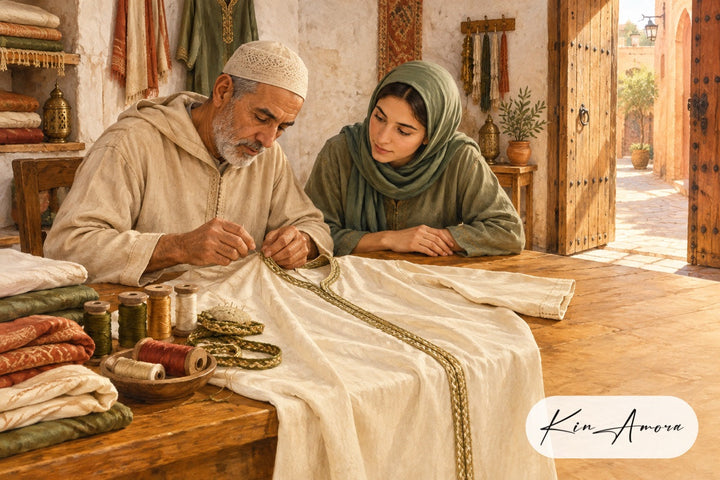
- Kaftans and djellabas, ideally with buttons, braids and embroidery made by hand. Factory versions hang beside them, so they get their own checks below.
- Hand-woven scarves and shawls in cotton or wool. A plain woven scarf is one of the lightest handmade textiles to carry home.
- Handira shawls and other Amazigh textiles from the Middle Atlas. The Textile Museum of Canada notes that handiras are still made today, partly for visitors and collectors.
- Wool rugs woven by women in villages such as Taznakht. One carpet takes 2 to 4 weeks on the loom, according to the Associated Press (2025).
- Leather babouches, the Moroccan slipper.
- Brass lanterns from the metalworkers' souks.
- Ceramics, with the thicker pieces coming from Safi and Fez.
- Spices and argan oil. Marrakech spices are locally produced and sold by the bag, according to Lonely Planet (2019).
Each buy has its own quick check, and the table below adds where it is made.
| Buy | Where it is made | Quick check |
|---|---|---|
| Kaftan or djellaba | Moroccan workshops and cooperatives | Fiber label, buttons, braid |
| Scarf | Moroccan looms, or imports from India | Plain indigo cotton or a printed pattern |
| Handira | Amazigh women in the Middle Atlas | Wool and cotton stripes |
| Rug | Villages such as Taznakht, about 250 km (155 miles) south | Wool, dye and the weaver's name |
| Babouches | Leather workshops | Leather, not fabric |
| Lantern | Souk Haddadine metalworkers | Brass, heavy and unpainted |
| Ceramics | Safi and Fez | Thick walls |
| Argan oil | Arganeraie Biosphere Reserve, south-west Morocco | Source cooperative |
Several of these checks come from a Lonely Planet guide by Rosa Kumar (2019), which warns that the patterned scarves in Marrakech markets are mostly imported from India. Argan oil is extracted mainly by rural women in the Arganeraie Biosphere Reserve, a practice UNESCO inscribed as intangible heritage in 2014.
How do you spot a factory made kaftan?
You spot a factory made kaftan by its synthetic fiber label, machine-made trim and identical stock, and 6 checks confirm it in a few minutes. The handmade standard comes first. A handmade Moroccan kaftan is a robe with a central opening, buttons and hand-made decoration, according to UNESCO, which inscribed the Moroccan caftan as intangible cultural heritage in 2025. Weavers make its brocade, velvet or silk, tailors shape it, and artisans make the buttons, braids and embroidery. The Metropolitan Museum of Art holds an early 20th-century Moroccan kaftan in silk, cotton and metal-wrapped thread, brocaded.
The 6 checks below each take under a minute.
- Read the fiber label. The Marrakech label New Tangier works only in wool, linen, cotton and silk and avoids polyester (Africanews, 2025), so polyester satin points to factory cloth.
- Turn the embroidery over. A tidy grid of a second, often white, bobbin thread on the back points to machine embroidery.
- Check the buttons. Hand-made kaftan buttons are worked in thread, so plastic buttons point to a factory.
- Check the braid along the central opening. Small hand stitches hold a hand-applied braid, while glue or one long machine seam holds factory tape.
- Compare pieces on the rack. Hand-trimmed kaftans differ slightly, and dozens of identical pieces in every size suggest a production line.
- Ask who made it and how long it took. New Tangier puts 18 to 35 hours into one garment, and a seller who cannot name a maker or a time is selling stock.
The table below sets the 2 kinds of kaftan side by side.
| Feature | Handmade kaftan | Factory-made kaftan |
|---|---|---|
| Fiber | Silk, wool, linen or cotton | Polyester satin or blends |
| Embroidery back | Same thread as the front, small irregularities | Even grid of bobbin thread |
| Buttons | Worked in thread | Plastic or metal |
| Braid | Sewn on by hand | Glued or machine-stitched |
| Rack | Small variations between pieces | Identical units in every size |
| Seller's answer | Names the maker and the hours | Names a price only |
A kaftan can be partly handmade, because UNESCO lists separate weavers, tailors and trim makers. The Moroccan legal test, predominant manual work, is set out in what artisan goods means for a Moroccan workshop.
Where can you buy clothes and kaftans in Marrakech?
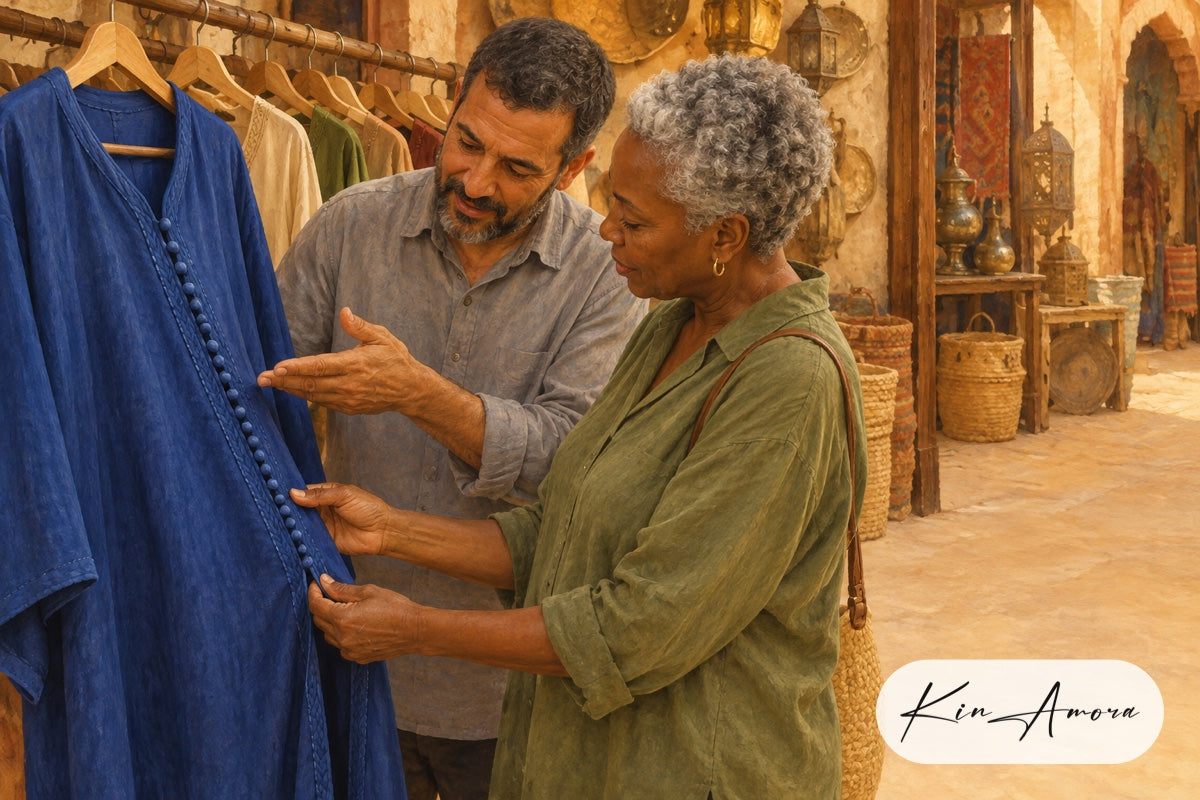
You can buy clothes and kaftans in Marrakech in the medina souks, the fixed-price boutiques on medina streets, and the designer shops of Gueliz. Time Out (October 2026) places the fixed-price boutiques on Rue Sidi Abdelaziz, Rue Mouassine and Rue Amsafah, and lists several Moroccan labels near the Majorelle garden and in Gueliz, the modern quarter west of the medina. The caftan label New Tangier sells from a boutique inside the La Mamounia hotel, according to Africanews (2025). Bargain in the souks, and expect a marked price in the boutiques.
Should you buy clothes in Marrakech to wear on the trip?
Yes, a loose kaftan, djellaba or long shirt bought early in the trip covers shoulders, chest and knees for the medina. That coverage is the respectful norm in Moroccan towns and near mosques, as the guide to what to wear in Morocco explains. Marrakech's average July high is 99.9°F (37.7°C), so choose cotton or linen over polyester for daytime wear.
How do you spot handmade quality in a souk?
You spot handmade quality in a souk by weight, material and a maker you can see or name. Five goods show the pattern, following Lonely Planet (2019) and the Associated Press (2025).
- Lanterns. Brass lanterns are heavier, unpainted and open smoothly, while cheaper tin lanterns are often painted to look like brass and chip.
- Ceramics. Better pieces from Safi and Fez are thicker and often ridged, and thin pieces tend to shatter.
- Scarves. Amazigh scarves tend to be plain indigo-dyed cotton, while the colorful patterned ones are imported and mass-produced.
- Rugs. Ask for the weaver's village and the dye, since many weavers now use industrial dyes.
- Babouches. Buy leather, not fabric, slippers.
Quality pieces hold their price. Lonely Planet's writer notes that shopkeepers compromise less on their best work, and that pushing on a quality piece insults the craft.
Where are the souks in Marrakech?
The souks in Marrakech are in the medina, the walled old city, in covered lanes that open off Jamaa el-Fna square. Britannica calls Jamaa el-Fna the heart of the medina and its central marketplace. UNESCO describes the 700-hectare medina, a World Heritage site since 1985, as a living town of lanes, houses, souks, fondouks, artisanal activities and traditional trades. Each souk tends to specialize, and in Souq Haddadine blacksmiths work and sell directly, according to Lonely Planet (2019). GPS works poorly in the covered lanes, so note a landmark at each turn.
What is the Marrakech market called?
The Marrakech market is called the souk, and its central square is Jamaa el-Fna. UNESCO describes Jamaa el-Fna as a triangular square at the entrance to the medina, ringed by restaurants, stands and public buildings, with commercial activity and entertainment from morning into the night. The square has been protected as part of Morocco's artistic heritage since 1922, and UNESCO inscribed its cultural space in 2008, after first proclaiming it in 2001.
How much should you pay in Marrakech?
You should pay somewhere between 10% of the first asking price and the seller's second counter-offer, the rule of thumb Lonely Planet gave in 2019. Buying several pieces lowers the unit price. The table below collects the dated prices found for this guide.
| Item | Price reference | Source and year |
|---|---|---|
| Scarf | About €5 to €10 after bargaining, against a €40 first ask | Lonely Planet, 2019 |
| Scarves bought in fours | About €5 each, against €7 to €8 for one | Lonely Planet, 2019 |
| Tagine | €1 decorative to €20 for a clay cooking tagine | Lonely Planet, 2019 |
| Lantern | Offers of €2 for tin against €15 for brass | Lonely Planet, 2019 |
| Djellaba bziouia | 1,500 to 5,000 dirhams from the Bzou cooperative | Aujourd'hui le Maroc, 2024 |
| Large rug in Taznakht | 250 dirhams on average, resold in Marrakech for up to 10 times as much | Associated Press, 2025 |
The euro figures date from 2019, so treat them as ratios rather than current prices. The rug gap shows why a named cooperative or weaver is worth seeking out.
What can you buy in Marrakech on a small budget?
You can buy spices, plain scarves, small ceramics and decorative tagines in Marrakech on a small budget. Lonely Planet (2019) priced decorative tagines from €1 and described Amazigh indigo cotton scarves as fairly inexpensive. Spices sold by the bag cost little and pack small. A handmade kaftan or a handwoven djellaba sits at the other end of the scale, because one piece takes days or months of work. Spend the small budget on several cheap goods, or save it for one handmade textile with a named maker.
How should different visitors shop in Marrakech?
Different visitors shop best in Marrakech by setting one rule before entering the souks. Men shopping for themselves can start with the 7 buys in Marrakech for men, led by the djellaba, the gandora and babouche slippers.
For first-time visitors. Walk the souks once without buying to compare prices and quality. Say you are looking before you stop, and walk on with a smile.
For men. A djellaba or a long cotton shirt covers the same ground as a kaftan, and the same fiber and button checks apply.
For carry-on travelers. Textiles fold flat, while ceramics and lanterns need wrapping and space. Buy cloth and leather first.
For gift buyers. A plain woven scarf, a bag of spices or a pair of leather babouches covers several people at small cost. Ask for the maker's name and write it on the gift card.
Kaftan-length dresses at Kin Amora, the Goddess Gown and Goddess Wrap Dress
Kin Amora's clothing is handmade by local artisans in Morocco, and two of its handmade best-selling dresses give a long, kaftan-like line for travel and home. These are relaxed dresses, not traditional caftans.
- The Goddess Gown costs $145 in One Size Fits Many, which fits up to size 10, in Black, White, Olive, Miami Mango or Royal Blue. It is Kin Amora's long dress, in 60% cotton, 40% rayon, with full-length sleeves and pockets at hip level, and it pairs with a belt. Tailoring is available on request.
- The Goddess Wrap Dress costs $175 in One Size Fits Many, in White, Berry or Black. It is a billowing, soft open wrap dress for the beach, a festival or home, and it can be worn a few different ways. Its product page gives no fabric content.
Choose the Goddess Gown for a covered, sleeved line in the medina heat. Choose a Moroccan workshop's caftan instead for brocade, hand-made buttons and braid.