
What should you wear in Portugal?
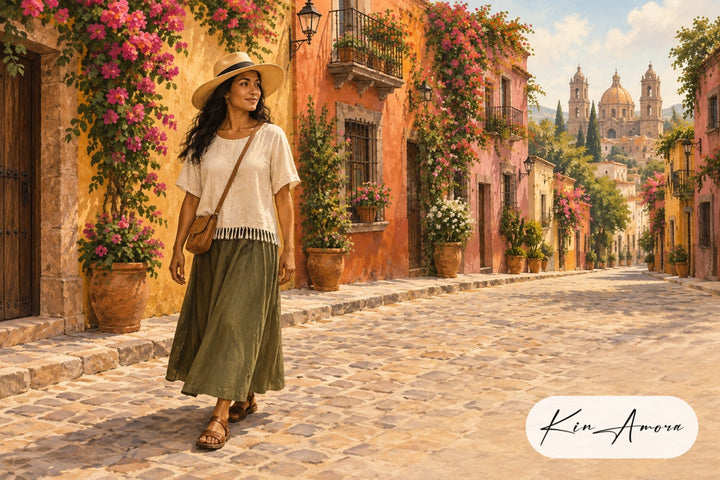
In Portugal, wear breathable layers you can add and remove, a wind-blocking top layer and flat shoes with rubber soles, because the weather changes between the city, the cliffs and the coast on the same day. Cotton, linen and cotton-rayon suit the warm months. A light jacket or long-sleeve top handles the wind and the evenings.
A Portugal trip moves through 6 settings, and each one changes the outfit.
| Setting | What to wear | Shoes |
|---|---|---|
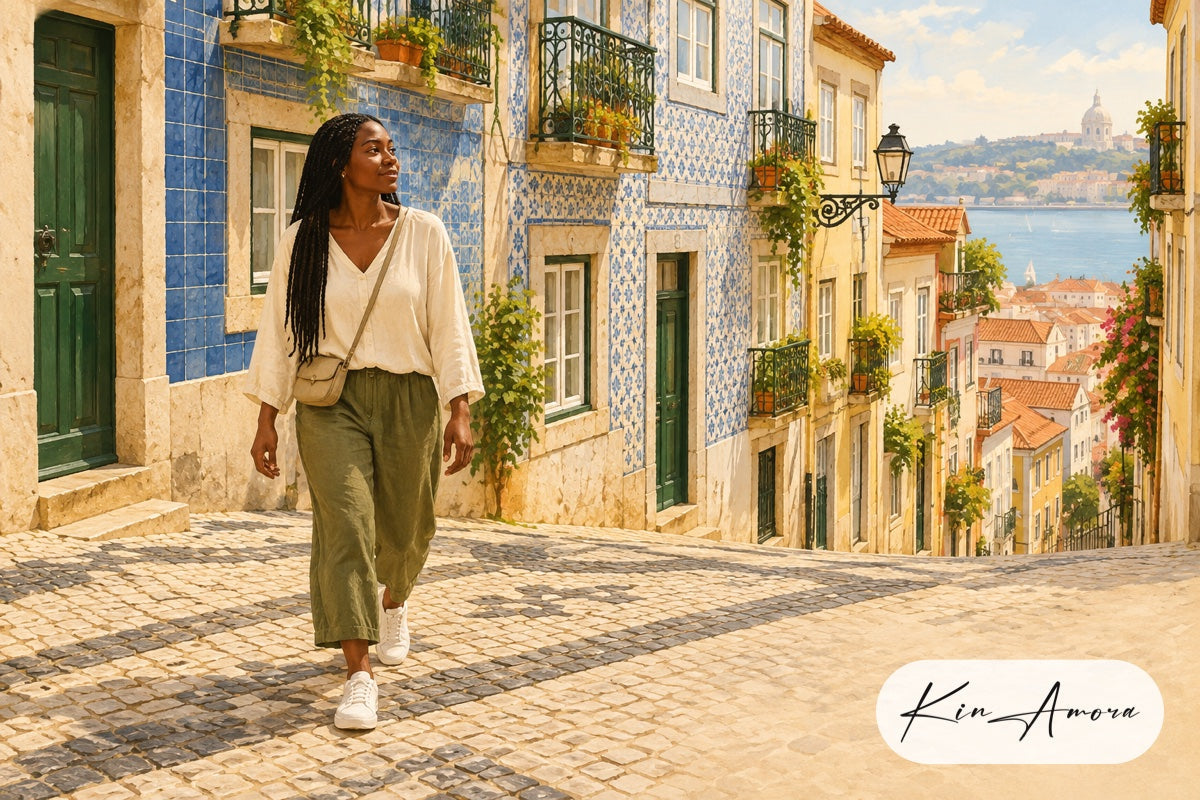
| Lisbon or Porto city day | Loose pants or a midi dress, a tee or long-sleeve top | Sneakers or sandals with rubber soles |
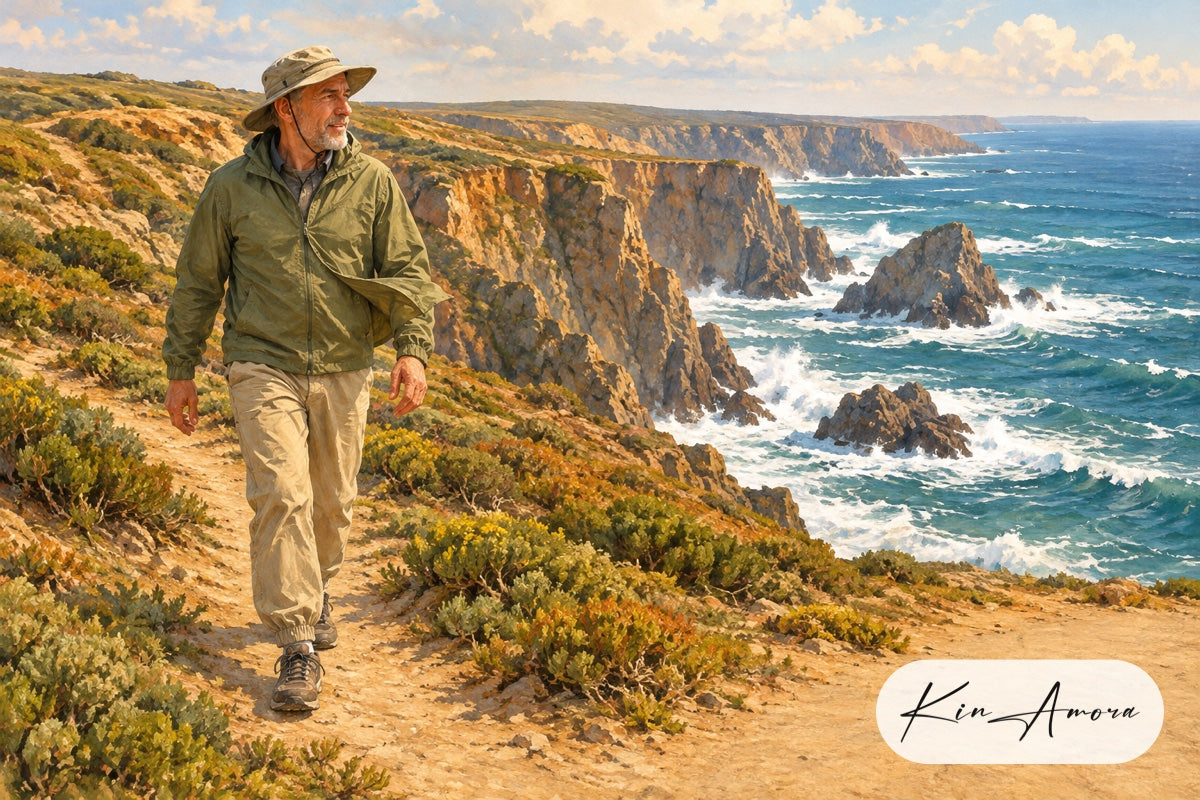
| Cliff and coast walk | Long pants, sleeves, a windproof layer, a hat that ties on | Trail shoes or grippy sneakers |
| Algarve beach day | Swimsuit, sleeved cover-up, hat | Slides or sandals |
| Dinner or fado night | Trousers or a dress with a light layer | Loafers, flat leather sandals or low heels |
| Church visit | Sleeves or a scarf over the shoulders, a hem at or below the knee | Any clean, flat pair |
| Autumn and winter day | Layers, a rain jacket, closed shoes | Waterproof walking shoes |
The cliff row needs the most layers, and the Algarve row the fewest. The month of travel decides how many layers go in the bag.
What to wear in Portugal by month?
What to wear in Portugal by month follows a warm, dry summer from June to September and a wetter, cooler season from October, with the north wetter than the south. IPMA's 1991 to 2020 normals show the pattern across 3 cities, as the mean daily high and low in degrees Fahrenheit.
| Month | Lisbon high / low | Porto high / low | Faro (Algarve) high / low | What to wear |
|---|---|---|---|---|
| May | 74°F / 58°F | 69°F / 54°F | 74°F / 59°F | Light pants, sleeves, a sweater at night |
| June | 79°F / 62°F | 73°F / 58°F | 80°F / 64°F | Summer clothes, a light layer |
| July | 83°F / 65°F | 76°F / 60°F | 85°F / 67°F | The lightest fabrics, a layer for the coast |
| August | 84°F / 66°F | 77°F / 60°F | 85°F / 68°F | The lightest fabrics, a layer for the coast |
| September | 80°F / 64°F | 74°F / 59°F | 80°F / 65°F | Summer clothes, a jacket for evenings |
| October | 73°F / 60°F | 69°F / 55°F | 74°F / 60°F | Long sleeves, a rain jacket, closed shoes |
| November | 65°F / 53°F | 62°F / 49°F | 67°F / 53°F | Layers, a warm jacket, waterproof shoes |
Porto runs about 7°F cooler than Lisbon in high summer, and Faro runs slightly warmer. Rain changes the picture more than heat from October onward.
What to wear in Portugal in summer?
In summer, wear light, loose pieces by day and keep 1 long-sleeve layer for the coast and the evening. Lisbon averages 83°F (28.2°C) in July and 84°F (28.8°C) in August, with lows near 65°F (18°C). IPMA counts only 0.6 days of rain in an average Lisbon July, so rain gear stays home. The Atlantic keeps the coast a little cooler than inland areas, according to Lonely Planet's Portugal writers.
What to wear in Portugal in September?
In September, wear summer clothes by day and add a jacket or long sleeves after dark. Lisbon averages 80°F (26.6°C) by day and 64°F (17.6°C) at night, and Porto's nights average 59°F (14.8°C). Rain returns slowly, with 3.8 rainy days in an average Lisbon September. A compact umbrella covers the odd shower.
What to wear in Portugal in October?
In October, wear long pants, long sleeves, a rain jacket and closed, grippy shoes, and pack 1 summer outfit for warm Algarve afternoons. Porto averages 5.9 inches (148.9 mm) of rain over 11.1 rainy days in October, according to IPMA. Lisbon gets 4.4 inches (110.6 mm) over 8.7 days, and Faro 2.2 inches (56.0 mm) over 6.0 days. Lisbon still averages 73°F (22.8°C) by day.
What to wear in Portugal in November?
In November, wear layers, a warm jacket, waterproof shoes and a scarf. Porto averages 62°F (16.8°C) by day and 49°F (9.4°C) at night, with 6.5 inches (165.9 mm) of rain over 13 rainy days. Lisbon averages 65°F (18.1°C) and 53°F (11.8°C). A knit layer under a rain shell beats one heavy coat for city walking, and every walk in Portugal starts with the sidewalk.
What shoes should you wear on Portugal's cobblestones?
Wear flat walking shoes with rubber, grippy soles on Portugal's cobblestones, and save heels for dinner. Lonely Planet's Portugal writers Regis St Louis and Austin Bush warn that Portugal's calçadas, the patterned stone sidewalks, are "slippery on the best of days and are downright ice-like when wet." The same guide notes steep slopes and loose cobblestones in Lisbon, Porto, Coimbra and many other towns.
A 3-pair plan covers most trips.
- Walking sneakers or trail shoes with a rubber tread for hills, cliffs and rain.
- Flat sandals with a back strap and a textured sole for summer city days.
- Loafers, low block heels or dressy flats for dinner.
Smooth leather soles slide on polished stone, and thin flip-flops give no grip on a wet slope. Lonely Planet's writers suggest saving heels and dress shoes for nicer restaurants and nightclubs. The steepest walks of the trip lead out to the cliffs.
How do you dress for the Atlantic wind on the cliffs?
Dress for the Atlantic wind on the cliffs with a windproof outer layer, long sleeves, long pants and a hat that ties on, even on a hot day in Lisbon. IPMA's normals put the August high at Cabo da Roca at 71°F (21.9°C), against 84°F (28.8°C) in central Lisbon. That 13°F (6.9°C) gap means a summer city outfit feels cool on an exposed cliff path.
Cliff wind changes 4 parts of an outfit.
- Outer layer: a light windbreaker or a long-sleeve top over a tee blocks the breeze and folds into a day bag.
- Pants: long pants that taper or gather at the ankle stop flapping and protect the legs from scrub on narrow paths.
- Skirts and dresses: long pants beat any skirt on a cliff path, and a wrap skirt over leggings is the next best choice.
- Hats: a hat with a chin strap stays on, and a loose straw hat blows off.
Lonely Planet's Portugal writers note that the Atlantic is cooler than the Mediterranean, so a wetsuit helps for surfing even in summer. Sun still matters on a breezy day, since wind cools the skin but does nothing to block UV. Pack sunscreen and sunglasses for every coast walk. The cities ask for a different kind of layering.
What to wear in Lisbon and Porto?
In Lisbon and Porto, wear comfortable city clothes, such as loose pants or a midi dress with a tee or long-sleeve top, and rubber-soled shoes for hills. Lisbon is the warmer and drier of the 2 cities. Porto averages about 7°F less than Lisbon in summer and more rain in every month, so a light rain layer travels with you there from autumn.
Both cities reward 3 habits.
- Layer a long-sleeve top over a tank, so the top layer comes off on a sunny hill and goes back on in a shaded lane.
- Choose ankle-length or tapered pants, which clear wet stone better than floor-length hems.
- Carry a crossbody bag that sits close to the body on crowded trams and steep stairs.
Evenings in both cities lean casual, with one step up for nicer restaurants. Trousers or a dress with a light jacket fit a fado dinner or a rooftop bar. The south coast runs warmer and drier than either city.
What to wear in the Algarve?
In the Algarve, wear beach clothes by day and a light layer at night, since Faro averages 85°F (29.4°C) in July with only 0.2 rainy days, according to IPMA. A swimsuit, a sleeved cover-up, a brimmed hat and slides cover the beach. Linen or cotton-rayon pants with a tank top cover lunch and the old towns.
Faro's July nights average 67°F (19.6°C), warmer than Lisbon's, so a shawl or kimono usually covers dinner. Travelers who pair the Algarve with a Mediterranean island can compare these looks with the Greek island heat outfits, where the sea and the air run warmer. Men need fewer pieces for the same settings.
What should men wear in Portugal?
Men should wear light pants or tailored shorts with a tee or linen shirt by day, a long-sleeve layer for the coast and trousers with a collared shirt for dinner in Portugal. Rubber-soled sneakers handle the cobbles, and loafers cover dinner.
Relaxed pants work across the whole trip. A tapered or drawstring pant in cotton-rayon stays cool on an 84°F (28.8°C) August afternoon in Lisbon and reads as dinner wear with a collared shirt. A light jacket or overshirt covers the cliffs and the evening. In October and November, swap shorts for long pants and add a rain shell. Many visitors pair Portugal with Spain on one trip, which widens the climate range.
What to wear in Portugal and Spain on one trip?
For Portugal and Spain on one trip, pack for the hottest inland stop and the coolest coastal one, then layer between them. Spain's inland cities run much hotter in summer than Portugal's Atlantic coast. Spain's weather agency, AEMET, puts Seville Airport's July high at 97°F (36.0°C) and Madrid Retiro's at 90°F (32.1°C), in its 1981 to 2010 normals. Lisbon's July high averages 83°F (28.2°C) in IPMA's 1991 to 2020 normals.
A combined trip needs 4 kinds of pieces.
- The lightest loose fabrics for Seville and Madrid in summer, such as cotton-rayon pants and sleeveless dresses.
- A wind layer and long pants for the Portuguese coast and cliffs.
- A rain jacket for northern Portugal from October.
- One dinner outfit that works in both countries, such as trousers with a long-sleeve top.
The pieces overlap more than the climates do, so 1 capsule in 2 or 3 colors serves both countries. Rain is the next question on most autumn trips.
Do you need a rain jacket in Portugal?
Yes, you need a rain jacket in Portugal from October to spring, and most of all in the north. Porto averages 11.1 rainy days in October and 13 in November, according to IPMA. A summer trip to Lisbon or the Algarve can skip rain gear, since both average under 1 rainy day in July.
Can you wear shorts in Portugal?
Yes, you can wear shorts in Portugal for city days, the coast and the beach in summer. Swap to long pants or a skirt for a nicer dinner, a church visit and a windy cliff walk. Shorts and hems above the knee feel cold on the coast in spring and autumn, when lows sit between 54°F and 60°F (12°C and 16°C).
Which travelers need a different Portugal plan?
The settings above cover most trips, and 3 kinds of traveler adjust the plan. The notes below give one practical angle for each.
For travelers flying in from the US. Plan one outfit that works on the plane and on the first hill, so arrival day needs no change, and these long-haul flight outfits cover the layers for a cold cabin.
For church visits. Portugal's churches are places of worship, so a sleeved top or a scarf over the shoulders and a hem at or below the knee keep a visit respectful. A long-sleeve top worn all day saves a change.
For hikers on the coast. Trail shoes, long pants and a wind layer matter more than any dress code. Start early on summer days and carry water and sunscreen.
Portugal layers at Kin Amora, the Lisbon Top
The Lisbon Top is Kin Amora's long-sleeve layer for Portugal, priced at $110 in 2 sizes, S/M and M/L. The Lisbon Top covers a cool cliff walk, a church visit and a fado dinner without a change, and it sits under a windbreaker when the Atlantic wind picks up. The product page lists 5 features.
- A take on the casual T-shirt with longer sleeves
- A pointed V-neckline at the front and the back
- A loose look
- 11 colors: White, Black, Rose, Blush, Olive, Sand, Brown, Classic Striped, Minnie Striped, Black Grey Minnie Striped and Royal Blue
- 60% cotton, 40% rayon, handmade by local artisans in Morocco
Kin Amora pairs the Lisbon Top with the Classic Capri, Olivia Pant, Santorini Pant or Gypsy Flare Pant. The Lisbon Top x Gypsy Flare Pant Set costs $240 in One Size Fits Many and Plus, and Kin Amora's men's and unisex collection lists a Men's Lisbon Top. The Lisbon Top suits travelers who want sleeves for wind, sun and churches in a breathable, loose cut. It does not suit a November evening in Porto on its own, when lows average 49°F (9.4°C) and a warm jacket belongs on top, or anyone who needs a size above M/L. See the Lisbon Top colors and choose 1 neutral and 1 stripe for the trip.