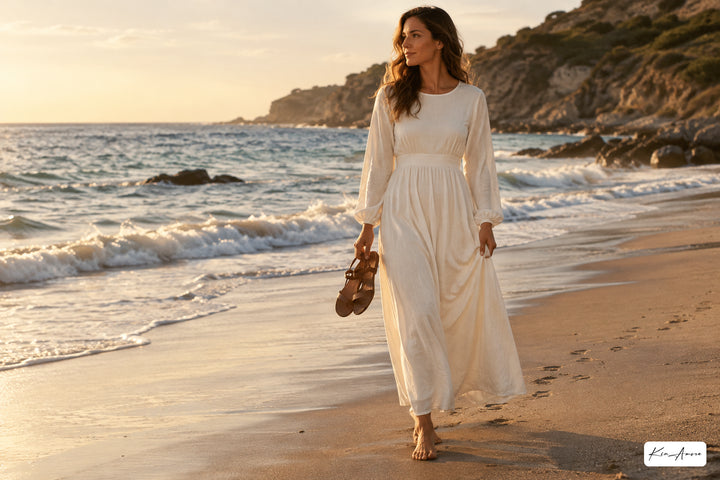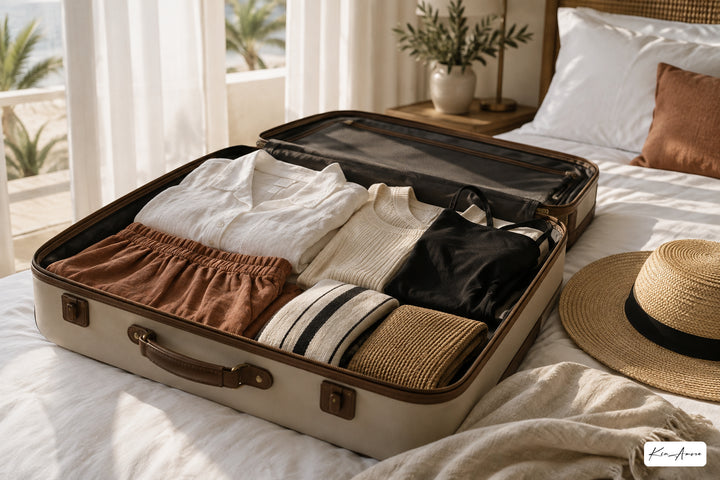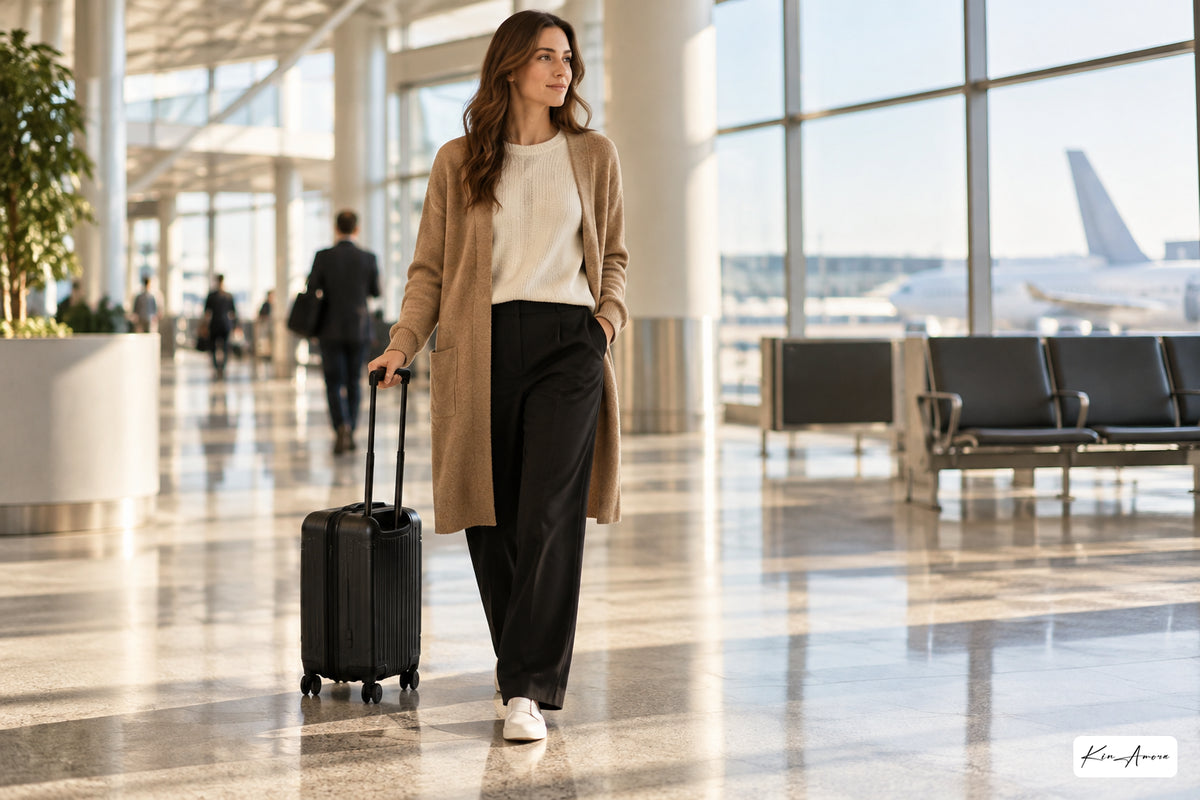

Relaxed loungewear already does most of this work, and if your flight lands somewhere warm, the same outfit doubles as resortwear. Resortwear is relaxed, breathable clothing made for warm-weather travel that can move from daytime to evening.
What are the most comfortable pants for flying?
The most comfortable pants for flying are loose, soft pants on an elastic or drawstring waist, cut with room through the hip and thigh. They let you sit for hours, tuck a foot under you and climb past a sleeping neighbor without a waistband pressing into your stomach somewhere over the Atlantic.
Two shapes do this best. Wide-leg pants fall straight and loose from the hip to a wide hem, with no taper at the ankle. From a few feet away they pass for tailored trousers.
Harem pants are loose trousers with a dropped crotch, roomy through the hip and thigh, that gather or taper at the ankle, usually on an elastic waistband. That gathered ankle keeps the hem off the cabin floor when you curl up, and the deep seat gives you the most room of any pant shape.
Fabric decides the rest. You want something that drapes instead of clinging, and that's lighter than fleece if the cabin warms up. Cotton-rayon fabric fits that description: Kin Amora pieces are made from a 60% cotton, 40% rayon blend and are handmade by local artisans in Morocco. Rayon is a fiber regenerated from plant cellulose, usually wood pulp; it is soft and drapey but more heat-sensitive than cotton. That drape is what makes a loose pant look intended rather than baggy.
Should you wear loose clothes on a plane?
Yes, loose clothes are the better choice for a long flight, and the NHS lists wearing loose clothing among its DVT-prevention tips for anyone traveling 4 hours or more by plane, train or car. Loose doesn't mean shapeless. It means nothing pinches at the waist, knees or ankles after hours in one position.
That guidance is about blood clots, not style. According to the CDC, anyone traveling more than 4 hours by air, car, bus or train can be at risk for blood clots. The CDC advises moving your legs often and working your calf muscles, for example by stretching your legs out and flexing your ankles to pull your toes toward you. Roomy pants simply make those moves easier in a cramped seat. Loose clothing alone won't prevent clots, and this is general guidance from the NHS and CDC, not medical advice. If you think you may be at higher risk, talk with your doctor before you fly.
Here's how common choices hold up over a long-haul day.
| Piece | After hours in a seat | At arrivals | Verdict |
|---|---|---|---|
| Rigid jeans | Waistband and seams press when you sit | Polished | Save them for the destination |
| Leggings | Fine if they aren't tight; thin pairs feel cold | Can look gym-bound | Wear with a long top |
| Joggers | Soft waist, cuffed ankle | Sporty | Comfortable, but dressier options exist |
| Wide-leg pants | Roomy, no pressure points | Closest to tailored | Best for looking put together |
| Harem pants | Deepest seat for curling up | Relaxed | Best for sleeping |
| Matching set | Depends on the cut | Most deliberate | Easiest polished option |
How do you look put together in comfortable travel clothes?
Comfortable travel clothes look put together when the top and pants match in color or fabric and one detail is clearly chosen, like a clean V-neck or a pair of good leather slip-ons. A matching set does the first part for you. Head-to-toe tone reads as an outfit, even when both pieces are loose.
The Milan Tee and Island Pant set follows that logic. The brand describes the tee as a relaxed, oversized, soft stretch knit with a V-neckline and an asymmetrical draped hem. The Island Pant is a gauzy wide leg with a slightly gathered ankle and side pockets, listed with a 24-inch (61 cm) inseam and a 33-inch (84 cm) length. Check that inseam against a pair you already own, because on taller travelers it will sit higher on the leg. The set was listed at $260 on October 13, 2026.
Skip anything that needs constant fixing in a seat: wrap tops that slide open while you sleep, or straps that keep falling. Creases after landing are their own problem, and one this guide leaves for another day.
What layers work for a cold plane cabin?
For a cold plane cabin, wear three layers: a breathable top, a long-sleeve or light knit over it, and a large soft outer piece, such as a long wrap or kimono, that works as a blanket. Each layer should come off while you're seated, so front openings beat pullovers.

You can't count on the thermostat. In 2018 the Association of Flight Attendants-CWA petitioned the US Department of Transportation to limit cabin temperature extremes, recommending a 65-75°F (18-24°C) target range. Plan for both ends of that range. At 65°F, six hours of sitting still feels cold; at 75°F, a heavy sweater feels like a mistake.
The air is dry as well. The CDC Yellow Book notes that cabin air usually holds 10-20% humidity, which can dry your eyes and upper airway. Keep lip balm with your layers, and if contact lenses bother you on long flights, wear glasses instead.
Keep the warm layer on you, not in the overhead bin. Getting it down means waking your row.
What should you wear on an overnight flight?
On an overnight flight, wear clothes you could sleep in and still walk through arrivals in: an elastic waist, no belt or stiff hardware, a top without a structured collar, and a layer big enough to pull over yourself. Changing into pajamas in a tiny lavatory is possible, but one outfit that does both jobs is simpler.
This is where a dropped-crotch pant earns its place. You can sit cross-legged or pull your knees up, which a straight trouser fights all night. Pair it with a long-sleeve top so your arms stay warm when the blanket slips.
Before you settle, take off chunky jewelry and anything with a buckle. Both press into you the moment you lean against the window.
Which shoes and socks work on a long-haul flight?
The best shoes for a long-haul flight are wide, soft-soled slip-ons with a low heel, worn with socks that aren't tight at the cuff. That matches the NHS advice on swollen feet and ankles, which it says are usually caused by things like standing or sitting in the same position for too long.

The NHS guidance on swelling also says not to wear clothes, socks or shoes that are too tight. Slip-ons help here: you can ease them off once you're seated and get them back on at landing without a fight with laces.
Compression socks are a separate question. The CDC says some people may benefit from graduated compression stockings on long trips, but whether you should wear them, and at what strength, is one for your doctor, especially if you've had a blood clot before.
The one test to run before you fly
Dress for the seat, not the mirror. Put your flight outfit on at home, sit cross-legged for 20 minutes, then stand up and look. If nothing pinched and it still reads as an outfit, you're packed. As Kin Amora's motto puts it, "If you can travel with it, you can do anything with it."
Shop Related Products
Explore the pieces, colours and sizing on the Kin Amora store.
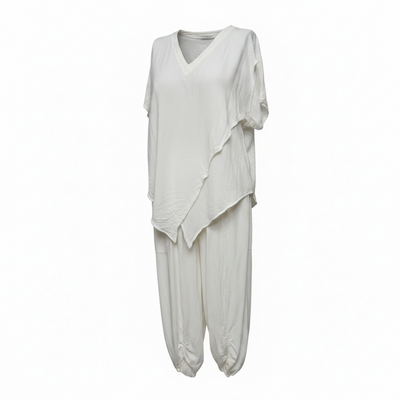
Milan Tee x Island Pant
$260.00 USD
View product
Island Pants
$143.00 USD
View product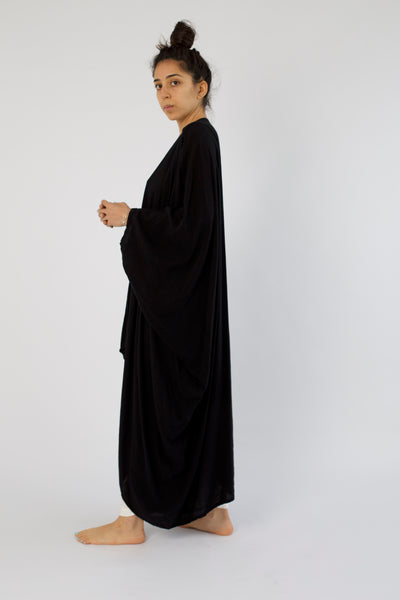
Classic Kimono
$210.00 USD
View productFrequently Asked Questions
Is it OK to wear pajamas on a plane?
Yes, nobody will stop you. Real pajamas can feel out of place at immigration, though, and a soft loungewear set gives the same comfort while reading as daywear.
Can you wear a dress on a long flight?
You can, but a long, loose dress needs a plan for the cold, such as loose pants or leggings underneath and warm socks. Short or fitted dresses ride up when you sleep curled in a seat, which makes pants the easier choice.
What colors are best for a long flight?
Dark and mid-tone colors and stripes hide coffee drips and armrest smudges better than pale solids. If you love white, wear it on top and keep the pants darker.
What should you wear on a flight to somewhere hot?
Dress for the cabin, not the destination. Wear your layers on board, and keep a lighter top and sandals in your carry-on to switch into after landing.
Should you wear jeans on a long-haul flight?
No, save rigid jeans for the destination instead of wearing them on a long-haul flight, because the waistband and seams press when you sit for hours. They look polished at arrivals, but loose, soft pants on an elastic or drawstring waist let you tuck a foot under you and climb past a sleeping neighbor without a waistband pressing into your stomach.