

How do you tie a kimono cardigan?
To tie a kimono cardigan, knot the two front panels together at the front or the side, or cinch the kimono at the waist with a belt. Each of the 3 ties changes the shape in a different way. A front knot shortens the front hem, a side knot pulls the hem into a diagonal, and a waist belt closes the kimono into a wrap top.
The table below compares the 3 ties.
| Tie | Where the knot sits | Kimono length it needs | Best over | Look |
|---|---|---|---|---|
| Front knot | Center front, at the waist or hip | Mid-thigh or longer | High-waisted jeans, wide-leg pants, skirts | Short and casual |
| Side knot | Over one hip | Mid-thigh or longer | Slip dresses, straight pants | Draped and asymmetric |
| Waist belt | At the natural waist | Any length | A fitted knit, a bodysuit, slim trousers | Closed, like a wrap top or wrap dress |
The front knot is the quickest of the 3 and needs no extra piece, so it comes first.
How do you tie a kimono cardigan at the front?
Tie a kimono cardigan at the front by knotting the two bottom corners together at your waist or hip, in 5 steps.
- Put the kimono on and let both front panels hang straight.
- Take the bottom corner of each front panel in each hand.
- Bring the corners together at the height you want the knot, from the waist down to the hip.
- Tie the corners in a double knot and pull both ends level.
- Pull the back hem down so the back stays straight while the front lifts.
A front knot sits best on high-waisted pants or a skirt, where the knot lands on the waistband. Light cotton-rayon or rayon knots small and flat, while thick or stiff cloth makes a bulky knot.
How do you tie a kimono cardigan at the side?
Tie a kimono cardigan at the side by knotting both front corners together over one hip, in 4 steps.
- Choose the hip for the knot.
- Pull the far front corner across your body to that hip.
- Bring the near corner to meet it and tie a double knot just in front of the hip bone.
- Let the ends hang along the side seam and smooth the back panel flat.
A side knot draws the front hem into a diagonal line, which suits slip dresses and straight pants. Who What Wear's 2017 kimono guide by Barbara McMillan showed a long kimono tied slightly to one side over indigo denim, the same knot on a longer kimono.
How do you tie a kimono cardigan at the waist?
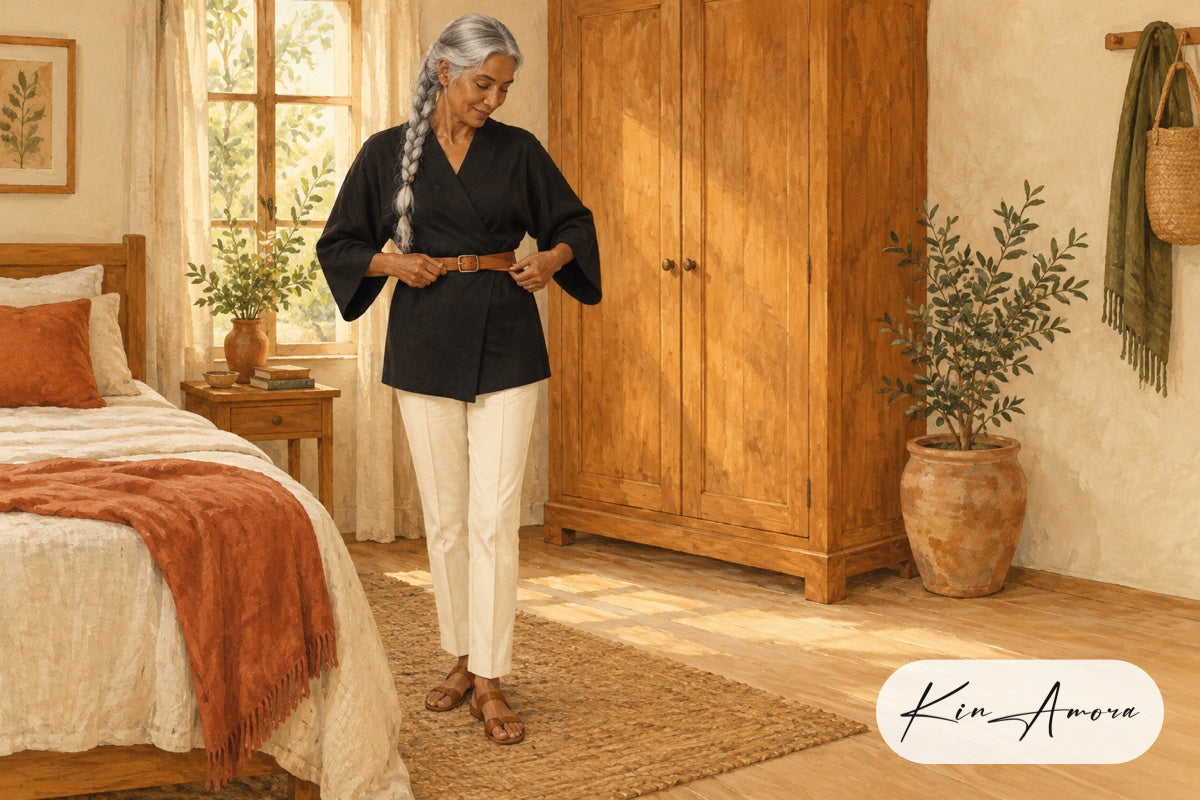
Tie a kimono cardigan at the waist with its own sash or a separate belt, wrapping the kimono closed like a wrap top, in 5 steps.
- Close the kimono by laying the left front panel over the right.
- Hold the overlap at your natural waist, the narrowest part of the torso.
- Pass the sash or belt around the waist from back to front.
- Tie a sash in a single knot or a bow just off center, or buckle a leather belt over the overlap.
- Ease a little fabric up above the belt so the sleeves move freely.
Grazia USA's Anna Maria Giano wrote in September 2026 that a leather belt at the waist gives a kimono jacket a sharper, more urban mood, while the original sash keeps it soft.
How do you tie a kimono cardigan with no tie belt?
You tie a kimono cardigan with no tie belt by knotting its own front panels or by adding a separate belt, scarf or elastic. Many kimono cardigans come with no sash, so the front and side knots above are the default. 3 extra pieces close a beltless kimono, a leather belt, a long scarf and a hair elastic. First, a leather belt cinches the waist over the overlapped front panels. Second, a long scarf wraps twice around the waist and ties in a soft knot at the side. Third, a hair elastic gathers each front corner into a small tail, which ties more easily than a wide panel.
A belt in the kimono's own color hides the join, while a contrasting belt marks the waist.
What is the correct way to tie a kimono?
The correct way to tie a Japanese kimono is left side over right, closed with a sash called an obi, according to the Victoria and Albert Museum. The V&A adds that the wearer adjusts the length of a kimono by drawing extra fabric up under the obi. Wrap a kimono robe the same way, left over right, then tie its fabric belt at the front or side. A kimono cardigan is a Western layer worn open, so the left-over-right rule matters only when you wrap and belt it closed.
How do you tie a kimono robe for men?
Men tie a kimono robe left side over right, with the belt knotted flat at the front or the hip. The wrap direction is the same for men and women.
How do you tie a kimono jacket with side ropes?
A kimono jacket with side ropes ties by knotting the two cords loosely across the open front. The Horniman Museum in London describes haori himo as a pair of silk cords that loosely tie together the fronts of a haori, each cord hooked to a small loop behind the lapel. Merriam-Webster defines the haori as a loose, coat-like outer garment worn in Japan. The Edo-Tokyo Museum catalogs the same kind of cord as a string tied across the open front of a haori.
Tie side ropes on a modern kimono jacket in 3 steps.
- Bring both cords to the center front at chest or waist height.
- Tie a single bow or a loose knot that leaves a gap between the fronts.
- Let the tails hang, because side ropes hold the fronts in place rather than pulling them shut.
Does a duster or a kaftan tie the same way as a kimono cardigan?
No, a duster and a kaftan do not tie the same way as a kimono cardigan, because a duster usually closes with buttons or a waist belt and a kaftan pulls on over the head. A duster's front panels hang to mid-calf or the ankle, which is too long for a neat knot at the hip. A waist belt suits a duster better than a knot. A Western kaftan has no front opening, so a kaftan is belted at the waist or left loose. The cardigan side of the family closes with a button band instead, a difference laid out in the comparison of open kimono vs buttoned cardigan layers.
Which kimono cardigans should you leave untied?
Leave a kimono cardigan untied when the cloth is sheer, heavily trimmed or too short to reach the hip. A knot in sheer chiffon pulls the fabric into tight creases. Heavy fringe or tassels tangle inside a knot. A cropped kimono that ends above the hip has too little panel to knot, so a belt or an open front works better.
What do you wear under a tied kimono cardigan?
Wear a high-waisted bottom under a front knot, a slip dress or straight pants under a side knot, and a fitted knit under a waist belt. Each tie lifts or closes the front, so the layer underneath shows more. The guide to seven kimono cardigan outfits matches each kimono length to jeans, wide-leg pants and dresses.
How do petite wearers, travelers and men tie a kimono cardigan?
Petite wearers, travelers and men each choose a tie by length, packing or fit.
For petite wearers. A front knot at the hip shortens a long kimono's front and keeps the leg line visible. A waist belt marks the waist on a duster-length kimono that would otherwise hang to the floor.
For travelers. A knot needs no extra piece to pack, and a long scarf doubles as a belt at dinner and a wrap on the plane.
For men. Men usually wear a kimono jacket open. A side rope or a loose front knot suits men who want the fronts held in place without a belt.
Tying a kimono cardigan at Kin Amora, the Bahia Kimono
Kin Amora's Bahia Kimono with side pockets is the shorter version of the brand's kimono, priced at $170 in White or Black. The Bahia Kimono has an oversized, loose fit, detailed lining along the edge of both sides and side pockets. The size is One Size, described as fitting many bodies, including plus sizes. The fabric is 60% cotton and 40% rayon, handmade by local artisans in Morocco.
The Bahia Kimono product page lists no tie belt. A front knot, a side knot or a separate leather belt closes it, following the steps above. Kin Amora sells the Bahia Kimono for day or night, paired with its Santorini, Stella, Gypsy Flare or Classic Capri pants.
The Bahia Kimono suits readers who want a shorter open layer to wear loose, knot or belt over pants. The Bahia Kimono does not suit readers who want a kimono that comes with its own sash, or a long duster line.