What is the difference between a kimono and a cardigan?
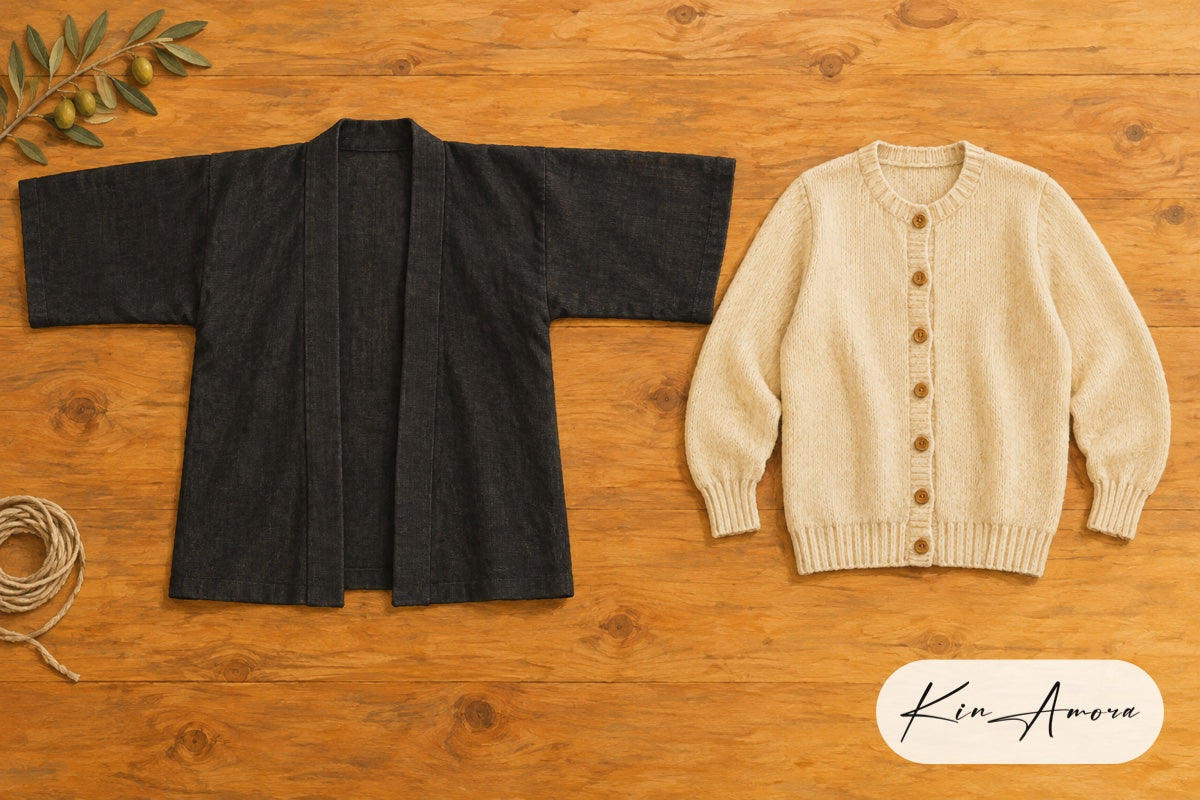
The difference between a kimono and a cardigan is woven cloth cut flat versus knitted cloth shaped to the body. A kimono hangs open from wide, dropped shoulders and falls in straight folds. A cardigan follows the torso, closes with buttons and holds warmth close to the skin.
The word "kimono" here means the kimono cardigan, also sold as a kimono jacket, a loose layer worn over Western clothes. The Japanese kimono is a full-length robe wrapped left panel over right and tied with a wide sash called an obi.
The cardigan is named after James Brudenell, 7th Earl of Cardigan, the British officer who led the Charge of the Light Brigade at the Battle of Balaclava in 1854. A cardigan is a sweater that opens down the front, which is the trait that separates a cardigan from a pullover.
The table below compares the two layers on 8 attributes.
| Attribute | Kimono | Cardigan |
|---|---|---|
| Origin | The Japanese kimono and haori, adapted by Western designers | A knitted waistcoat named after the 7th Earl of Cardigan in the 1850s |
| Fabric construction | Woven cloth such as rayon, cotton, linen, chiffon or silk | Knitted yarn such as wool, cotton, cashmere or acrylic |
| Body shape | Straight T-shape with no darts or waist shaping | Shaped to the torso, often finished with ribbed bands |
| Sleeves | Wide, often cut in one piece with the body | Set-in or raglan, narrowing to a ribbed cuff |
| Closure | Open front, sometimes a self-tie belt | Buttons, sometimes a zipper |
| Length | Hip to ankle | Mostly hip length, with longline styles past the knee |
| Drape | Hangs straight in loose vertical folds | Stretches and follows the body |
| Warmth and season | Light cover from sun and air-conditioning in warm months | Holds body heat in fall and winter |
Both pieces do one shared job, an extra layer worn open over a top. Cut pulls them apart first.
How does a kimono differ from a cardigan in cut?
A kimono differs from a cardigan in cut because a kimono is assembled from rectangles, while a cardigan is shaped piece by piece to the body. The kimono's body and sleeves form a T, so the shoulder line drops past the wearer's own shoulder. The cardigan's sleeve joins the body at the natural shoulder through a set-in or raglan seam.
Western sewing uses the term kimono sleeve for a sleeve cut in one piece with the body, with no separate armhole seam. That single piece gives the kimono a wide, square wrist opening and room under the arm. A cardigan sleeve narrows from the shoulder to a ribbed cuff.
A kimono has 2 straight front panels that hang parallel and never need to meet. A cardigan's 2 fronts overlap on a button band. The open front and dropped shoulder let one-size kimonos fit a wide range of bust and hip measurements, while cardigans come in graded sizes because shaped pieces have to match the body.
The cut sets where each layer sits. Drape sets how each layer moves.
How does a kimono differ from a cardigan in drape?
A kimono differs from a cardigan in drape because woven cloth hangs from the shoulders, while knitted cloth stretches and settles on the body. A woven kimono falls in long vertical folds and swings when the wearer walks. A knit cardigan follows the curve of the shoulders, chest and hips, then springs back after each movement.
Fiber changes the drape inside each group. Rayon, a manufactured fiber made from regenerated plant cellulose, gives woven cloth a heavy, fluid fall. A 60% cotton, 40% rayon blend keeps most of that fall and adds the body of cotton, so a kimono in that cloth hangs close without clinging. A linen kimono stands slightly away from the body.
Knit weight does the same work in a cardigan. A fine-gauge merino cardigan lies flat under a jacket, while a chunky cable knit stands away from the body and adds bulk. Summer shoppers can compare 6 woven options, from rayon to silk, in the guide to kimono cardigan fit and fabric.
Drape explains most of the warmth gap. Knit loops trap still air against the torso, while an open woven layer lets air move underneath.
Should you choose a kimono or a cardigan?
Choose a kimono when the day is warm and the outfit underneath is fitted, and choose a cardigan when you need warmth and a front that closes. The choice turns on 5 conditions, such as temperature, the base layer and the setting.
- Temperature favors the kimono in heat and the cardigan in cold.
- The base layer favors the kimono over a tank, a slip dress or a swimsuit, and the cardigan over a collared shirt.
- The setting favors the kimono at the beach or on a plane, and the cardigan at an office desk.
- The silhouette favors the kimono for a long vertical line, and the cardigan for a closer, buttoned shape.
- Packing favors the kimono, because a woven layer folds flatter than a knit sweater of the same length.
The overlap starts where the kimono grows long, which is where the kaftan and the duster come in.
Where do the kaftan and the duster fit between a kimono and a cardigan?
The kaftan and the duster sit at the long end of the same family, the kaftan as a pull-on robe and the duster as a long open layer. A Western kaftan pulls on over the head, so a kaftan replaces the outfit instead of layering over it. The traditional Moroccan kaftan is a long, formal robe, often closed with small buttons and worn for weddings.
A duster is a long, open layer that hangs from mid-calf to the ankle. The name comes from the light coats that 19th-century American riders wore to keep trail dust off their clothes. A knit duster cardigan behaves like a long cardigan, and a woven duster behaves like a long kimono. Hem placement matters most on a duster, and the page on duster cardigan length shows where the hem should land for each height.
Is a kimono a cardigan?
No, a kimono is not a cardigan by construction, although shops sell the kimono cardigan under both names. A cardigan is knitted, and a kimono is woven. Retailers borrow "cardigan" for the open, layered way a kimono is worn.
A kimono is closer to a jacket, and a hip-length kimono over a tee reads like a light shirt jacket. The Japanese ancestor of that jacket is the haori, a hip- to thigh-length coat worn open over a kimono and held with a short cord called a haori-himo.
How do travelers, petite wearers and men wear a kimono or a cardigan?
Travelers, petite wearers and men each follow a different rule, set by packing, length and fit.
For travelers. A knee-length or shorter kimono folds into a day bag and covers bare shoulders in churches and on cold planes. A cardigan earns its suitcase space on trips with cool nights.
For petite wearers. US retailers usually define petite as 5 feet 4 inches (163 cm) and under. A hip-length kimono or a hip-length cardigan keeps the leg line visible, while an ankle-length kimono can reach the floor on a petite frame.
For men. Men wear a kimono the way they wear an unbuttoned overshirt, open over a tee or tank with straight or wide-leg pants. A fine merino cardigan suits men better under a blazer, where a kimono's wide sleeve would bunch.
Do a kimono and a cardigan wash the same way?
No, a kimono and a cardigan do not wash the same way, because woven cotton-rayon and knitted wool react differently to water and heat. Wash a cotton-rayon kimono in cold water on a gentle cycle, then air dry it. The FTC's Care Labeling Rule (16 CFR 423) defines cold water as an initial temperature up to 86°F (30°C). Rayon loses strength while wet, so press water out with a towel instead of wringing.
A wool cardigan needs a hand wash or a wool cycle and a flat dry, because a wet knit stretches on a hanger. The care label always comes first.
Kimono vs cardigan at Kin Amora, the Classic Kimono
Kin Amora's answer to the kimono side of this comparison is the one-size Classic Kimono, an oversized, loose-fit open layer priced at $210. The Classic Kimono comes in Black or White and is cut One Size Fits Many, including plus sizes. The fabric is 60% cotton and 40% rayon, handmade by local artisans in Morocco. A subtle patchwork in the shape of an upside-down triangle sits in the upper back.
The Classic Kimono suits readers who want the woven drape described above, an open layer for warm days, travel and evenings. The Classic Kimono does not suit readers who need a cardigan's warmth or a front that buttons, because the woven cotton-rayon cloth blocks sun and air-conditioning rather than cold. The product page suggests the Santorini, Stella, Gypsy Flare and Classic Capri pants as pairings.