
What are tunic tops?
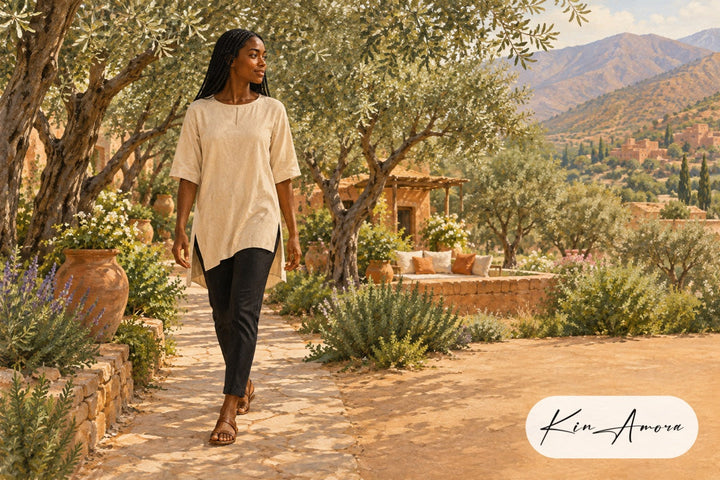
Tunic tops are loose tops that pull on over the head and fall to the hip or lower. Merriam-Webster defines the modern tunic as a hip-length or longer blouse or jacket, and Britannica notes that in the 20th century the word usually refers to a long blouse. The defining attribute of a tunic top is length, since a regular blouse stops at the waist or high hip while a tunic covers the hips.
Tunic tops share 4 traits, such as a long hem, a pull-on body and side slits.
- A hem at the hip or lower, cut straight, curved, high-low or asymmetrical.
- A pull-on body with no full front opening, or only a short placket at the neck.
- A straight or A-line body that skims the waist instead of fitting it.
- Side, front or back slits that let the longer hem move over the hips and thighs.
Tunic tops for women come in every sleeve length, from sleeveless to long, in woven and knit fabrics. The same cut sold for men usually goes by kurta or long tunic shirt.
What does tunic mean?
Tunic means a simple slip-on garment, and the word comes from Old English tunice and Latin tunica, according to Merriam-Webster. Britannica describes the ancient tunic as a basic garment of the ancient Mediterranean world, worn by men and women and made of 2 linen panels seamed at the sides and top, with openings for the head and arms. The ancient tunic reached the knee or lower, was belted at the waist and was held at the shoulders by clasps.
The tunic stayed in European dress into the Middle Ages, until the fitted body garment replaced it in the 14th century, according to Britannica. Church vestments such as the alb and the dalmatic kept the tunic shape. The modern tunic top keeps the 2 oldest features, a pull-on body and a hem that covers the hips.
How does a tunic top differ from a long shirt?
A tunic top differs from a long shirt in its opening, its collar and its hem. Merriam-Webster describes a shirt as a cloth garment that usually has a collar, sleeves, a front opening and a tail long enough to tuck into trousers or a skirt. A tunic top usually pulls on, skips the shirt collar, and ends in a straight or slit hem meant to stay out.
The table below compares the 2 garments on 8 attributes.
| Attribute | Tunic top | Long shirt |
|---|---|---|
| Opening | Pull-on, often with a split neck or short placket | Buttons from collar to hem |
| Collar | Round, V, split, band or cowl neck | Pointed collar on a stand |
| Hem | Straight, curved, high-low or slit, worn untucked | Curved shirttail, cut to tuck in |
| Length | Hip to knee | Hip to upper thigh |
| Body | Straight or A-line, few darts | Shaped with a yoke, darts or a back pleat |
| Sleeves | Sleeveless to long, often cut wide | Set-in, with buttoned cuffs |
| Common fabrics | Cotton, rayon, linen, jersey, cotton-rayon blends | Cotton poplin, oxford, chambray, linen |
| Worn with | Tapered, wide-leg or capri pants, leggings | Tucked into trousers or worn open as a layer |
Choose a tunic top when you want a pull-on layer that covers the hips and stays untucked over pants. Choose a long shirt when you want a collar, a front that opens into a light jacket, or a tail to tuck in. A button-front tunic, often sold as a shirt tunic, sits between the 2 and works both ways.
How long is a tunic top?
A tunic top is at least hip length and usually ends between the hip bone and mid-thigh, with long tunics reaching the knee. Tunic length is measured from the high point of the shoulder, where the shoulder seam meets the neckline, down to the hem.
The table below sets out the 4 common tunic lengths and how each one reads.
| Tunic length | Where the hem ends | Reads as | Best with |
|---|---|---|---|
| Hip length | The hip bone | A long blouse | Most pants, jeans and skirts |
| Upper thigh | Just below the seat | A classic tunic | Tapered pants, leggings, capris |
| Mid-thigh | Halfway to the knee | A tunic or a mini dress | Leggings, slim pants, shorts |
| Knee | The knee | A tunic dress | Worn alone or over slim pants |
Compare your own shoulder-to-hem measurement with the listed length before you order. An asymmetrical or high-low tunic usually lists its longest point, so check the short side as well.
What are the types of tunic tops?
Tunic tops come in 8 common types, such as the kaftan top, the kurta and the peasant tunic. Each type changes one attribute of the basic tunic, such as the sleeve, the opening or the hem.
- Kaftan top, a hip- to thigh-length tunic with wide sleeves cut in one with the body.
- Kurta, a long, loose, collarless shirt of a style that began in India, as Merriam-Webster defines it.
- Peasant tunic, a tunic with a gathered round neckline and full sleeves, often embroidered.
- Shirt tunic, a long button-front tunic with a collar or band, close to a long shirt.
- Asymmetrical tunic, a tunic whose hem dips lower at one side or at the front.
- Slit tunic, a tunic with a deep side, front or back slit that parts over pants.
- Cowl neck tunic, a tunic whose neckline drapes in soft folds below the throat.
- Sweater tunic, a long knit tunic, often with a turtleneck or cowl, for cold weather.
The kaftan top takes its wide sleeves from the full-length kaftan, and the guide to caftan dress versus kaftan top separates the 2 by length and by how each one is worn.
What fabrics are tunic tops made of?
Tunic tops are made of light, breathable wovens for warm weather and soft knits for cool weather. The fabric decides whether a long hem swings away from the hips or clings to them.
The table below compares 6 common tunic fabrics.
| Fabric | Drape | Season | Best tunic type |
|---|---|---|---|
| Cotton voile or gauze | Light and airy | Summer | Peasant and beach tunics |
| Linen | Crisp, creases easily | Summer | Shirt tunics and kurtas |
| Rayon (viscose) | Fluid and swingy | Spring to fall | Kaftan and asymmetrical tunics |
| 60/40 cotton-rayon | Soft with some body | Year-round and travel | Slit and draped tunics |
| Cotton jersey | Stretchy, close to the body | Year-round | Casual T-shirt tunics |
| Wool or cashmere knit | Thick and warm | Fall and winter | Sweater tunics |
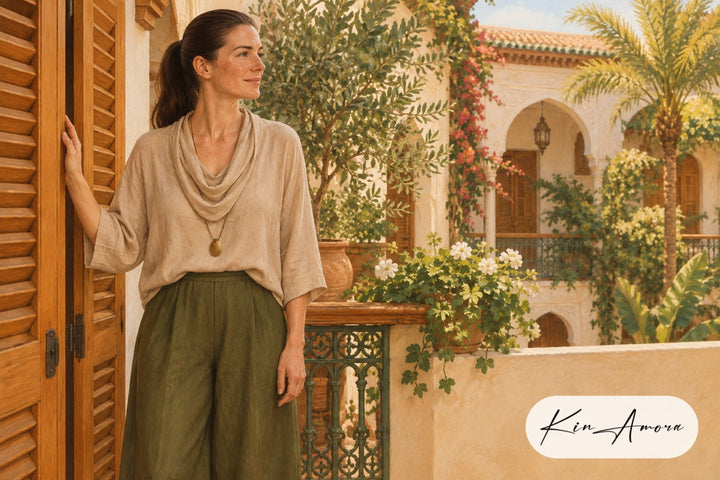
Rayon is a fiber regenerated from plant cellulose, usually wood pulp, and it gives a long tunic its swing. A 60% cotton, 40% rayon blend keeps most of that drape and adds body from the cotton, so a slit or asymmetrical hem hangs straight instead of clinging. The neckline changes the drape too, and a cowl neck top adds soft, U-shaped folds below the throat that hang softest when cut on the bias.
How should a tunic top fit?
A tunic top should fit at the shoulders and skim the bust and hips, with enough room that the hem stays down when you sit. Check 4 fit points before you keep a tunic.
- Shoulders, with the seam at the edge of the shoulder, or lower on a dropped-shoulder cut.
- Bust, with the fabric falling straight from the bust and no pull across the neckline.
- Hips, with the tunic clearing the widest part of the hips without riding up.
- Slits, which start at or just above the hip so the hem opens over the thigh as you walk.
One-size tunics fit a wide range of bodies because the width is built into the cut. Length is the measure to compare, and fit then shapes how the tunic is worn.
How do you wear a tunic top?
You wear a tunic top over slim, tapered or cropped pants, or over wide legs when the tunic has deep slits or a high-low hem. Leggings and straight jeans suit long tunics, and a belt at the waist or hip turns a straight tunic into a shaped one. The working rule is one loose half, so a full tunic needs a narrower bottom and a full pant needs a tunic that shows the waist or the leg. Seven ways to wear tunic tops with relaxed pants put that rule to work, from a long tunic over tapered pants to a slit tunic over wide legs.
When does a tunic read as a top and when as a short dress?
A tunic reads as a top when it ends above mid-thigh and sits over pants, leggings or a skirt, and as a short dress when it reaches mid-thigh or lower, is opaque and is worn alone. The hem, the fabric and the slits decide the reading together.
3 quick tests sort a tunic before you leave the house.
- Check the length by standing with your arms at your sides, since a hem below the fingertips can work alone.
- Check the opacity by holding the fabric to a window, since sheer voile and gauze need pants or a slip.
- Check the slits, since a slit that opens above mid-thigh needs pants or shorts underneath.
A belt changes the reading as well. A belt at the hip makes a long tunic read as a short dress over pants, while the same tunic worn loose over tapered pants reads as a top.
Is a tunic top a boho top?
Yes, a tunic top is a boho top when it joins a loose cut, a natural fabric and handwork such as embroidery, smocking or fringe. A plain jersey tunic reads as a basic, while an embroidered cotton or a draped cotton-rayon tunic reads as boho. The explainer on the boho top's loose cut lists the tunic among the boho top types and shows which construction details keep it from clinging.
Can men wear tunic tops?
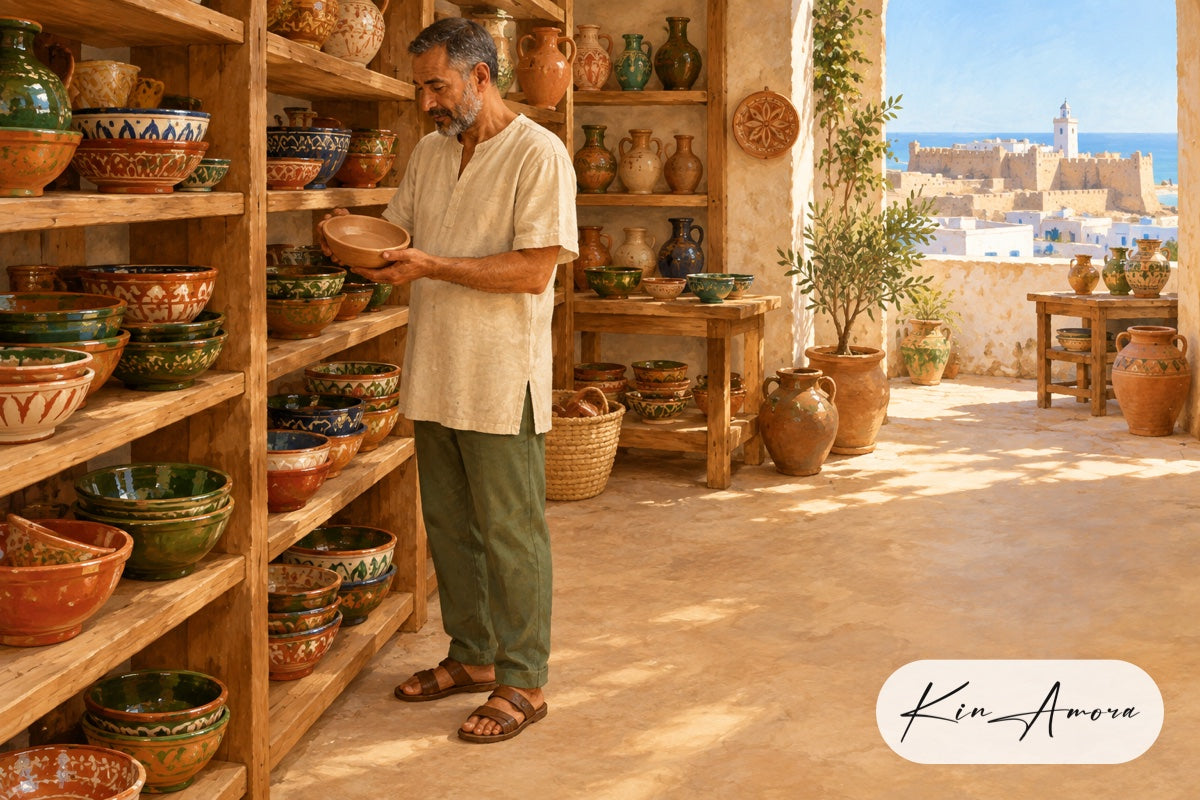
Yes, men can wear tunic tops, and the earliest tunics were worn by men and women alike, according to Britannica. Men today wear the cut as a kurta or a long linen shirt over straight or tapered pants, with the hem at the hip or upper thigh. Solid colors, a band or split neck and short side slits keep a men's tunic plain and practical.
What makes the best tunic tops?
The best tunic tops pair a breathable fabric with a hem that suits your height and slits that let the tunic move. 5 checks separate a tunic you will wear often from one that stays in the drawer.
- Fabric, with cotton, linen, rayon or a cotton-rayon blend for warm days.
- Length, with the hem landing at the hip or upper thigh for most outfits.
- Slits, deep enough to part over the thigh when you walk or sit.
- Neckline, with a V, split or cowl neck that sits flat without a camisole.
- Sleeves, chosen for the season, from sleeveless for heat to long for sun cover.
A tunic that passes all 5 checks works over several pant cuts, and the right length still depends on the wearer.
How do tunic tops suit different wearers?
Tunic tops suit most bodies once the length, the slits and the fabric weight are right. The notes below give one practical angle for each kind of wearer.
For petite wearers. Choose a hip-length or upper-thigh tunic with side slits over tapered pants or capris. A knee-length tunic covers most of a short leg, so save it for wearing alone as a dress.
For plus-size wearers. A straight or A-line tunic in a fluid woven falls from the shoulders without pulling at the bust or hips. Side slits give room at the hip, and a V or split neck keeps the neckline open.
For travelers. A tunic covers the shoulders and hips for places that expect modest dress, and one tunic works over 2 or 3 pant cuts. A cotton-rayon tunic packs flat and hides small creases.
Tunic tops at Kin Amora, the Santa Fe Tunic
The Santa Fe Tunic is Kin Amora's tunic top, priced at $150 in One Size Fits Many and 5 colors, White, Sand, Magenta, Black and Olive. The Santa Fe Tunic has a relaxed, draped silhouette, soft structure through the shoulders and a fluid body that does not cling. Its asymmetrical hem and front and back slit let the tunic move with every step. Kin Amora styles the Santa Fe Tunic with a statement belt or worn loose. The fabric is 60% cotton, 40% rayon, handmade by local artisans in Morocco.
The Santa Fe Tunic suits readers who want a long, slit, draped tunic to wear over tapered pants or capris, or belted as a short dress. The Santa Fe Tunic does not suit readers who want a button-front shirt tunic, a fitted blouse or a stated length, since the product page lists no measurements. See every color of the Santa Fe Tunic on its product page.