


How do you tie a sash belt?
To tie a sash belt, wrap it around the waist, cross the ends and lock them in a flat square knot, in 6 steps. The square knot lies flat, so it suits soft dresses, tunics and kaftans.
- Place the center of the sash against the back of your waist and bring both ends around to the front.
- Pull the ends level so they hang at the same length.
- Cross the right end over the left end and pull it up through the gap at the waist to tie the first half knot.
- Cross the end now on the left over the other end and pull it through the new loop to tie the second half knot.
- Slide the knot just off center, where it sits flat over the hip bone or the side of the waist.
- Tighten the knot by pulling both ends at once, then smooth the ends so they hang straight.
The order of the crossings decides whether the knot lies flat. Right over left, then left over right, gives a flat square knot, while the same crossing twice gives a granny knot that twists and loosens.
What is a sash belt?
A sash belt is a long band of fabric worn around the waist and tied instead of buckled. Merriam-Webster defines a sash as a band worn about the waist or over one shoulder and used as a dress accessory or as the emblem of an honorary or military order. The word comes from Arabic shāsh, meaning muslin, and Merriam-Webster dates the clothing sense to about 1678.
A sash belt has no buckle, no holes and no hardware, so one sash fits a wide range of waists.
What is a sash belt called?
A sash belt is also called a tie belt, a wrap belt, an obi belt or a waist sash, and several dress traditions have their own name for the band. The table below sorts 6 names by origin and by how each one ties.
| Name | Where the name comes from | Form | How it ties |
|---|---|---|---|
| Sash | Arabic shāsh, muslin, in English since about 1678 (Merriam-Webster) | Any width | Knot, bow or tucked ends |
| Tie belt or wrap belt | Shop names for a fabric belt | Narrow to medium, often cut from the dress fabric | Bow or knot |
| Obi belt | The obi, a broad sash worn with a Japanese kimono (Merriam-Webster) | Wide, often stiffened | Wraps flat around the waist |
| Cummerbund | Hindi and Urdu kamarband, from Persian kamar, waist, and band (Merriam-Webster) | Broad waistband | Worn in place of a vest with men's dress clothes |
| Faja | The Spanish name in Mexican weaving, catalogued as "Sash or Belt" | Long and narrow, handwoven | Wraps the waist, ends tucked or tied |
| Navajo sash belt | Navajo women's woven belts | Long, narrow and fringed | Wraps several times, ends tucked behind |
The traditional names add a set length, width and way of tying to the same basic band.
What are the different ways to tie a sash belt?
There are 6 common ways to tie a sash belt, such as the square knot, the bow and the side knot. Each way changes where the knot sits and how much of the ends hangs free.
- Square knot, a flat double knot at the front or just off center, for everyday wear.
- Bow, 2 loops and 2 tails, for dresses and soft blouses.
- Half bow, one loop and one tail, for a short sash that cannot reach a full bow.
- Side knot, a single knot at the hip with long ends hanging, the look costume guides call a pirate sash.
- Double wrap, 2 turns around the waist before the knot, for long sashes.
- Tucked ends, wraps finished by tucking each end under the band, with no knot at all.
The double wrap and tucked ends suit the long woven sashes of the Navajo and Mexican traditions.
How do you tie a sash belt in a bow?
To tie a sash belt in a bow, start with the first half knot, then tie the 2 ends into loops, in 4 steps.
- Wrap the sash and tie the first half knot from the main steps, with the ends level.
- Fold the lower end into a loop about the width of your hand.
- Wrap the upper end around the base of that loop and push a fold of it through the gap to make the second loop.
- Pull both loops to tighten, then adjust the loops and tails until they match.
A bow lies flatter when the loops point sideways rather than up and down, and a cotton or linen sash holds the loops better than satin.
How do you tie a sash belt on a dress?
You tie a sash belt on a dress at the natural waist, the narrowest point of the torso, with the knot or bow just off center. Thread the sash through any loops sewn on the dress so it cannot ride up. A bow suits light dresses, while a square knot suits a long kaftan or a wrap dress where a bow would add bulk at the front.
How do you tie a sash belt on pants?
You tie a sash belt on pants over the waistband or low on the hips, with a side knot or tucked ends. A sash rarely fits through narrow belt loops, so wear it over a tucked top or over the elastic waist of relaxed pants. A sash at the hips over a long tunic gives the pants outfit a waistline without a buckle.
How do you tie a Navajo or Mexican sash belt?
You tie a Navajo or Mexican sash belt by wrapping the long band around the waist several times and tucking the ends under the wraps rather than knotting them. The Brooklyn Museum holds a Navajo woman's belt from the late 19th to early 20th century, made of wool and cotton yarns, that measures 130 by 3 3/8 inches (332 by 8 cm). The museum's catalogue notes that the wearer tucked the belt's loose ends behind when she wore it.
The National Museum of Mexican Art holds a faja o ceñidor from Oaxaca, catalogued as a sash or belt, woven in cotton and wool on a backstrap loom and about 65 inches (165 cm) long. A faja that length wraps a 32-inch (81 cm) waist twice. Wrap these sashes firmly, keep each turn flat, and tuck the last end at the side or back.
How do men tie a sash belt?
Men tie a sash belt with a side knot or tucked ends over a tunic, a kurta or relaxed pants, keeping the ends shorter than on a dress. A cummerbund is the formal men's waist sash, worn in place of a vest with dress clothes.
How long should a sash belt be?
A sash belt should be your waist measurement times the number of wraps, plus the length you want for each hanging end. Add a few inches for the knot itself. A 32-inch (81 cm) waist with one wrap and 2 ends of 12 inches (30 cm) needs a sash of about 56 inches (142 cm), plus the knot.
The table below shows what 4 sash lengths allow on a 32-inch (81 cm) waist.
| Sash length | Wraps on a 32 in (81 cm) waist | What the length allows |
|---|---|---|
| 50 in (127 cm) | 1 | A square knot with short ends |
| 65 in (165 cm), like the Oaxaca faja | 1, or 2 with tucked ends | A bow with long tails, or a double wrap with no knot |
| 90 in (229 cm) | 2 | A double wrap and a knot with ends about 13 in (33 cm) long |
| 130 in (330 cm), like the Navajo belt | About 4 | Several wraps with the ends tucked behind |
Redo the arithmetic with your own waist, and use the hip measurement for a sash worn low.
What is a sash belt with fringe or tassels?
A sash belt with fringe or tassels is a sash whose ends finish in loose threads or bound bunches of thread instead of a sewn hem. Woven sashes often end in fringe, which is the unwoven warp left at each end of the band. The Navajo belt at the Brooklyn Museum carries a coral bead, a white bead and a red ribbon tied into its fringe.
Tie a fringed sash with the knot off center, so the fringe falls along the hip instead of bunching at the front. A tassel sash works best in a bow or a half bow, where the tassels hang free at the ends of the tails. Fringe and tassels are 2 of the trims in the guide to boho belt materials and styles, which places the wrap or tie belt among the 8 main boho belt styles.
When is a sash better than a buckle belt for relaxed clothing?
A sash is better than a buckle belt for relaxed clothing when the garment is soft, the waist is elastic or loose, and you want the fit to adjust to any point. A buckle belt is better when the outfit needs structure, belt loops hold the belt, or the look calls for leather and hardware.
The table below compares the 2 belts on 7 attributes.
| Attribute | Sash belt | Buckle belt |
|---|---|---|
| Fit adjustment | Any point along the band | Only at the punched holes |
| Hardware | None | A metal buckle, sometimes studs or stones |
| Feel on soft fabric | Lies flat and gathers the cloth evenly | A firm strap that can press or crease thin cloth |
| Structure | Soft, follows the body | Firm, holds a straight line at the waist |
| Belt loops | Worn over the garment | Threads through loops or sits over the garment |
| Travel | Folds into a pocket, no metal at security | Heavy metal hardware can set off airport detectors |
| Best garments | Kaftans, tunics, wrap dresses, kimono layers | Jeans, long dresses, Western and boho looks |
Choose a sash for a cotton-rayon kaftan, a tunic or a wrap dress, where the soft band gathers the fabric without a hard edge. Choose a buckle belt for a long dress or tunic that needs a firm waist, for jeans with loops, or for a leather texture against plain cloth.
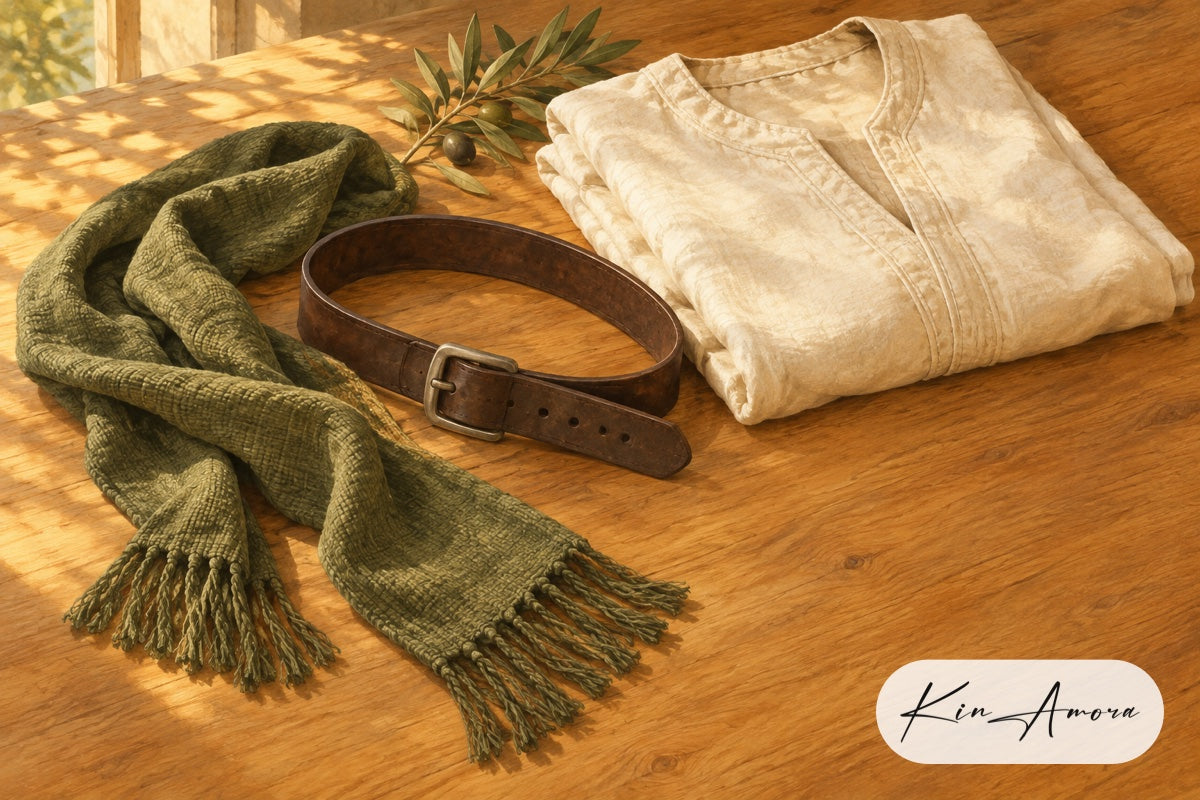
Can you use a scarf as a sash belt?
Yes, you can use a scarf as a sash belt, as long as it is a rectangle long enough to wrap the waist once with ends to spare. Fold a wide scarf lengthwise into a band before you wrap it, so it lies flat. A square scarf folded corner to corner works only on a small waist, since the diagonal is its longest line. A fringe scarf ties like a fringed sash, with the knot off center.
How do you keep a sash belt from slipping?
A sash belt stays put when it is tied at the narrowest point of the waist, over a matte fabric, with a square knot. A bow slips more than a knot, and satin slides over satin. Wrap a slippery sash twice, thread it through any belt loops, or pin it at the side seam with a small safety pin hidden under the band.
How does tying a sash differ from tying a kimono cardigan?
Tying a sash differs from tying a kimono cardigan in what the knot holds. A sash belt on a dress only shapes the waist, while the tie on a kimono cardigan also holds the 2 front panels closed. Merriam-Webster defines the obi as a broad sash worn with a Japanese kimono, and the obi belt borrows its name and its wide, flat wrap. The steps for kimono cardigan tie positions show the front, side and waist knots for an open layer.
How do petite, plus-size and male wearers tie a sash belt?
Petite, plus-size and male wearers each tie a sash belt by a different rule, set by width, length and knot.
For petite wearers. Choose a narrow sash tied at the natural waist with short ends. Tails that reach mid-thigh cut the leg line, so use a half bow or tucked ends.
For plus-size wearers. A sash fits any waist because it has no holes, so check only that the band is long enough for one wrap and 2 ends. Tie the knot at the side or wherever it sits flat, and choose a matte cotton or linen sash that grips.
For men. Tie a solid sash with a side knot over a long tunic or a kurta, and keep the ends at the hip. A plain leather belt still suits jeans and trousers.
Sash belt alternatives at Kin Amora, the accessories collection
Kin Amora does not sell a sash belt. The accessories collection holds the buckle belts this page sets against the sash, plus a fringe scarf, all made in Morocco.
- The Stone Fringe Leather Belt ($110) is handmade Moroccan leather with a metal buckle set with a turquoise stone, the same turquoise along the strap and metal inside hook holes to adjust the size, in One Size and Black.
- The Snake Stud Belt ($68) has a leather strap, a metal clasp and stone detailing, can be worn casual or upscale, and comes in Black or Brown.
- The Puglia Scarf ($65) is a fringe scarf in 60% cotton, 40% rayon, in Black, Classic Striped, Silver or White, which Kin Amora lists for wraps, headpieces or traditional wear.
The 2 belts suit readers who want a firm waist and leather texture over a kaftan, a tunic or a long dress, which is where a buckle beats a sash. The collection does not suit readers who want a soft tied sash, since the Puglia Scarf is sold as a scarf and its page lists no length to check against a waist. Compare every belt and scarf among the handmade Moroccan belts and scarves in the accessories collection.



