
Does viscose hold heat in on a hot day?
No, viscose does not hold heat in on a hot day, because it is an absorbent cellulose fiber that takes sweat vapor off the skin. Viscose is the ISO name for the main form of rayon, according to the Federal Trade Commission's textile labeling guide. US textile rules (16 CFR 303.7) define rayon as a manufactured fiber of regenerated cellulose. Joyce A. Smith of Ohio State University Extension describes rayon as more moisture absorbent than cotton, breathable and comfortable to wear.
Viscose traps heat only in 3 situations.
- A dense weave or heavy knit, such as a thick viscose twill or ponte, blocks the air that carries heat away.
- A tight cut, such as a bodycon dress in viscose-elastane, presses the cloth against the skin.
- A blend that is mostly polyester or nylon lowers absorption, because polyester takes up only 0.4% moisture.
The fiber itself sits with cotton and linen. Meredith McQuerry, a Florida State University professor who studies clothing performance, told the Associated Press in 2026 that cellulosic fibers such as cotton and flax tend to be more breathable and comfortable, and viscose is built from the same cellulose.
Does viscose breathe?
Yes, viscose breathes, as long as the weave is light and open. The fiber absorbs sweat vapor, and the gaps between yarns let air carry it away. McQuerry told the AP that a more open woven structure is generally more breathable whatever the fiber, so a viscose challis or voile breathes far more than a viscose satin.
Viscose comes in several cloths, and each breathes differently. Rayon challis is a light, soft plain weave used for summer dresses and wide pants. Viscose crepe has a pebbled, drapier surface. Viscose jersey is a knit that stretches and sits closer to the body. Smith of Ohio State University Extension warns that bias-cut viscose crepe can develop uneven hemlines, a problem she calls especially bothersome in damp climates.
Does viscose make you sweat?
No, viscose does not make you sweat, since heat and activity cause sweating and the fabric only decides where the sweat goes. Viscose takes up about 13% moisture from the air, using the standard values in an IIT Delhi textile course on India's NPTEL platform. That capacity draws sweat vapor into the fiber, so viscose feels drier on damp skin than polyester at 0.4%.
Viscose has a limit once soaked. A saturated viscose piece hangs heavier and can cling, much as the AP report describes cotton turning heavy when saturated. A loose cut keeps a damp viscose piece from sticking, and a fitted viscose top shows sweat sooner than a flowing one.
Is viscose good for hot humid weather?
Yes, viscose is good for hot humid weather in loose, open cuts, though it fills with moisture faster than in dry heat. Humid air slows evaporation, so every fabric stays damp longer. George Havenith, emeritus professor of environmental physiology and ergonomics at Loughborough University, told the AP that the most important rule in choosing clothing is not to hamper sweat evaporation.
Viscose meets that rule through absorbency, and a loose cut lets the absorbed moisture leave. Linen wicks best of the natural fibers, so a viscose dress suits a humid evening and a linen shirt suits a humid afternoon of walking.
How does viscose compare with cotton, linen and polyester in heat?
Viscose absorbs more moisture than cotton and far more than polyester, while linen wicks best of the natural fibers. The table compares the 4 fibers on 5 hot-weather attributes.
| Attribute | Viscose rayon | Cotton | Linen | Polyester |
|---|---|---|---|---|
| Fiber class | Manufactured cellulosic | Natural cellulosic | Natural cellulosic | Synthetic |
| Moisture absorption | About 13% regain | 8.5% regain | Best wicking of natural fibers | 0.4% regain |
| Wrinkling | Wrinkles easily | Wrinkles unless treated | Wrinkles badly | Resists wrinkles |
| Drape | Fluid, heavy fall | Crisp, with body | Crisp | Varies |
| Feel in heat | Soft, cool, heavy when soaked | Absorbent, heavy when soaked | Cool and dry | Clammy unless engineered |
The wrinkling and linen entries come from University of Georgia Cooperative Extension's fiber guide. Viscose wins on absorbency and drape, linen on airflow and wicking, and polyester on wrinkle resistance and drying, as the ranking of seven fabrics for hot weather shows in full.
Which viscose blends work in hot weather?
Viscose blends work in hot weather when the absorbent fiber makes up most of the cloth. The 5 blends below appear most often on summer labels, ordered from coolest to warmest.
- Linen-viscose pairs linen's wicking with viscose's soft fall, so it creases less than pure linen.
- Cotton-viscose, such as a 60/40 mix, reaches an estimated 10.3% moisture regain in the NPTEL worked example and adds cotton's wet strength.
- Bamboo viscose is rayon made from bamboo pulp, and the FTC said in 2009 that most bamboo textiles really are rayon, with no trace of the original plant left.
- Viscose-elastane is a stretch blend that breathes well in a loose cut and runs warm in a tight one.
- Viscose-polyester and viscose-nylon (polyamide) blends trade absorption for neatness, since Smith notes that polyester and nylon add strength, wrinkle resistance and easy care to rayon blends.
A label that names viscose, cotton or linen first is the cooler choice. A label that leads with polyester holds more heat against damp skin.
Which viscose pieces suit summer?
Loose, flowing viscose pieces suit summer best, such as wide-leg pants, long dresses, camp-collar shirts, kimonos and relaxed tops. Each shape lets viscose's heavy drape pull the cloth down and away from the body. Close-fitting viscose jersey and dense viscose suiting suit cooler days.
Viscose earns its place in these 5 shapes because the fiber is soft, absorbent and fluid. The fiber's source, its steps from wood pulp to yarn and its 5 types, from modal to lyocell, are covered in the guide to how viscose rayon is made.
Is viscose good for travel?
Yes, viscose is good for travel in heat, with one trade-off in creasing. Viscose packs small and feels cool on a long flight, but University of Georgia Extension lists rayon as wrinkling easily. Roll viscose pieces instead of folding them, and hang them in a steamy bathroom on arrival.
Washing on the road needs care. Regular viscose rayon loses up to about half its strength when wet, so press a sink-washed piece dry in a towel instead of wringing it. Smith notes that untreated regular rayons can shrink as much as 10% when machine washed.
How do you wash viscose after a hot day?
To wash viscose after a hot day, follow the care label first, then use 4 steps that limit shrinking and stretching.
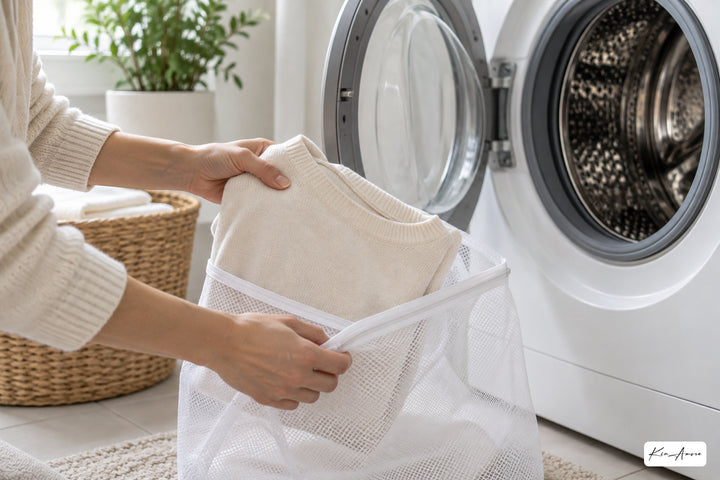
- Turn the piece inside out and wash it in cold water on a gentle cycle.
- Press water out with a towel instead of wringing, because viscose is weaker when wet.
- Air dry, or tumble dry on low and take the piece out while slightly damp.
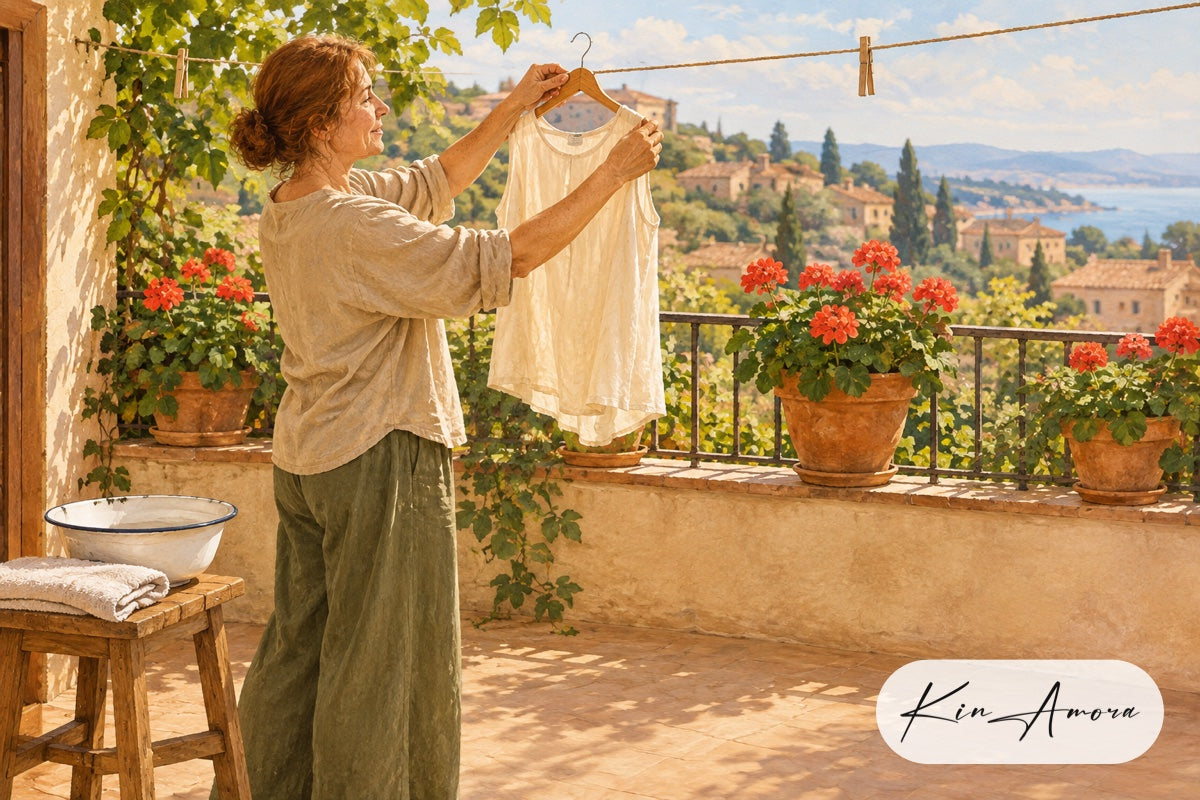
- Hang lighter pieces on a non-rusting hanger to finish drying, and lay heavy pieces flat.
Sweat left in viscose overnight dries into the cloth, so rinse a soaked piece the same day.
How does viscose suit different wearers in heat?
Viscose works for most wearers in heat once the cut is loose. The notes below give one practical angle for 2 kinds of wearer.
For humid climates. Choose a viscose challis or a cotton-viscose blend over viscose jersey, and pack a spare top, since soaked viscose hangs heavy until it dries.
For men. A camp-collar shirt or a relaxed tank in viscose or a cotton-viscose blend sits cooler than a fitted polyester tee. Wear it loose at the chest and untucked so air reaches the skin.
Viscose in summer tops at Kin Amora, the 60/40 cotton-rayon tops
Kin Amora cuts most of its tops in a 60% cotton, 40% rayon blend, the cotton-viscose mix described above, handmade by local artisans in Morocco. The rayon share gives each top a soft fall, and the cotton share adds body.
Four tops show how the blend is cut for heat.
- The Lisbon Top ($110) is a longer-sleeved take on the T-shirt with a pointed V-neckline front and back and a loose look, in S/M and M/L and 11 colors, including White and Sand.
- The Marra Cowl Neck Top ($155) has an asymmetrical drape and a cowl neck, worn as a top or a short dress, in One Size Fits Many and Plus.
- The Sahara Sleeveless Vest ($110) works as a beach cover-up or over jeans, and its page lists a delicate cycle and a low tumble dry.
- The Cabo Fringe Long Sleeve ($155) is a loose, poncho-style cotton-rayon blouse with fringe, in Berry, Sand and White.
These tops suit wearers who want an absorbent, loose layer for hot days, travel and beach evenings. They do not suit a buyer who wants a wrinkle-free synthetic or a close-fitting stretch top. Browse every style in Kin Amora's cotton-rayon tops, and check each product page for sizing and care.