
What is the best breathable fabric for hot weather?
Linen is the best breathable fabric for hot weather, because it joins a cellulose fiber to the best wicking of the natural fibers, according to University of Georgia Cooperative Extension. Open-weave cotton, viscose rayon and cotton-rayon blends follow closely, and all 4 absorb far more sweat than polyester.
The 7 fabrics below are ranked by 3 properties, namely how open the usual cloth is, how much moisture the fiber absorbs and how the fabric hangs away from the body. The order is an editorial reading of textile evidence, not a lab test of finished garments. Meredith McQuerry, a Florida State University professor who studies clothing performance, told the Associated Press in 2026 that a more open woven structure will generally be more breathable whatever the fiber, so weave can move any fabric up or down the list.
Which 7 fabrics breathe best in hot weather?
Seven fabrics breathe best in hot weather, from linen at the top to silk at the bottom. Viscose, the most common rayon, earns its place here, and viscose in hot weather feels cool because it absorbs about 13% moisture from the air.
1. Linen
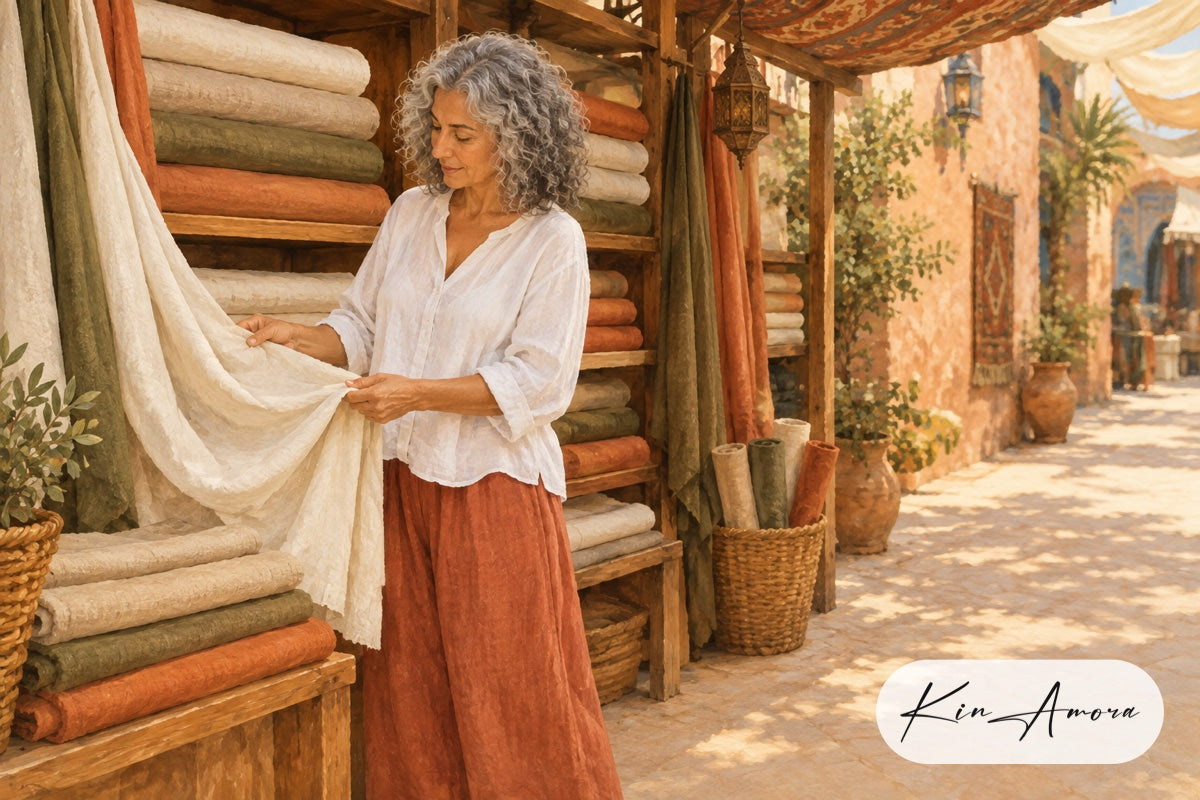
Linen is woven from flax, a plant fiber, and University of Georgia Extension calls it the best wicking of the natural fibers and therefore cool to wear. McQuerry told the AP that cellulosic fibers such as cotton and flax tend to be more breathable and comfortable, while noting that the word linen on a label does not tell the whole story. The weak point is creasing, since the same extension guide says linen wrinkles badly unless treated. Linen suits loose shirts, wide pants and dresses on hot, dry days.
2. Open-weave cotton
Open-weave cotton, such as gauze and voile, ranks second because cotton absorbs 8.5% moisture and the open weave adds airflow. University of Georgia Extension describes cotton as absorbent, cool and comfortable to wear. The weak point is saturation, as the AP report notes that cotton absorbs sweat but can become heavy when saturated. Gauze and voile suit blouses, shirts and sundresses.
3. Viscose rayon
Viscose rayon ranks third for absorbency, at about 13% moisture regain against 8.5% for cotton, using the standard values in an IIT Delhi textile course on India's NPTEL platform. Joyce A. Smith of Ohio State University Extension describes rayon as more moisture absorbent than cotton, breathable and comfortable to wear. The weak points are wet strength and creasing, because regular viscose rayon loses up to about half its strength when wet and wrinkles easily. Rayon challis suits flowing dresses, wide-leg pants and camp-collar shirts.
4. Cotton-rayon blend
A cotton-rayon blend ranks fourth, with a 60% cotton, 40% rayon mix at an estimated 10.3% moisture regain, the weighted figure worked out in the same NPTEL course. Cotton gives the cloth body and wet strength, and rayon adds absorbency and a soft fall that holds the fabric off the skin. The weak point is care, because the rayon share needs cold water and gentle drying. The blend suits relaxed pants, kimonos and long dresses.
5. Lyocell
Lyocell ranks fifth as an absorbent cellulose fiber whose coolness depends on the cloth. The FTC's textile rules (16 CFR 303.7) class lyocell as a rayon made from cellulose dissolved in an organic solvent with no chemical intermediates formed. A light lyocell voile passes far more air than a dense lyocell twill. Lyocell suits shirts, dresses and summer trousers.
6. Modal
Modal ranks sixth because it is absorbent, but a modal tee or tank is a knit that sits close to the body. The FTC's labeling guide lists modal as an ISO fiber name permitted on US labels, and modal is a high-wet-modulus form of rayon that holds its shape in the wash better than regular viscose. A close modal tee leaves less room for air than a loose woven. Modal suits tees, tanks and sleepwear.
7. Silk
Silk ranks seventh as a light, absorbent protein fiber that needs more care in sweaty weather. University of Georgia Extension lists silk as absorbent and moderately wrinkle resistant, but also as losing strength when wet and being affected by high temperatures. Silk suits light blouses and evening pieces more than daily hot-weather wear.
How do the 7 fabrics compare?
The table compares the 7 fabrics on the attributes that decide hot-weather comfort and upkeep.
| Rank | Fabric | Fiber class | Moisture absorption | Wrinkling | Best hot-weather pieces |
|---|---|---|---|---|---|
| 1 | Linen | Natural cellulosic | Best wicking of natural fibers | Wrinkles badly | Shirts, wide pants, dresses |
| 2 | Open-weave cotton | Natural cellulosic | 8.5% regain | Wrinkles unless treated | Blouses, sundresses |
| 3 | Viscose rayon | Manufactured cellulosic | About 13% regain | Wrinkles easily | Flowing dresses, wide pants |
| 4 | 60/40 cotton-rayon | Cellulosic blend | About 10.3% (calculated) | Wrinkles, less than linen | Relaxed pants, kimonos |
| 5 | Lyocell | Manufactured cellulosic (rayon) | Absorbent | Varies by weave | Shirts, trousers |
| 6 | Modal | Manufactured cellulosic (rayon) | Absorbent | Varies by knit | Tees, tanks |
| 7 | Silk | Natural protein | Absorbent | Moderately wrinkle resistant | Blouses, evening wear |
The top 4 share one trait, a cellulose fiber in a cloth that can be woven open and cut loose. Air permeability, moisture absorption, wicking and weave each play a part, as the guide to what makes fabric breathable explains mechanism by mechanism.
What is the coolest fabric for hot humid weather?
The coolest fabric for hot humid weather is an open-weave linen or cotton in a loose cut, because humid air slows evaporation and an open weave gives sweat the best chance to leave. George Havenith, emeritus professor of environmental physiology and ergonomics at Loughborough University, told the AP that the most important rule in choosing clothing is not to hamper sweat evaporation. Havenith also recommended garments with enough room for ventilation in hot outdoor conditions.
Absorbent fibers fill up faster in humid air. A soaked rayon or cotton piece hangs heavier, so a cut that falls away from the body matters more on a sticky day than on a dry one. Pale, loose layers and a spare top cover most humid days, and the guide to outfits for humid heat builds full looks that keep sweat from showing.
Which fabrics should you skip in hot weather?
Skip dense, low-absorbency and coated fabrics in hot weather, because they block air or leave sweat on the skin. Four kinds of fabric run hottest in everyday clothes.
- Dense polyester and nylon, which absorb little moisture and melt if too hot, according to University of Georgia Extension.
- Acrylic, which the same guide describes as absorbing little moisture.
- Heavy denim, canvas and thick twill, which pass little air even in cotton.
- Fabrics with water- or soil-repellent finishes, which McQuerry advised avoiding for the most airflow.
Labels that promise cooling deserve a second look. Po-Chun Hsu, a University of Chicago materials researcher, told the AP that without more evaporation, sunlight reflection or better breathability, a continuous cooling effect is unlikely.
Which of these suits travel in heat?
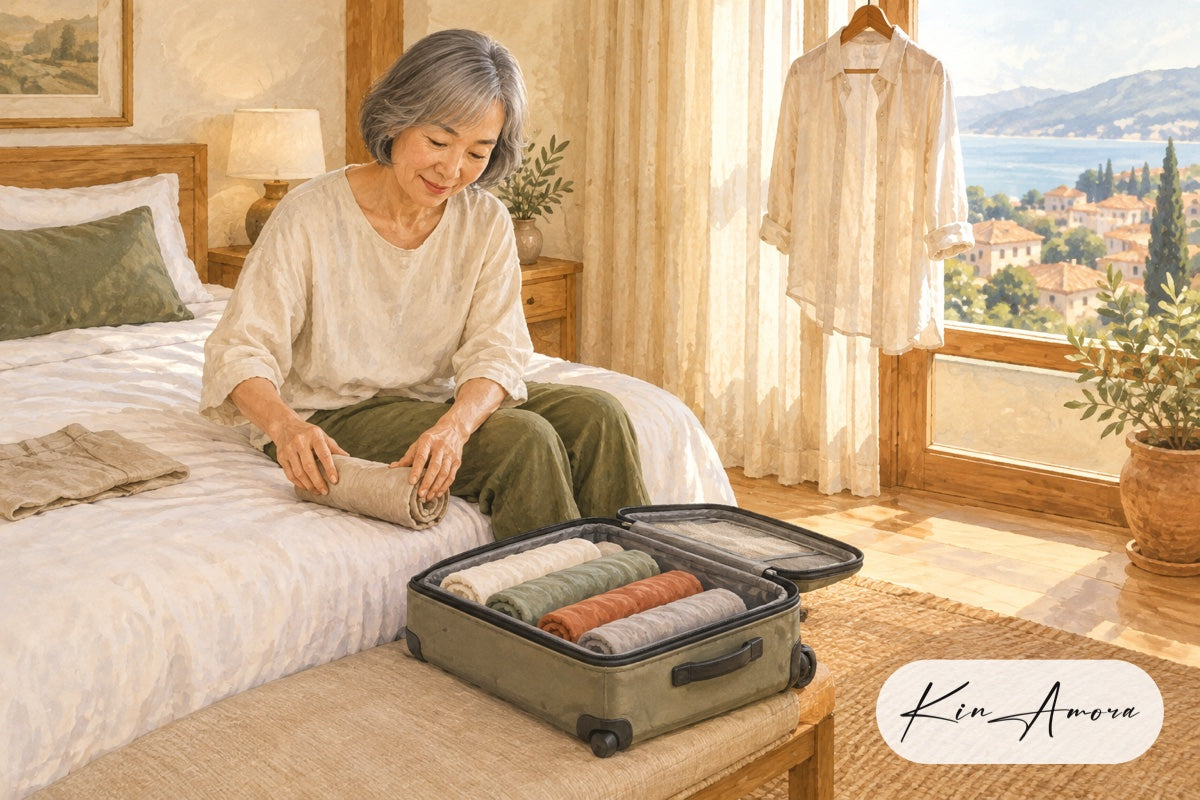
A cotton-rayon blend and viscose rayon suit travel in heat best for packing small and staying cool, while engineered polyester suits a trip with daily sink washing. Rayon and blends crease, so roll them instead of folding and hang them in a steamy bathroom on arrival. Linen stays cool on the road but wrinkles badly unless treated.
Washing on the road changes the choice. Rayon is weaker when wet, so press a hotel-sink wash dry in a towel instead of wringing it. Engineered polyester dries quicker, according to the AP report, which makes it the fallback for a trip with no laundry.
How do these fabrics suit different wearers?
Hot-weather fabric choices shift with the wearer and the climate. The notes below give one practical angle for 2 kinds of wearer.
For men. Wide or tapered pants in linen or cotton-rayon and a loose camp-collar shirt in rayon give the same airflow as women's relaxed cuts. A fitted polyester tee runs warmer on a still day than any of the top 4 fabrics.
For desert trips. Dry desert heat favors full-length, loose layers that keep sun off the skin and let air move underneath. A 1980 study in Nature by Amiram Shkolnik and colleagues found that a Bedouin gained the same heat in a loose black robe as in a white one, because the extra heat was lost before it reached the skin.
Breathable fabric for hot weather at Kin Amora, the cotton-rayon pants
Kin Amora cuts most of its pants in the 60% cotton, 40% rayon blend ranked fourth above, handmade by local artisans in Morocco.
Four Kin Amora pants show the range of cuts.
- The Stella Wide Leg ($165) has a wide leg, a front panel, an elastic back and pockets, in Small to Large.
- The Gypsy Flare Pant ($120) is a wide leg with pockets and an elastic waistband, in Small to XLarge and 12 colors.
- The Marrakesh Harem Pant ($145) has a harem cut, pockets and an elastic waistband, in One Size Fits Most.
- The Classic Capri ($98 in Black, White and Sand) falls to the ankle with a front yoke panel, a 3-button side closure and pockets.
All 4 offer tailoring on request through the order notes. These pants suit wearers who want an absorbent, loose pant for hot days and travel and who wash cold. They do not suit a buyer who needs a quick-drying synthetic for workouts or a pant that survives hot washes. Browse every cut and color in Kin Amora's breathable pants, and add your waist measurement in the order notes for tailoring.