
How do you wear a maxi dress in summer heat without it sticking?
You wear a maxi dress in summer heat without sticking by choosing a loose cut that hangs away from the back, seat and thighs, in an absorbent woven cloth. Meredith McQuerry, a Florida State University professor who studies clothing comfort, told The Associated Press in 2026 that a looser fit allows more airflow while standing or sitting, and that open weaves breathe best.
Choose a summer maxi dress in 5 steps.
- Pick a cut that falls from the shoulders or the bust, such as an A-line, trapeze, tiered or kaftan maxi.
- Pick an absorbent woven cloth, such as cotton, linen, rayon or a cotton-rayon blend, over a polyester knit.
- Skip a full polyester lining, which adds a second layer that holds sweat against the skin.
- Pick a light color for direct sun, since the Centers for Disease Control and Prevention recommends loose, lightweight, light-colored clothing in heat.
- Sit down in the fitting room and check that the skirt does not pull tight across the thighs.
Step 5 matters most, because sticking starts where the dress presses on the body.
Why does a maxi dress stick to your skin in summer?
A maxi dress sticks because damp skin grips the cloth that presses on it. Tang, Chau, Kan and Fan reported in Royal Society Open Science in 2018 that rising skin wetness increases fabric-to-skin adhesion and friction. In their tests, thin cotton fabrics gave the strongest sticky feeling once wet.
Contact drives the feeling as much as sweat does. Filingeri and colleagues at Loughborough University (2015) found in a test with 10 men that the sense of wetness depends mainly on how much skin, sweat and clothing touch and rub together. A maxi dress covers more skin than a short dress, so it has more places to grip, such as the upper back, the underarms, the seat and the backs of the thighs. Sitting pins the skirt between the thighs and the chair, which is why a maxi feels fine on a walk and clings at a café table.
Which fabric keeps a summer maxi dress from clinging?
An absorbent woven fabric keeps a summer maxi dress from clinging, and viscose rayon, cotton-rayon and cotton absorb far more moisture than polyester. Moisture regain is the water a dry fiber takes up from the air.
| Fabric | Moisture regain | How it behaves in summer heat | Verdict for a summer maxi |
|---|---|---|---|
| Viscose rayon | About 13% | Absorbs sweat and drapes close, so thin challis can cling when soaked | Good in a loose cut |
| Cotton-rayon blend (60/40) | About 10.3% (weighted average) | Absorbs well, with cotton adding body that holds the skirt off the legs | Good |
| Cotton | About 8.5% | Absorbs well, and open voile or gauze stays airy | Good in an open weave |
| Linen | Absorbent (no shared site value) | Crisp, so it stands away from the skin, but it creases | Good in dry heat |
| Polyester | About 0.4% | Leaves sweat on the skin surface | Poor in humid heat |
The 13%, 8.5% and 0.4% figures are commonly cited textbook values, and the 10.3% blend figure is a weighted average of the first two, not a lab result. Two absorbent fibers can still stick in a tight cut, so the cut decides the rest.
Which maxi dress cut stays off the skin?
The cuts that stay off the skin fall from the shoulders or the bust and widen toward the hem, such as the A-line, trapeze, tiered, empire-waist and kaftan maxi. A pleated front adds the same ease at the bust. Cuts that cling in heat include the bias-cut slip, the bodycon jersey maxi and any maxi fitted through the hips.
Side slits let air in at every step, and a skirt wide enough to sit cross-legged in will not stretch tight on a chair. Sleeves matter too. Short, flutter and loose elbow sleeves keep air moving around the arm, and the comparison of which sleeve suits heat rates 6 sleeve lengths for heat and sun.
How should a summer maxi dress fit?
A summer maxi dress should fit at the shoulders and bust, then hang free with a hem that clears the ground in your sandals. A maxi dress is a dress whose hem falls to the ankle or the floor. A summer hem works best at the ankle bone, so it stays off hot pavement and wet sand. The way to measure your own shoulder-to-ankle length is in the guide to maxi length and fit, which sets out 6 fit points. Add one more for heat. Pinch the cloth at each hip while standing, and leave at least 2 inches (5 cm) of loose fabric on each side.
Are maxi dresses good for summer?
Yes, maxi dresses are good for summer when the cut is loose and the cloth absorbs sweat. A long, loose skirt shades the legs from direct sun and lets air move underneath. A tight jersey or polyester maxi does the opposite, holding damp against the skin across the whole leg.
Which summer maxi dress suits each occasion?
The summer occasion changes the color, sleeve and hem of a maxi dress more than its fabric. The 4 settings below drive most summer searches.
What maxi dress works for a casual summer day?
A tiered or A-line cotton or cotton-rayon maxi with short sleeves works for a casual summer day. Flat sandals keep the hem at the ankle, and a crossbody bag leaves the hands free.
Can you wear a maxi dress to a summer wedding?
Yes, a maxi dress suits a summer wedding when the color avoids white and ivory and the fabric matches the dress code. The full guide to maxi dresses for wedding guests covers dress codes in detail.
What maxi dress suits a European summer trip?
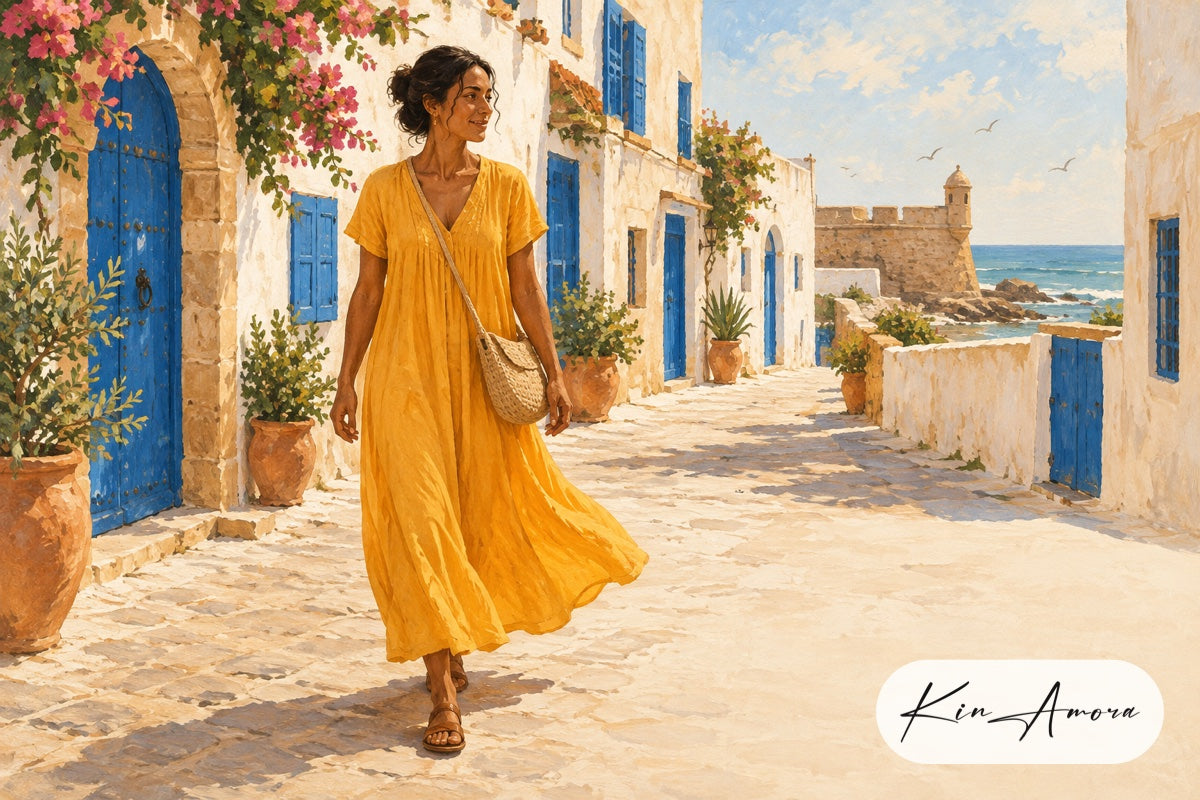
A sleeved maxi or a strappy maxi with a light shawl suits a European summer trip, because some churches enforce dress codes. The Italian State Police state that St. Peter's Basilica enforces a dress code that bars shorts, bare shoulders and miniskirts. A short-sleeve maxi meets that rule in one piece, and an ankle hem handles cobblestones better than a floor-length one.
What maxi dress works for a summer party at night?
A darker solid or a print in rayon or a cotton-rayon blend works for a summer party at night, since the evening air runs cooler. Swap flat sandals for a low wedge or block heel, and keep the hem clear of the ground.
How does a summer maxi dress suit different wearers?
A summer maxi suits most bodies once the shoulders and hem are right. The notes below give one practical angle for each kind of wearer.
For petite wearers. Choose an ankle-length hem rather than a floor-length one, since extra length pools at the feet and traps heat around the ankles. A V-neck and a single color keep the line clean.
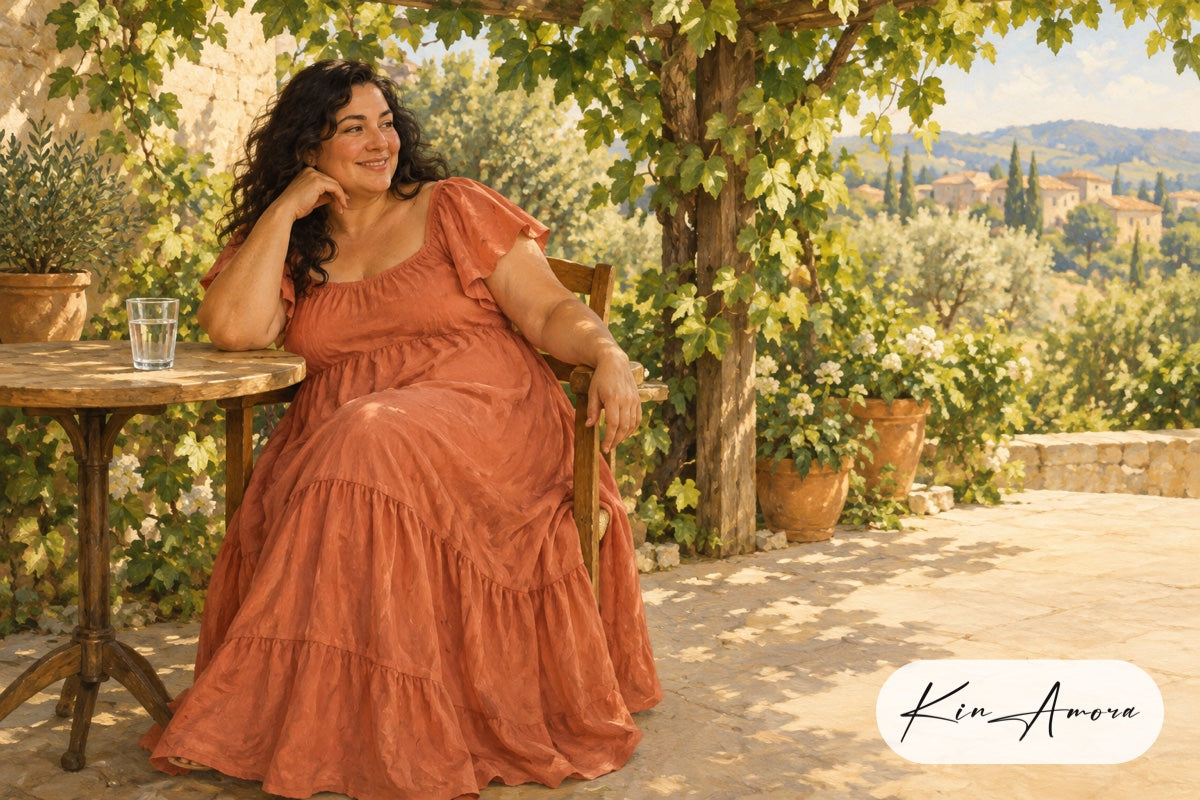
For plus-size wearers. Run the seated test with extra care, because the thighs carry most of the contact on a chair. A pleated or A-line front and a loose sleeve opening keep air moving, and many relaxed dresses come in a separate Plus size.
For travelers. Roll a cotton-rayon maxi instead of folding it, then hang it in a steamy bathroom on arrival to drop the creases. Pack one sleeved maxi for churches and one strappy maxi for the beach.
A summer maxi dress at Kin Amora, Koya's Summer Pleated Dress
Koya's Summer Pleated Dress is Kin Amora's short-sleeve maxi with a pleated V front, priced at $210. The dress is part of Kin Amora's collaboration with Koya Webb, and its product page names travel and special occasions as its uses. Kin Amora cuts it from a 60% cotton, 40% rayon blend, handmade by local women in Morocco.
The dress comes in One Size Fits Many or Plus, in 6 colors, which are Yellow, Black, White, Orange, Blue and Purple. The pleated front gives ease at the bust, and the short sleeves cover the shoulders for a church visit on a summer trip.
The dress suits readers who want an absorbent cotton-rayon maxi with sleeves, a Plus option and a bright summer color. The dress does not suit readers who want a sleeveless maxi for the hottest beach days, or a fitted bodice. The product page lists no length, so petite and tall wearers should ask before ordering. See the colors and sizes of Koya's Summer Pleated Dress on its product page.