
Which garment suits rayon, polyester or cotton?
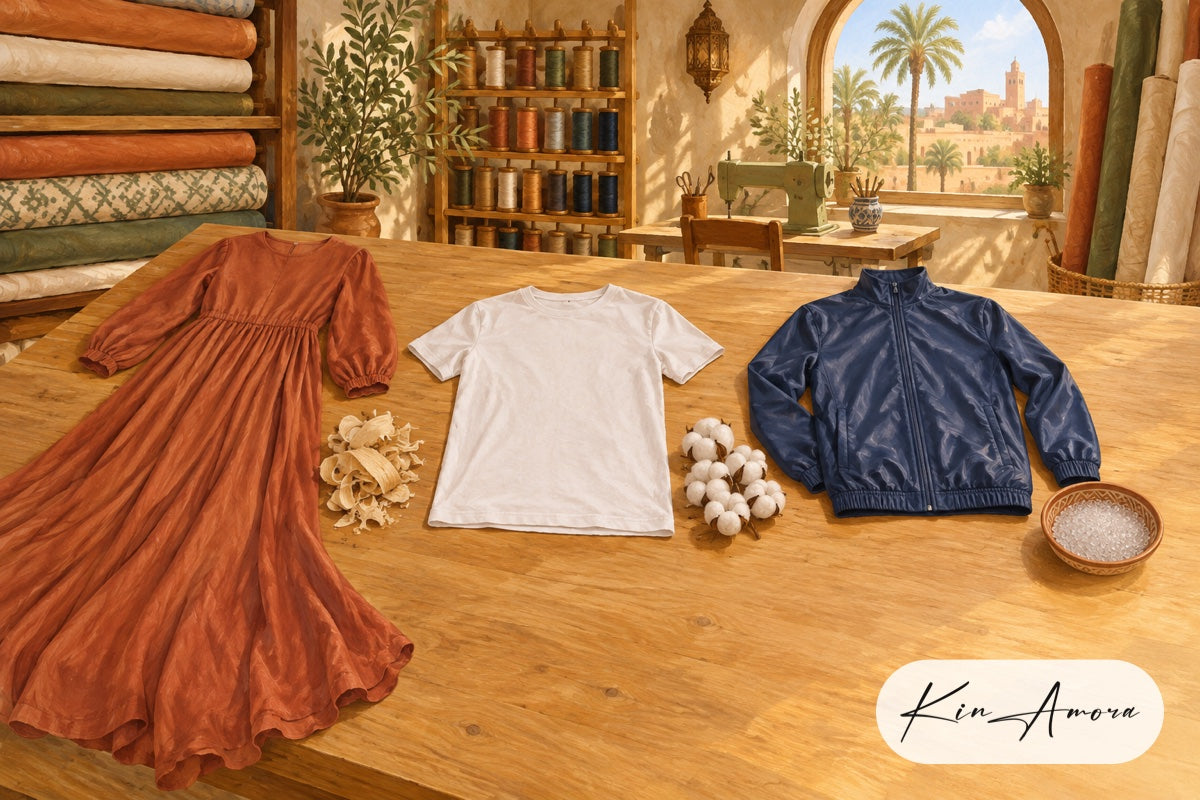
Rayon suits garments that need to hang, cotton suits garments that need hard washing, and polyester suits garments that need to dry fast and resist creasing. The garment's job decides the fiber, not a ranking of the fibers. The table matches 9 common garments to the fiber that fits each job.
| Garment | Best fiber | Why it fits |
|---|---|---|
| Maxi and summer dresses | Rayon or cotton-rayon | Drapes in folds and absorbs sweat |
| Wide-leg and harem pants | Rayon or cotton-rayon | The fabric's weight pulls the leg into a clean line |
| Kimonos and tunics | Rayon or cotton-rayon | Falls softly over the body |
| T-shirts | Cotton or a cotton blend | Absorbent and takes frequent washing |
| Underwear | Cotton | Absorbent and washed often |
| Bed sheets | Cotton | Takes repeated washing |
| Activewear | Polyester | Holds little water, so it dries fast |
| Travel pieces | Polyester or a polyester blend | Resists wrinkles in a packed bag |
| Rain shells and outer layers | Polyester | Absorbs little moisture and keeps its shape |
The rows follow one rule. Absorbent cellulose goes next to the skin in heat, and polyester goes where speed and shape matter more than comfort.
What is the main difference between rayon, polyester and cotton?
The main difference between rayon, polyester and cotton is where each fiber comes from, which sets how much moisture it holds. Cotton is a natural fiber, and the Textile Fiber Products Identification Act (15 U.S.C. 70) defines a natural fiber as one that exists as such in the natural state. The FTC's textile rules (16 CFR 303.7) define rayon as a manufactured fiber of regenerated cellulose and polyester as a manufactured fiber made of a long-chain synthetic polymer.
Moisture follows from origin. Viscose rayon takes up about 13% moisture from the air, cotton about 8.5% and polyester about 0.4%, the standard values in a textile course from IIT Delhi on India's NPTEL platform. The table compares the three fibers across 8 attributes.
| Attribute | Rayon (viscose) | Polyester | Cotton |
|---|---|---|---|
| Source | Cellulose from wood pulp | Petroleum-based chemicals | Seed fiber of the cotton plant |
| Fiber class | Manufactured cellulosic | Manufactured synthetic | Natural cellulosic |
| Moisture regain | About 13% | About 0.4% | About 8.5% |
| Wash stability | Weaker when wet, may stretch or shrink | Easy care, adds strength to blends | No wet-strength warning |
| Wrinkling | Wrinkles easily | Wrinkle-resistant | Wrinkles unless treated |
| Static | Does not build static | Accumulates static | Not flagged |
| High heat | Scorches, does not melt | Melts if too hot | Scorches, does not melt |
| Ironing | Medium-hot, slightly cooler than cotton | Synthetic setting | Hotter than rayon |
The wrinkling, static and heat rows come from University of Georgia Extension's fiber chart, and the wash and ironing rows from Ohio State University Extension. Rayon leads on absorbency, polyester on stability, and cotton sits between them on both.
Is viscose vs polyester vs cotton the same comparison?
Yes, viscose vs polyester vs cotton is the same comparison, because viscose is the most common form of rayon. Ohio State University Extension notes that regular rayon is identified on labels by the term "viscose." Modal is a high wet modulus rayon that the same fact sheet says performs much like cotton in washing.
When does rayon suit a garment?
Rayon suits loose garments worn in warm weather, such as maxi dresses, wide-leg pants and kimonos. Ohio State University Extension describes rayon as more moisture absorbent than cotton, breathable and comfortable to wear. Rayon's fluid drape lets extra width fall close to the body instead of puffing out.
Rayon struggles in fitted garments under strain. Regular rayon has low wet strength, and Ohio State's fact sheet warns that rayon is especially prone to relaxation shrinkage, so close-fitting pieces can tighten over repeated washing. Choose rayon when you can wash cold and air dry.
When does cotton suit a garment?
Cotton suits everyday garments that are washed often, such as T-shirts, underwear and sheets. University of Georgia Extension lists cotton as absorbent, cool and comfortable to wear. Cotton holds more shape than rayon, so a cotton shirt keeps a crisp collar and a cotton dress keeps a defined waist.
Cotton wrinkles unless treated and dries slower than polyester. Choose cotton for the pieces that face the hot wash, the dryer and daily wear.
When does polyester suit a garment?
Polyester suits garments that must dry fast, resist wrinkles and keep their shape, such as activewear, travel pieces and outer layers. Polyester's moisture regain of about 0.4% means the fiber holds almost no water. University of Georgia Extension rates polyester wrinkle-resistant.
Polyester falls short on comfort in heat. The same chart notes that polyester absorbs body oils and perspiration odor and accumulates static electricity. Choose polyester for a workout or a long flight, and rayon or cotton for a long, hot day. The feel of the two manufactured fibers side by side is covered in the guide to six rayon and polyester differences.
Which fiber do you want against your skin?
Rayon and cotton are the fibers most people want against the skin in warm weather, because both are absorbent cellulose. Ohio State University Extension calls rayon comfortable and soft to the skin. University of Georgia Extension calls cotton absorbent, cool and comfortable to wear.
Polyester works better one layer out, or for short bursts of sweat. Polyester holds little moisture in the fiber, so sweat stays on the skin and the fabric surface. A polyester shell over a cotton or rayon layer keeps the comfort next to the body and the weather protection outside.

How do blends mix rayon, polyester and cotton?
Blends mix the traits of each fiber in proportion to its share, so the label's percentages tell you how a garment will behave. Clothing shops sell 3 common blends of these fibers.
- Cotton-rayon, which adds rayon's drape and absorbency to cotton's body. A worked example in the same IIT Delhi NPTEL course weights a 60% cotton, 40% viscose mix at about 10.3% moisture regain, a calculated figure.
- Poly-cotton, which adds polyester's wrinkle resistance to cotton's absorbency, often in shirts and sheets.
- Rayon-polyester, where the synthetic share adds strength, wrinkle resistance and ease of care, according to Ohio State University Extension.
Blends with polyester need a cooler iron. Ohio State's fact sheet warns that iron temperatures safe for rayon can melt or fuse synthetic fibers, so a blend gets the setting for its most heat-sensitive fiber. The cotton-rayon pairing gets its own comparison in the guide on rayon and cotton durability.
How do you care for rayon, polyester and cotton?
Rayon, polyester and cotton need 3 different care routines, and the care label comes first for each.
- Rayon needs cold water, a gentle cycle and no wringing, then air drying, because untreated regular rayon can shrink as much as 10% in a machine wash.
- Polyester needs a low iron setting, because it melts if too hot.
- Cotton needs the least fuss, tolerating warmer washes and a hotter iron than rayon when its label allows.
Wash mixed loads to suit the most delicate fiber in them.
How do the three fibers suit different wearers?
Rayon, polyester and cotton suit different wearers by trip, climate and routine.
For travelers. Pack polyester or a blend for pieces that must come out smooth, and roll rayon pieces so they crease less. Cotton survives a hotel-sink wash best.
For hot climates. Wear rayon or cotton-rayon in loose cuts for long days outside, and save polyester for a quick workout.
For matching sets. A top and pant in one fiber wash on one routine, so a cotton-rayon set goes in the same cold, gentle load.
Rayon and cotton in one garment, Kin Amora's cotton-rayon sets
Kin Amora's sets combine 60% cotton and 40% rayon in both pieces, made in Morocco, so a top and pant share one fiber, one feel and one wash routine. The rayon share gives the drape, and the cotton share gives the body. The fact sheets list 4 sets.
- The Lisbon Top x Gypsy Flare Pant Set ($240) pairs a longer-sleeve tee with a pointed V-neckline and a wide-leg pant, in One Size Fits Many and Plus.
- The Sunriser Top x Gypsy Flare Leg ($229) pairs a cold-shoulder oversized tee with the wide leg, in One Size Fits Many and Plus.
- The Zaza Tank x Maeve Skirt ($215) pairs a tank with a back corset tie and an ankle-length skirt with side pockets.
- The Men's Gandora Jacket x Island Pants Set ($385) pairs an asymmetrical jacket with a gauzy wide-leg pant.
These sets suit anyone who wants a matched outfit that drapes and stays cool in heat. They do not suit anyone who needs polyester's wrinkle-free finish for a business trip. Browse colors and pairings in Kin Amora's cotton-rayon sets, and use the order notes for tailoring or a mix-and-match request where the product page offers it.