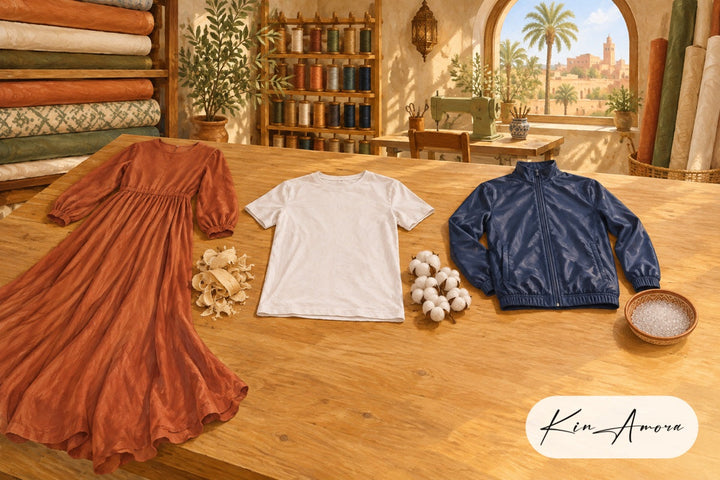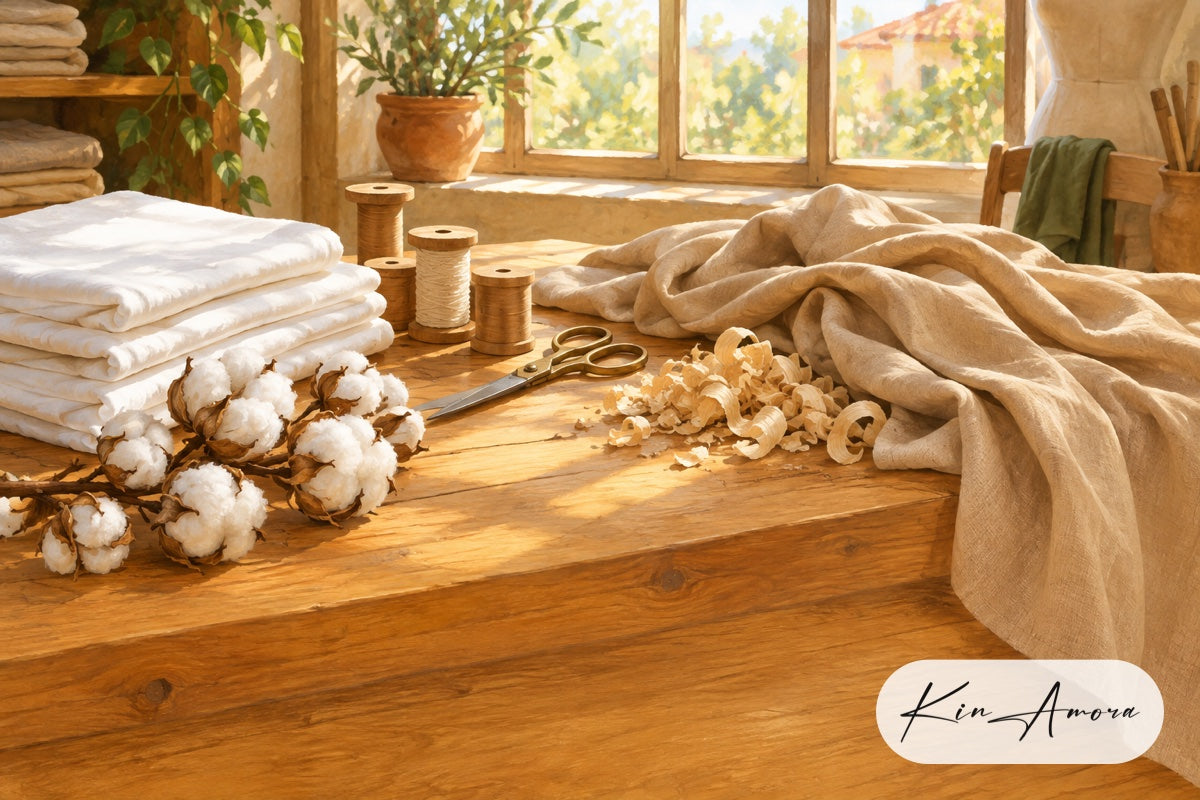

Which wears better in relaxed clothing, rayon or cotton?
Cotton wears better over years of hard washing, and rayon wears better on the body in loose, warm-weather cuts. Cotton keeps its strength when wet, tolerates hot water and holds a shape. Rayon feels softer and cooler, absorbs more moisture and falls into folds, but it needs cold water and gentle drying to last.
Relaxed clothing shows the trade most clearly. A wide leg or a dropped seat in stiff cotton stands away from the body, while the same cut in rayon hangs close and swings with each step. Rayon gives relaxed clothing its movement, and cotton gives it toughness. The rest of the page compares the two fibers attribute by attribute.
What is the difference between rayon and cotton?
The main difference between rayon and cotton is wet strength, because cotton gets stronger when wet while rayon gets weaker. Cotton's strength generally increases with moisture, while regenerated cellulose fibers such as rayon generally lose strength as moisture rises, according to Cotton Incorporated's technical guide to cotton fiber. Regular viscose rayon loses up to about half its strength when wet and regains it as it dries.
The second difference is origin. Cotton is the seed fiber of the cotton plant, and a 2024 review in Frontiers in Bioengineering and Biotechnology puts an average mature fiber at 88.0% to 96.5% cellulose. Rayon starts as wood pulp that mills dissolve and spin into new fiber, and the FTC's textile rules (16 CFR 303.7) define it as a manufactured fiber of regenerated cellulose. The table compares the two fibers across 12 attributes.
| Attribute | Rayon (viscose) | Cotton |
|---|---|---|
| Source | Regenerated cellulose from wood pulp | Seed fiber of the cotton plant |
| Fiber class | Manufactured cellulosic, often called semi-synthetic | Natural cellulosic |
| Moisture regain | About 13% | 8.5% |
| Strength when wet | Weaker, losing up to about half | Stronger |
| Shrinkage | Untreated rayon can shrink up to 10% in a machine wash | Shrinks mainly in hot water and high dryer heat |
| Wrinkling | Wrinkles easily | Wrinkles unless treated |
| Drape | Fluid and heavy, falls in folds | Crisp, with body |
| Hand feel | Soft, smooth, cool | Soft to crisp, depending on weave |
| Response to high heat | Scorches, doesn't melt | Scorches, doesn't melt |
| Ironing | Medium-hot iron, slightly cooler than cotton | Hot iron |
| Dye uptake | Deep, saturated color | Good, even color |
| Home care | Cold wash, gentle cycle, air dry or low heat | Tolerates warm and hot washes |
Moisture regain is the water a dry fiber takes up from the surrounding air, and the 13% and 8.5% figures are commonly cited textbook values. The shrinkage figure comes from Ohio State University Extension, whose fact sheet by Joyce A. Smith says untreated regular rayons can shrink as much as 10% when machine washed. The rows show a pattern, with rayon ahead on comfort and color and cotton ahead on durability and easy care.
Is rayon cotton?
No, rayon is not cotton. Both fibers are made of cellulose, but cotton grows in fiber form on the cotton seed, while rayon is rebuilt from dissolved wood pulp in a mill. Viscose is the most common form of rayon, and a European label reading "viscose" describes the same fiber as a US label reading "rayon." The steps from pulp to yarn, and the types such as modal and lyocell, are covered in the guide to how rayon is made.
Is rayon or cotton more breathable?
Rayon is more absorbent than cotton, so it feels cooler against the skin in dry heat, while cotton handles repeated sweating and washing better. Ohio State University Extension describes rayon as more moisture absorbent than cotton, breathable and comfortable to wear. Both fibers are cellulose, so both pull moisture away from the skin far better than polyester does.
Weave and cut decide breathability as much as fiber. A thin, open cotton voile breathes more than a dense rayon twill, and a loose cut lets air move between the fabric and the body. A relaxed rayon piece in an open weave is the coolest of the four combinations.
Is rayon or cotton better in summer?
Rayon is better in summer for loose, drapey clothes, and cotton is better for pieces that get sweaty and washed often. Rayon's higher moisture regain and fluid drape keep it off the skin in heat. Cotton's wet strength means a cotton shirt survives daily hot-weather washing with less care. Choose rayon or a cotton-rayon blend for summer dresses and wide pants, and cotton for tees and underwear.
Does rayon shrink more than cotton?
Yes, rayon usually shrinks more than cotton, because water weakens rayon and lets heat and tumbling pull it out of shape. The low wet strength of untreated viscose rayon is likely to cause shrinkage and loss of body when washed, according to Ohio State University Extension, which puts the shrinkage at up to 10% for untreated regular rayon in a machine wash. Cotton shrinks too, mostly in its first hot wash and on high dryer heat.
Both shrink less with cold water and air drying. Rayon needs that routine every time, while cotton needs it only when the label asks. That shrinkage, along with lost strength when wet, is why people ask whether rayon is a bad material, though its moisture uptake and drape are just as real.
Which wrinkles more, rayon or cotton?
Rayon wrinkles more than cotton, though both crease because neither cellulose fiber springs back well. University of Georgia Extension lists rayon as "wrinkles easily" and cotton as "wrinkles unless treated." Rayon holds creases until it is steamed or pressed. Cotton creases too, but a crisp cotton looks intentional with some rumpling, while rayon creases show on a flowing garment. Steam both, and press rayon inside out at a lower setting so the face doesn't shine.
Which should you choose, rayon or cotton?
Choose rayon for drape, softness and cool comfort in loose cuts, and choose cotton for durability and hot-water care. Rayon suits wide-leg pants, maxi dresses and kimonos, where the fabric has to hang and swing. Cotton suits tees, sheets and workwear that go through hot washes and the dryer every week. Pick rayon when you can wash cold and air dry, and cotton when you can't. A blend covers the cases in between, and the next section explains how.
What happens when you blend the two?
A cotton-rayon blend keeps cotton's body and wet strength and adds rayon's drape and absorbency. In a 60% cotton, 40% rayon fabric, cotton is the larger share and is listed first on a US label. The blend absorbs slightly more water vapor than plain cotton. Weighting the standard values by share (60% of 8.5% plus 40% of 13%) gives an estimated regain of about 10.3% for a 60/40 blend, a calculated figure rather than a lab measurement.
The blend changes 4 things about how a garment wears.
- Drape loosens, so a relaxed cut falls close to the body instead of standing out.
- Hand softens, with less of the crispness of new cotton.
- Wet strength stays closer to cotton than to pure rayon.
- Care sits in between, gentler than a cotton tee and easier than pure viscose.
The ratio decides the balance, with more cotton for structure and more rayon for swing. The label rules, feel and breathability of the most common ratio are explained in the guide on why a 60/40 blend drapes.
How do you wash rayon and cotton clothes?
Wash rayon in cold water on a gentle cycle and air dry it, and wash cotton warm or hot when its label allows. For machine washing, the FTC's Care Labeling Rule (16 CFR 423) defines cold as an initial water temperature up to 86°F (30°C), warm as 87 to 111°F (31 to 44°C) and hot as 112 to 145°F (45 to 63°C). The care label comes first for both fibers.
The two fibers differ in 5 care steps.
- Water temperature runs cold for rayon and blends, and warm to hot for sturdy cotton.
- Cycle choice runs gentle for rayon and normal for cotton.
- Wringing is out for rayon, because it is weak when wet, so press water out with a towel.
- Drying runs to air drying or low heat for rayon, and medium heat for cotton.
- Ironing runs medium-hot for rayon, which withstands slightly less heat than cotton, according to Ohio State University Extension.
A cotton-rayon blend follows the rayon column. Cold water, a gentle cycle and air drying keep the rayon share from shrinking.
Is rayon or cotton better for sheets and underwear?
Rayon sheets feel cooler and silkier, and cotton sheets last longer and take hotter washes. Most "bamboo" sheets are rayon, and the FTC requires them to be labeled "rayon made from bamboo." Cotton percale feels crisp and cotton sateen feels smoother, and both tolerate the hot washes bedding often gets. Cotton suits underwear for the same reason, since underwear is washed often and warm.
How does polyester compare with rayon and cotton?
Polyester is a petroleum-based synthetic with a moisture regain of about 0.4%, far below rayon at about 13% and cotton at 8.5%. Polyester resists wrinkles, dries fast and keeps its strength when wet. Polyester melts under high heat, while rayon and cotton scorch. Choose polyester for fast-drying travel and sportswear, and rayon or cotton for comfort against the skin in heat.
How do rayon and cotton suit different wearers?
Rayon and cotton suit different wearers by climate, travel and washing habits. The notes below give one practical angle for each.
For travelers. Rayon and cotton-rayon pieces pack small and feel cool on a long flight, but they crease, so roll them instead of folding and hang them in a steamy bathroom on arrival. Cotton survives hotel-sink washing in warm water better than pure rayon.
For hot, humid climates. Pick loose cuts in rayon or a cotton-rayon blend for days out, and cotton for anything you wash daily. Rayon soaked with sweat hangs heavier, so a looser cut keeps it off the skin.
For hot-wash households. Keep rayon pieces out of the hot load and the high dryer, and wash them with the cold delicates. Untreated rayon can shrink up to 10% in a machine wash, and hot water and high heat push it further.
Rayon and cotton at Kin Amora, the 60/40 cotton-rayon pants
Kin Amora cuts most of its pants in a 60% cotton, 40% rayon blend, handmade by local artisans in Morocco, so each pair takes cotton's body and rayon's drape. The rayon share lets a wide leg, a flare or a dropped seat fall softly, and the cotton share keeps the cloth from turning limp.
The blend shows up in 5 pant cuts.
| Pant | Cut and details on the product page | Price |
|---|---|---|
| Marrakesh Harem Pant | Harem cut, pockets, elastic waistband, Small to XL sizing | $145 |
| Stella Wide Leg | Wide leg, front panel, elastic back, pockets | $165 |
| Gypsy Flare Pant | Wide leg, pockets, elastic waistband, Small to XL sizing, 12 colors | $120 |
| Classic Capri | Front yoke panel, falls to the ankle, 3-button side closure, pockets, elastic waistband, regular and plus | $134 and $98 |
| Mallorca Pant | Front-panel waist, elastic back, pockets, One Size Fits Many | $98 |
All 5 pages offer tailoring on request through the order notes. The pant pages don't list a care line, so follow the sewn-in label and the rayon routine of cold water, a gentle cycle and air drying. These pants suit anyone who wants relaxed pants that drape and stay cool in heat. They do not suit anyone who wants 100% cotton that goes in a hot wash and a hot dryer every week. Compare every cut and color in Kin Amora's cotton-rayon pants, and add your waist in the order notes when you want it tailored.