What do Moroccans wear on a daily basis?
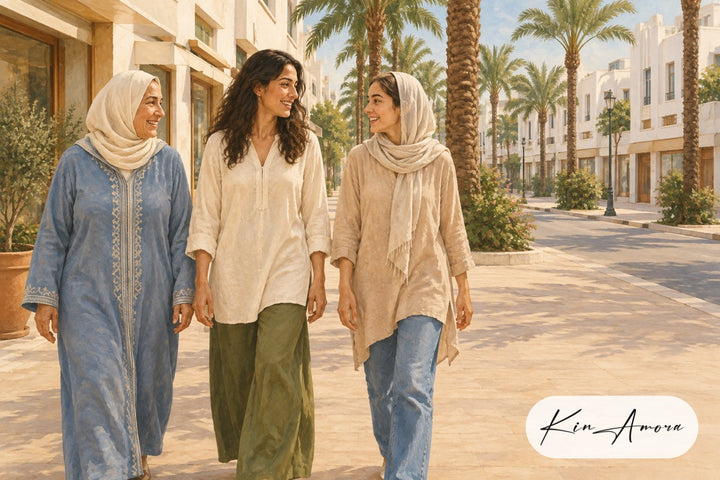
Moroccans wear Western clothes for most of the day and a djellaba on top when the weather, the day or the occasion calls for one. The Encyclopedia of Clothing and Fashion (Gale) describes the Moroccan jillaba as the long, hooded robe worn as an outer garment by both sexes. A djellaba slips over jeans or a dress in seconds, so it works like a coat rather than a full outfit.
Everyday dress in Morocco draws on 5 kinds of clothing.
- Western separates, such as jeans, trousers, shirts, knitwear, T-shirts and sneakers, worn to work, school and the café.
- The djellaba, a long, loose robe with long sleeves and a pointed hood, worn over other clothes.
- The gandora (also gandoura), a lighter tunic in the djellaba's shape but without the hood.
- Head coverings, such as a woman's headscarf, the djellaba's own hood or a straw hat in the north.
- Footwear, from sneakers and leather shoes to belgha, the soft, heelless leather slippers often dyed yellow.
Seasons change the fabric more than the cut. A djellaba is sewn from local or imported cloth whose weight varies with the season, according to the Metropolitan Museum of Art. Lightweight cotton djellabas are now common, and they run slimmer and shorter than the older wool versions. Summer heat explains the shift, since Marrakech averages a July high of 99.9°F (37.7°C) on 1991 to 2020 climate normals. City and country then split that balance differently.
How do Moroccans dress in the city?
Moroccans in cities such as Casablanca, Rabat, Marrakech, Fez and Tangier dress mostly in Western clothes, with a djellaba added for errands, prayers, holidays and cold mornings. Office workers wear suits, trousers and shirts. Students and younger adults wear jeans, hoodies and sneakers. In the medinas, a djellaba over everyday clothes is a common sight on shoppers of every age.
City dress changed fastest in the 20th century. Skirts and trousers spread in Moroccan cities during the colonial era, and women in middle-class Casablanca neighborhoods of the 1960s and 1970s dressed with more freedom, according to historian Mohamed Latif in a 2019 Yabiladi report. Modesty still shapes city clothing. Covered shoulders and knees are the common standard in the old medinas and near mosques.
Religious holidays and weddings are the days men are most likely to wear a full djellaba or a jabador. The countryside follows its own calendar and its own fabrics.
How do Moroccans dress in the countryside?
Moroccans in the countryside wear more traditional and regional clothing than city residents, with heavier wool for mountain winters and wraps that mark a region. Morocco's 2024 census found that 24.8% of the population uses an Amazigh language, and many regional garments come from Amazigh communities in the Rif, the Atlas and the south.
Mountain dress answers the cold. Country djellabas are traditionally woven from thick wool or goat hair, according to the Encyclopédie berbère (1995). The Beni Ouarain of the Middle Atlas weave the handira, an ornate wool winter cloak whose loose loops help snow fall off. Some Amazigh women wear the tahruyt, a large covering made of 2 lengths of dark cotton joined by a decorative seam, with tassels and sequins framing the forehead, according to the Textile Research Centre in Leiden.
Eastern oasis towns keep older wraps. In Figuig, near the Algerian border, women still wear the white haik, which reflects sunlight and marks local identity, Le360 reported in June 2026.
Why do Moroccans wear cowboy hats?
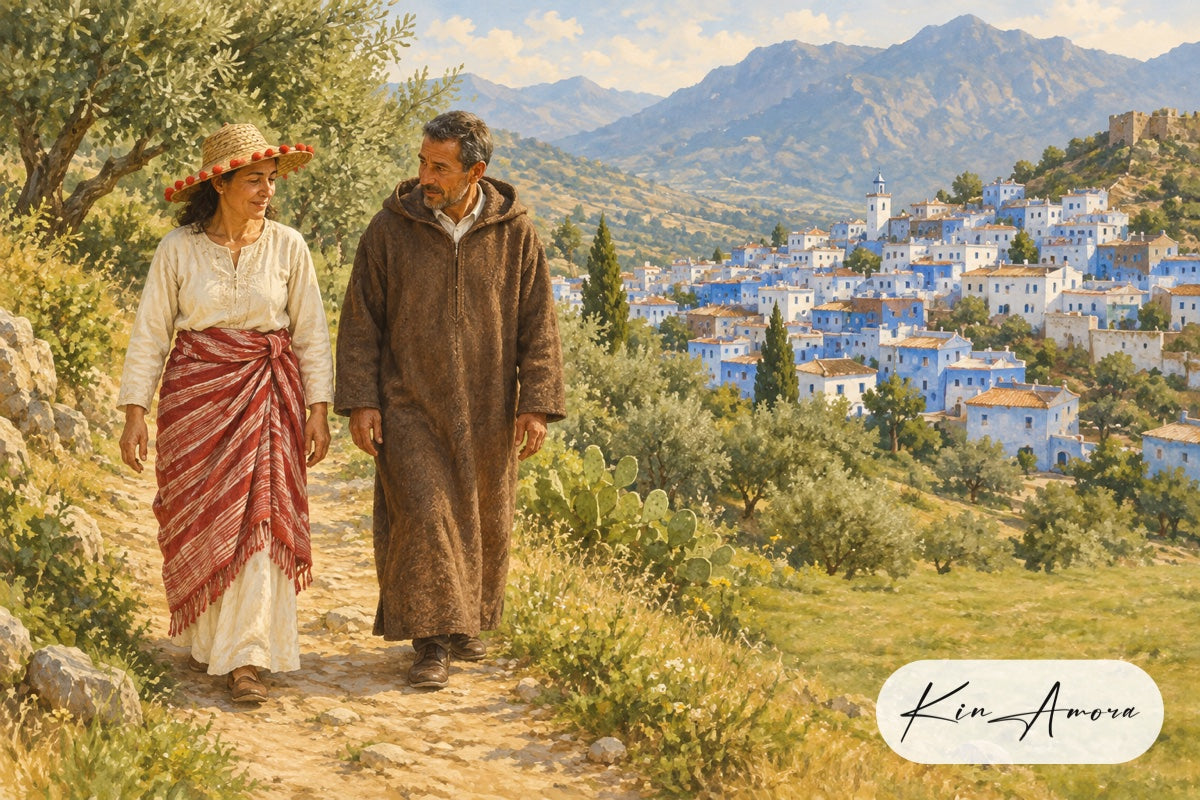
Moroccans in the north wear a wide-brimmed straw hat, the chachiya jeblia, which looks like a cowboy hat but belongs to Jebli mountain dress. Women artisans weave the hat by hand from doum palm leaves, and the open weave lets air reach the head through long days in fields and markets, according to a July 2026 Le360 report. Women wear it most, mainly in summer, around Chefchaouen, Ouazzane, Tetouan, Fahs-Anjra and Beni Arous, and men wear plainer versions in several areas. Women's hats around Chefchaouen carry small red or dark blue wool pom-poms. Le360 adds that women wear the hat with the well-known scarf of the north. Le360 notes that similar hats appear in parts of Mexico. The south, with its sand and sun, dresses differently again.
What do Moroccans wear in the desert?
Moroccans in the Saharan south wear loose, full-length garments that cover the skin and the head, the deraa for men and the melhfa for women. The deraa is a wide, square-cut gandora that covers the whole body, usually in blue or white. The melhfa is a long draped cloth that wraps the body and covers the hair.
Both garments are daily wear, not costume. Women of every generation wear the melhfa at work and at home, and children's deraas sell beside adult ones, according to a March 2026 Le360 report from the region. The same report put a deraa at roughly 800 to 5,000 dirhams, depending on fabric and embroidery. Indigo-dyed melhfas have lost ground because the dye stains walls and other surfaces.
The djellaba's hood historically shielded the face from blowing sand, the same full-cover logic that desert dress follows.
What do Moroccan men wear?
Moroccan men wear Western trousers, shirts and sneakers on most days, and a djellaba, jabador or gandora for prayers, holidays and family occasions. Men's djellabas come in plainer, more neutral colors than women's.
Moroccan men's traditional wardrobe rests on 6 pieces, shown below with the occasions for each.
| Garment | What it is | When men wear it |
|---|---|---|
| Djellaba | Long hooded robe, usually in white, beige, grey or brown | Over everyday clothes in cool weather and at religious celebrations |
| Jabador | Tunic with matching trousers, sometimes with a vest | Eid and family celebrations |
| Gandora | Lighter, hoodless tunic | Warm days and relaxed occasions |
| Sarouel | Full, loose trousers drawn in at the waist | Under a jabador or tunic |
| Belgha | Soft, heelless leather slippers, classically yellow | With a djellaba or jabador at prayers, Eid and weddings |
| Fez (tarbouche) | Brimless red felt cap | Weddings, religious celebrations, royal court dress |
A man in a white djellaba, red fez and yellow belgha is dressed for a religious holiday or a wedding, not an ordinary Tuesday. Spelling variants and the history behind each garment sit in the guide to traditional Moroccan clothing names. Women's dress covers a wider range of choices.
What do Moroccan women wear?
Moroccan women wear jeans or trousers with longer tops, dresses, djellabas and, for celebrations, the kaftan, in combinations that change with age, city and region. Women's djellabas can carry fine needlework, such as the lace-like randa embroidery that a Moroccan designer described to Africanews in March 2025. Many women wear a djellaba over Western clothes, and many younger city women wear only Western clothes.
Head coverings are a personal decision. Moroccan law neither requires nor forbids the headscarf, and the headscarf was more popular with older women in Rabat than with younger women, according to a 2006 BBC News report. The full picture of age, region and dress names is covered in the companion guide to what Moroccan ladies wear today. Head coverings for men and women form their own question.
What do Moroccans wear on their heads?
Moroccans wear headscarves, the djellaba's pointed hood, straw hats in the north, regional headdresses and, on formal days, the red fez, depending on gender, region and occasion.
Why do Moroccans wear pointed hoods?
Moroccans wear pointed hoods because the djellaba's qob shields the head from sun and wind and, in the mountains, works as a winter hat. The qob is the baggy hood of the djellaba, and it comes to a point at the back. The hood also works as a pocket, and a farmer or shepherd without a bag can carry a simple meal in it, according to the Encyclopédie berbère (1995).
Why do Moroccans wear the fez?
Moroccans wear the fez as formal dress for weddings, religious celebrations and royal court occasions, not as an everyday hat. The fez takes its name from the city of Fez, which was the only place in the world where the hat was made until the late 19th century, according to Encyclopaedia Britannica. Morocco remains one of the last places where the fez is still worn, and it stays part of royal court dress. Moroccans call it the tarbouche.
What do Moroccans wear on Eid and to weddings?
Moroccans wear new or best traditional clothes on Eid and at weddings, which makes these the 2 occasions when the whole family dresses in Moroccan garments at once.
What do Moroccans wear on Eid?
Moroccans wear djellabas, jabadors, kaftans and belgha slippers on Eid, and many families buy new traditional clothes for the holiday. Demand for tailored djellabas and kaftans peaks in the last days of Ramadan, before Eid al-Fitr, according to a March 2025 Africanews report. The same report found velvet djellabas and kaftans in fashion that year, with custom pieces starting at about $200. Men favor white or light djellabas and jabadors for the morning prayer.
What do Moroccans wear to weddings?
Moroccan guests wear kaftans, takchitas, djellabas and suits to weddings, and brides wear regional bridal dress. The takchita is a 2-piece kaftan, an under-dress called the tahtia beneath an over-dress called the dfina, often cinched with a wide belt called the mdamma. One example is the Fez lebsa, a kaftan worn with a jeweled breastplate, a crown and a silk veil. UNESCO added the Moroccan caftan to its intangible cultural heritage list in 2025 and describes it as a long tunic worn by people of all genders and ages for special occasions. Men wear a light djellaba with a fez and yellow belgha, or a Western suit.
Why do Moroccans wear djellabas?
Moroccans wear djellabas because the robe covers everyday clothes in one layer, adapts to heat or cold through its fabric and carries national meaning. The robe answers 3 needs at once.
- Cover. A djellaba goes over jeans, a suit or a housedress, so the wearer looks dressed for the street without changing.
- Climate. Wool keeps out mountain cold, and cotton stays light in summer heat.
- Identity. Under the French protectorate, Moroccan women began wearing the djellaba in place of the haik to signal nationalist conviction, according to Jonathan Wyrtzen of Yale in Making Morocco (2016).
The same logic carries well beyond Morocco.
What does everyday Moroccan dress teach about relaxed clothing?
Everyday Moroccan dress teaches that loose, covering clothes in breathable cloth handle heat better than tight, bare ones. Margaret Frey, a professor of fiber science and apparel design at Cornell University, told TIME in 2024 that loose garments covering most of the body, like traditional desert robes, are a good model for hot weather.
Moroccan dress offers 4 lessons for relaxed clothing anywhere.
- Room through the body lets air move between cloth and skin.
- An outer layer that goes over clothes saves a full outfit change.
- Fabric that changes with the season keeps one cut useful all year.
- Pull-on construction, with no zip and few buttons, makes a garment fast to dress in.
Does Morocco have a strict dress code?
No, Morocco has no national law that sets what citizens wear, and the headscarf is neither required nor banned. Social norms do the work instead. Covered shoulders and knees are the respectful standard in medinas, villages and near mosques, and beachwear stays at the beach and the pool.
How do these lessons apply to different readers?
For travelers. Loose trousers or a long skirt with a sleeved top match local norms in medinas and villages. Ask before photographing people in traditional dress, since many Moroccans prefer to be asked first.
For men. A long tunic or kimono over relaxed trousers gives the same easy line as a gandora over sarouel. Plain white, brown, grey and black sit closest to Moroccan men's own color choices.
For winter visitors. The Atlas sees snow, and Ouarzazate drops to a January average low of 35.2°F (1.8°C), so pack wool or a warm outer layer for the mountains and the desert nights.
Moroccan everyday dress and Kin Amora's handmade relaxed clothing
Kin Amora makes relaxed clothing handmade by local artisans in Morocco, most of it in a 60% cotton, 40% rayon blend. The pieces borrow the djellaba's loose line and pull-on ease without copying ceremonial garments.
- The Royal Duster ($330) has full-length sleeves, a small collar with buttons and woven detailing that falls from the shoulders into an upside-down triangle at the mid-back. It wears as a jacket or, belted, as a dress, in One Size Fits All, in Black, White or Classic Striped.
- The Marrakesh Harem Pant ($145) is Kin Amora's harem cut, a cousin of the sarouel, with pockets, an elastic waistband and Small to XL sizing, in Black, White, Classic Striped or Berry.
- The Mens Marrakesh Harem Pant ($155) has side pockets and comes in Black, White or Classic Striped.
- The Men's Classic Kimono ($210) has an oversized, loose fit and a subtle upside-down triangle of patchwork at the upper back, in One Size Fits Many, including plus, in Black or White.
Waist tailoring for both harem pants is available on request through the order notes. These pieces suit anyone who wants loose, covered layers for heat, travel and long days. They don't suit a shopper looking for a ceremonial kaftan or a hooded wool djellaba, which a Moroccan tailor or cooperative makes, or anyone who prefers a fitted silhouette. Browse Kin Amora's handmade relaxed clothing by cut and color, and add your waist measurement in the order notes for a tailored fit.