
Spellings vary because the words reach English from Arabic, often through French. You'll also see jellaba or jillaba, caftan, gandoura or gandura, and saroual, seroual or serwal. We cover the handwork behind these garments in our guide to Moroccan artisan clothing.
What is a djellaba?
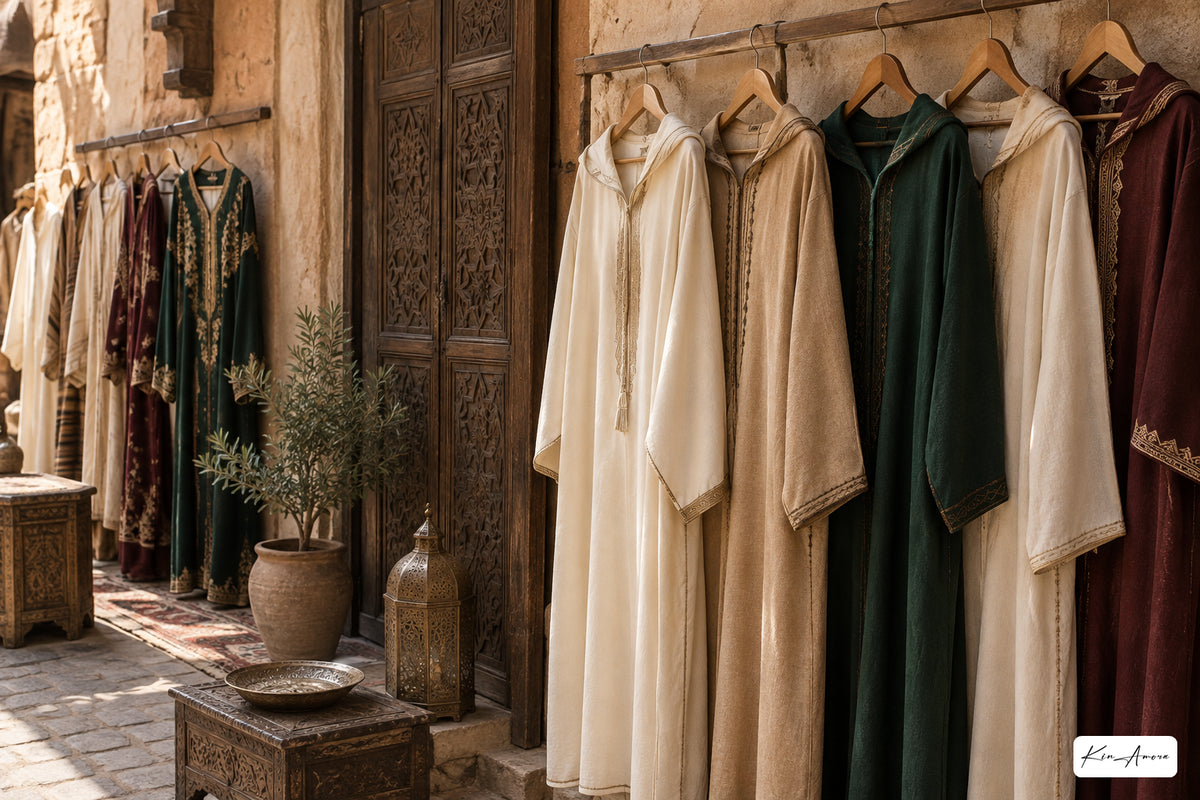
A djellaba is a long, loose, hooded robe that Moroccan men and women have worn as everyday dress since the 18th century, according to Morocco's official portal, maroc.ma. Its materials, colors and finishes change with the season and the region, so no single fabric or color defines it. The hood is the quickest way to recognize one.
Britannica groups it with related robes across the Arab world, such as the gallibiya in Egypt and the jubbeh in Syria: voluminous, with wide, long sleeves and a skirt sometimes slit at the sides.
A textile-arts brochure from Maison de l'Artisan, Morocco's state crafts agency, says Fez, Marrakech and Tetouan once made all of the country's textiles, djellabas included. We trace weaving in those cities separately.
The design is still evolving. The V&A holds a red linen djellaba from Moroccan designer Amine Bendriouich's 2020 Djellabas & Tricks collection (T.64-2022), which reworks the large volume of traditional Marrakchi djellabas.
Kaftan vs djellaba, what is the difference?
The difference comes down to the hood and the occasion: a djellaba is a hooded robe for daily life, while a kaftan is a long tunic without a hood, opening down the center with buttons and kept for special occasions. UNESCO added the Moroccan caftan to its intangible cultural heritage list in 2025.
| Djellaba | Kaftan | |
|---|---|---|
| Hood | Yes | No |
| Cut | Voluminous robe, wide long sleeves, skirt sometimes slit at the sides | Long tunic with a central opening and buttons |
| Usual setting | Daily life | Weddings, baptisms, coming-of-age rituals, festivals |
| Who wears it | Men and women | People of all genders and ages |
| Decoration | Finishes vary by region | Hand-made embroidery, beads, sequins; belt optional |

A kaftan takes a chain of makers. UNESCO's listing names weavers of brocade, velvet and silk, tailors, and the artisans behind its buttons, braids and embroidery.
Britannica traces the caftan to an open, coatlike garment known in ancient Persia as the candys. In Morocco, Maison de l'Artisan says Andalusian weavers brought brocade, first used for the wide belts of Tetouan's women (made by Fez artisans) and much later for the Fassi bridal kaftan.
"A Moroccan kaftan" is really a family of styles. Morocco's official portal has separate videos on the Rbati, Tetouani, Amazigh and Makhzani caftans, among others. (US shops often call any loose beach cover-up a kaftan, which is a different garment story.)
What is a gandora?
A gandora is a light tunic, made in wool or cotton and cut with or without sleeves, often described as a djellaba without the hood. Maison de l'Artisan lists gandouras alongside kaftans, djellabas and sarouels in Morocco's traditional couture, so the gandora is a garment in its own right, not a cut-down djellaba.
That hoodless comparison comes from accounts of the Algerian men's gandoura, which encyclopedic sources describe as casual clothing close to the djellaba. Documentation of the Moroccan gandora is thinner than for the kaftan or djellaba, so treat any precise rule about its sleeves or season with caution.
What is a sarouel?
A sarouel is a pair of full, loose trousers drawn in at the waist, usually with a drawstring, and often gathered or tied near the ankle. Maison de l'Artisan lists sarouels among Morocco's traditional garments, and the word traces back to Persian shalwar, the name behind a trouser family worn well beyond Morocco.

Britannica says these baggy trousers are believed to have started in Persia, where Arabs met them in the 7th century. Historic versions measured about 3 yards (2.75 m) across at the waist, drawn in with cords and tied at each ankle, which gave field workers room to move.
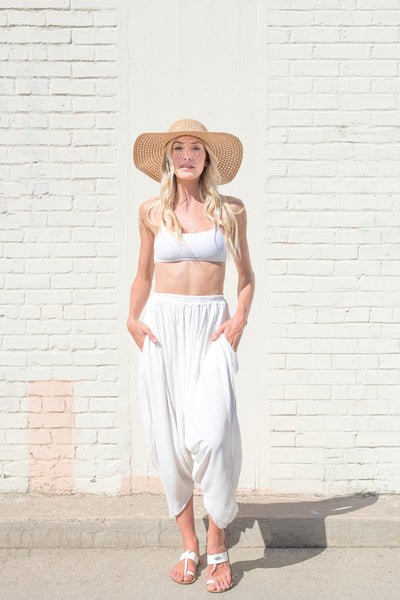
The sarouel also has a close modern relative. Harem pants are loose trousers with a dropped crotch, roomy through the hip and thigh, that gather or taper at the ankle, usually on an elastic waistband. The name is a Western label, unpacked in our pants guide, and the V&A handles it with care: it catalogs a 1960-1980 outfit by Moroccan designer Zina Guessous as a bolero with "harem pants," keeping the term in quotation marks.
Our Marrakesh Harem Pant is, as its product page puts it, "our version of the harem pant": a $145 pant with pockets and an elastic waistband, in black, white, berry or a classic stripe. It's a modern relaxed pant, not a reproduction of a traditional sarouel, and it's made the way the rest of our range is: Kin Amora pieces are made from a 60% cotton, 40% rayon blend and are handmade by local artisans in Morocco. Rayon is a fiber regenerated from plant cellulose, usually wood pulp; it is soft and drapey but more heat-sensitive than cotton.
What other traditional Moroccan clothing names should you know?
Four more names are worth knowing: the jabador, a matching tunic-and-trouser set for celebrations; the selham, a sleeveless hooded wool cape; the haik, a long rectangle of cloth wrapped around the body; and belgha, the traditional slippers that finish a festive outfit. Each one does a job the first four don't.
Jabador
A jabador combines a tunic with serwal trousers, often with a vest, according to a 2022 Wealth of Morocco feature in Moorish Times. It's worn for family celebrations and religious holidays, and it began as a layer under the kaftan or djellaba. Before Eid al-Fitr in 2021, Morocco World News photographed white-and-gold jabadors on display in the souk and a young boy being fitted for a velvet one.
Selham
The selham is a wide outer garment, mostly wool, long and without sleeves, with a large hood finished by a silk tassel called the bloula, maroc.ma explains. It closes at the chest with the sdîr, a small, strong stitch about 15 cm (6 in) long. The Met's 20th-century burnus/selham measures 72 1/2 by 84 in (184.2 by 213.4 cm).
Haik
The haik is a wrap, not a sewn garment. Britannica describes it as an oblong, generally striped cloth wrapped around the body and head, about 18 by 6 feet (5.5 by 1.8 m).
Belgha
Belgha are the slippers of a dressed-up outfit. Morocco World News's 2021 Eid coverage noted that a velvet jabador is usually finished with a pair, and that merchants set out rows of them before the holiday.
How can you tell these garments apart at a glance?
Start with the hood. A hood with sleeves points to a djellaba, and a hood without sleeves points to a selham; no hood plus a buttoned front and celebration finish points to a kaftan, while a plain, light tunic is probably a gandora. Trousers are a sarouel, or part of a jabador if a matching tunic comes with them.
If you remember one thing, make it the hood test.
Shop Related Products
Explore the pieces, colours and sizing on the Kin Amora store.
Marrakesh Harem Pant
$145.00 USD
View product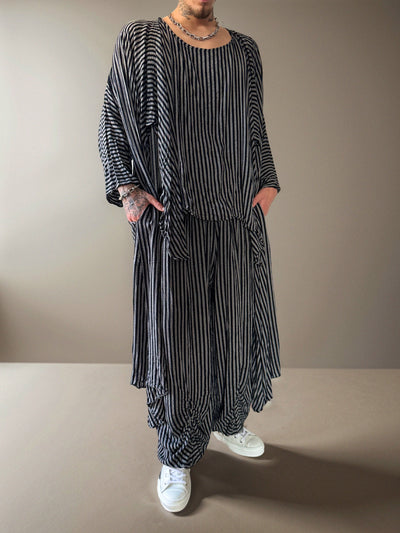
Men's Gandora Jacket x Island Pants Set
$385.00 USD
View product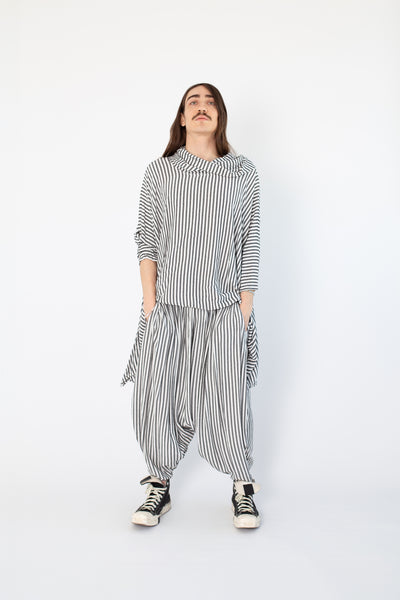
Mens Marrakesh Harem Pant
$155.00 USD
View productFrequently Asked Questions
How long is a traditional djellaba?
There's no standard length. As one reference point, the Met's early 20th-century djellaba from Morocco or Algeria, in wool and silk, measures 68 in (172.7 cm) from top to hem.
Can you wear a djellaba in hot weather?
Yes. Djellabas are made in cotton as well as wool, according to Maison de l'Artisan, so lighter versions exist for warm months.
What is the red hat worn with traditional Moroccan dress?
That's the fez, a brimless red felt hat. Maison de l'Artisan notes that Moroccan felt-making is an old craft used for red fez hats, which the felt-maker shapes around a bowl.
Is it respectful for visitors to wear a djellaba or kaftan?
Yes, as long as you treat it as clothing rather than a costume. Use the garment's real name, buy from Moroccan makers where you can, and save heavily decorated kaftans for occasions that call for them.
Why do Moroccan clothing names have different spellings?
Moroccan clothing names have different spellings because the words reach English from Arabic, often through French. So you'll see the djellaba written as jellaba or jillaba, the kaftan as caftan, the gandora as gandoura or gandura, and the sarouel as saroual, seroual or serwal.