
What do Moroccan women wear outside the home?
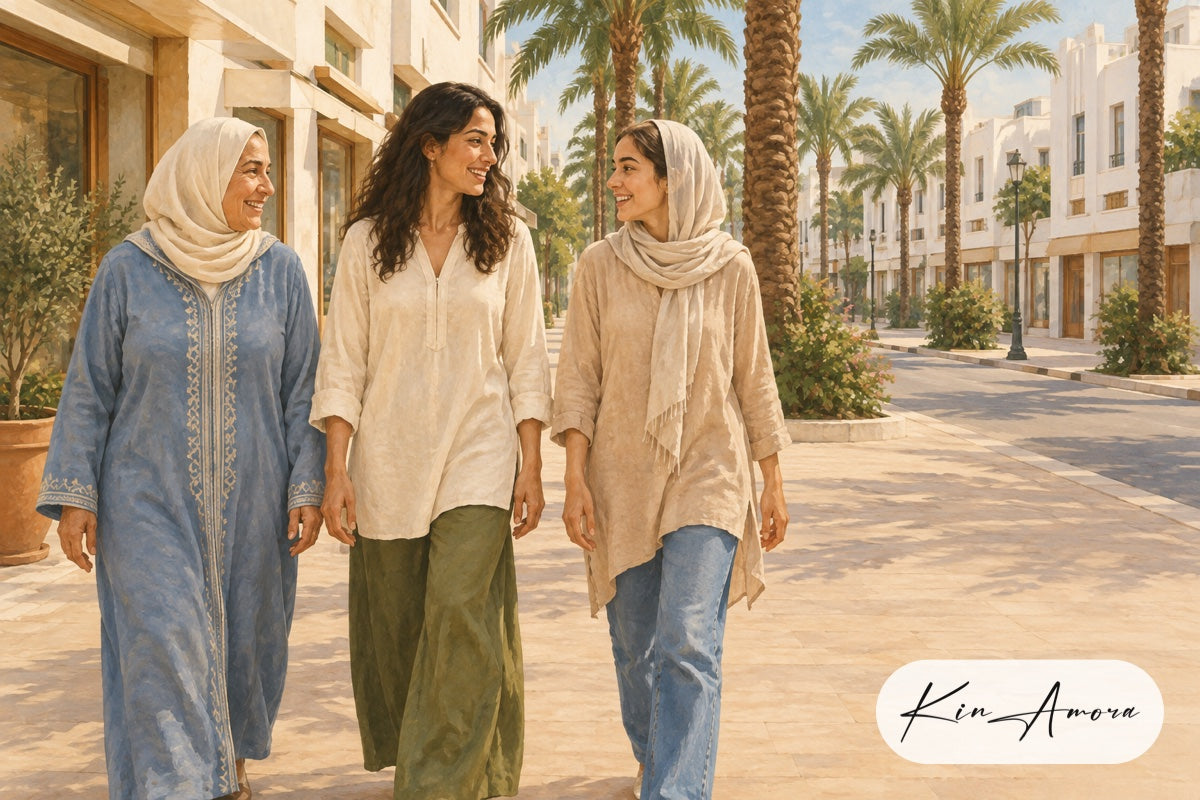
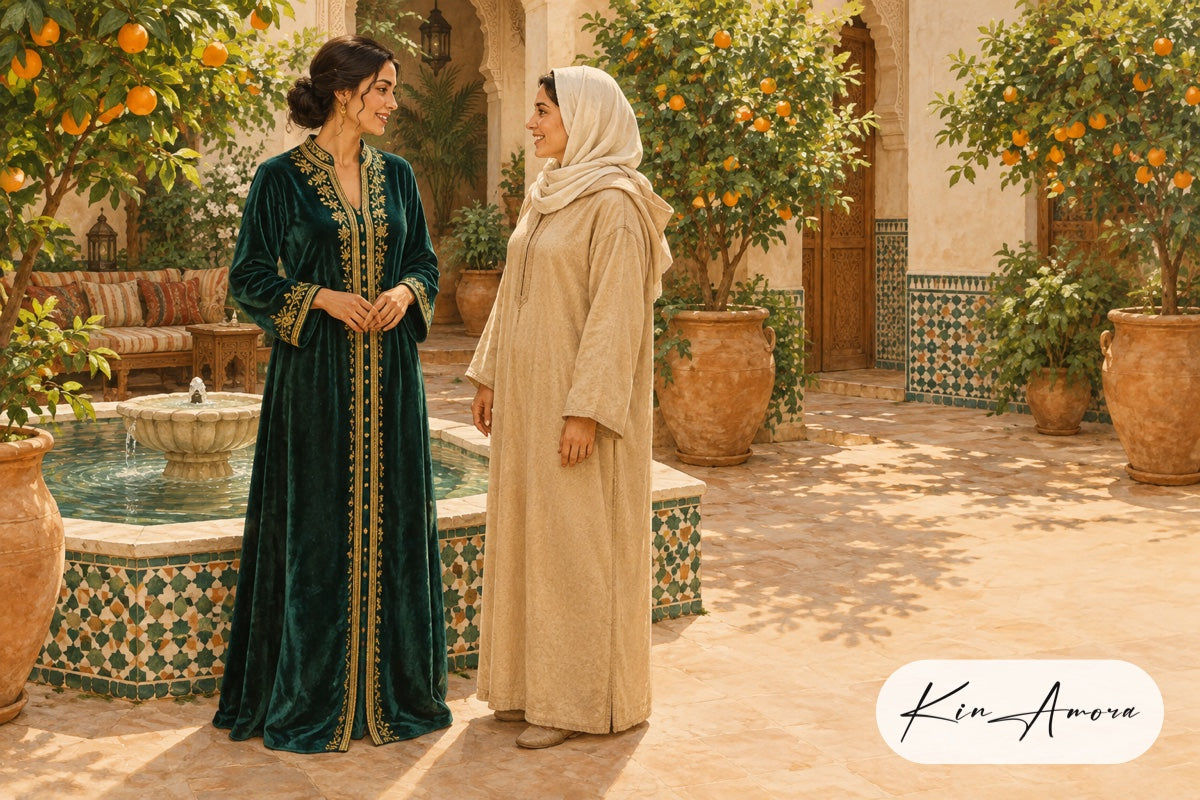
Moroccan women wear Western clothes in modest cuts, the djellaba, or a djellaba over Western clothes outside the home, and they add the kaftan for celebrations. The balance depends on the woman, the town and the day.
Moroccan women outside the home wear 5 common outfits.
- Jeans or wide trousers with a long top or tunic that covers the hips.
- A long skirt or dress, usually with sleeves.
- A djellaba over everyday clothes, with or without a headscarf.
- A kaftan or takchita for weddings, Eid and family celebrations.
- A regional wrap, such as the melhfa in the Saharan south or the white haik in Figuig.
Women's djellabas can carry fine needlework, such as the lace-like randa embroidery that a Moroccan designer described to Africanews in March 2025. Lightweight cotton djellabas are now common, and they run slimmer and shorter than the old wool cut. At the coast the choice widens, and Moroccan women at the beach wear swimsuits, burkinis or everyday clothes, each choosing her own coverage. Each of these garments has its own name.
What is a Moroccan dress called?
A Moroccan dress is called a kaftan (or caftan) when it is a formal, hoodless gown, and a djellaba when it is the everyday hooded robe. Moroccan women use 6 main names, shown below with the moment each garment belongs to.
| Name | What it is | When women wear it |
|---|---|---|
| Djellaba | Long, loose robe with long sleeves and a pointed hood | Errands, visits, prayers, cool weather |
| Kaftan | Long, hoodless tunic that opens down the front with buttons, often embroidered | Weddings, baptisms, Eid, festivals |
| Takchita | 2-layer kaftan, a tahtia under-dress and a dfina over-dress, belted with a mdamma | Weddings and formal parties |
| Gandora | Lighter, hoodless tunic | Warm days and casual wear |
| Melhfa | Long draped cloth wrapped around the body and over the hair | Daily wear in the Saharan south |
| Haik | Large white cloth wrapped around the body and head | Figuig and heritage events |
The djellaba and the kaftan cover most of what a visitor sees. The other 4 names belong to a region or an occasion.
How do Moroccan women wear the djellaba?
Moroccan women wear the djellaba over everyday clothes, as a coat-like layer for the street. A djellaba covers jeans or a dress from shoulder to ankle in one piece, and the hood stays down unless rain, sun or wind calls for it. Under the French protectorate, Moroccan women began wearing the djellaba in place of the haik to signal nationalist conviction and widen their public role, according to Jonathan Wyrtzen of Yale in Making Morocco (2016). Women's shoes range from sneakers and flats to heeled sandals trimmed with silver or gold tinsel.
When do Moroccan women wear the kaftan?
Moroccan women wear the kaftan for weddings, baptisms, coming-of-age rituals, Eid and other celebrations. UNESCO added the Moroccan caftan to its intangible cultural heritage list in 2025 and describes it as a long tunic worn by people of all genders and ages for special occasions. Velvet djellabas and kaftans were the Eid fashion of 2025, and tailored pieces started at about $200, according to a March 2025 Africanews report. Where a woman lives shapes the rest of her wardrobe.
How does dress change with age, city and region?
Moroccan women's dress changes with age, city and region in 3 visible ways, the share of Western clothes, the head covering and the regional wrap. Large cities such as Casablanca, Rabat and Marrakech show the most Western clothing. Smaller towns and villages show more djellabas, more headscarves and more regional cloth.
Generations carry different histories. Women who studied or worked in the 1950s often wore a djellaba with a face veil that showed only the eyes, according to a 2019 Yabiladi report. Princess Lalla Aicha appeared unveiled in public in 1947, and many urban women gradually followed. Today a grandmother, a mother and a daughter in one family can each dress differently and still be dressed for the same street.
What do women wear in the north?
Women in the Jbala north wear the chachiya jeblia, a wide-brimmed straw hat woven from doum palm leaves, mainly in summer, according to a July 2026 Le360 report. Women's hats around Chefchaouen carry small red or dark blue wool pom-poms. Le360 notes that women wear the hat with the well-known scarf of the north.
What do women wear in the Sahara?
Women in the Saharan south wear the melhfa, a long draped cloth that wraps the body and covers the hair, at work and at home. Women of every generation wear it, and vendors say each age group favors its own style, according to a March 2026 Le360 report. A popular Persi melhfa costs about 400 dirhams, and a high-end Diana melhfa reaches 10,000 dirhams.
What do women wear in the Atlas and the east?
Women in the Atlas and the eastern oases keep wool cloaks, dark head coverings and the white haik in regional dress. Some Amazigh women wear the tahruyt, 2 lengths of dark cotton joined by a decorative seam, with tassels and sequins framing the forehead, according to the Textile Research Centre in Leiden. In Figuig, more than 50 women walked through the oasis in white haiks during a June 2026 sports event, Le360 reported. Men's clothing and the rest of the country's garments are covered in what Moroccans wear day to day. The head covering is the choice most visitors notice first.
What do Moroccan women wear on their heads?
Moroccan women wear a headscarf, the djellaba's hood, a regional headdress or nothing at all, and each woman makes that choice herself. Moroccan law neither requires nor forbids the headscarf. The headscarf was more popular with older women in Rabat than with younger women, according to a 2006 BBC News report.
Head coverings come in 4 common forms.
- A wrapped headscarf (hijab) that covers the hair and neck.
- A loose scarf draped over the hair.
- The djellaba's pointed hood, raised against sun, wind or rain.
- A regional headdress, such as the straw chachiya of the north.
Most head and neck ties start with a long rectangle folded into a band, and the guide to tying a Moroccan scarf shows 5 common ways.
Why do Moroccan women wear the hijab?
Moroccan women who wear the hijab do so mainly for religious reasons, by personal decision. Religion leads the reasons, with 62.5% of 1,320 young Moroccans calling the veil a matter of the Muslim religion in a 2021 survey by Menassat for Social Research and Studies, as reported by Bladi. About 38% cited practical, personal or moral reasons. In big Moroccan cities, seeing a woman in a hijab was about as common as seeing one without, Jillian C. York reported for Global Voices in 2008. Both choices sit side by side in Moroccan families, offices and streets.
Which relaxed pieces echo these silhouettes?
Long-sleeved gowns, dusters and loose wide pants echo the djellaba's long line and the kaftan's full length without copying either garment. Moroccan women's dress shares 4 features with relaxed clothing.
- Full length, from shoulder to ankle.
- Long or elbow-length sleeves.
- Room through the body, so air moves between cloth and skin.
- An open front or an outer layer that goes over other clothes.
A long gown with sleeves gives the djellaba's covered line in one piece. A duster or kimono worn open gives the kaftan's front opening. Wide pants under a long tunic give the sarouel's ease.
What do Moroccan women wear to the beach?
Moroccan women wear swimsuits, burkinis or light clothes at the beach, and all 3 appear on the same sand. Moroccans were increasingly wearing the burkini on the beaches of Rabat, Africanews reported in 2016. Morocco's tourism minister Lahcen Haddad said the same year that the burkini and the bikini coexist on Moroccan beaches, according to Morocco World News.
How should different readers use this guide?
For visitors. Visitors don't need to copy Moroccan dress, and loose clothes that cover the shoulders and knees match local norms in medinas and villages. The visitor packing guide for Morocco covers mosque rules, seasons and what to pack.
For shoppers. A tailored kaftan from a Moroccan workshop is a celebration garment, so buy one for a wedding or Eid rather than for daily wear. Ask the tailor about fabric and embroidery before you agree on a price.
Long gowns at Kin Amora, the Goddess Gown and the Legacy Gown
Kin Amora's long gowns carry the full-length, sleeved line of Moroccan dress in relaxed, handmade pieces. Both gowns below are cut from a 60% cotton, 40% rayon blend and handmade in Morocco.
- The Goddess Gown ($145) has full-length sleeves and pockets at hip level. It comes in One Size Fits Many, which fits up to size 10, in Black, White, Olive, Miami Mango or Royal Blue, and Kin Amora suggests pairing it with a belt. Tailoring is available on request through the order notes.
- The Legacy Gown ($240) is a double-material gown with fringe at the bottom and pockets. It comes in One Size Fits Many, including plus, in Black, Tobacco, Mint or Lilac Crystal Wash, and it is travel-friendly.
The Goddess Gown suits anyone up to size 10 who wants a sleeved maxi with the djellaba's covered line. The Legacy Gown suits plus sizes and anyone who wants more weight and movement at the hem. Neither gown replaces a ceremonial kaftan for a Moroccan wedding. Browse Kin Amora's relaxed handmade gowns and add your waist measurement in the order notes for a tailored fit.