
What should you wear in hot and humid weather?
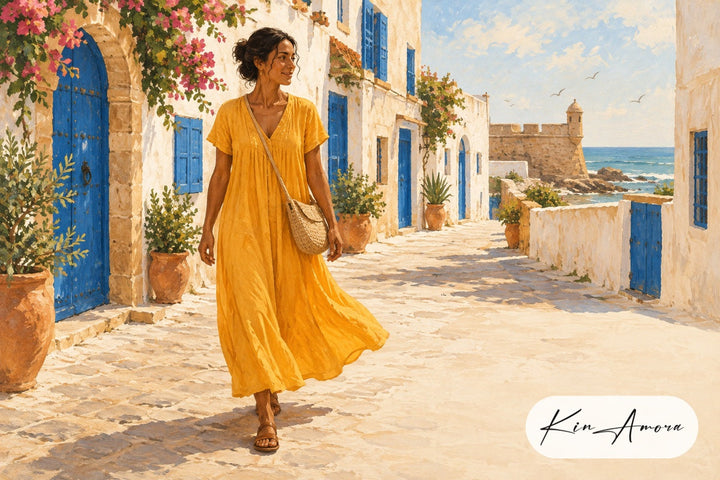
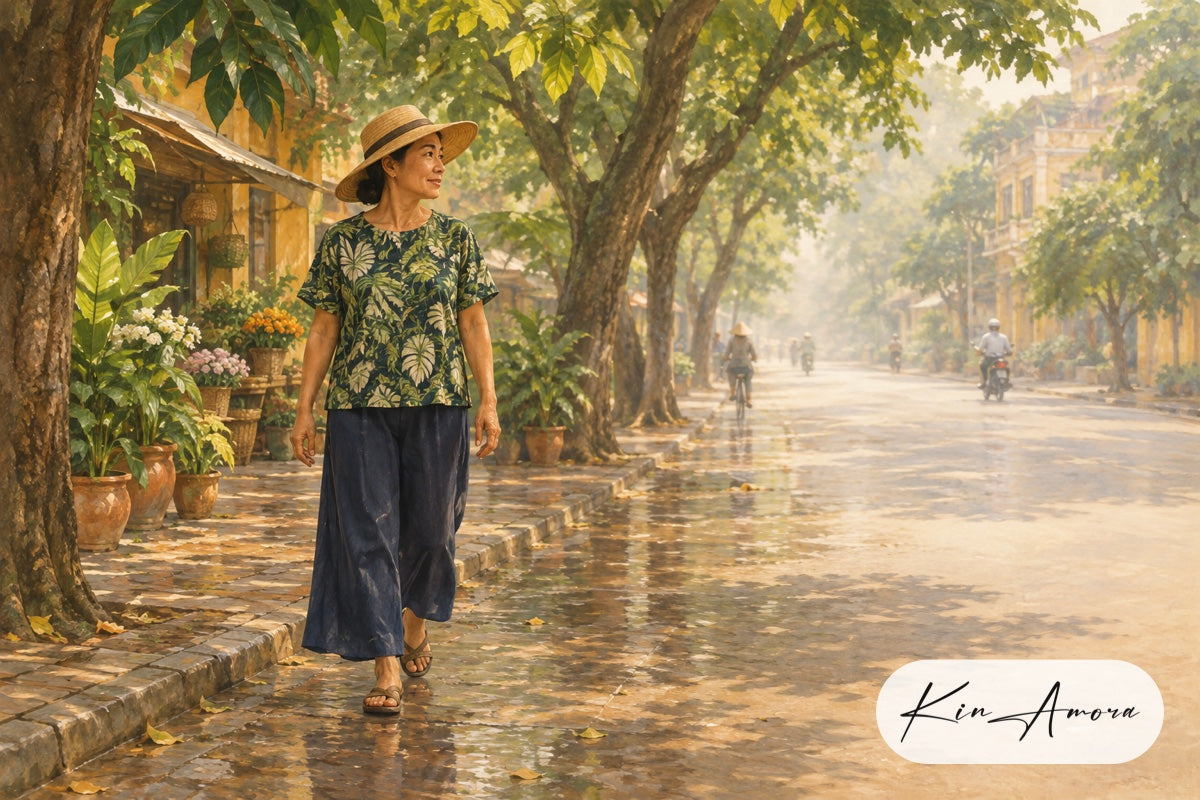
Wear loose, woven clothes in absorbent fibers and sweat-hiding colors, with sweat-wicking layers next to the skin, in hot and humid weather. Kimberly McMahon, who leads the National Weather Service's Public Weather Services Program, told TIME in 2024 that sweat sitting on the skin under tight clothing does not evaporate. A loose garment leaves room for air to reach the skin and carry that moisture away.
A humid-weather outfit follows 6 rules.
- Choose loose, woven cuts that hang away from the skin.
- Pick absorbent fibers, such as cotton, linen, rayon or blends of them.
- Wear navy, dark green, other dark shades that are not grey-based, or a busy print, to hide damp patches.
- Put sweat-wicking underwear and bra layers next to the skin.
- Choose sandals or open shoes for air at the feet.
- Add a brimmed hat for shade on the walk between buildings.
The rules pull in two directions on one point. Pale colors stay cooler in the sun, while dark colors hide sweat better, and the color section below sets out that trade. The reason humid heat needs these rules at all comes first.
Why does humid heat feel hotter?
Humid heat feels hotter because sweat evaporates more slowly when the air is already full of moisture. The North Carolina Division of Public Health states that when humidity is high, sweat can't evaporate well and the body has a harder time staying cool. The National Weather Service measures the effect with the heat index, which it defines as how hot it really feels when relative humidity is combined with the air temperature.
The heat index sorts humid days into 4 bands, according to the National Weather Service's Amarillo office.
| Heat index | National Weather Service band |
|---|---|
| 80°F to 90°F (27°C to 32°C) | Caution |
| 90°F to 103°F (32°C to 39°C) | Extreme Caution |
| 103°F to 124°F (39°C to 51°C) | Danger |
| 125°F (52°C) or higher | Extreme Danger |
The National Weather Service adds that full sunshine can raise heat index values by up to 15°F, because the index assumes shade and a light wind. Clothing cannot lower the heat index. Clothing can leave the skin free to sweat and keep the sun off it, and the fabric decides most of that.
Which fabrics are best for hot and humid weather?
The best fabrics for hot and humid weather are absorbent, breathable wovens, such as linen, cotton, viscose rayon and cotton-rayon blends. Textile scientists compare absorbency by moisture regain, the water vapor a dry fiber takes up from the air. An IIT Delhi textile course on India's NPTEL platform uses 8.5% for cotton, 13% for viscose rayon and 0.4% for polyester, and works a 60/40 cotton-viscose blend out at 10.3%.
The table compares 6 common summer fabrics by moisture regain and by how each one wears on a humid day.
| Fabric | Moisture regain | How it wears in humid heat |
|---|---|---|
| Viscose rayon | 13% | Soft and fluid, cool in a loose cut |
| 60% cotton, 40% rayon | About 10.3% | Soft drape with some of cotton's body |
| Cotton | 8.5% | Absorbent and breathable, heavy when soaked |
| Linen | Not given in the NPTEL course | Breathable and stiff, so it stands off damp skin |
| Polyester and nylon | 0.4% for polyester | Wicks sweat in sportswear, traps heat in tight weaves |
| Silk | Not given in the NPTEL course | Insulating over large areas of the body |
The figures come from the NPTEL course, and the wear notes come from textile researchers quoted below. Saetbyul Park, an assistant professor of apparel and textile design at Michigan State University, told The Guardian in 2026 that linen breathes, absorbs moisture and will not cling to the skin when wet. Park added that cotton can absorb moisture and get heavy on people who sweat a lot, and that tightly woven polyester and nylon tend to trap heat against the body.
Weave matters as much as fiber, because air passes through the gaps between yarns. An open weave breathes more than a dense one in the same blend, as the guide to the breathability of cotton-rayon cloth explains. Margaret Frey, a professor of fiber science and apparel design at Cornell University, suggested a quick test to TIME in 2024, which is to blow through the fabric and feel for your breath on the other side.
Are linen pants good for hot humid weather?
Yes, linen pants are good for hot humid weather, because linen breathes, absorbs moisture and stays stiff enough not to cling when damp, according to Saetbyul Park of Michigan State University. A loose linen pant stands away from the leg and lets air move around it.
Is viscose good for hot humid weather?
Yes, viscose is good for hot humid weather in a loose, woven cut, because viscose rayon has the highest moisture regain in the NPTEL figures, at 13%. A fitted viscose knit sits on the skin and behaves more like a tight tee. A loose viscose or cotton-rayon pant or dress hangs away from the body and lets air move under it.
What colors hide sweat best?
Navy, dark green, other dark colors that are not grey-based, and busy prints hide sweat best, while heathered grey shows it most. Los Angeles stylist Sophie Strauss told The Guardian in 2026 that heathered grey turns close to black when wet, so the contrast between dry and damp patches is severe. Strauss added that darker colors that are not grey-based change less when wet, and that a big pattern hides sweat stains better than any single color.
Wet fabric looks darker for a physical reason. A thin layer of water on damp cloth bends reflected light away and less light reaches the eye, Robert Matthews explains in BBC Science Focus Magazine. The visible mark is the contrast between that darker patch and the dry cloth around it.
The table compares 5 color choices by sweat visibility, heat in the sun and sun protection.
| Color choice | Sweat visibility | Heat in direct sun | Sun protection |
|---|---|---|---|
| Heathered grey | Highest, turns near-black when wet | Between pale and dark | Between pale and dark |
| Navy or dark green | Low | Higher than pale colors | Higher than pale colors |
| Busy print | Lowest, the pattern breaks up the patch | Depends on the base color | Depends on the base color |
| White or pale colors | Damp patches show as a darker shade | Lowest | Lowest, a white T-shirt rates about UPF 7 |
| Black | Low | Highest | Highest |
Pick by the day's plan. A dark or printed piece suits a humid commute, a meeting or a dinner where damp patches matter most. A pale piece suits a long walk in full sun, where heat matters more than marks. The Skin Cancer Foundation notes that a white T-shirt's UPF of about 7 drops to about 3 when the shirt gets wet. Color matters less than many expect, since white clothes reflect more sun yet fit, weave and wind decide how much heat reaches the body.
How should clothes fit in hot and humid weather?
Clothes should fit loose enough to hang away from the skin at the underarms, back, waist and thighs in hot and humid weather. Tight seams press fabric against the sweatiest areas, where sweat then sits and shows. Margaret Frey of Cornell told TIME that warm-climate dress traditionally covers most of the body without fitting tightly.
Check a humid-weather fit with 3 tests.
- Blow through the fabric and feel for your breath on your hand, Frey's breathability test.
- Raise both arms and twist, and the fabric should not pull tight across the back or the underarms.
- Sit for a minute, then stand, and the fabric should fall away from the thighs and the seat.
Pants follow the same rule. Wide-leg, harem and relaxed tapered pants leave air around the leg, and the guide to harem pants in summer heat compares cuts and fabrics at 90°F. What sits under the loose layer matters just as much.
What should you wear under your clothes in humid heat?
Wear sweat-wicking underwear, a breathable bra and moisture-wicking socks under your clothes in humid heat. Guowen Song, who runs the Lab for Heat and Thermal Protection Research at Iowa State University, told TIME in 2024 that sweat-wicking fabric suits undergarments because they touch the skin.
What bra should you wear in hot humid weather?
Wear a bra in a sweat-wicking or breathable fabric in hot humid weather, since Song's advice on wicking fabric applies to every layer that touches the skin. A wicking sports bra or a light cotton bralette under a loose top suits most humid days, and a dark or patterned top hides any damp line.
What socks should you wear in hot humid weather?
Wear thin, moisture-wicking socks in closed shoes, or skip socks with sandals, in hot humid weather. Song told TIME that open-toed shoes help ventilation. Pack a spare pair of socks for a long humid day on foot.
What to wear in hot, humid and rainy weather?
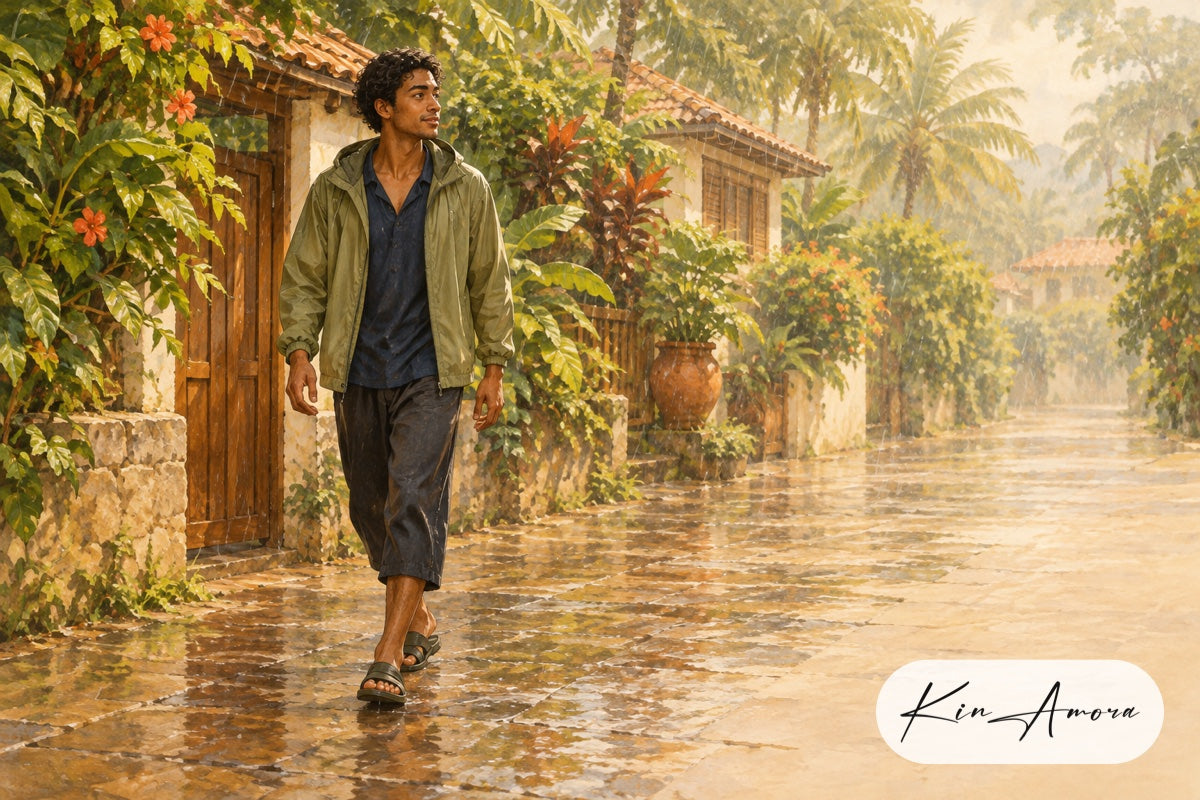
Wear quick-drying, lightweight fabrics, sandals that can get wet and a packable rain shell in hot, humid and rainy weather. Park noted that cotton absorbs moisture and gets heavy, which applies to rain as much as sweat. Choose light linen or chambray over denim, which Park says can trap heat.
A rain shell in a humid climate needs vents or an open front, so the wearer does not sweat inside it. Cropped pants or capris keep hems off wet pavement.
How is dressing for humid heat different from dry heat?
Dressing for humid heat differs from dry heat because sweat evaporates poorly in humid air and nights stay warm. Penn State's METEO 3 meteorology course notes that high dew points often keep nighttime lows in the 70s. Cancún averages a July low of 77.4°F (25.2°C) on Mexico's 1971 to 2000 normals, so a humid evening needs no warm layer.
Dry heat changes 2 things. Sweat dries fast, and the National Weather Service gives the example that 100°F air at 15% relative humidity has a heat index of 96°F. Desert nights drop much further, so dry-heat trips need a warm layer after dark. Humid trips need more spare tops instead, because a damp shirt stays damp.
How do humid-weather outfits suit different wearers?
Humid heat asks different things of travelers, commuters and men. The notes below give one practical angle for each.
For travelers. Pack one spare top per day in a humid climate, since sweat evaporates slowly in humid air. Dark or printed tops hide the day on a long transit.
For commuters. Wear a loose, absorbent top for the walk and keep a light layer at the desk for the air conditioning. A dark or printed shirt hides damp patches from the commute.
For men. Choose linen or cotton shirts in navy, olive or a print, loose chinos or drawstring pants, and a wicking undershirt. Heathered grey tees show sweat the most.
Is black good for hot and humid weather?
Yes, black is good for hot and humid weather for hiding sweat in the shade and after dark, and less good in direct sun. Black is a dark color that is not grey-based, so damp patches show less. Dark colors absorb more heat than pale ones in the sun, The Guardian's 2026 report notes, and they block more UV.
Fit narrows that gap. A 1980 study in Nature by Amiram Shkolnik, C. Richard Taylor, Virginia Finch and Arieh Borut found that a Bedouin in the hot desert gained the same amount of heat in a loose black robe as in a white one. The extra heat that the black robe absorbed was lost before it reached the skin. A loose black pant works better in humid heat than a tight black legging.
Hot and humid weather pants at Kin Amora, cotton-rayon cuts
Kin Amora's relaxed pants are cut from a 60% cotton, 40% rayon blend and handmade by local artisans in Morocco, with elastic waistbands, pockets and tailoring on request through the order notes. The blend's moisture regain of about 10.3% and the loose cuts suit humid days. The table lists 5 Kin Amora cuts that suit hot weather.
| Pant | Cut | Price | Sweat-hiding colors on the product page |
|---|---|---|---|
| Santorini Pant | Tapered leg | $120 | Black, Olive, Tobacco and 3 striped options |
| Gypsy Flare Pant | Wide leg | $120 | Black, Olive, Jade, Berry, Tobacco and stripes |
| Stella Wide Leg | Wide leg | $165 | Black, Cacao, Tobacco and Classic Striped |
| Marrakesh Harem Pant | Harem | $145 | Black, Berry and Classic Striped |
| Classic Capri | Capri, falls to the ankle | From $98 | Black |
Browse the relaxed cotton-rayon pants and pick a dark or striped color for humid commutes, or White and Sand for a full-sun day. Skip Charcoal and Silver when sweat marks matter, because grey-based colors show damp patches most. Kin Amora's cotton-rayon pants suit humid travel, city summers and warm evenings. The same pants do not suit a workout in humid heat, where a synthetic wicking fabric works better, or a buyer who needs a certified UPF garment, since the product pages list no UPF rating.