
So there's no named workshop door to open here. Kin Amora hasn't published one. What follows is every confirmed fact, with its source, and a clear list of what's still unknown.
Who makes Kin Amora clothing?
Local artisans in Morocco make Kin Amora clothing, and founder and CEO Alexandra Benaim runs the brand. She came into fashion through her father, who has worked in the industry for more than 30 years, according to her 2020 ShoutoutLA interview. In that interview she describes Kin Amora as a family brand.
The family link runs through the product range too. In a 2023 interview with CanvasRebel, she said that between them, she and her father carry dresses, pants, tops, jackets, bags, belts, shoes and jewelry.
Morocco makes clothing both in factories and by hand, and the label alone won't tell you which, so it helps to know how Moroccan artisan clothing differs from factory work.
What is confirmed about how Kin Amora clothing is made?
Kin Amora's product pages confirm what the pieces are made of, where, and by whom, and little else. Kin Amora pieces are made from a 60% cotton, 40% rayon blend and are handmade by local artisans in Morocco. Of the store's 130 catalog listings on October 13, 2026, 109 mention Morocco and 75 use the words "local artisans."

Rayon is a fiber regenerated from plant cellulose, usually wood pulp; it is soft and drapey but more heat-sensitive than cotton. That makes the cotton-rayon blend part plant fiber, part regenerated fiber, not an all-natural textile.
The cut is kept simple so one piece fits many people. Kin Amora's one-size pieces use relaxed cuts and elastic waists to fit a range of sizes, and many styles can have the waist tailored on request. Forty listings mention tailoring, and the usual instruction is to add your measurements in the order notes, so that adjustment happens after you order.
A few listings name hand finishing outright. The Positano Fringe Dress lists hand-knotted fringe, and the Velvet Outlaw Belt is described as hand-cut suede.
Who are the Kin Amora artisans?
Kin Amora identifies its artisans only as local artisans in Morocco; it hasn't published their names, how many there are, or which city they work in. Alexandra Benaim mentions them in her 2023 CanvasRebel interview, listing her father, her family and the artisans of Morocco as the people she does this work for.
In the same interview she ties the brand to the culture her family comes from. She says she spent much of her youth hiding from that culture, and Kin Amora became her way of showing it respect.
That's a thinner record than a page called "Inside the Workshop" might promise. A short list of true facts is more useful to you than a long list of guesses.
What hasn't Kin Amora published about its production?
Kin Amora hasn't published the city where its pieces are made, the number of artisans, the loom or weaving method behind its cloth, or the time each garment takes. The table below separates what the brand states from what it doesn't, so you can quote either side accurately.
| Question | Public answer | Source |
|---|---|---|
| Country where pieces are made | Morocco | Product pages |
| Who makes them | Local artisans | Product pages; CanvasRebel, 2023 |
| Made by hand | Yes, per the listings | Product pages |
| Fiber content | 60% cotton, 40% rayon on most clothing | Product pages |
| Hand-finished detail named | Hand-knotted fringe (Positano Fringe Dress) | Product page |
| Waist tailoring | On request, via order notes | Product pages |
| City or region | Not published | None |
| Workshop name | Not published | None |
| Number of artisans | Not published | None |
| Loom type or weaving method | Not published | None |
| Time to make one piece | Not published | None |
If one of the blank rows matters to your purchase, ask the brand before you buy. Treat any third-party site that fills those rows in as unsourced.
Who is Kin Amora founder Alexandra Benaim?
Alexandra Benaim is the founder and CEO of Kin Amora, a loungewear line she built after growing up around her father's fashion work. She told CanvasRebel in 2023 that she first sold at markets, where shoppers kept remarking on the fabric. In 2020 she told ShoutoutLA that wearing samples her father brought home pulled her into the business.
The fabric is the thread through both interviews. In 2020 she said she was, and still is, obsessed with it. Three years later, asked what makes the brand special, she told CanvasRebel: "It is the material we work with. It is subtle but unique." Her favorite part, she added, is the colors.
She also said the line was moving toward sets, such as tops paired with pants or dresses with belts.
How long does one piece take to make?
Kin Amora hasn't published how long one piece takes to make, and this page won't guess. Making time depends on the garment, the cut and any tailoring you request, and the brand hasn't released a figure for any garment. Ask Kin Amora directly if timing matters for a trip or a gift.
You may see hour counts for other Moroccan garments, such as a Fez drazza djellaba. Those figures describe other makers and other cloth, so don't apply them to Kin Amora.
How can you check a Kin Amora piece before you buy?
Read the closing lines of each listing, where Kin Amora usually puts fiber content, origin and fit notes, and use the measurements where they're given. The Island Pant listing, for example, gives a 24-inch (61 cm) inseam and a 33-inch (84 cm) length. Where a listing gives no measurements, ask for them before ordering.
Trust the listing line over any third-party story about the brand. If you want to feel the cloth the founder keeps coming back to, the Kin Amora best sellers are a sensible first look.
Shop Related Products
Explore the pieces, colours and sizing on the Kin Amora store.
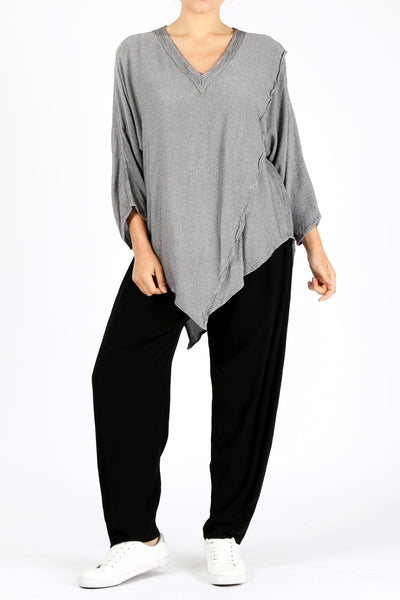
Milan Long Sleeve
$145.00 USD
View product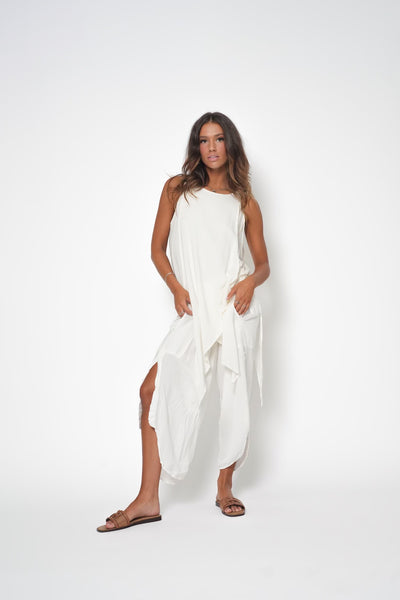
Monaco Tank
$145.00 USD
View product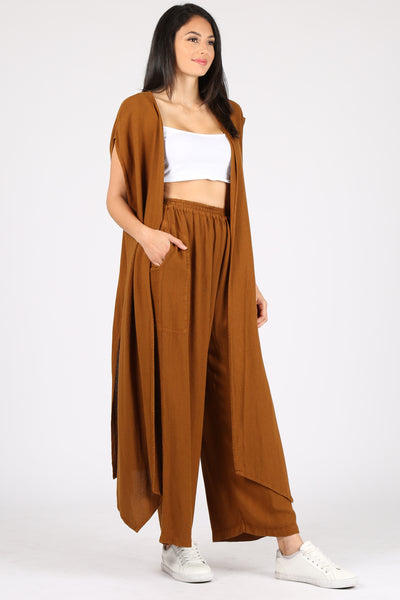
Gypsy Flare Pant
$120.00 USD
View productFrequently Asked Questions
Is Kin Amora's fabric woven by hand?
Kin Amora hasn't said. Its listings describe the pieces as handmade by local artisans in Morocco, but the brand hasn't published who weaves the cloth, on what equipment, or where.
Is every Kin Amora piece made from cotton-rayon?
No, though most clothing is. In the catalog, 104 listings state the 60/40 cotton-rayon content. Belts and bags use other materials, and a few clothing listings, such as the Positano Fringe Dress and the Amalfi Jacket, don't state fiber content at all.
Are Kin Amora's bags and belts made in Morocco too?
Some are, according to their listings. The Stone Fringe Leather Belt lists handmade leather from Morocco, the Athena Crossbody says handmade in Morocco, and the Jungle Shoulder Bag credits local artisans in Morocco. Other accessories, such as the Ojai Pink Belt, don't state an origin.
Can you get the waist adjusted on a Kin Amora one-size piece?
Yes, many Kin Amora one-size styles can have the waist adjusted on request, and the usual instruction is to add your measurements in the order notes. The adjustment happens after you order. Forty catalog listings mention the option, and the one-size pieces use relaxed cuts and elastic waists to fit a range of sizes.
Which Kin Amora pieces have hand-finished details?
Kin Amora listings that name hand finishing outright include the Positano Fringe Dress, which lists hand-knotted fringe, and the Velvet Outlaw Belt, described as hand-cut suede. Beyond those details, the listings describe the pieces as handmade by local artisans in Morocco. The brand hasn't published the city where its pieces are made or the number of artisans.