
What does artisan-made mean?
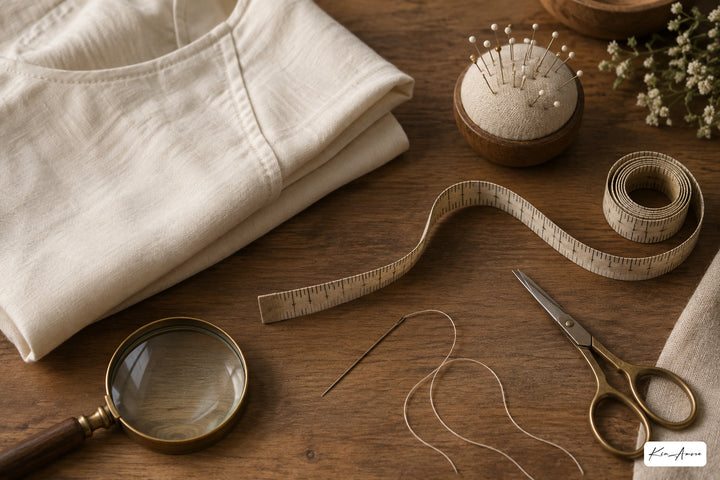
Artisan-made means the maker's own hands do most of the work in the finished piece, even when tools or machines help. That's the substance of UNESCO's 1997 definition of artisanal products, which allows hand tools and even mechanical means as long as the artisan's direct manual contribution remains the most important part of the product.

So a sewing machine doesn't disqualify a garment. A process where machines make the decisions and people only feed them does. The same UNESCO wording sets no limit on quantity, either, which means artisan-made doesn't automatically mean one of a kind.
If you'd like to examine a specific garment yourself, our guide to spotting handmade work walks through seams, hems and finishing.
Is Moroccan clothing handmade?
Some Moroccan clothing is handmade, but a large share isn't. Morocco runs a big factory garment industry. Eurostat figures reported by Hespress put Moroccan clothing sales to the European Union at €650.7 million for January to March 2025 alone, which ranked Morocco eighth among the EU's apparel suppliers.
The craft economy runs right alongside it. Handicrafts employ more than 2.7 million people, according to Lahcen Saadi, Morocco's Secretary of State for Handicrafts, speaking in parliament in June 2025, as reported by Hespress. The Maison de l'Artisan counts weaving, embroidery and traditional couture among the country's textile arts.
That's why "made in Morocco" on its own tells you a country, not a method. You need the seller to say how the piece was made.
What weaving heritage sits behind Moroccan artisan clothing?
Moroccan artisan clothing grows out of city weaving and embroidery traditions, with Fez, Rabat, Salé and Tetouan named by the Maison de l'Artisan as standout textile centers. In Fez, weavers still make drazza cloth for djellabas on traditional wooden looms, a craft Morocco World News Lifestyle described in 2025 as fighting to survive.
Drazza is slow, shared work. That same report says most pieces need two or more artisans, and the work runs from preparing threads of equal length to stitching the finished garment. We cover the looms, the cities and the history in our guide to weaving in Fez.
What are the traditional Moroccan garments called?
The names you'll meet most are the djellaba, the kaftan, the gandora and the sarouel. The djellaba is a long hooded robe worn by both men and women, and the sarouel is a roomy trouser. The Maison de l'Artisan also lists the takchita and the jabador under traditional couture, the branch of Moroccan craft devoted to ceremonial and everyday dress.
Finishing is where the handwork shows. On caftans, Morocco World News points to hand-stitched buttons and braided trims in the styles called sfifa and aqad. Our Moroccan clothing glossary explains each name, including how a kaftan differs from a djellaba.
Where is Kin Amora made?
Kin Amora is made in Morocco, by local artisans. The brand's Our Story page says its focus on fabric quality led it to "a remarkable fabric from Morocco," and the product pages credit the making to local Moroccan artisans. The site doesn't name a city or a workshop, so this answer stops at Morocco, though the founder has described how Kin Amora is made in more detail.
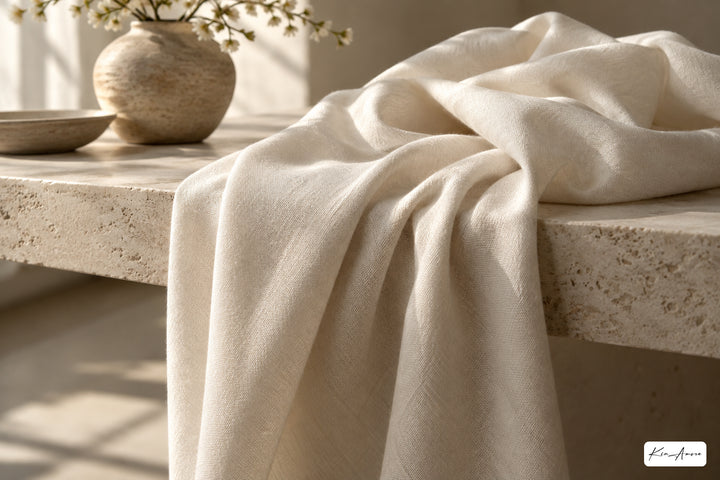
As for the cloth, Kin Amora pieces are made from a 60% cotton, 40% rayon blend and are handmade by local artisans in Morocco. Rayon is a fiber regenerated from plant cellulose, usually wood pulp; it is soft and drapey but more heat-sensitive than cotton. It starts as a plant, then goes through a chemical process, so it isn't a natural fiber in the strict sense, and we'd rather you hear that from us.
What is Moroccan made loungewear?
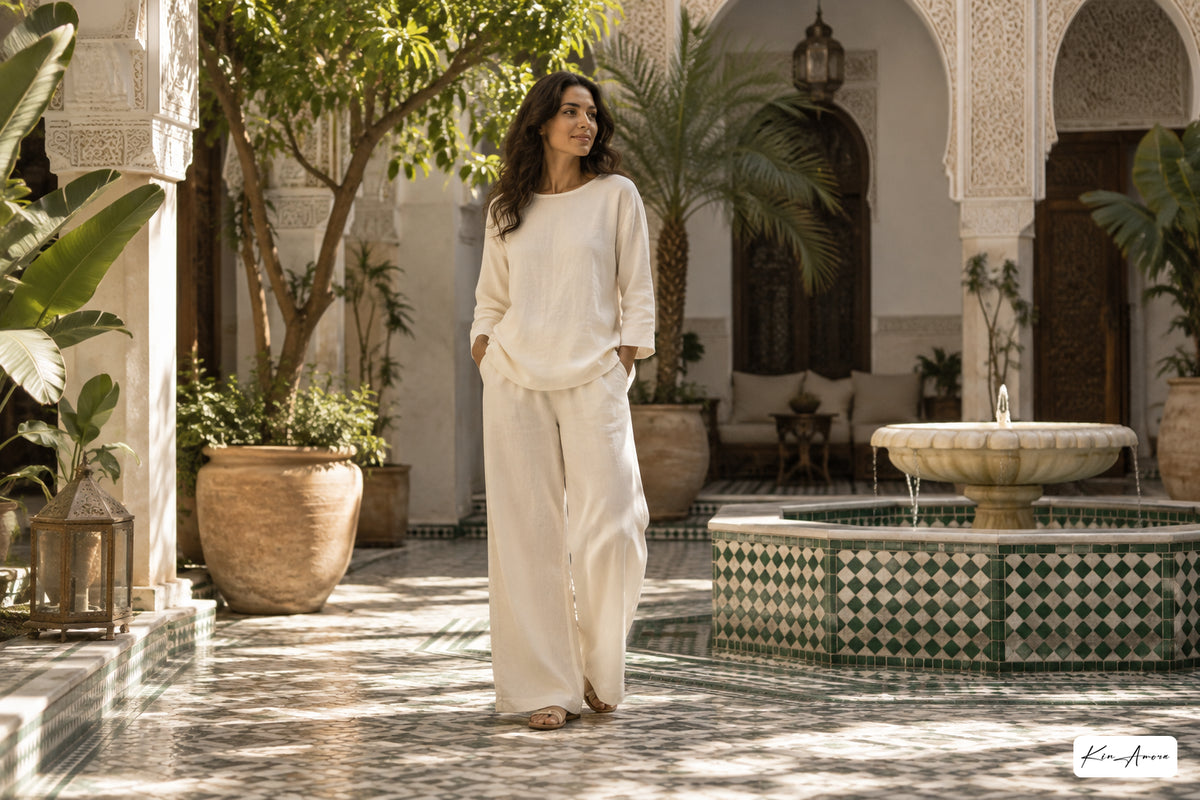
Moroccan made loungewear is relaxed clothing for home, travel and rest that's cut and sewn in Morocco. The better pieces use soft, light cloth and loose, unstructured shapes closer to everyday Moroccan dress than to gym clothes, so the same outfit can work on the couch, on a long flight and at a café.

Kin Amora designs for traveling, meditating, lounging or exploring, in the words of its Our Story page. Most single pieces cost $98 to $165, most sets run $145 to $310, and US orders of $150 or more ship free.
The trade-off with loose cuts is that they forgive fit but can also hide thin, flimsy fabric. Weight and drape matter more in a relaxed piece than in a tailored one.
What should a seller tell you before you buy Moroccan artisan clothing?
A seller should tell you the country of origin, the fiber content and who made the piece. US law covers the first two, and it also requires the name or registered number (RN) of the company responsible, which can be an importer or retailer rather than the maker. Under the Textile Fiber Products Identification Act, the Federal Trade Commission says labels must list fiber content and country of origin, and online listings must state whether an item is made in the USA, imported or both.
Naming the people who actually made the piece is voluntary, which is exactly why it's the one to look for. A line that names the makers, even simply as local artisans, is a claim a seller chose to put in writing. A listing that says only "Moroccan style" or "boho," with no origin line, is describing a look, not a craft.
Care instructions and fit details, such as whether the waist can be tailored, are the next things worth finding before you check out.
The one thing to check
Look for two statements in writing: where a piece was made and whose hands made it. "Moroccan" covers the first, "artisan-made" covers the second, and a good seller gives you both plus the fiber percentages. When you've found that, you can shop artisan-made Moroccan loungewear knowing what you're paying for.
Shop Related Products
Explore the pieces, colours and sizing on the Kin Amora store.
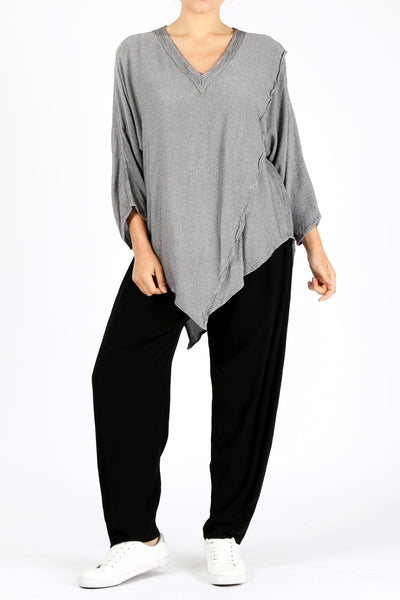
Milan Long Sleeve
$145.00 USD
View product
Island Pants
$143.00 USD
View product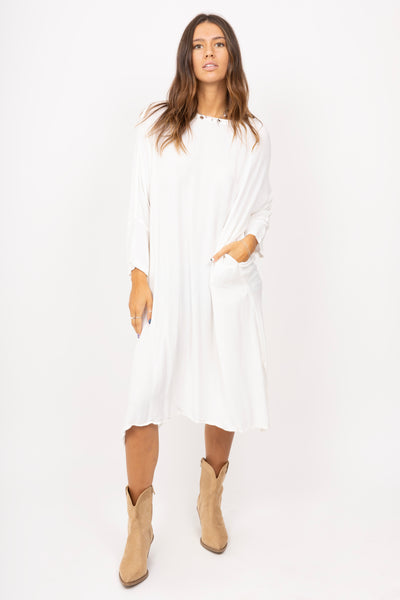
Goddess Gown
$145.00 USD
View productFrequently Asked Questions
How long does it take to make a handmade djellaba?
A handmade djellaba can take four hours or more, according to a 2025 Morocco World News Lifestyle report from Fez. Roughly half that time goes on spinning and weaving and half on sewing and finishing.
Is the Moroccan caftan recognized by UNESCO?
Yes. In December 2025, UNESCO's Intergovernmental Committee for the Safeguarding of the Intangible Cultural Heritage, at its 20th session in New Delhi, inscribed "Moroccan Caftan: Arts, Traditions and Know-How" on the Representative List of the Intangible Cultural Heritage of Humanity.
Do Kin Amora's one-size pieces fit everyone?
They fit a broad range rather than everyone. Kin Amora's one-size pieces use relaxed cuts and elastic waists to fit a range of sizes, and many styles can have the waist tailored on request. Add your measurements in the order notes to ask for it; some styles also come in Plus.
Does artisan-made Moroccan clothing have to be one of a kind?
No, artisan-made Moroccan clothing doesn't have to be one of a kind, because UNESCO's 1997 definition of artisanal products sets no limit on quantity. The same definition permits hand tools and mechanical means, as long as the artisan's direct manual contribution remains the most important part of the product. So a sewing machine doesn't disqualify a garment, but a process where machines make the decisions does.
Does a US label on Moroccan artisan clothing have to name who made it?
No, a US clothing label doesn't have to name the people who made the piece, because naming the makers is voluntary. US law requires labels to show fiber content, country of origin and the name or registered number (RN) of the company responsible, which can be an importer or retailer. A line naming the makers, such as local artisans, is a claim the seller chose to put in writing.