
What is a caftan dress?
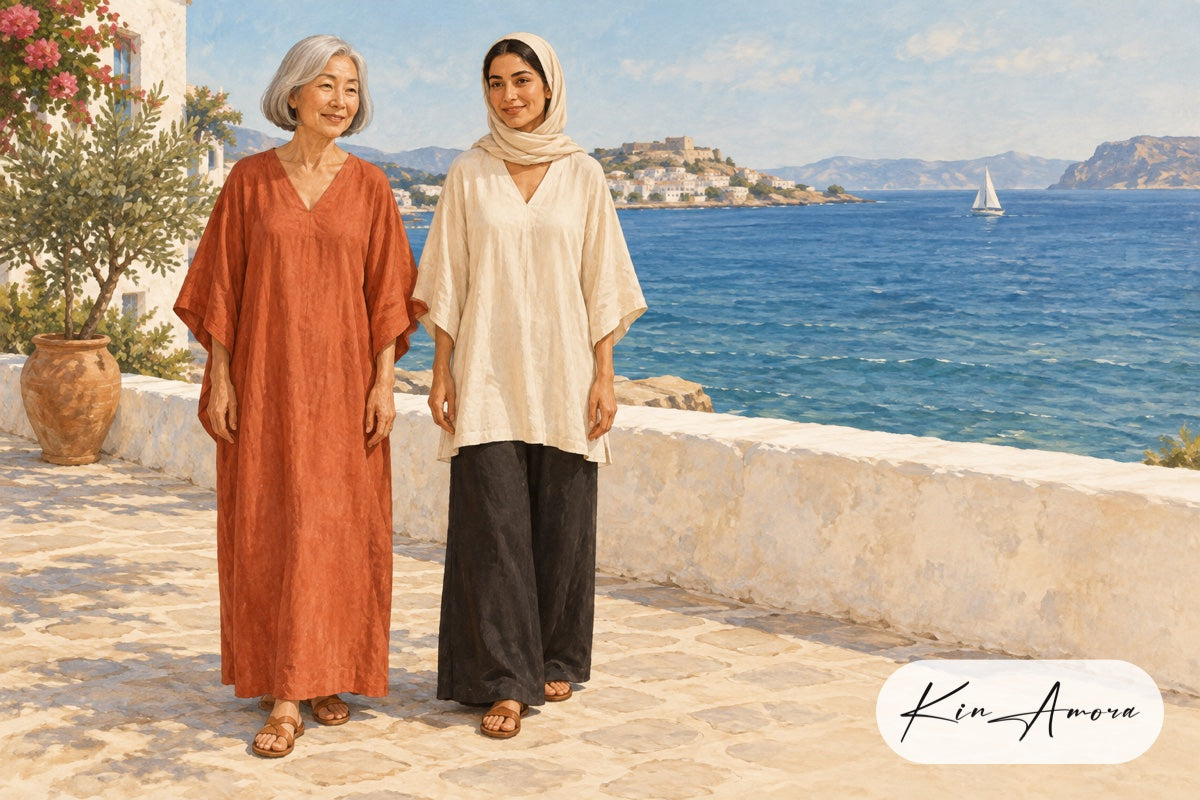
A caftan dress is a loose dress whose body and sleeves hang straight from the shoulders, with no fitted waist and no zip. The caftan dress pulls on over the head through a slit, V or keyhole neckline. The sleeves of a caftan dress are wide and usually cut in one piece with the body, so the arms and torso share one flowing shape.
The caftan dress is the modern, dress-length form of the kaftan, a robe worn across West Asia and North Africa. Caftan and kaftan are 2 spellings of one word, and both name the same garment. Shops sell the caftan dress as resortwear, loungewear and, in silk or with embroidery, eveningwear.
What does a caftan dress look like?
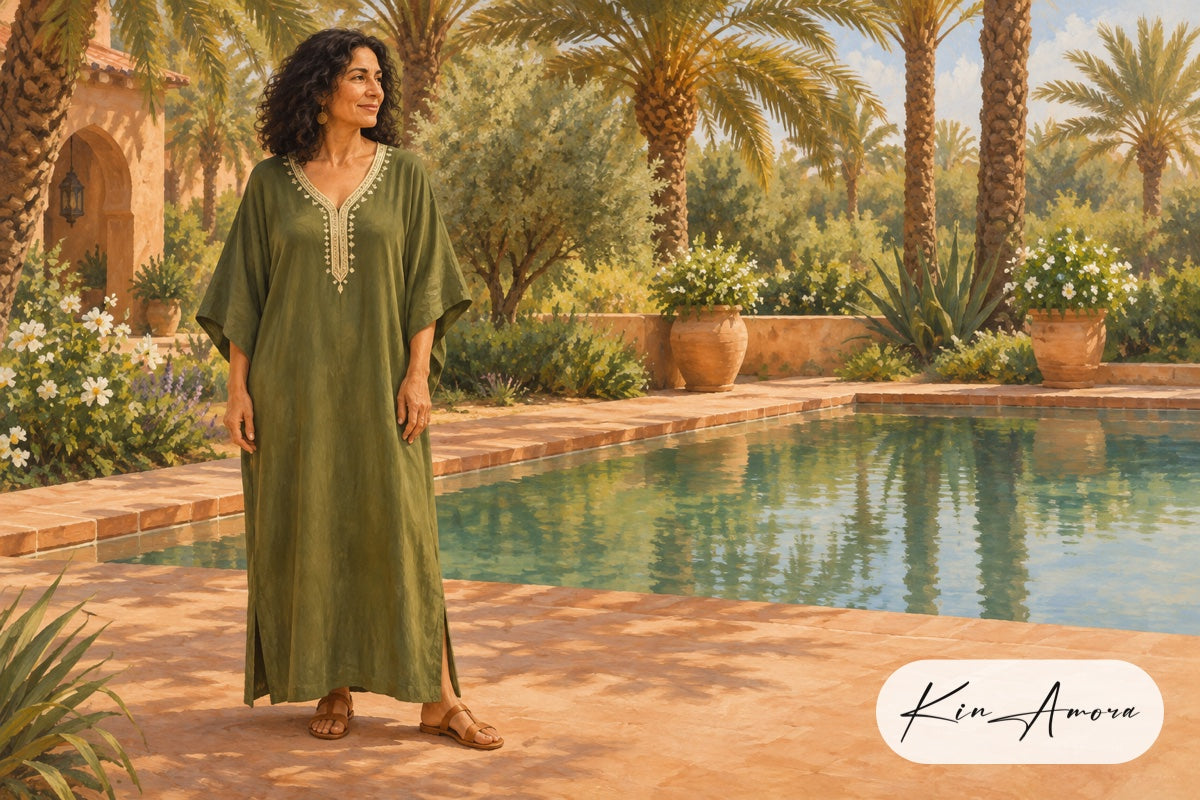
A caftan dress looks like a wide rectangle of cloth with an opening for the head, falling from the shoulders to the knee, calf or ankle. Caftan dresses share 5 visible features.
- Straight, unfitted body: the side seams run from the underarm to the hem without shaping.
- Wide sleeves: batwing, bell or kimono-style sleeves cut in one with the bodice.
- Open neckline: a V, a keyhole, a slit or a round neck with a tie.
- No waist seam: any waist comes from a drawstring, an inner tie or a belt.
- Trim at the edges: embroidery, braid or beading at the neckline, cuffs or hem.
Side slits are common on longer caftan dresses. Slits of a few inches let the wearer stride and climb steps without lifting the hem.
What is a caftan dress used for?
A caftan dress is used for warm-weather days when comfort and coverage matter more than a fitted line. Caftan dresses cover 6 common uses.
- Lounging at home, where the loose body feels like a robe but looks dressed.
- Beach and pool cover-up, where a short or sheer caftan slips over a swimsuit.
- Resort dinners, where a long caftan in silk or with embroidery reads as evening wear.
- Hosting at home, where the dress moves easily through cooking and serving.
- Travel days, where a pull-on dress clears airport security without belts or zips.
- Hot-weather events, such as garden parties and beach weddings.
How does a caftan dress differ from a kaftan top?
A caftan dress differs from a kaftan top in length and in how it is worn. A caftan dress reaches the knee, the calf or the ankle and is worn alone. A kaftan top stops at the hip or the upper thigh and is worn over pants, shorts or a swimsuit. The cut, the sleeves and the neckline stay the same.
| Attribute | Caftan dress | Kaftan top |
|---|---|---|
| Length | Knee, midi or ankle | Hip to upper thigh |
| Worn with | Alone, with sandals | Wide-leg pants, harem pants, shorts or a swimsuit |
| Role in the outfit | The whole outfit | The top half of an outfit |
| Sleeves | Wide, cut in one with the body | Wide, cut in one with the body |
| Neckline | V, keyhole, slit or tie neck | V, keyhole, slit or tie neck |
| Common fabrics | Cotton, rayon, linen, silk, chiffon | Cotton, rayon, linen, gauze |
The spelling does not decide the garment, because shops use both spellings for both lengths. Read the listed length, not the name, and compare it with your own shoulder-to-knee measurement. A piece that stops above your knee works better as a kaftan top over pants than as a dress. Length decides the role, and wearing a kaftan as a dress works once the hem reaches at least the knee and the cloth is opaque.
Where does the caftan dress come from?
The caftan dress comes from the kaftan, which Encyclopaedia Britannica describes as a full-length garment of ancient Mesopotamian origin worn throughout the Middle East. Christian Dior and Cristóbal Balenciaga had added kaftan-like styles to their collections by the 1950s and 1960s, and young travelers returning from the hippie trail brought more traditional kaftans to the United States and Europe in the late 1960s and 1970s, according to Nico Frederick's 2022 entry in the Fashion Institute of Technology's Fashion History Timeline. In Morocco, the kaftan remains a hoodless robe that opens down the center with buttons and is kept for weddings and festivals, and UNESCO added the Moroccan caftan to its intangible heritage list in 2025. The ceremonial Moroccan robe and its neighbors are covered in the guide to the Moroccan kaftan and djellaba, while this page stays with the everyday caftan dress.
What are the types of caftan dresses?
Caftan dresses come in 7 common types, such as the maxi caftan, the short cover-up caftan and the belted caftan. Each type changes one attribute of the basic caftan, such as length, waist or finish.
- Maxi caftan: an ankle- or floor-length caftan dress for evenings and resort dinners.
- Midi caftan: a calf-length caftan dress for daytime and travel.
- Short caftan: a knee-length or shorter caftan worn as a beach cover-up.
- Drawstring caftan: a caftan dress with an inner tie that gathers the waist on demand.
- Embroidered caftan: a caftan dress with handwork at the neckline, cuffs or hem.
- Silk evening caftan: a caftan dress in silk, satin or chiffon, often with beading.
- Open-front caftan: a caftan that buttons or ties down the front, closer to the Moroccan robe.
The maxi caftan is the most common type sold as a caftan dress. The drawstring caftan suits wearers who want a waist some days and a loose line on others.
What is the best fabric for a caftan dress?
The best fabric for a caftan dress is a light, drapey woven such as cotton voile, rayon, linen or a cotton-rayon blend. A caftan dress has no shaping seams, so the fabric decides whether the width falls in soft folds or stands out like a tent.
| Fabric | Drape | Breathability | Best caftan use |
|---|---|---|---|
| Cotton voile or gauze | Soft, light | High | Beach cover-ups, hot days |
| Rayon (viscose) | Fluid, swingy | High | Day and resort caftans |
| Cotton-rayon blend | Soft with some body | High | Everyday caftans and travel |
| Linen | Crisp, airy | Very high | Hot, dry climates |
| Silk | Smooth, light sheen | High | Evening and wedding-guest caftans |
| Polyester chiffon | Floaty, sheer | Low | Evening caftans over a slip |
| Jersey knit | Clingy, stretchy | Medium | Lounging and sleep |
Rayon is a fiber regenerated from plant cellulose, usually wood pulp, and it gives a caftan dress its swing. A 60% cotton, 40% rayon blend keeps most of that drape and adds cotton's body, so a wide caftan hangs straight instead of clinging. Sheer voile and chiffon need a slip underneath for daytime wear away from the beach.
How should a caftan dress fit?
A caftan dress should fit at the shoulders and the length, because the body is meant to stay loose. Check 4 fit points before you buy.
- Shoulders: the shoulder line should sit on your shoulders, not slide toward the elbow.
- Neckline: the V or slit should stay in place when you lean forward.
- Sleeve opening: the sleeve should let you raise your arm to shoulder height without the side seam lifting the hem.
- Length: the hem should clear the floor in the shoes you plan to wear.
One-size caftan dresses fit a wide range of bodies, because width is built into the cut. Length is the measure to compare. Measure from the high point of your shoulder to your ankle bone, then compare that number with the listed length of the dress.
How do you wear a caftan dress?
To wear a caftan dress, pick the waist treatment first, then match the shoes and layers to the setting, in 5 steps.
- Decide on the waist, leaving the caftan loose for the beach and belting it for dinner.
- Choose flat sandals, slides or espadrilles for day, and heeled sandals for evening.
- Add a slip or a swimsuit under sheer voile or chiffon.
- Layer a cropped denim jacket or a light cardigan on cool evenings, keeping the layer shorter than the sleeves.
- Finish with one jewelry focus, such as hoop earrings or stacked bangles.
The belt changes the caftan dress most. A thin leather belt or a tie at the natural waist pulls the width in and shows the waist, while a loose caftan reads as a relaxed beach or home look.
How does a kaftan dress differ from a maxi dress?
A kaftan dress differs from a maxi dress in that kaftan names a cut, while maxi names a length. A kaftan dress is defined by its straight body and wide sleeves at any length. A maxi dress is defined by a hem at the ankle or the floor in any cut. An ankle-length kaftan dress is both a kaftan and a maxi.
| Attribute | Kaftan dress | Maxi dress |
|---|---|---|
| Defined by | Cut (straight body, wide sleeves) | Length (ankle or floor hem) |
| Length | Knee, midi or ankle | Ankle or floor only |
| Waist | None, or a tie or belt | Any, from fitted to empire |
| Sleeves | Wide, cut in one with the body | Any, including sleeveless |
| Closure | Pull-on | Pull-on, zip, buttons or wrap |
Choose a kaftan dress when you want the widest, airiest fit and sleeves that cover the arms. Choose a fitted maxi dress when you want a defined waist or a sleeveless line.
Is a caftan dress a boho dress?
Yes, a caftan dress counts as a boho dress when it is cut in a natural fabric and carries handwork such as embroidery or tassels. The kaftan entered bohemian dressing in the late 1960s, and the loose caftan dress remains one of the 8 common boho dress types. A plain polyester caftan without trim reads as a cover-up rather than boho. The full test for what makes a dress boho sorts the cut, fabric, detail and color traits.
Can you wear a caftan dress to a wedding?
Yes, you can wear a caftan dress to a wedding when the fabric and the length match the dress code. A floor-length caftan in silk or with beading suits an evening or cocktail wedding. A cotton or rayon caftan suits a beach or garden wedding. Guests should avoid white and ivory caftans, which can read as bridal.
How does a caftan dress suit different wearers?
A caftan dress suits most bodies once the length and the shoulder line are right. The notes below give one practical angle for each kind of wearer.
For petite wearers. Choose a midi or ankle-length caftan dress with a V-neck and a drawstring or belt at the natural waist. Very wide batwing sleeves and a floor-length hem can swamp a short frame, so measure the listed length against your shoulder-to-ankle number.
For men. Men wear the same cut as a long, loose tunic, usually sold as a men's kaftan, in cotton or linen. A solid caftan in white, sand or black with slides reads as resort and home wear.
For travelers. A caftan dress packs flat, pulls on without fastenings, and covers the shoulders and arms in destinations that expect modest dress. A cotton-rayon or linen caftan breathes in heat and hides small creases.
Long, loose dresses at Kin Amora, the gowns collection
Kin Amora's gowns collection holds long, relaxed dresses that give the ease of a caftan dress through different cuts. None of these dresses is a caftan. The Goddess Gown and the Mojave Dress are both full-length and cut from 60% cotton, 40% rayon, handmade in Morocco.
- The Goddess Gown ($145) is Kin Amora's long dress, with full-length sleeves and pockets at hip level, in One Size Fits Many up to size 10, in Black, White, Olive, Miami Mango or Royal Blue. Tailoring is available on request in the order notes.
- The Mojave Dress ($165) is a full-length dress with a cold-shoulder shape, short sleeves and pockets, in One Size Fits Most with a Plus size, in 10 colors.
- The Goddess Wrap Dress ($175) is a billowing, open wrap dress that can be worn a few different ways, in White, Berry or Black.
Kin Amora's gowns suit readers who want a long, easy dress with pockets and a softer line than a fitted maxi. The gowns do not suit readers who want true batwing sleeves cut in one with the body, or a sheer silk evening caftan. Compare every cut and color in Kin Amora's handmade cotton-rayon gowns.