
How do you tie a Moroccan scarf?
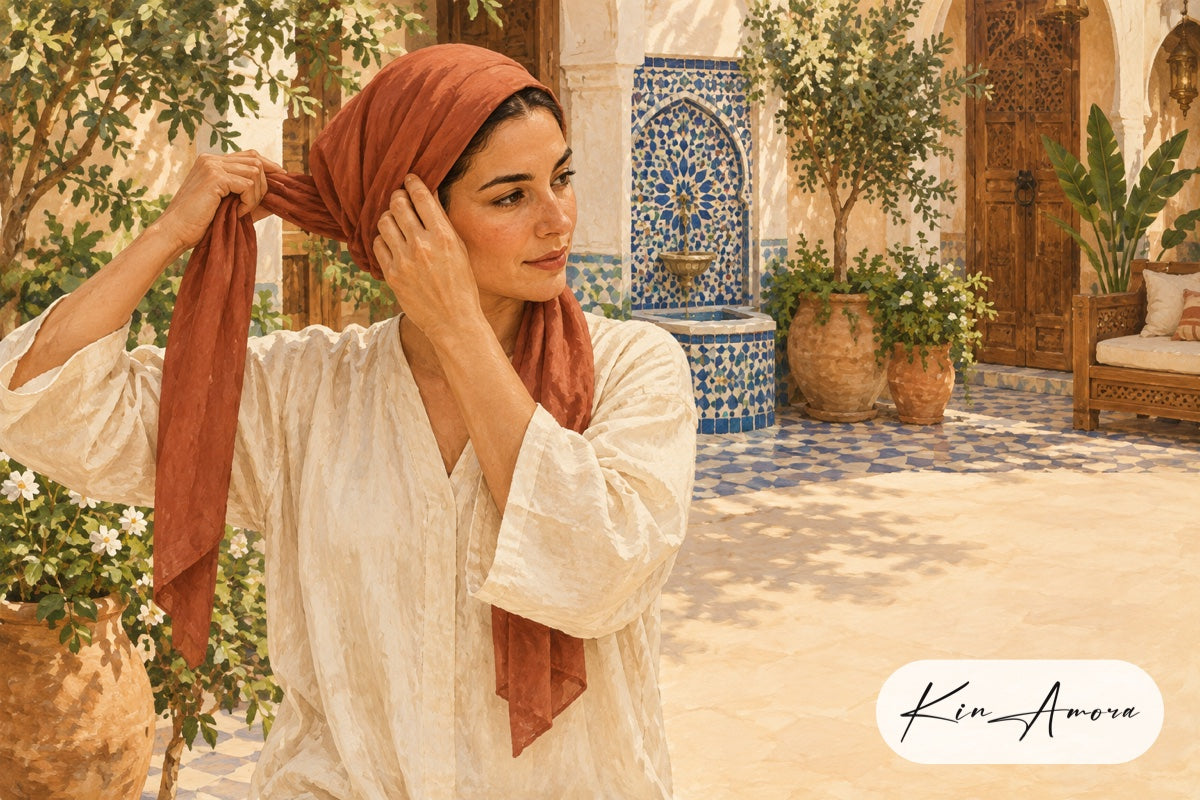
To tie a Moroccan scarf as a wrapped headscarf, fold it lengthwise, frame the face with the folded edge, wrap the long end around the head and pin it at the side, in 6 steps. The wrapped headscarf covers the hair and the neck.
- Fold the scarf in half lengthwise, so the folded edge will frame the face.
- Place the folded edge across the forehead at the hairline, with one end hanging longer than the other.
- Pin the 2 sides together under the chin.
- Wrap the long end around the back of the head and bring it forward over the opposite shoulder.
- Pin the long end at the side of the head, just above the ear.
- Drape the remaining end over the shoulder and chest, or tuck it into the wrap.
A matte cotton scarf grips the hair better than silk, so it needs fewer pins. Older city styles show how far the same scarf can go.
How have Moroccan city women tied scarves?
Moroccan city women have tied scarves in styles that changed by town and by era, and written records describe Tetouan and Rabat in the most detail. Tetouan's old headpieces largely disappeared by the mid-20th century, sometimes replaced by a thin silk scarf called a hina, fastened with pins, Yabiladi reported in March 2026. Rabat brides once layered a long red silk veil called the cherbiya, a white cotton scarf called the ched el biad and a thick brocade piece called the abrouq, which together formed the base for velvet bands. Published accounts of Fez dress focus on its brocade and caftans rather than on one scarf tie.
The north has its own pairing. Women in the Jbala region wear the wide straw chachiya jeblia with the well-known scarf of the north, according to a July 2026 Le360 report.
What are the different ways to tie a Moroccan scarf?
A Moroccan scarf ties in 5 common ways, each suited to a different setting. The table compares them by how the scarf sits, the best cloth and when each tie works.
| Tie | How it sits | Best scarf | When to wear it |
|---|---|---|---|
| Wrapped headscarf | Covers the hair and neck, pinned at the side | Matte cotton or a cotton blend | Daily wear |
| Loose drape | Rests over the hair, ends over the shoulders | Light cotton or silk | Visits and mosque visits |
| Pinned silk scarf | Thin silk tied over the hair and fixed with pins | Thin silk | Dressier occasions, after the Tetouan style |
| Turban wrap | Wrapped around the head with the hair tucked in, neck bare | Long cotton | Sun and warm days |
| Desert wrap | Around the head and loosely across the mouth and nose | Long cotton | Sun, wind and sand |
The wrapped headscarf and the loose drape cover the hair. The turban and the desert wrap shade the head, and the desert wrap adds cover for the face.
How do you tie a turban wrap?
To tie a turban wrap, center the scarf at the nape, cross the ends at the forehead and tuck them at the back, in 4 steps.
- Place the middle of the folded scarf at the nape of the neck.
- Bring both ends up over the ears and cross them at the forehead.
- Take the ends back around the head and twist them once at the nape.
- Tuck both ends under the wrapped layers.
A twist at the forehead in step 2 gives a raised knot at the front.
How do you tie a Moroccan head scarf for men?
To tie a Moroccan head scarf for men, wrap a long cotton scarf around the head, then pass the end loosely across the mouth and nose, in 5 steps. The wrap shades the head and face from sun and blowing sand.
- Hold one end against the side of the head, letting about 12 inches (30 cm) hang to the shoulder.
- Wrap the long end around the forehead and the back of the head 2 or 3 times.
- Bring the long end down under the chin and up across the mouth and nose.
- Tuck the end into the wraps at the side of the head.
- Pull the face layer down to the chin when you don't need it.
A white or plain indigo cotton scarf suits this wrap best.
Which scarf works best for Moroccan ties?
A cotton scarf works best for most Moroccan ties, because cotton grips, absorbs sweat and stays cool. University of Georgia Extension lists cotton as absorbent, cool and comfortable to wear. Silk is absorbent and moderately wrinkle resistant, but it slides on the hair, which is why the Tetouan hina was held with pins.
Shop with care in the souks. Many colorful patterned scarves sold in Marrakech are imported from India, and the Berber scarves sold there tend to be plain, indigo-dyed cotton, according to a 2019 Lonely Planet guide. Wash an indigo scarf alone at first. Indigo melhfas have lost ground in the Saharan south because the dye marks walls and other surfaces, sellers told Le360 in March 2026.
Do Moroccan women have to cover their hair?
No, Moroccan women do not have to cover their hair, because Moroccan law neither requires nor forbids the headscarf. Each woman decides. The headscarf was more popular with older women in Rabat than with younger women, according to a 2006 BBC News report. Religion leads the reasons for wearing it, with 62.5% of 1,320 young Moroccans calling the veil a matter of the Muslim religion in a 2021 survey by Menassat for Social Research and Studies, as reported by Bladi. Djellabas, regional wraps and head coverings by age and city are covered in what Moroccan ladies wear today.
What do Moroccan men wear with a head wrap?
Moroccan men wear a head wrap with long, loose garments such as the djellaba, the gandora or the Saharan deraa. Moroccan men's clothing rests on 5 traditional pieces.
- The djellaba, a long, loose robe with full sleeves and a pointed hood.
- The gandora, a lighter tunic in the djellaba's shape but without the hood.
- The jabador, a tunic with matching trousers for Eid and family celebrations.
- The deraa, a wide, square-cut robe of the Saharan south, usually blue or white.
- The sarouel, full, loose trousers drawn in at the waist.
Western trousers, shirts and sneakers fill most days, and these pieces come out for prayers, holidays and the desert.
What is a Moroccan thobe?
A Moroccan thobe is a shop name for a long men's tunic, and the Moroccan garments closest to it are the gandora and the djellaba. The gandora has no hood, and the djellaba has one. Style either one over loose trousers with flat leather slippers, in plain white, brown, grey or black, the colors closest to Moroccan men's own choices.
How do you keep a Moroccan scarf from slipping?
You keep a Moroccan scarf from slipping with pins, a cotton under-layer and a matte fabric. Pins hold silk, as the Tetouan hina shows. A close cotton under-scarf gives the outer scarf something to grip, much as Rabat's bridal headdress built on a white cotton scarf.
Can a Moroccan scarf double as a sash?
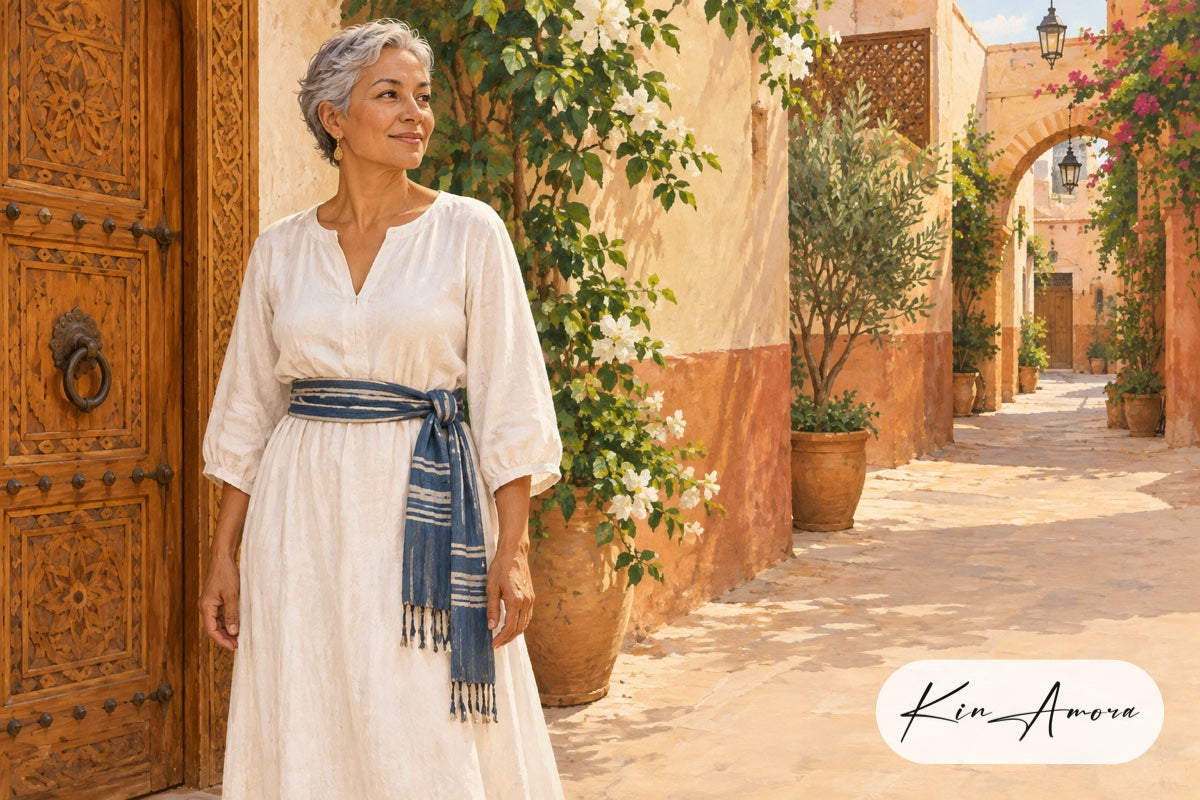
Yes, a Moroccan scarf can double as a sash, and the English word sash comes from the Arabic shāsh, meaning muslin, according to Merriam-Webster. Moroccan kaftans are typically worn with fabric belts, according to the Metropolitan Museum of Art, and the old Tetouan kaftan took a long belt tied at the waist. Fold the scarf into a band about 3 inches (7.5 cm) wide, wrap it at the waist and finish with a flat square knot. The full method for tying a sash belt covers knots, lengths and slipping.
How should different wearers tie a Moroccan scarf?
The notes below give one practical angle for each kind of wearer.
For travelers. Women visiting Morocco don't need to cover their hair, but a light scarf weighs nothing and covers the hair for a mosque visit. A loose drape is enough for most visits.
For men. A long white or indigo cotton scarf tied as a desert wrap handles sun and sand on a desert trip, and it folds into a neck wrap in town.
Moroccan scarf ties with Kin Amora's Puglia Scarf
The Puglia Scarf ($65) is Kin Amora's fringe scarf for wraps, headpieces or traditional wear, cut from 60% cotton, 40% rayon. It comes in Black, Classic Striped, Silver or White, and Kin Amora designs it for multifunctional use. The product page gives no length, so ask Kin Amora before ordering when you plan a full desert wrap.
The Puglia Scarf suits anyone who wants a cotton-rich scarf that grips for a wrapped headscarf, a turban or a sash, with fringe that moves when the ends hang loose. It doesn't suit anyone who needs a thin silk scarf for a pinned Tetouan-style tie, or a scarf of a known length. Choose a color of the Puglia Scarf in four colors and try the 6-step headscarf first.