
What is a poncho top?
A poncho top is a loose top made from a wide panel of fabric with a central head opening, worn as a shirt or a light layer rather than as rain gear. The poncho top drapes from the shoulders over the upper arms, so the cloth itself forms the sleeves. The defining attribute of a poncho top is that drape, because no armhole seam limits where the fabric falls.
Poncho tops share 4 traits, such as the head opening, the shoulder drape and the open or partly closed sides.
- A head opening sits in the middle of the panel and is finished as a boat neck, a V-neck, a cowl or an off-the-shoulder edge.
- A shoulder drape replaces the sleeve, so the fabric covers the upper arm and falls loose from the elbow.
- Sides stay open, are stitched partly closed to leave arm holes, or are sewn into full sleeves.
- A hem runs from a cropped hip length to mid-thigh, cut straight, rounded or in points at the front and back.
Fringe, tassels and embroidered borders are common trims on the hem.
Where does the poncho top come from?
The poncho top comes from the poncho of the Americas, a woven wool outer garment worn by pre-Hispanic peoples of the Andes and other regions. The word poncho is traced to Quechua punchu and Mapudungun pontro, both meaning roughly "blanket" or "woolen fabric."
Fashion designers took up the poncho in the late 1960s and early 1970s. The FIDM Museum at Arizona State University holds a Roberto Cavalli poncho from about 1970, made of loosely woven cotton with appliquéd patches of printed and painted leather. According to the museum, Cavalli's work matched the decorative "rich-hippie" style of that period. The modern poncho top keeps the flat panel and head opening in lighter, shorter form.
How does a poncho top differ from a rain poncho?
A poncho top differs from a rain poncho in purpose and fabric, with the poncho top made of breathable cloth for an outfit and the rain poncho made of watertight material for weather. Both garments share the flat panel and the head opening. A rain poncho adds a hood, side fasteners and arm openings so the shell stays closed in wind and rain.
The US military adopted rubberized rain ponchos during the Civil War (1861 to 1865), and soldiers could spread them on the ground as ground sheets. Lightweight nylon ponchos followed in the 1950s.
The table below compares the two garments on 9 attributes.
| Attribute | Poncho top | Rain poncho |
|---|---|---|
| Purpose | Part of an outfit, worn as a top or light layer | Weather protection worn over clothes |
| Fabric | Breathable cotton, rayon, linen, chiffon, knit or crochet | Watertight nylon, vinyl, polyester or rubberized canvas |
| Water resistance | None | Waterproof or water-resistant |
| Hood | Rare | Common |
| Sides | Open, with arm holes or with sleeves | Snaps or fasteners with arm openings |
| Size | Cut to drape over the body | Cut oversized to cover a coat or backpack |
| Length | Hip to mid-thigh | Hip to knee or longer |
| Where worn | Beach, travel, dinner, everyday | Hiking, festivals, theme parks, rainy commutes |
| Care | Cold, gentle wash and flat dry | Wipe clean and air dry |
The two garments do not swap, because a poncho top soaks through in a downpour and a rain poncho traps heat at a beach dinner. Fit comes next.
How should a poncho top fit?
A poncho top should fit flat at the neckline and loose everywhere else, with the hem between the hip and mid-thigh. The neckline should sit on the collarbone or the edge of the shoulder without sliding off unless the style is cut off-the-shoulder. The front and back panels should hang straight, with no pulling across the upper back when you reach forward.
Length decides most of the fit. A cropped poncho top that ends at the high hip suits high-rise bottoms. A mid-thigh poncho top covers the hips and works over leggings, slim pants and swimwear. A one-size poncho top fits a wide range of bodies because the panel drapes instead of fitting at the bust or waist.
What is a poncho with sleeves called?
A poncho with sleeves is usually sold as a sleeved poncho or a poncho sweater. The cut sits close to a batwing or dolman top, where a deep, wide sleeve joins a loose body. Sleeves add warmth but turn the free-falling poncho shape into something closer to an oversized sweater.
What is a poncho with arm holes?
A poncho with arm holes is a poncho whose sides are stitched partly closed, leaving an opening for each arm. The arm holes hold the front panel in place, so the poncho stays put when you carry a bag, drive or eat. Arm holes suit busy days, while a fully open poncho drapes more freely and suits standing, walking and posing for photos.
What fabrics are poncho tops made of?
Poncho tops are made of light wovens for warm weather and knits or crochet for cool weather. Woven poncho tops use cotton, rayon, linen, cotton gauze, chiffon or blends such as 60% cotton, 40% rayon. Knit poncho tops use wool, cashmere, cotton or acrylic yarn, and crochet versions use cotton or wool.
The table below compares 6 common poncho top fabrics.
| Fabric | Feel and drape | Warmth | Best season |
|---|---|---|---|
| 60/40 cotton-rayon | Soft, fluid, falls close to the body | Light | Spring, summer and travel |
| Cotton gauze | Airy, crinkled, floats away from the body | Light | Summer and beach days |
| Chiffon or sheer polyester | Sheer and floaty, needs a layer underneath | Light | Beach cover-ups and evenings |
| Crochet cotton | Open and textured, shows the layer beneath | Light to medium | Summer evenings and festivals |
| Knit wool or cashmere | Soft, warm, holds its shape | Warm | Fall and winter |
| Chunky acrylic knit | Heavy, stands away from the body | Warm | Winter |
Rayon, a manufactured fiber made from regenerated plant cellulose, gives a woven poncho top its swinging fall, and cotton adds body so the panel holds its line. Sheer chiffon and open crochet need a cami or a swimsuit underneath.
How do you wear a poncho top?
You wear a poncho top over a fitted base with slim or cropped bottoms, so the outfit has one loose zone and one close one. These 6 outfits cover most days.
- Layer the poncho top over a fitted tank and straight or slim jeans for everyday errands.
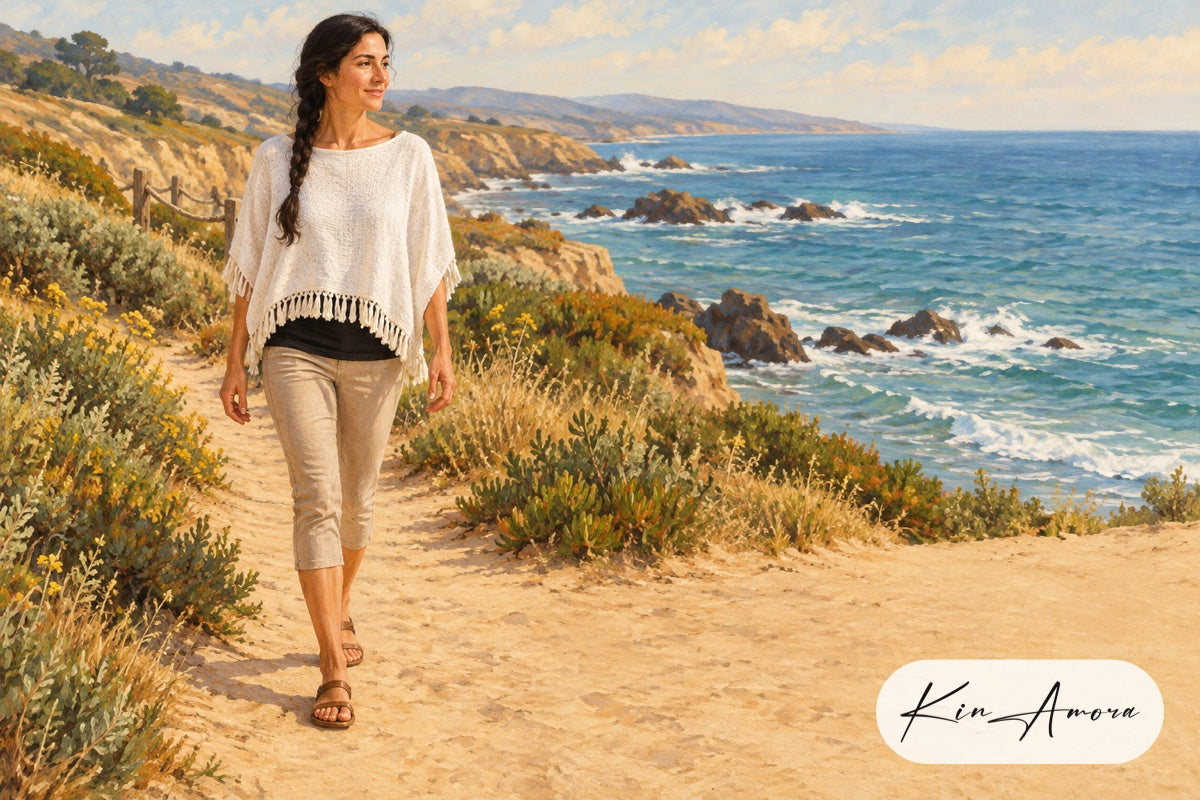
- Pair the poncho top with capri or cropped pants and flat sandals for warm afternoons.
- Belt the poncho top at the waist over leggings or slim pants to show the body's line.
- Throw the poncho top over a swimsuit as a beach cover-up.
- Wear the poncho top over a slip dress or a maxi dress to add coverage at the shoulders.
- Layer a knit poncho top over a turtleneck and dark jeans with ankle boots in fall.
Wide-leg pants work under a poncho top when the poncho is cropped or belted. A hip-length poncho over full pants hides the waist and adds width at both ends of the outfit. The full method for wearing a poncho without losing your frame takes 7 steps, with the hem between the hip bone and mid-thigh.
How do you wear a poncho top with a belt?
To wear a poncho top with a belt, cinch the panels at the natural waist in 4 steps.
- Put the poncho top on and let the front and back panels hang straight.
- Pull the side drape forward so the fabric covers the upper arms evenly.
- Wrap a slim or medium belt around the natural waist, over both panels.
- Blouse the fabric above the belt by tugging it up 1 to 2 inches (2.5 to 5 cm), so the top falls softly over the belt.
A leather belt with a metal buckle suits cotton and rayon poncho tops, and a woven or rope belt suits crochet.
What do you wear under a poncho top?
Wear a fitted tank, a cami, a bodysuit or a swimsuit under a poncho top. The base layer shows at the sides and the neckline, so match its color to the poncho or the pants. Thin straps suit off-the-shoulder ponchos.
How does a poncho top differ from a cape, shawl, ruana or serape?
A poncho top differs from a cape, shawl, ruana or serape in the head opening and the front, since only the poncho has a central head opening and a closed front. A cape is a sleeveless outer garment that hangs loosely from the neck or shoulders and leaves the front open. A shawl is a flat piece of cloth draped over the shoulders with no opening at all.
The ruana and the serape are the poncho's closest relatives. A ruana is a poncho-style garment from the Colombian and Venezuelan Andes with a head opening and a slit down the front, often handcrafted from sheep's wool. A serape is a blanket-like shawl or cloak from Mexico, worn especially by men, with no head opening in the traditional form and fringed ends.
The table below sorts the 5 garments by opening and front.
| Garment | Head opening | Front | Region of origin | Worn as |
|---|---|---|---|---|
| Poncho top | Yes | Closed | The Americas, modern fashion | A top or light layer |
| Ruana | Yes, with a front slit | Open | Colombian and Venezuelan Andes | A warm wrap |
| Serape | No, in the traditional form | Open | Mexico | A shawl or cloak |
| Cape | No | Open, fastened at the neck or shoulders | Europe and worldwide | An outer layer |
| Shawl | No | Open | Worldwide | A wrap over the shoulders |
A poncho top is the only one of the 5 that pulls on over the head and stays put without a fastener, which lets a poncho top stand on its own as clothing.
When does a poncho stop being a layer and become the whole outfit?
A poncho stops being a layer and becomes the whole outfit when the poncho is opaque, long enough to cover the hips, and worn over swimwear or a single base piece. At the beach, a poncho over a swimsuit is the outfit from the sand to the lunch table. On a hot evening, a mid-thigh poncho over bike shorts or a slip reads as a short dress.
Resort dressing uses this trick most. A light poncho is one of the resortwear key pieces that moves from pool to dinner with a change of shoes, because the same cloth covers a swimsuit at noon and bare shoulders at night. A sheer or cropped poncho never becomes the whole outfit, since sheer cloth and a short hem still need a full outfit underneath.
Can men wear a poncho top?
Yes, men can wear a poncho top, usually a solid or striped poncho in cotton or wool over a tee and straight pants. The serape of Mexico is traditionally worn by men, and Clint Eastwood's poncho in Sergio Leone's 1964 western A Fistful of Dollars made the shape a menswear reference. Men tend to choose a hip-length poncho with a crew or boat neck and skip fringe, sheer cloth and off-the-shoulder cuts.
Are poncho tops for summer or winter?
Poncho tops are for both seasons, and the fabric decides which. A cotton, rayon, linen or gauze poncho top suits summer, travel and beach days. A wool, cashmere or chunky knit poncho top suits fall and winter over a turtleneck. Crochet poncho tops sit between the two and work on cool summer nights.
How do travelers, petite wearers and plus-size wearers wear a poncho top?
Travelers, petite wearers and plus-size wearers each wear a poncho top by a different rule, set by packing, length and drape.
For travelers. A woven poncho top folds flat, covers shoulders in churches and markets, and blocks air-conditioning on planes and in restaurants.
For petite wearers. US retailers usually define petite as 5 feet 4 inches (163 cm) and under. A poncho top that ends at the high hip keeps the leg line long, while a mid-thigh poncho can cover most of a short torso. A belt at the natural waist helps a longer poncho.
For plus-size wearers. A one-size poncho top fits by drape, so check the width across the panel and the length rather than a bust size. Arm holes keep the front panel in place, and a fluid woven falls closer to the body than a stiff knit.
How do you wash a fringe poncho top?
Wash a fringe poncho top in cold water on a gentle cycle or by hand, with the fringe bundled and the poncho inside a mesh bag. The FTC's Care Labeling Rule (16 CFR 423) defines cold water as an initial temperature up to 86°F (30°C) and a gentle cycle as slow agitation and reduced time. Comb the fringe straight, tie the strands into loose bundles, and fold the body over them. Dry the poncho flat, because a wet poncho on a hanger drags on the shoulders and fringe. The full method for washing fringe without tangling covers bundling, untangling and repairing frayed strands.
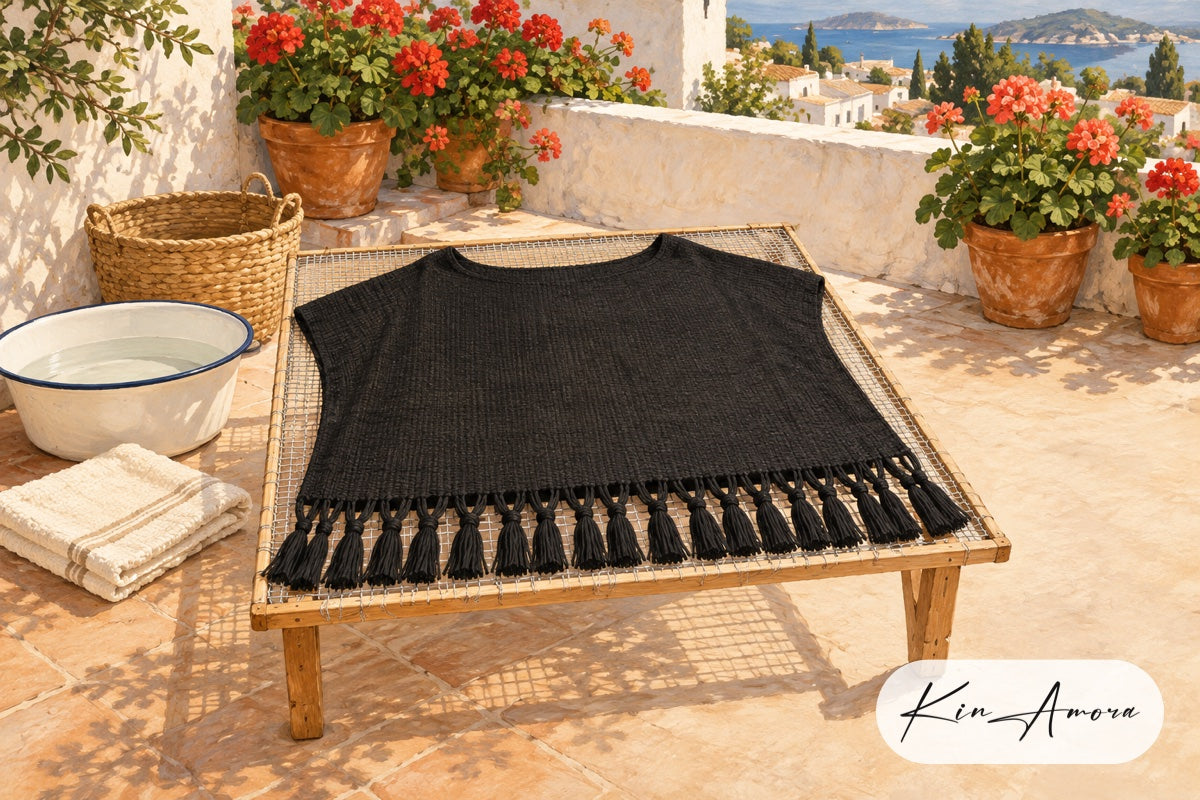
Poncho tops at Kin Amora, the Lily Fringe Poncho
Kin Amora's poncho top is the Lily Fringe Poncho, a lightweight, travel-friendly piece priced at $143. The Lily Fringe Poncho comes in Black or White, in One Size Fits All. The fabric is 60% cotton, 40% rayon, handmade in Morocco. Kin Amora describes the piece as one that acts as a shawl or a beach cover-up, and the product page pairs the Lily Fringe Poncho with the Classic Capri, the Santorini Pant or the Island Pants.
The Lily Fringe Poncho suits readers who want a light woven layer for beach days, cool restaurants and travel, worn over a swimsuit, a tank or a dress. The Lily Fringe Poncho does not suit readers who need rain protection or a warm knit for winter. The product page lists no care line, so wash the poncho cold and dry it flat.