What is a kimono cardigan?
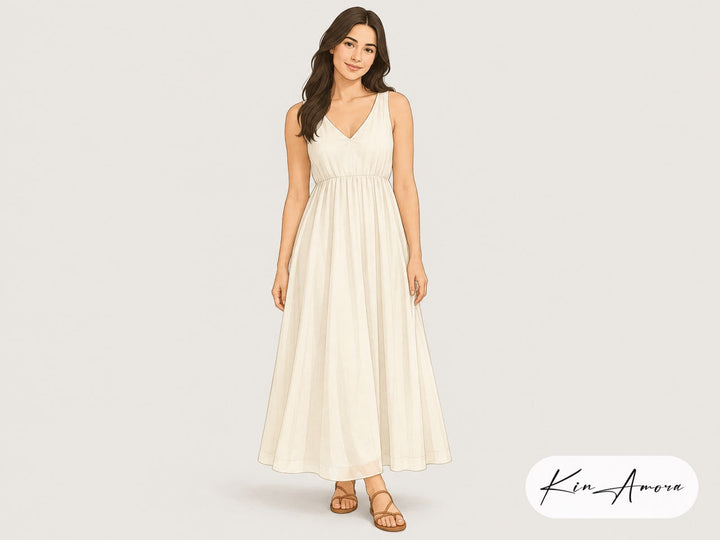
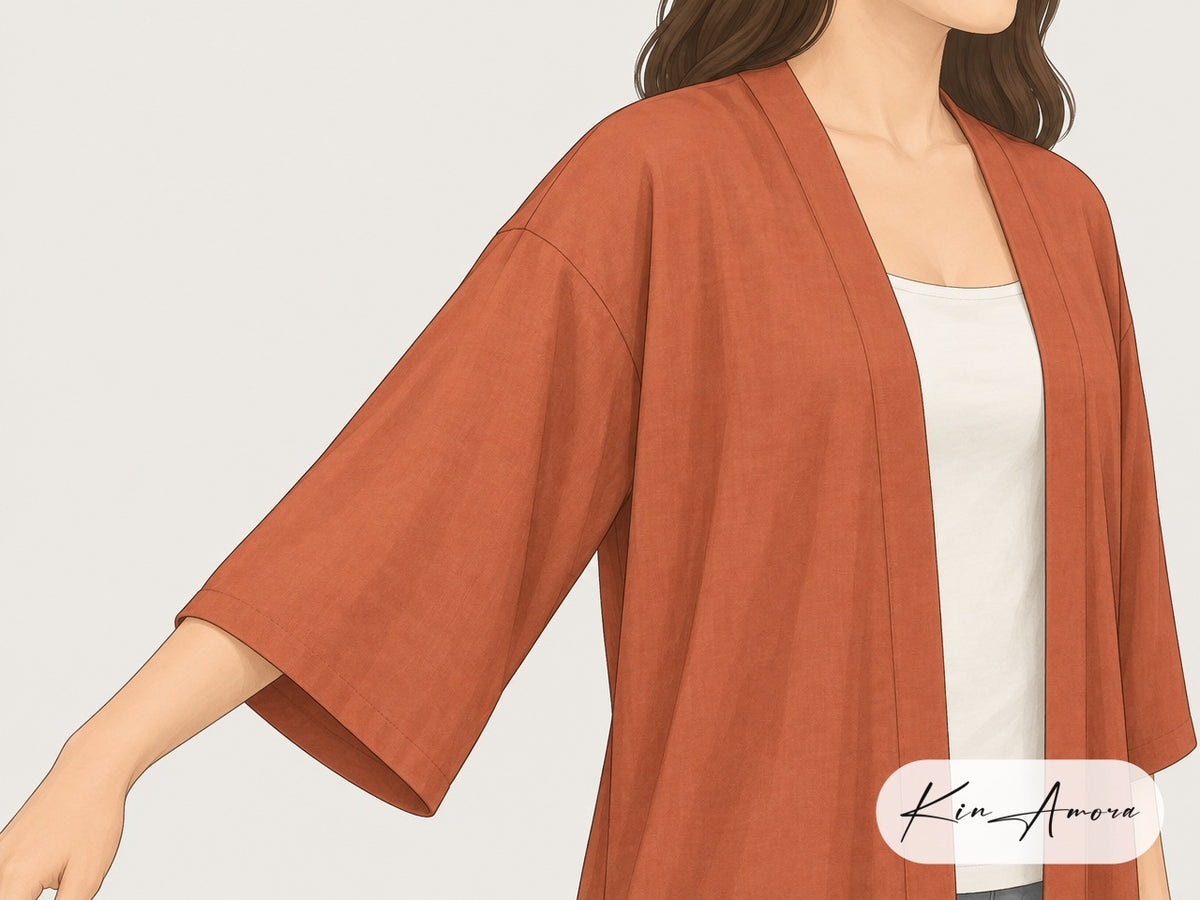
A kimono cardigan is an open-front, loose-fitting layer with wide sleeves and a straight, T-shaped body that borrows its cut from the Japanese kimono. The kimono cardigan is worn like a light jacket over a top and pants, a dress or a swimsuit. The defining attribute of a kimono cardigan is the open front, which usually has no buttons, zipper or snaps.
Retailers sell the same garment as a kimono jacket, a kimono wrap or a kimono top. The word "cardigan" in the name describes how the piece is worn, open and layered, not how it is made. A classic cardigan is knitted and closes with buttons. A kimono cardigan is usually woven from flat fabric and hangs open.
Where does the kimono cardigan come from?
The kimono cardigan comes from the Japanese kimono, a T-shaped robe whose name means "thing to wear" in Japanese. A traditional kimono wraps the left panel over the right and closes with a wide sash called an obi. The closer Japanese ancestor of the kimono cardigan is the haori, a hip- to thigh-length jacket worn open over a kimono and held together with a short cord.
Western designers adopted kimono shapes in the late 19th century, when Japanese art and dress spread through Europe in the movement known as Japonisme. Western sewing still uses the term "kimono sleeve" for a sleeve cut in one piece with the body, with no separate armhole seam. The modern kimono cardigan keeps 3 elements of that history: the straight body, the wide rectangular sleeve and the open front. US shops now use the word kimono for robes too, so the guide to kimono vs robe shows how to tell which one a listing sells.
What are the main features of a kimono cardigan?
A kimono cardigan has 6 defining features, such as the open front, the wide sleeve and the unshaped body.
- Open front: no buttons, zipper or snaps, so the two front panels hang straight down or overlap slightly.
- Wide sleeves: rectangular or bell-shaped sleeves, often cut in one piece with the body, ending between the elbow and the wrist.
- Straight body: a T-shaped cut with no darts, no waist shaping and no shoulder pads.
- Lightweight woven fabric: rayon, cotton, linen, chiffon or silk, chosen for drape rather than warmth.
- Variable length: anything from a cropped hip length to a duster length at the ankle.
- Optional ties and trim: some versions add a self-tie belt, fringe, tassels or a printed border.
Because the body has no shaping, the fit of a kimono cardigan depends almost entirely on the shoulder line, the sleeve and the length.
How should a kimono cardigan fit?
A kimono cardigan should fit loosely through the body, with the shoulder seam dropping past your natural shoulder and the front panels hanging straight without pulling. The front panels never need to meet. The sleeve opening should let you bend your arm without the back hem riding up. A kimono cardigan that pulls open at the bust or wrinkles across the upper back is too narrow, even though the style is meant to be worn open.
Check 3 measurements before you buy a kimono cardigan. First, compare the garment's chest width, measured flat across the back, with your own upper-back width plus several inches of ease. Second, check where the sleeve ends on your arm, since a wide sleeve that falls past the wrist gets in the way. Third, compare the length from the back of the neck to the hem with the same measurement on your body, so you know where the hem will land.
One-size kimono cardigans fit a wide range of bodies because the open front and dropped shoulder absorb differences in bust and hip measurements. The label means something specific, and the guide to one size fits most explains which measurements a one-size garment actually covers. The length is the measurement a one-size kimono cardigan cannot adjust, so it deserves its own check.
How long is a kimono cardigan?
A kimono cardigan runs from hip length to ankle length, and each length pairs best with a different outfit.
| Length name | Where the hem ends | Wear it with |
|---|---|---|
| Cropped or hip length | At the hip bone | High-waisted jeans, wide-leg pants, maxi dresses |
| Mid-thigh length | Halfway down the thigh | Shorts, slim pants, swimwear |
| Knee length | At or just above the knee | Knee-length dresses, leggings, straight pants |
| Midi length | Mid-calf | Wide-leg pants, slip dresses |
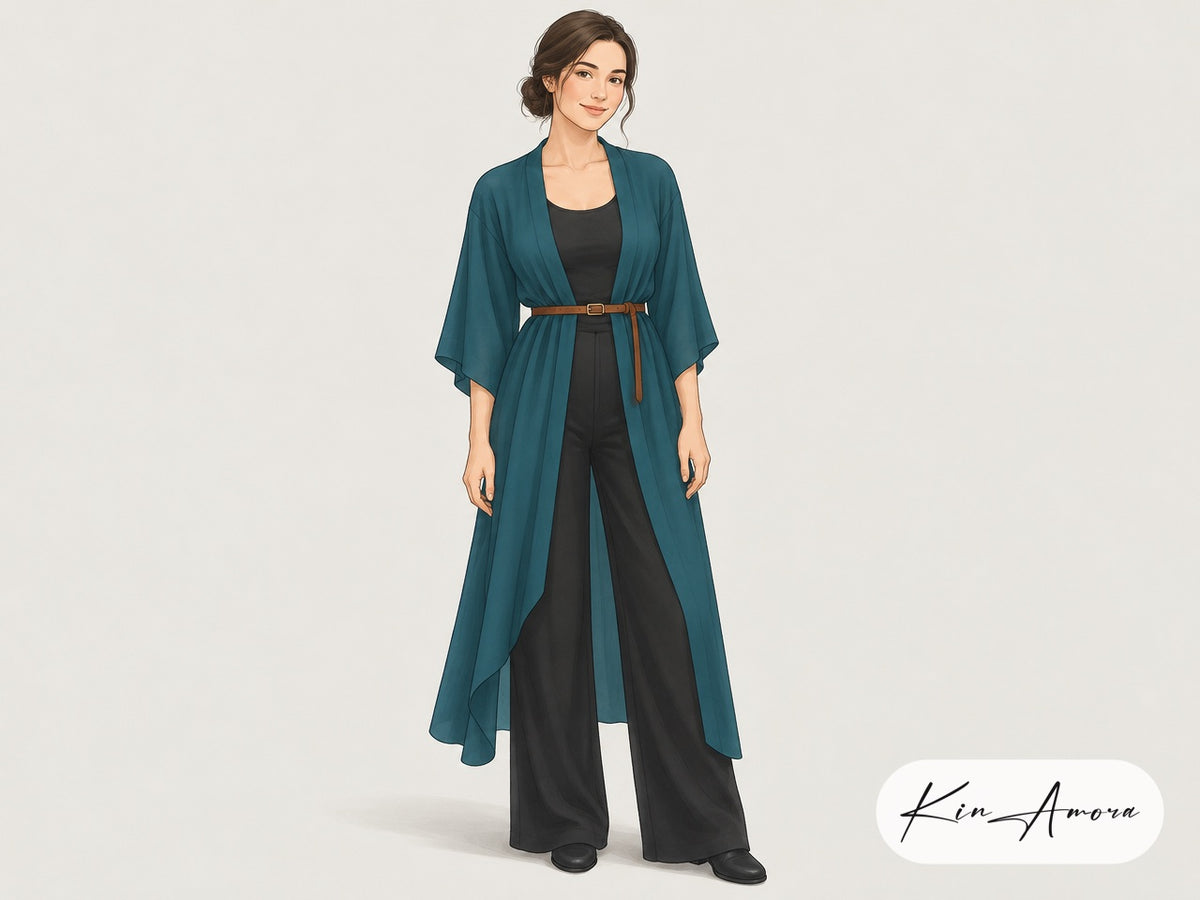
| Duster length | At or near the ankle | Long dresses, straight or flared pants |
The same garment ends lower on a shorter wearer and higher on a taller one. Read the listed length in inches against your own back-neck-to-hem measurement, not against the photo on the model.
What fabric is a kimono cardigan made of?
Kimono cardigans are made of light, drapey woven fabrics, most often rayon, cotton, linen, polyester chiffon, silk or blends of these fibers. The fabric decides how the kimono hangs, how warm it feels and how you wash it.
| Fabric | How it feels and drapes | Breathability | Usual care | Best for |
|---|---|---|---|---|
| Rayon (viscose) | Soft, fluid, cool on the skin | High | Cold, gentle wash, air dry | Summer, travel |
| Cotton-rayon blend | Softer than cotton, more body than rayon | High | Cold, gentle wash, air dry | Everyday layering, travel |
| Cotton | Crisp, holds its shape | High | Machine wash | Casual daytime |
| Linen | Crisp, wrinkles easily | Very high | Gentle machine wash | Hot, dry climates |
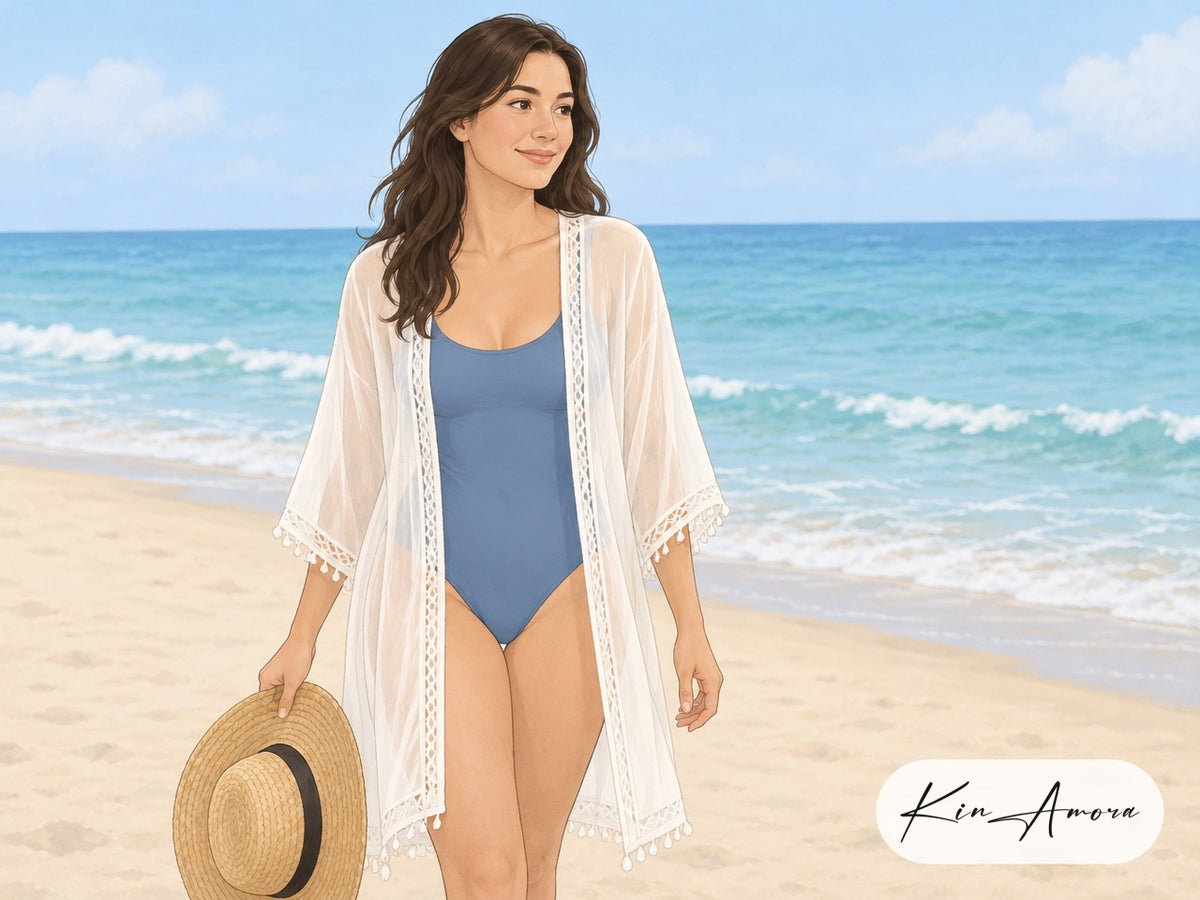
| Polyester chiffon | Sheer, floaty, slippery | Low | Machine wash, quick dry | Beach cover-ups, evenings |
| Silk | Smooth, light sheen | High | Dry clean or hand wash | Evenings, dressy layers |
Rayon is a regenerated cellulose fiber made from dissolved wood pulp, which is why rayon drapes like silk and breathes like cotton. The full story of what rayon is and how it is made explains why rayon behaves differently from cotton in the wash. A cotton-rayon blend keeps most of rayon's drape and adds the structure of cotton, so the kimono holds its line instead of clinging.
Under the Federal Trade Commission's rules for the Textile Fiber Products Identification Act, clothing sold in the US must carry a label listing its fiber content by percentage of weight. The care tag therefore tells you exactly what a kimono cardigan is made of before you buy it.
How do you wear a kimono cardigan?
You wear a kimono cardigan open, over a fitted or simple base layer, so the loose layer contrasts with a closer shape underneath. These 6 outfit formulas cover most days.
- Layer the kimono over a tank top and straight jeans for a casual daytime look.
- Wear the kimono over a slip dress or a maxi dress to add sleeves without adding heat.
- Throw the kimono over a swimsuit as a beach cover-up that also works at lunch.
- Pair the kimono with matching wide-leg pants to make a two-piece set.
- Belt the kimono at the waist over a bodysuit to wear it as a wrap top.
- Pack the kimono as a travel layer for planes, air-conditioned rooms and cool evenings.
Keep one part of the outfit fitted when the kimono is long or patterned. A duster-length kimono over loose pants and a loose top hides the body's line completely, which reads as a robe rather than an outfit.
How do men wear a kimono cardigan?
Men wear a kimono cardigan the same way they wear an unbuttoned overshirt, open over a T-shirt or tank with straight or wide-leg pants. Hip to mid-thigh lengths read most like a shirt jacket. Duster lengths read more like a robe or a festival layer.
Men in Japan wear the kimono too, traditionally in darker, solid colors with a narrower obi than women's kimonos. Kin Amora makes a Men's Classic Kimono for men who want the open-front layer.
Where does the kimono cardigan stop and the Moroccan kaftan or duster begin, and which piece suits you?
The kimono cardigan stops where the garment either closes over the head, which makes it a kaftan, or grows into a long, coat-like layer that reaches the calf or ankle, which makes it a duster. The three pieces share loose cuts and wide sleeves, so shoppers mix up the names.
In Western fashion, a kaftan is a loose, long robe or dress that is usually pulled on over the head. The traditional Moroccan kaftan is a long, formal robe, often closed down the front with a row of small buttons, and worn for weddings and celebrations. A duster is a long, open layer named after the light coats that 19th-century riders wore to keep dust off their clothes.
| Garment | Closure | Usual length | Worn as | Suits you if |
|---|---|---|---|---|
| Kimono cardigan | Open front, no fasteners | Hip to ankle | A light layer over clothes | You want sleeves and coverage over outfits you already own |
| Western kaftan | Pulled over the head, often with a V or keyhole neck | Knee to floor | A dress or cover-up on its own | You want one piece that replaces the whole outfit |
| Traditional Moroccan kaftan | Front closure with small buttons | Floor | A formal robe | You are dressing for a wedding or a celebration |
| Duster | Open front, sometimes a tie | Mid-calf to ankle | A long, coat-like layer | You want a long vertical line over pants or a dress |
| Knit cardigan | Buttons | Hip | A warm layer | You need warmth more than drape |
Morocco has its own long garments beyond the kaftan, including the hooded djellaba and the gandora. The list of traditional Moroccan clothing names explains each one and how it is worn today.
Are kimono cardigans still in style?
Yes, kimono cardigans are still sold as a standard summer and resort layer, because the shape solves a lasting need for sleeves and coverage without heat. The version that looks dated is the sheer polyester kimono with heavy fringe worn over every outfit. The version that looks current is a solid or quietly patterned kimono in a natural-feeling fabric, worn open over clean basics. Kimono cardigans sit inside the wider resortwear category, which covers relaxed clothes built for warm-weather travel and slow days.
Who wears a kimono cardigan, and how?
Kimono cardigans suit 4 common situations, each with its own best length and fabric.
For travelers
A traveler gets the most use from a mid-thigh or knee-length kimono cardigan in a breathable fabric that packs flat. The kimono covers bare shoulders in churches and markets, blocks air-conditioning on planes, and folds into a day bag. The kimono cardigan is one of the easiest pieces in long-flight outfits, since it adds warmth without a zipper or a bulky collar.
For yoga and meditation practitioners
A yoga practitioner can wear a kimono cardigan to and from class, then take it off before practice. Kundalini yoga students often dress in white, and an open white layer keeps the look calm and covered between sessions. The guide to kundalini yoga clothes covers the full outfit, from head covering to pants.
For petite wearers
A petite wearer, usually defined by US retailers as 5 feet 4 inches and under, looks best in a hip or mid-thigh length kimono. A duster-length kimono on a petite frame can reach the floor and swallow the outfit. Pair a longer kimono with a heeled sandal or a monochrome base to keep one unbroken vertical line.
For tall wearers
A tall wearer can carry duster and midi lengths that would overwhelm a shorter frame. Check the sleeve length first, since a wide sleeve that ends mid-forearm on a tall wearer looks cropped by accident.
How do you wash a cotton-rayon kimono cardigan?
Wash a cotton-rayon kimono cardigan in cold water on a gentle cycle or by hand, then air dry it. Rayon fibers lose strength when wet and can shrink with heat, so skip high dryer heat and hot water. Turn the kimono inside out before washing to protect prints and trim. The step-by-step guide to washing cotton-rayon blends covers detergent, drying and ironing in detail. Always follow the care label first, since the label lists the exact fiber percentages.
The Classic Kimono: Kin Amora's kimono cardigan, handmade in Morocco
Kin Amora's Classic Kimono cardigan is a one-size, open-front layer handmade by artisans in Morocco. The Classic Kimono costs $210, is made from 60% cotton and 40% rayon, and comes in Black or White in a size that fits many bodies, including plus sizes. The Classic Kimono follows the cut described above, with a straight body, wide sleeves and an open front that sits over tanks, dresses and wide-leg pants.
Kin Amora also makes the Bahia Kimono and the Lucia Kimono for different lengths and details. The Bahia Kimono ($170) is a shorter version of the Classic Kimono, with detailed lining on both edges and side pockets. The Lucia Kimono ($130) is a semi-sheer white button-down duster tunic with 3/4 sleeves and an asymmetrical hem. Readers who want the coat-like line from the comparison above can choose the Royal Duster ($330) instead, which has full-length sleeves, a small collar and buttons.