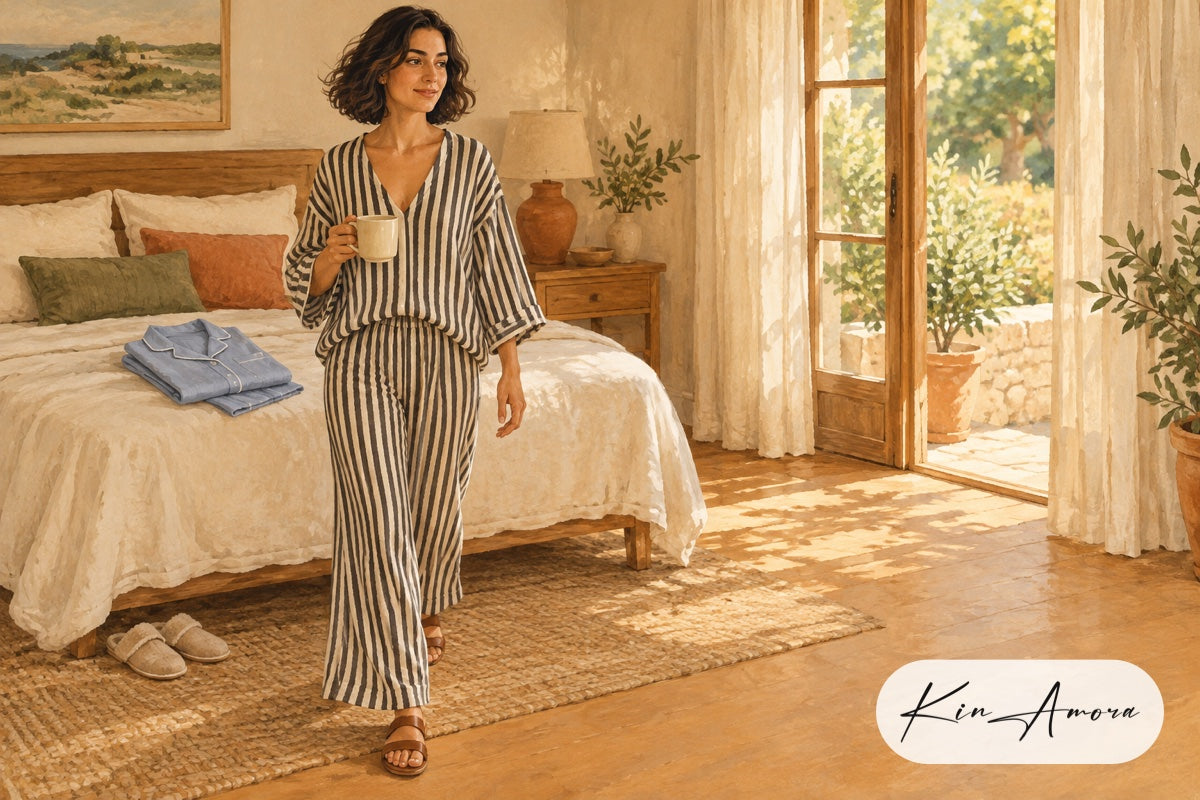

What is the difference between loungewear and pajamas?
The main difference between loungewear and pajamas is what the clothes are made to do, with loungewear made for resting while awake and pajamas made for sleeping. Merriam-Webster defines loungewear as "informal clothing usually designed to be worn at home." The same dictionary defines pajamas as "a loose usually two-piece lightweight suit designed especially for sleeping or lounging."
Purpose shapes the other 4 differences. Loungewear has to look finished in daylight, so it uses smoother fabrics, cleaner hems and cuts that hang well on a standing body. Pajamas only have to feel right lying down, so they can be fuzzier, plainer and cut straighter.
The table compares loungewear and pajamas across 8 attributes.
| Attribute | Loungewear | Pajamas |
|---|---|---|
| Main purpose | Resting while awake | Sleeping |
| Hours worn | Daytime and evening at home, short trips out | Bedtime to morning |
| Typical fabric | Cotton, rayon, modal, linen | Cotton, flannel, satin |
| Cut | Wide-leg, harem or tapered pants, tees, tanks, tunics | Straight pants, button-front shirts, camisoles |
| Waist | Elastic, drawstring or tie | Elastic or drawstring |
| Design detail | Prints, fringe, finished hems | Piping, sleep prints |
| Shoes | Slides, flat sandals, clean sneakers | Slippers or socks |
| Worn in public | Often | Rarely |
The first 3 rows carry the split, and the other 5 follow from them. A piece that matches the loungewear column in fabric and finish can leave the house, even when a shop sold it as sleepwear.
Which should you choose, loungewear or pajamas?
Choose loungewear for the hours you are awake and pajamas for the hours you sleep, and keep both when the two uses fill different parts of your day. Neither one replaces the other in most wardrobes. The right pick depends on 4 conditions.
- Choose loungewear when you work from home, take video calls or step out for coffee and school pickup.
- Choose pajamas when you want fabric picked for the bedroom, such as flannel for a cold room or thin cotton for a warm one.
- Choose a woven loungewear set when suitcase space is short, since one set covers the flight, the hotel room and the walk to breakfast.
- Choose separate pajamas when your loungewear goes outside most days, so the clothes you sleep in stay off the street.
The 5 differences below explain why each choice works, starting with purpose.
What are the five things that set loungewear and pajamas apart?
Loungewear and pajamas are set apart by 5 things, which are purpose, fabric, cut and waist, finish, and where each one can be seen. The same cues explain why some matching sets look like pajamas, with sleep fabric, contrast piping, a sleep print and slippers showing most. Each difference below names what to check on a label or in a mirror.
How does purpose separate loungewear from pajamas?
Purpose separates loungewear from pajamas because loungewear moves through the day and pajamas lie still through the night. Loungewear has to survive cooking, desk work, floor sitting and a walk to the mailbox. Pajamas have to stay comfortable through hours of turning over, with nothing that presses into the skin.
The two purposes split about a century ago. According to the FIDM Museum, pajamas were worn mainly as sleepwear until the 1920s, when they left the bedroom as swimsuit cover-ups on French Riviera beaches. Women without a resort life wore the same cut at home for entertaining and relaxing. The museum notes that these became lounge pajamas, which Bullock's department store advertised as "lounjamas." Modern loungewear descends from that daytime branch.
How does fabric separate loungewear from pajamas?
Fabric separates loungewear from pajamas through surface and weight, with smooth wovens and fine knits for loungewear and brushed or glossy cloth for pajamas. Loungewear favors cotton, rayon, modal, linen and cotton-rayon blends, which hang in folds and look finished in daylight. Pajamas favor flannel, satin and thin cotton, chosen for warmth, slip or coolness in bed.
The rule is older than the word loungewear. The FIDM Museum records that in the 1930s, lace and silk satin marked pajamas as nightwear, while silk shantung, linen and cotton marked them as beach and lounging wear. Merriam-Webster describes cotton flannel as a napped fabric of soft yarns, and that fuzzy nap is the surface most people read as bedclothes. A cotton-rayon set and a flannel set can share a waist and a leg shape, and the fabric alone tells a stranger which one left the bedroom.
How do the cut and the waist differ?
The cut and the waist differ in how each garment hangs on a standing body. Loungewear pants come in shaped legs, such as wide-leg, harem, flare and tapered cuts, and they are hemmed to the ankle or just above the floor. Pajama pants usually fall straight and loose, because nobody judges their line while the wearer sleeps.
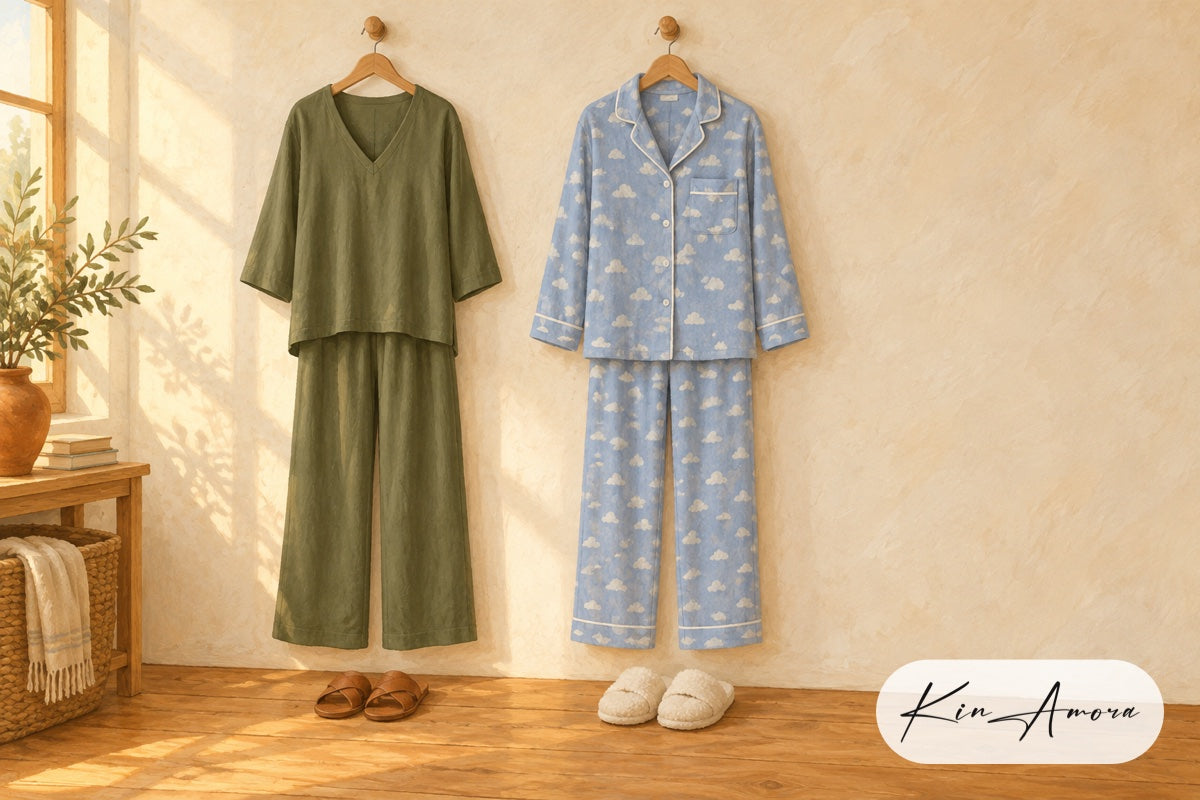
Both waists pull on. Loungewear uses an elastic band, a drawstring or a wrap tie, and pajamas use elastic or a drawstring. Loungewear tops follow streetwear shapes, such as tees, tanks, tunics, cowl necks and open kimonos. Classic pajama tops button down the front, often with a notched collar and a chest pocket, and that shirt reads as nightwear the moment it appears in public.
What details mark a garment as pajamas?
Piping, sleep prints and a button-front shirt with a notched collar mark a garment as pajamas. Merriam-Webster defines piping as trimming stitched in seams or along edges, and pajama makers run it in a contrast color around collars, cuffs and pockets. Sleep prints include moons, stars, clouds and small repeated novelty motifs. Loungewear carries daytime details instead, such as side pockets, fringe, yokes, slits and cold-shoulder cuts.
Shoppers have watched for these signals for almost 100 years. A period New York Times article, quoted by the FIDM Museum, warned that on lounging pajamas anything "that faintly suggests the boudoir is taboo." The same test works today, since one line of piping turns a plain set into sleepwear in a stranger's eyes.
Where can each one be seen?
Loungewear can be seen at the door, on a video call, at a café and on a flight, while pajamas stay at home, at sleepovers and at pajama parties. The door test sums up the split. A piece you would answer the door in without reaching for a robe counts as loungewear, and a piece that sends you to the robe counts as pajamas.
Are loungewear and pajamas the same?
No, loungewear and pajamas are not the same, although the 2 categories share soft fabric and a pull-on waist. Loungewear is defined by where it is worn, at home and on short trips out. Pajamas are defined by bed. Merriam-Webster's pajama definition allows "sleeping or lounging," which is why a plain cotton pajama pant can pass as loungewear and a soft jogger can end up in bed.
The words arrived centuries apart. Merriam-Webster dates "nightclothes" to 1567, "pajama" to 1801, "sleepwear" to 1935 and "loungewear" to about 1957. Pajama comes from the Hindi pājāma, built from the Persian pā, meaning leg, and jāma, meaning garment. The dictionary's first sense of the word is loose, lightweight trousers once widely worn in the Near East, so pajamas began as daytime trousers before they became bedclothes. The guide to the 12 loungewear examples sorts the modern category by cut, fabric and season.
What is the difference between loungewear and sleepwear?
The difference between loungewear and sleepwear is the same purpose split, but sleepwear is a wider group than pajamas. Merriam-Webster treats sleepwear and nightwear as other words for nightclothes, which it defines as "garments for wear in bed." Sleepwear covers 5 common garments.
- Pajamas, a matching top with pants or shorts.
- Nightgowns, a loose, dress-length garment for bed.
- Nightshirts, a long, loose shirt worn to sleep.
- Slips and chemises, thin dress-shaped pieces in satin or knit.
- Sleep shorts sets, a short top and shorts for warm nights.
Loungewear overlaps sleepwear only at the soft, plain end, such as a cotton tee or a drawstring pant. Nightgowns and satin slips sit firmly on the sleepwear side, because their thin, short or glossy cuts read as bedroom wear outdoors. Loungewear and nightwear are neighbors, not synonyms.
When can one set do both jobs?
One set can do both jobs when it is soft, loose, clean and free of hardware, and when the wearer accepts washing it more often. A cotton or cotton-rayon set with an elastic waist and no zips, studs or stiff trims sleeps comfortably and still passes the door test. A set that went out for the day should come off before bed, so the sheets stay cleaner. A lounge set passes as bed clothes when it is loose, soft, clean and free of hardware, the 4 tests behind sleeping in loungewear.
Can you sleep in loungewear?
Yes, you can sleep in loungewear that is loose, soft and free of hardware. Heavy fleece, thick waistbands and metal trims belong to the daytime side. Keeping separate pajamas keeps loungewear fresher and makes it last longer between washes.
Can you wear pajamas outside?
Yes, pajamas can be worn outside when the fabric, the print and the finish look like daywear. Plain silk, linen and cotton pajama sets have crossed over since the 1920s. The FIDM Museum quotes a 1931 Vogue report that some women wore pajamas to formal dinners at home and even to the theater. Flannel, piping and sleep prints still read as bedclothes on a street.
How do travelers, guests and men split loungewear and pajamas?
Travelers, guests and men split loungewear and pajamas in 3 different ways, each tied to where the clothes go next.
For travelers. Pack one woven loungewear set and one light sleep set. The loungewear set covers the flight and the walk to breakfast, and the sleep set stays in the room, which keeps airport dust out of the hotel bed.
For guests. The invitation decides the line, and the guide to a loungewear dress code on invitations explains which sets pass. "Loungewear" asks for a finished set, while "pajama party" asks for real sleepwear.
For men. Drawstring wide-leg pants with a plain tee work as loungewear, and a flannel pant with an old T-shirt stays as pajamas. A linen or cotton-rayon pant passes the door test, while a fleece pant with ribbed cuffs reads as gym or bed wear.
How should you wash loungewear and pajamas?
Wash loungewear and pajamas on a cold, gentle cycle and hang cotton-rayon pieces to dry, because cotton and rayon can both shrink in heat. Fleece pajama pants pill when washed with rough fabrics, so wash them inside out with other soft pieces. Sleepwear needs washing more often than a daytime set. Cleveland Clinic (2025) lists sweat, body oils and dead skin among what builds up in bedding, and the clothes worn in that bed collect the same. Follow the sewn-in care label first, since fiber content and dye decide the safe temperature.
Loungewear sets at Kin Amora, the Lisbon Top x Gypsy Flare Pant Set
The Lisbon Top x Gypsy Flare Pant Set is Kin Amora's loungewear set at $240, built for the waking-hours side of the table. The set comes in One Size Fits Many or Plus, in Black, Classic Striped, Minnie Striped, Black Grey Minnie Striped, Royal Blue or Hunter Green. Both pieces are cut from a 60% cotton, 40% rayon blend, handmade by local artisans in Morocco.
The Lisbon Top is Kin Amora's take on a casual T-shirt, with longer sleeves, a pointed V neckline at the front and back, and a loose look. The Gypsy Flare Pant is Kin Amora's wide leg, with pockets and an elastic waistband, and waist tailoring can be requested through the order notes. Kin Amora sells the Sunriser Top x Gypsy Flare Leg set at $229 and the Zaza Tank x Maeve Skirt set at $215.
The set suits wearers who want loungewear that passes the door test, packs into one bag and moves from the sofa to a café. The set does not suit anyone who wants flannel warmth on cold nights, a button-front pajama top or a stretch knit. Compare every pairing in Kin Amora's loungewear sets and pick the one you would answer the door in.