
What is a Moroccan djellaba?
A Moroccan djellaba is a long, loose, hooded outer robe with full sleeves, worn over other clothes by men and women in Morocco and across North Africa. In Morocco, "jillaba" names the long, hooded robe worn as an outer garment by both sexes, according to anthropologist Fadwa El Guindi in the Encyclopedia of Clothing and Fashion. The djellaba falls from the shoulders to the ankle in one loose line, with no waist seam. The front closes at the neck with a short opening and small buttons.
A museum piece shows the scale. The Metropolitan Museum of Art holds an early 20th-century djellaba from Morocco or Algeria, in wool and silk, that measures 68 inches (172.7 cm) from top to hem and 59 3/4 inches (151.8 cm) across. That width is what lets a djellaba slip over a full outfit and still move freely.
The name has several spellings, including djellaba, jellaba, jillaba and djellabah. Moroccan mountain communities use tadjellabit, a Berber form of the word, and central and eastern Algeria use qashabiya for a similar robe.
What does djellaba mean?
Djellaba means a hooded robe of the Maghreb, and English has no single native word for it. English took the word from French, which took it from the Arabic jallāba. Merriam-Webster dates the first known English use of djellaba to 1919. The origin of the Arabic word is debated. Dutch scholar Reinhart Dozy linked it to traders, while French linguist William Marçais tied it to jilbāb, an Arabic word for a draped garment. The djellaba itself is sewn, not draped, so the closest English description stays "a long hooded robe."
Why does a djellaba have a pointed hood?
A djellaba has a pointed hood because the loose, peaked qob protects the head from sun, sand and cold while leaving air around it. The hood comes to a point at the back of the head and hangs down between the shoulder blades when it isn't worn. The qob does 4 jobs.
- Shading the head and neck from strong sun.
- Blocking blowing sand and dust.
- Warming the head as a winter hat in the Atlas Mountains.
- Carrying small items, such as bread or groceries, when the hood hangs down.
A farmer or shepherd without a bag can carry a simple meal in the hood, according to the Encyclopédie berbère (1995). NationalClothing.org adds a reason for the shape itself. A peaked hood holds a pocket of air above the head, while a round hood fitted close to the skull traps more heat.
The pointed hood is the quickest way to tell a djellaba from its neighbors. The kaftan and the gandora have no hood at all, and the burnous has a pointed hood on a sleeveless cloak.
What are the parts of a djellaba?
A djellaba has 5 main parts, which are the qob, the body, the sleeves, the neck opening and the buttons. Each part has a job, and regional makers vary the finish on each one.
| Part | What it is | Detail |
|---|---|---|
| Qob (hood) | A loose hood ending in a point at the back | Hangs down the back when not worn and works as a pocket |
| Body | One long, loose panel front and back | Falls from shoulder to ankle with no waist seam |
| Sleeves | Long, full sleeves | Wide enough to push up over the forearm |
| Neck opening | A short slit at the front of the neck | Lets the robe pull on over the head |
| Buttons | Small knotted buttons closing the neck slit | Often made by hand from thread |
The buttons carry a craft of their own, since many are knotted by hand from thread. A djellaba's trim, buttons and fabric together show where it was made and what it cost.
What is a djellaba made of?
A djellaba is made of cotton for summer and coarse wool for winter, with silk and fine blends for dress versions. Traditional winter djellabas used wool from local mountain sheep, and lightweight cotton djellabas are now common for everyday wear. Women's dress djellabas use thinner, finer fabrics, and some use silk.
2 Moroccan places are tied to djellaba craft by name. The town of Bzou is known for handwoven djellaba cloth. Ouezzane, in the north, gives its name to the jellaba ouazzania, whose craftsmanship the Moroccan government portal maroc.ma lists under intangible heritage. Fabric weight decides the season of a djellaba more than its cut, which stays nearly the same from a summer cotton robe to a winter wool one.
How do men's and women's djellabas differ?
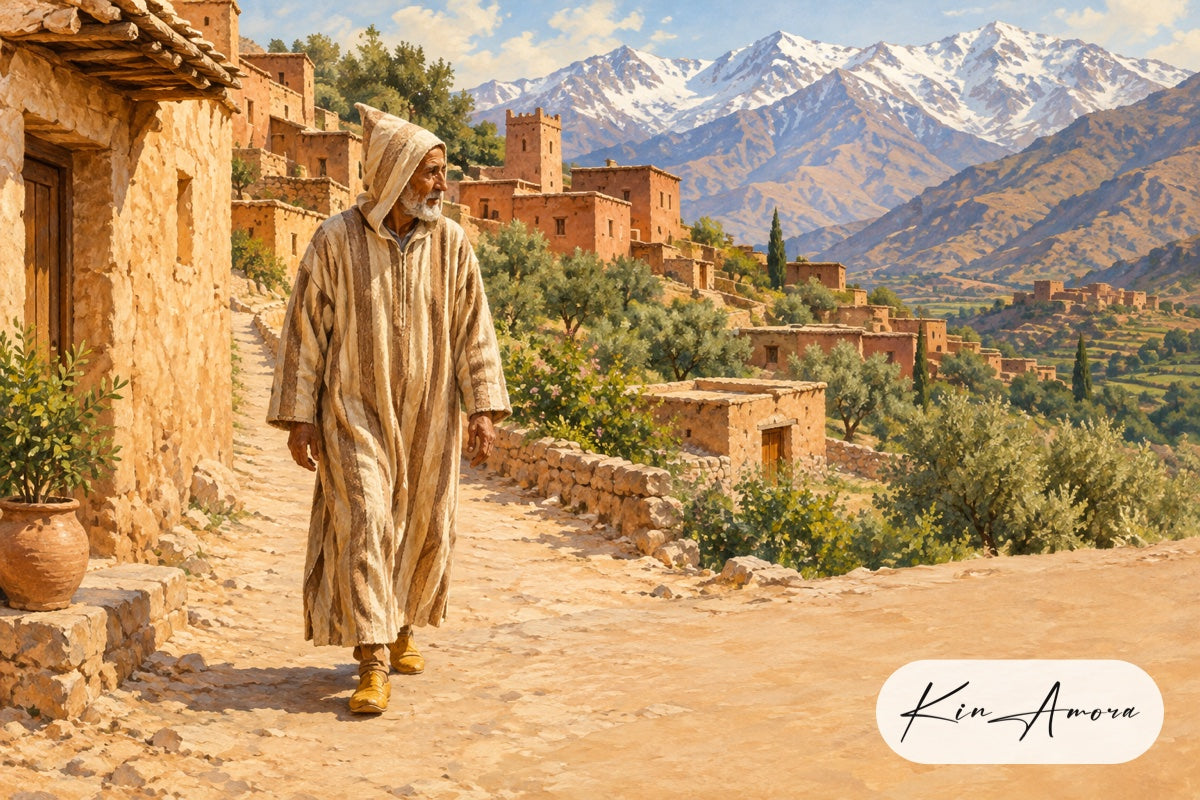
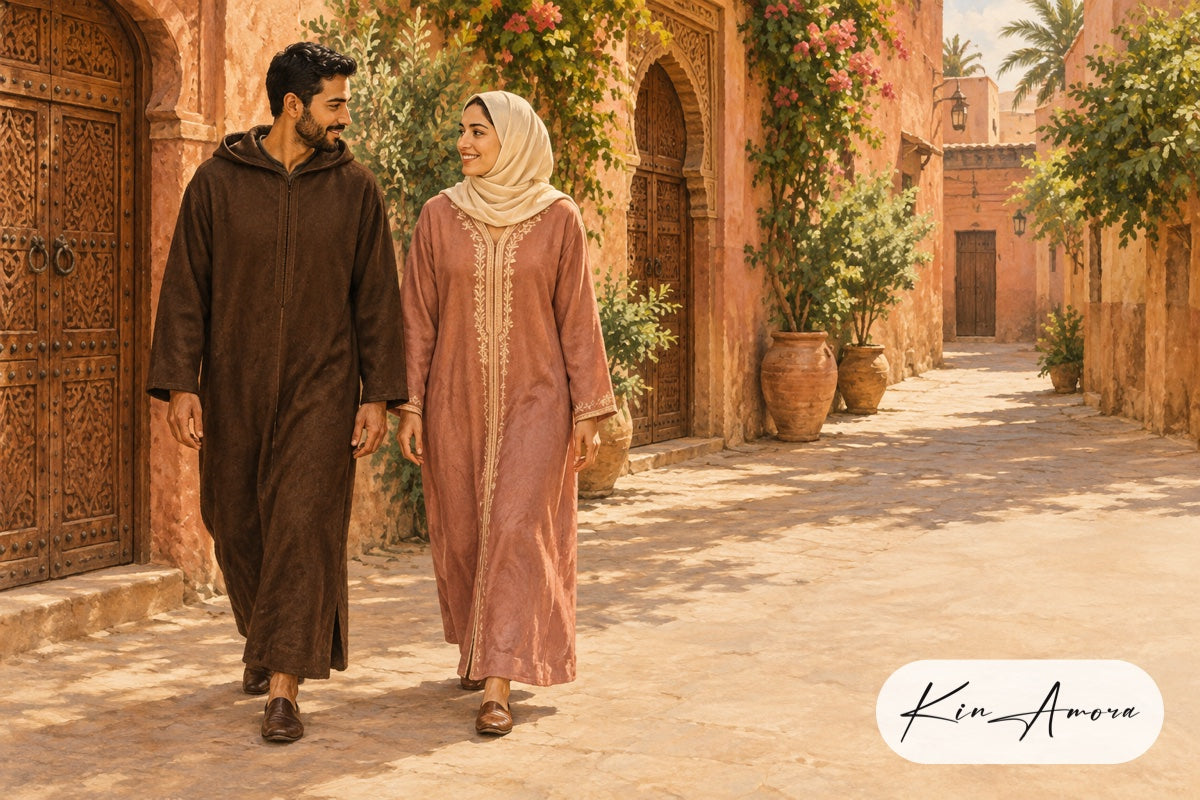
Men's djellabas are plainer, darker and heavier, while women's djellabas are lighter, more colorful and more decorated. Men's versions favor neutral colors, stripes and plain wool, with little ornament beyond the buttons. Women's versions carry embroidery on the neckline, front and sleeves, and they come in fine cottons, blends and silk in a wide range of colors.
Occasion changes the color for both. Many Moroccan men wear a light-colored djellaba with yellow leather slippers called balgha for religious holidays and weddings. Morocco World News describes men dressing in a djellaba or a jabador, a two-piece outfit, for Eid al-Adha.
For men. A striped or plain wool djellaba over trousers and a shirt is the classic everyday look. Choose a length that clears the ankle, so the hem stays out of street dust, and wear balgha or plain leather slippers.
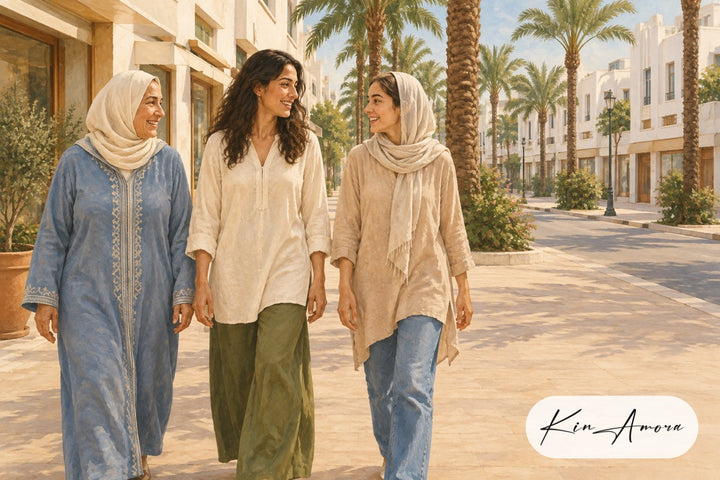
For women. Women's djellabas run from plain cotton for errands to embroidered silk blends for family visits and holidays. Many women wear a djellaba over Western clothes, so the robe works as a coat rather than a full outfit.
Is the djellaba Moroccan?
Yes, the djellaba is Moroccan, and the same robe is worn across the Maghreb, including Algeria, Tunisia and Libya. Morocco is the country most closely tied to the hooded djellaba, which is why shops and dictionaries often call it Moroccan dress. The djellaba is worn in Arab and Amazigh communities alike, from city medinas to Atlas villages such as Imilchil.
How has the djellaba changed over time?
The djellaba changed most in who wears it and how it is styled, while the cut stayed close to the old pattern. Urban Moroccan women wore the djellaba more widely during the French protectorate (1912 to 1956), many in place of the haik, a large wrapped cloth. Historian Jonathan Wyrtzen links that change to Moroccan nationalism in his book Making Morocco (2016).
Western fashion took notice later. Yves Saint Laurent first traveled to Marrakesh with Pierre Bergé in 1966, and he later designed capes inspired by the djellaba and the burnous, according to a 2021 AramcoWorld article by Jeff Koehler. Moroccan designers today cut djellabas in new fabrics and colors while keeping the hood, the sleeves and the long line.
How is a djellaba different from a kaftan, gandora and burnous?
A djellaba differs from a kaftan, a gandora and a burnous by its hood, its sleeves and when it is worn. The djellaba is the only one of the 4 with both a hood and full sleeves. The table compares them.
| Garment | Hood | Sleeves | Opening | Worn for |
|---|---|---|---|---|
| Djellaba | Pointed qob | Long and full | Short neck slit with buttons | Everyday wear, prayers, holidays |
| Kaftan | None | Long, often wide | Full front opening, often closed with many buttons | Weddings and celebrations |
| Gandora | None | Short or none | Neck opening | Warm weather |
| Burnous | Pointed hood | None, a sleeveless cloak | Wraps over the shoulders like a cape | Warmth over other clothes |
The kaftan is the dress garment, often in silk, velvet or brocade. The gandora is often described as a djellaba without the hood. The burnous, a one-piece hooded cloak of coarse wool, is worn over other clothes for warmth. The kaftan and the gandora each get their own entry in the guide to the kaftan, gandora and sarouel, alongside other traditional Moroccan pieces.
Who wears a djellaba today?
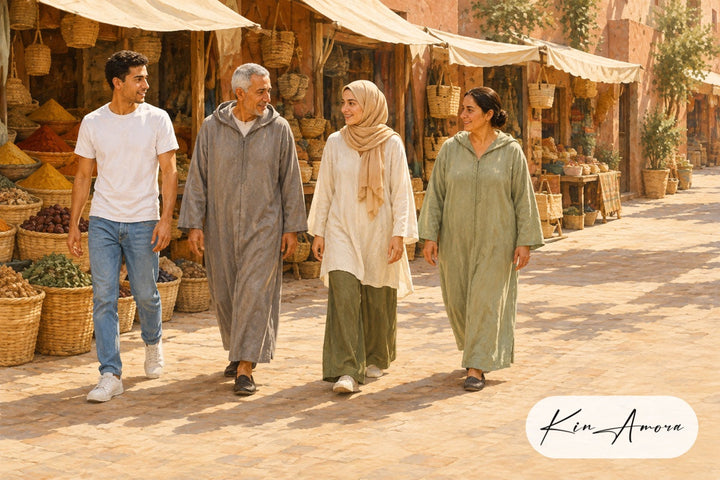
Moroccan men and women of all ages wear a djellaba today, as everyday outerwear, for prayers and for holidays. Older men wear one daily in many towns and villages. Many younger Moroccans keep a djellaba for religious holidays such as Eid and wear jeans and jackets the rest of the week. Women wear djellabas over their clothes for errands, visits and holidays. The full range of street and village dress, from djellabas to jeans, is described in the guide to what Moroccans wear daily.
Which modern layer carries the same long, loose line?
A long duster, an open kaftan or a full-length kimono carries the djellaba's long, loose line without the hood. These layers fall from the shoulder to the ankle or the calf, leave room for clothes underneath and move with each step. They share 3 attributes with the djellaba, which are length, full sleeves and a loose body.
What they lose is the hood and the closed front. A duster or kimono opens down the front and wears like a long coat, while a djellaba pulls on over the head. A belt brings back some of the djellaba's single column, since a belted duster closes like a robe.
Can non-Moroccans wear a djellaba?
Yes, non-Moroccans can wear a djellaba, because the djellaba is traditional Moroccan dress rather than a religious requirement. Visitors of any faith, Christians included, buy and wear djellabas in Morocco, and many Moroccan shops sell them to travelers. Wear it the way Moroccans do, over regular clothes, and skip costume extras such as a fez worn as a joke.
For travelers. A light cotton djellaba covers the shoulders and knees, which suits visits to medinas and religious sites in Morocco. Buy it from a local workshop or souk stall, try it over the clothes you'll wear, and check that the hem clears your shoes.
How do you wear a Moroccan djellaba?
To wear a Moroccan djellaba, pull it on over light clothes, button the neck slit and let the hood hang down the back, in 4 steps.
- Dress in light layers underneath, such as trousers and a tee or a long skirt.
- Pull the djellaba on over the head and fasten the buttons at the neck.
- Let the qob hang down the back indoors, and raise it outdoors against sun, wind or cold.
- Finish with flat leather slippers, sandals or plain shoes.
The length should fall near the ankle, and the sleeves should reach the wrist with room to push up. Wash a cotton djellaba according to its label, and take a wool one to a dry cleaner when the label asks.
Djellaba-style layers at Kin Amora, the Royal Duster
Kin Amora does not sell djellabas, and the Royal Duster is not a djellaba. The Royal Duster has no hood, and it opens at the front with a small collar and buttons instead of pulling on over the head. It is the closest Kin Amora layer to a djellaba's long, loose line, with full-length sleeves and a length that can be worn as a jacket or as a dress.
The Royal Duster costs $330 and comes in One Size Fits All, in Black, White and Classic Striped. Woven detailing runs across the shoulders and falls into an upside-down triangle down to the mid-back. Kin Amora lists the fabric as 60% cotton, 40% rayon, handmade in Morocco, and suggests pairing the duster with one of its vintage belts to wear it as a dress. The product page calls it a day or evening piece and a statement piece for travel. The Classic Striped option echoes the striped wool djellabas Moroccan men wear.
The Royal Duster suits anyone who wants a long, loose Moroccan-made layer for travel, evenings and warm-weather dressing. The Royal Duster does not suit anyone who needs a true djellaba for prayers, Eid or weather protection, because it has no qob. For that, buy from a Moroccan djellaba maker. See the Royal Duster in three colors and try it belted over a long dress or open over wide pants.