

Which Moroccan clothing brands make their pieces by hand?
Moroccan clothing brands that make their pieces by hand include Maison ARTC, Marrakshi Life, New Tangier and the Al Khayr djellaba cooperative, and 8 such labels are profiled below. A named press or museum source describes a hand step for each one.
The table below sums up the 8 labels by place, main pieces and the hand step a source reports, and each profile names its source.
| Label | City or region | Main pieces | Hand step reported |
|---|---|---|---|
| Al Khayr cooperative | Bzou, Azilal province | Djellaba bziouia | Women hand-weave wool with silk threads |
| By Faissal | Marrakech medina | Scarves and textiles | Woven on a traditional loom |
| Fadila El Gadi | Marrakech boutique in Gueliz | Couture clothing and accessories | Gold-thread embroidery, every piece handmade |
| Maison ARTC | Marrakech | Reworked couture pieces | Hand-assembled from antique and vintage textiles |
| Marrakshi Life | Marrakech | Loose unisex garments | Handwoven cloth, made to order |
| New Tangier | Marrakech, shop at La Mamounia | Unisex caftans | 18 to 35 hours of work per garment |
| Noureddine Amir | Exhibited in Marrakech | Sculptural dresses | Fibers assembled thread by thread, plant-dyed |
| The Makers Marrakech | Marrakech, Majorelle and Gueliz | Kimonos, jackets, dresses | Hand embroidery and patchwork |
The profiles that follow give the detail behind each row.
Al Khayr cooperative, Bzou
The Al Khayr cooperative in Bzou, Azilal province, makes the djellaba bziouia, a robe that women hand-weave at the loom from washed, carded wool and fine natural silk threads. Its president, Jamal Jakani, described the work to Aujourd'hui le Maroc in June 2024. One djellaba takes 20 days to 4 months, and prices ran from 1,500 to 5,000 dirhams by quality in 2024. The cooperative sells at weekly Friday auctions in the Bzou souk and at exhibitions.
By Faissal, Marrakech medina
By Faissal sells hand-woven cotton, wool and linen scarves and textiles from 2 shops in the Marrakech medina, according to Time Out (October 2026). The cloth is woven on a traditional loom and colored with natural dyes such as henna.
Fadila El Gadi, Marrakech boutique
Fadila El Gadi designs couture clothing and accessories, and Le360 reported in September 2014 that all of her pieces are made by hand. Her work pairs gold-thread embroidery, inspired by 18th-century embroidery, with brocade, taffeta, cashmere and silk. Le360 placed her Marrakech boutique in a gallery in Gueliz, open since September 1, 2014.
Maison ARTC, Marrakech
Maison ARTC is the label of designer and artist Artsi Ifrach, and its February 2025 London Fashion Week pieces were thrifted, reworked and hand-assembled in Marrakesh, according to The National. The collection used antique lace, golden brocade, black taffeta and mouzoun, which The National describes as traditional Berber sequins.
Marrakshi Life, Marrakech
Marrakshi Life makes handwoven unisex garments in Marrakech, where it employs about 55 people, according to Wallpaper (October 2022). New York photographer Randall Bachner built the label after a 2013 trip to Morocco, working with a master weaver and a tailor. The cuts are loose and utilitarian, elastic waists recur, and every piece is made to order with optional bespoke sizing.
New Tangier, Marrakech
New Tangier is the caftan label of designer Kenza Bennani, whose boutique sits inside the La Mamounia hotel in Marrakech, according to Africanews (December 2025). Artisans trace, cut and sew each piece, and one garment takes 18 to 35 hours. Bennani works only in natural fibers (wool, linen, cotton and silk), avoids polyester and cuts the same unisex shapes for men and women.
Noureddine Amir, shown in Marrakech
Noureddine Amir is a Moroccan couturier who builds sculptural dresses from wool, raffia, burlap and silk. The Musée Yves Saint Laurent Marrakech showed them from February 23 to April 22, 2018. The museum's announcement says the fibers are assembled thread by thread, then dyed with henna, dried pomegranate rind or indigo.
The Makers Marrakech
The Makers Marrakech makes unisex canvas kimonos, jackets and dresses in Marrakech with hand embroidery, patchwork and brasswork, according to Time Out (October 2026). The first shop stands near the Majorelle garden, and a second opened in Gueliz in December 2025.
How do you tell a handmade Moroccan label from an import?
To tell a handmade Moroccan label from an import, check 5 written facts before you pay, because "Moroccan style" on a tag describes a look rather than a maker.
- Find the city. A handmade label names a workshop city such as Marrakech or Bzou, while an import names only a country or a style.
- Find the makers. The profiles above name a weaver, a cooperative or a team size, and an import names nobody.
- Read the fiber content. A handmade caftan label such as New Tangier lists wool, linen, cotton or silk, and polyester satin points to factory cloth.
- Ask which steps are done by hand. Weaving, embroidery, button making and assembly are separate steps, and a label should say which ones its makers do.
- Ask for a registration number or label. Morocco's Law 50-17 (2020) requires artisans, craft cooperatives and craft enterprises to join the national crafts register, which gives each one an artisan identification number.
The table below sets the 2 kinds of label side by side.
| Check | Handmade Moroccan label | Import sold as "Moroccan style" |
|---|---|---|
| City | Named, such as Marrakech or Bzou | Country only, or none |
| Makers | Weaver, cooperative or team named | Not named |
| Fiber | Natural fibers listed by name | Often synthetic, or missing |
| Hand steps | Weaving, embroidery or assembly named | Not stated |
| Proof | Craft register number or national label | None |
A label that fails all 5 checks is selling a style. Morocco runs a national craft label, Maroc Fait Main, with 3 membership levels and an audit by certification bodies, according to Le360 (August 2024). The same checks apply to US brands that sell Moroccan-made clothing, and a published workshop production record shows how a confirmed fact differs from an unpublished one.
What do Moroccan clothing labels make?
Moroccan clothing labels make traditional garments and modern relaxed cuts. The traditional group covers the djellaba and the caftan, which UNESCO inscribed in 2025 on its list of intangible cultural heritage. UNESCO credits weavers for the cloth, tailors for the shape, and artisans for the buttons, braids and embroidery. The modern group covers kimonos, tunics, jackets and loose trousers, as in the Marrakshi Life and The Makers Marrakech lines. The names of the traditional garments, from the gandora to the sarouel, are explained in the guide to Moroccan artisan clothing.
Which kaftan idea matches the pieces you already own?
The kaftan idea that matches most wardrobes is a long, plain kaftan worn over trousers you already own. A kaftan from any of these labels works in 4 outfit ideas.
- Belted over a tank top and slim trousers for a day in town.
- Open like a duster over a T-shirt and wide-leg pants.
- Alone over flat sandals for an evening meal.
- Over a swimsuit as a beach cover-up at a resort.
A plain color carries all 4 ideas, while an embroidered caftan suits evenings and events.
How do you wear a long kaftan?
To wear a long kaftan, set the hem first and build the outfit around it in 4 steps.
- Choose an ankle-length hem for walking and a floor-length hem for evenings.
- Pick flat sandals or slides that leave the hem clear of the ground.
- Add a belt or sash at the natural waist when the kaftan feels too wide.
- Layer a light jacket or shawl on top for cool nights.
How do different wearers style a kaftan dress?
A kaftan dress suits most wearers once the hem and the fiber fit the trip.
For travelers. A cotton or linen kaftan packs flat and covers shoulders and knees for medina streets. Ask the seller how the piece should be washed before you buy it.
For men. New Tangier and Marrakshi Life cut unisex shapes, so men can wear the same caftan or loose trousers.
For petite wearers. Ask for the hem to be shortened to the ankle bone, because a floor-length kaftan on a shorter frame drags and hides the shoes.
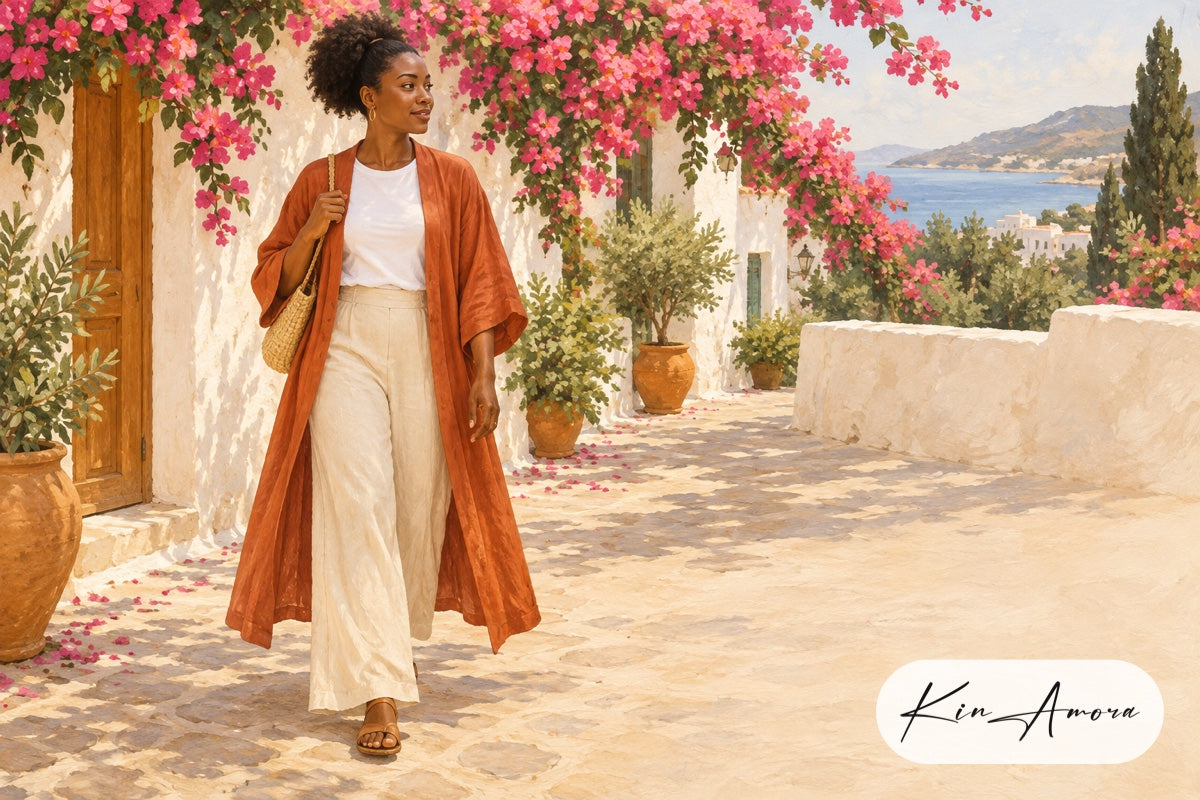
Moroccan-made relaxed clothing at Kin Amora, the Classic Kimono and Stella Wide Leg
Kin Amora's clothing is handmade by local artisans in Morocco in a 60% cotton, 40% rayon blend, according to its product pages, and two of its best-selling handmade pieces show the relaxed side of Moroccan-made dress. Measured against the 5 checks above, Kin Amora names the country, the makers as local artisans and the fiber content, and it has not published a workshop city.
- The Classic Kimono costs $210 in One Size, in Black or White. Kin Amora cuts it oversized and loose, with a subtle upside-down-triangle patchwork in the upper back, and it fits many sizes, including plus.
- The Stella Wide Leg costs $165 in Small, Medium or Large, in Black, White, Cacao, Classic Striped or Tobacco. It has a front panel, an elastic back and pockets, and the waist can be tailored on request through the order notes.
Choose these pieces for a loose, kaftan-like line that travels well. Choose a label above instead for a traditional caftan, a handwoven djellaba or a named workshop city.



