
What do Moroccan women wear to the beach?
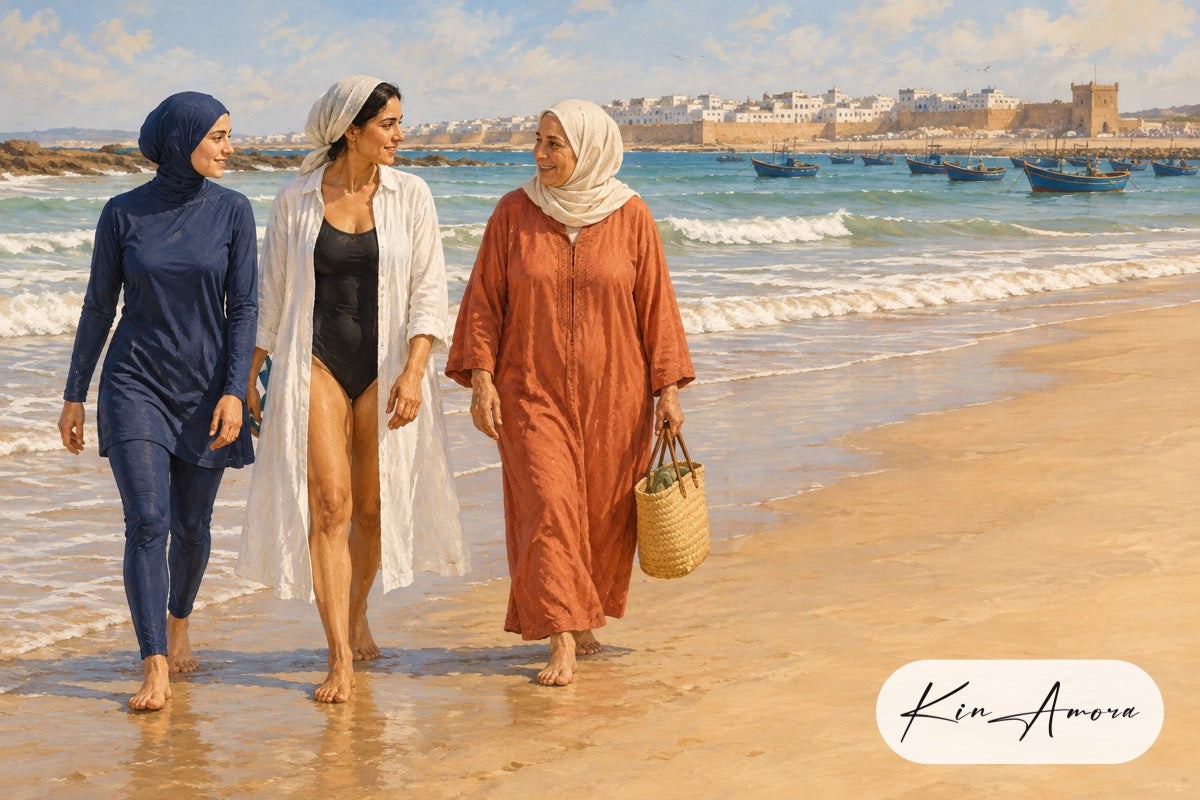
Moroccan women wear swimsuits, burkinis or everyday clothes to the beach, and the 3 choices appear side by side. Morocco's tourism minister Lahcen Haddad said in 2016 that the burkini and the bikini coexist on Moroccan beaches, according to Morocco World News. Africanews reported the same year that Moroccans were increasingly wearing the burkini on the beaches of Rabat.
Moroccan women's beachwear falls into 4 groups.
- Bikinis and one-piece swimsuits, the same suits sold at any beach in Europe or the US.
- Burkinis, full-cover swimsuits that leave only the face, hands and feet bare.
- Everyday clothes worn into the water, such as leggings, tracksuit pants, shorts and T-shirts.
- Headscarves, worn by some women with any of the outfits above.
Everyday clothes in the water are part of the mix. AFP found swimmers on Rabat's beaches in Bermuda shorts, tracksuit pants, leggings and denim shorts in 2018. The choice of group belongs to the woman, and the next 2 questions look at the swimsuit and the burkini in turn.
Do Moroccan women wear bikinis?
Yes, Moroccan women wear bikinis and one-piece swimsuits, and the tourism minister described bikinis and burkinis sharing Moroccan beaches in 2016. Morocco has no national law that sets what citizens wear, and the headscarf is neither required nor banned. The choice depends on the woman, her family and the beach she visits.
What is a burkini?
A burkini is a swimsuit that covers the entire body except for the face, feet and hands, according to Merriam-Webster, which dates the word to 2002 as a blend of burka and bikini. Moroccans living abroad introduced the burkini to Moroccan beaches, and the trend was advancing slowly in Rabat in 2016, Africanews reported. Cost shapes the choice. A burkini cost about 500 dirhams (about $56) on average in Rabat in 2018, out of reach for most beachgoers in the capital, according to AFP.
What covers up at a Moroccan beach?
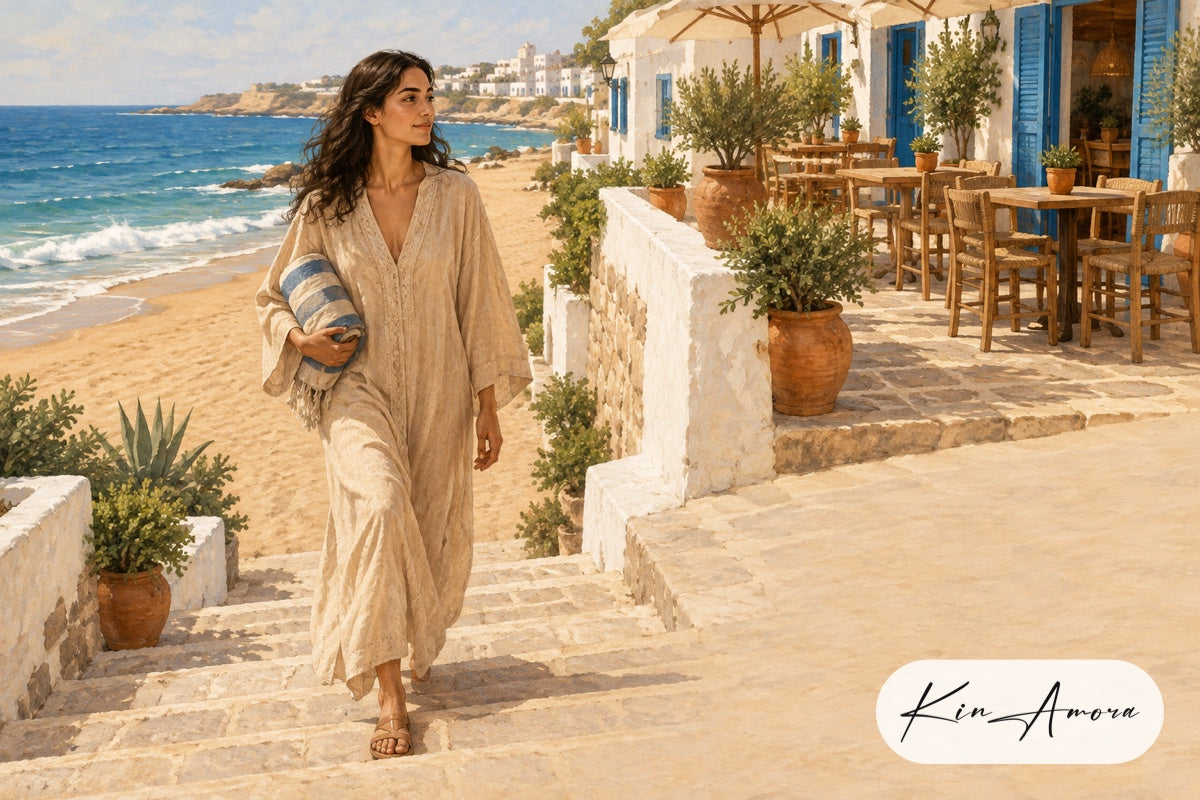
A cover-up for a Moroccan beach is any loose layer that covers the shoulders and knees for the walk from the sand into town. Beach norms stop at the promenade, and covered shoulders, chest and knees are the respectful standard in cities, villages and near mosques. A cover-up does its job in 2 places, the beach café and the street behind it.
Beach cover-ups come in 5 common shapes, compared below by coverage and best use.
| Cover-up | Coverage | Fabric to look for | Best for |
|---|---|---|---|
| Kaftan or caftan dress | Shoulders to ankle, with sleeves | Cotton, cotton-rayon or linen | Walking into town, lunch |
| Gandora | Shoulders to calf or ankle, with or without sleeves | Light cotton | Hot afternoons |
| Long tunic over leggings | Shoulders to thigh, legs covered | Woven cotton or cotton jersey | Swimming and walking in one outfit |
| Open wrap dress | Shoulders to knee or ankle, open front | Light woven | Quick changes over a swimsuit |
| Large scarf or sarong | Hips or shoulders | Cotton | Sitting on the sand |
A kaftan-style dress covers the most in one piece, while an open wrap goes on and off fastest between swims. The gandora is a light tunic in cotton or wool, cut with or without sleeves, and the cotton version suits the beach. Seasons, mosque rules and a full list for the trip are set out in the respectful Morocco packing guide.
Where does beachwear change in Morocco?
Beachwear in Morocco changes with the setting, from public city beaches to resort towns to private pools. Each setting has its own norms, and each woman decides within them.
What do women wear on city beaches such as Rabat?
Women on city beaches such as Rabat wear the full range, from swimsuits to burkinis to leggings and T-shirts. Africanews found the burkini spreading on Rabat's beaches in 2016, and AFP found swimmers there in everything from leggings to denim shorts in 2018. A retiree told AFP in 2018 that Moroccans living abroad brought the burkini to beaches in the north on their summer visits.
What do women wear in resort towns such as Agadir and Essaouira?
Women in resort towns such as Agadir and Essaouira wear swimwear on the beach and a cover-up beyond it. Swimwear stays on the beach in these towns, while medinas and villages call for more coverage. Agadir's coast stays milder than the interior, with an August average high of 80.6°F (27.0°C) on 1991 to 2020 climate normals.
Can you wear a burkini in Moroccan hotel pools?
No, not in every Moroccan hotel pool, because some hotels and private beaches ban the burkini. Women denied entry for wearing one said they wear it for religious reasons and for sun protection, Bladi reported in July 2024. The report cited no law or ministry rule, so the ban is each venue's own policy. Ask the hotel about its pool dress rules before you book.
Why do Moroccan women choose different beachwear?
Moroccan women choose different beachwear for faith, sun protection, cost and personal taste. Religion leads the reasons for covering the hair, with 62.5% of 1,320 young Moroccans calling the veil a matter of the Muslim religion in a 2021 survey by Menassat for Social Research and Studies, as reported by Bladi. Sun protection is a second reason women gave Bladi for the burkini in 2024. Cost is a third, since a 500-dirham burkini is beyond many budgets. The wider wardrobe, from djellabas to headscarves, is covered in what Moroccan ladies wear outside the home.
How did the kaftan reach modern relaxed clothing?
The kaftan reached modern relaxed clothing through Paris couture in the 1950s and 1960s and travelers returning home in the late 1960s, centuries after it reached Morocco. That path explains why a loose kaftan now hangs on beach racks far from North Africa.
Where does the kaftan originate from?
The kaftan originates from the ancient Near East, as a man's full-length garment of Mesopotamian origin worn throughout the Middle East, according to Encyclopaedia Britannica. Britannica describes the caftan as usually made of cotton or silk, with long, wide sleeves and an open front often bound with a sash.
Was the kaftan worn in the Ottoman Empire?
Yes, the kaftan was worn in the Ottoman Empire, where high-ranking officials wore it, according to the Fashion Institute of Technology's Fashion History Timeline. The garment was known in Persia and the Ottoman Empire before it arrived in Morocco, probably in the 16th century, according to the Metropolitan Museum of Art.
How did the kaftan become a beach cover-up?
The kaftan became a beach cover-up after Western designers and travelers turned it into loose resort wear. An ankle-length, coat-like garment with wide sleeves became fashionable for women's evening wear in the mid-20th century and was called a caftan, Britannica notes. Christian Dior and Cristóbal Balenciaga added kaftan-like styles in the 1950s and 1960s, and travelers on the hippie trail brought traditional kaftans home to the United States and Europe, according to Nico Frederick's 2022 FIT entry. The beach kaftan keeps the full length and wide sleeves of that cut.
How should different beachgoers use this guide?
The notes below give one practical angle for each kind of beachgoer.
For visitors. A swimsuit is fine on the beach in Morocco's resort towns, and a cover-up that reaches the knees and shoulders goes on before the promenade. Ask before photographing women on the beach, since many prefer to be asked first.
For modest swimmers. A burkini, or swim leggings with a long-sleeved swim top, gives full cover in the water. Check the pool rules first, since some Moroccan hotels and private beaches ban the burkini.
Beach cover-ups at Kin Amora, the Goddess Wrap Dress
The Goddess Wrap Dress ($175) is Kin Amora's billowing, soft, open wrap dress for the beach, a festival or home, and it can be worn a few different ways. It comes in One Size Fits Many, in White, Berry or Black. The product page gives no fabric content, so check the sewn-in label before the first wash. The Goddess Wrap Dress is not a kaftan, and it covers through an open wrap rather than a pull-on body.
The Goddess Wrap Dress suits anyone who wants a light layer that goes on and off over a swimsuit between swims, and a dress that moves from the sand to a beach lunch. It doesn't suit anyone who needs a garment to swim in, or a closed, sleeved dress for a medina walk, where a long gown with sleeves covers more. Kin Amora's Sahara Sleeveless Vest ($110, 60% cotton, 40% rayon, handmade in Morocco) is a shorter beach cover-up for the same job. Choose your color of the Goddess Wrap Dress for beach days and pack it beside your swimsuit.