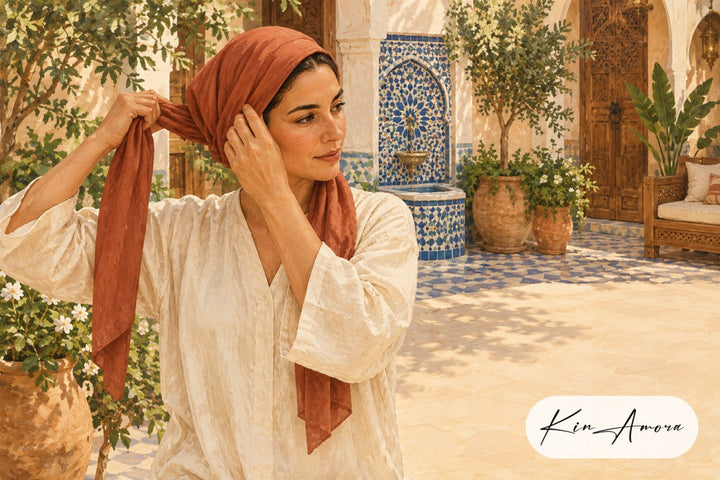

What is the history of the Moroccan kaftan?
The history of the Moroccan kaftan is the story of an imported robe that Moroccan weavers, tailors and dynasties turned into a celebration garment. The type of garment called a kaftan was known in Persia and the Ottoman Empire before it arrived in Morocco, probably in the 16th century, according to the Metropolitan Museum of Art. Moroccan accounts reach further back. Yabiladi's 2026 series on the caftan, drawing on Morocco's UNESCO nomination file, places a simple form under the Almoravids (1056 to 1147) and the garment's defining features under the Marinids (1248 to 1465).
The Moroccan kaftan passed through 8 stages, shown below with the source behind each one.
| Period | What changed | Source |
|---|---|---|
| Ancient | A full-length robe of Mesopotamian origin is worn across the Middle East | Encyclopaedia Britannica |
| 11th to 15th centuries | A simple tunic under the Almoravids gains its defining features under the Marinids | Yabiladi, citing Morocco's UNESCO file |
| Early 16th century | Leo Africanus describes a long garment open at the front, worn by men and women in Fez | Description of Africa, via Yabiladi |
| 16th century | The kaftan arrives from Persia and the Ottoman Empire, by the Met's dating | Metropolitan Museum of Art |
| Saadian era (1549 to 1659) | Court dress grows richer, and the muslin mansouria is worn over the kaftan | Yabiladi |
| 19th century | Rabat's kaftan takes a distinct form by 1880, and luxury cloth arrives from Lyon | Yabiladi, the Met |
| 1960s to 1980s | Designer Zina Guessous cuts a kaftan worn over a European-style underdress | Victoria and Albert Museum |
| 1996 to 2025 | Femmes du Maroc launches an annual caftan show, and UNESCO inscribes the Moroccan caftan | Morocco World News Lifestyle, UNESCO |
The dates differ by source, but every account ties the kaftan's growth to the cloth trade of Fez and to Andalusian craft.
Where does the kaftan come from?
The kaftan comes from the ancient Near East, as a full-length robe of Mesopotamian origin, according to Encyclopaedia Britannica. Britannica describes the original caftan as a man's garment, usually of cotton, silk or both, with long, wide sleeves and an open front often bound with a sash. The Fashion History Timeline of the Fashion Institute of Technology (FIT) traces the robe through ancient Persia and the Ottoman court, whose Turkish name for its long formal coats gave English the word in the late 16th century.
When did the kaftan reach Morocco?
The kaftan reached Morocco by the 16th century at the latest, and Moroccan sources place an early form several centuries before that. A 2016 BBC News report by Nora Fakim described the kaftan as a women's dress that dates back to at least the 16th century. In the early 16th century, the traveler Hassan al-Wazzan, known as Leo Africanus, described the Fez caftan as a long garment open at the front and worn by both men and women, as Yabiladi quotes him.
How did Andalusian craft shape the Moroccan kaftan?
Andalusian craft shaped the Moroccan kaftan through the weaving and embroidery that refugee families carried to Fez and Tetouan. After the fall of Granada in 1492, Andalusian Muslim and Jewish families took refuge in northern Morocco, and Andalusian refugees partly rebuilt Tetouan in the 16th century, Yabiladi reported in March 2026. Brocade weaving in Fez dates back to the 13th century, and designer Aziza Belkhayat told Yabiladi that Andalusian families in Fez passed those skills on.
What did the Saadian sultans add?
The Saadian sultans added a political message and a new over-layer, the mansouria. Ahmad al-Mansur took the throne in 1578 and revived Moroccan-style dress, after his brother Abd al-Malik had adopted Ottoman court attire, according to a 2024 Yabiladi article by Latifa Babas that cites historian Nabil Mouline. The mansouria was a long, wide-sleeved garment of fine muslin made for al-Mansur and worn over the caftan. The Met holds an early 20th-century farasia in cotton and silk, a thin, sheer over-kaftan worn by high-ranking members of the Moroccan elite.
How did the kaftan change in the 19th and 20th centuries?
The kaftan changed in its cloth, its cut and the people who designed it. By the 19th and 20th centuries, Morocco imported luxury fabric from Lyon, France, and the Met says a brocaded silk kaftan of that period was likely made for an elite, cosmopolitan city dweller. Rabat's kaftan became distinctly defined by 1880, as an urban fashion scene grew around Sultan Hassan I's court, Yabiladi reports. In mid-20th-century Tetouan, the kaftan closed at the front, sleeves shortened to show the forearm, and brighter floral fabrics spread.
Moroccan couturiers led the next change. The Victoria and Albert Museum holds a kaftan by Zina Guessous, made between 1960 and 1980 and worn over a European-style sleeveless underdress. The magazine Femmes du Maroc launched its caftan show in 1996, according to Morocco World News Lifestyle (2025). UNESCO inscribed "Moroccan Caftan, art, traditions and skills" on its Representative List of the Intangible Cultural Heritage of Humanity in December 2025.
What is a Moroccan kaftan?
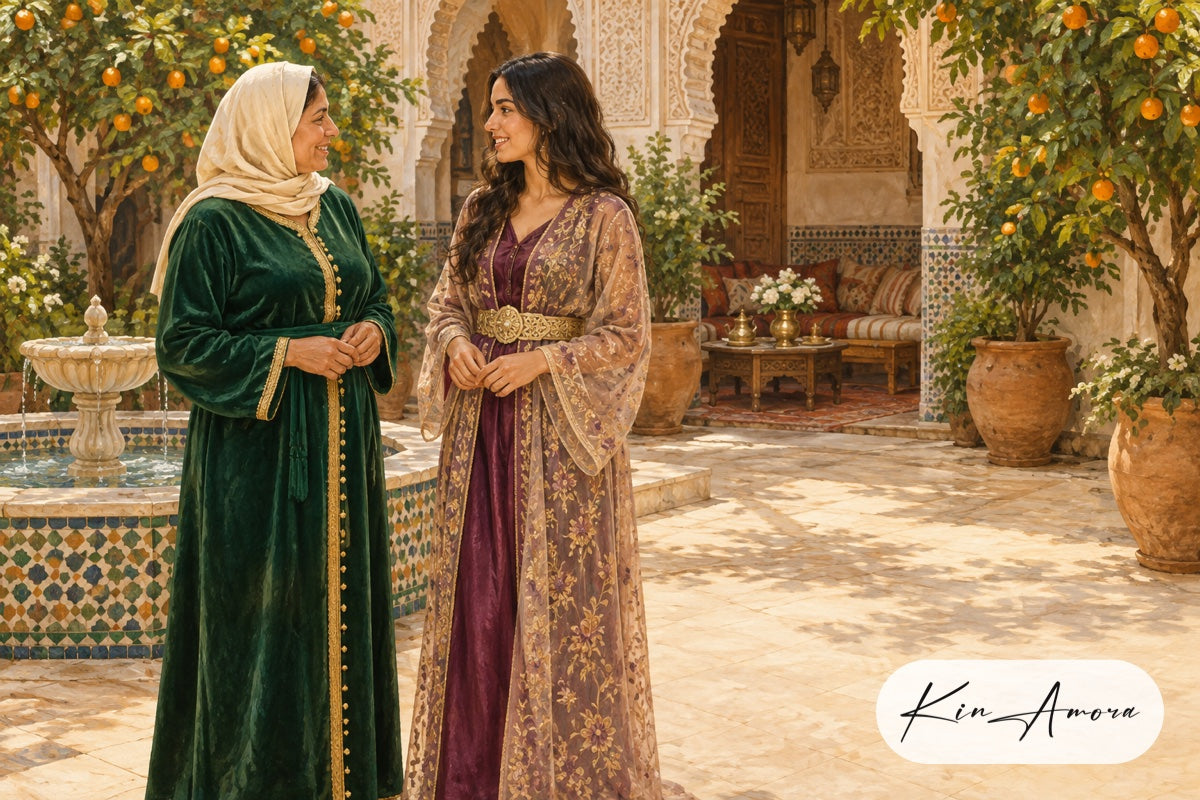
A Moroccan kaftan is a long tunic with a central front opening, buttons and handmade decoration, worn for special occasions by people of all genders and ages, as UNESCO describes it. The kaftan has no hood, which separates it from the djellaba, and it is typically worn with a fabric belt, according to the Met.
A Moroccan kaftan has 5 defining parts.
- The front opening, running down the center from the neck to the hem.
- The buttons, called âqad, set in a long row along the opening.
- The sfifa, a braided trim that runs along the opening.
- The embroidery, from gold-thread florals to beads and sequins.
- The belt, a silk or gold-thread mdamma worn at the waist.
Each part is its own trade, and UNESCO names weavers, tailors and the makers of buttons, braids and embroidery as the kaftan's practitioners.
What is a kaftan shirt?
A kaftan shirt is a hip-length cut of the kaftan's loose, wide-sleeved shape, worn over trousers or shorts instead of as a full robe. A kaftan shirt belongs to resort and casual dress, not to Moroccan celebrations. A caftan dress is the dress-length form of the same loose cut, with a straight body and wide sleeves. Length decides the name in Western shops, and the comparison of a caftan dress versus kaftan top sets out the cut, sleeves and fabrics of each.
What are Moroccan kaftans called?
Moroccan kaftans are called kaftan or caftan for the single robe and takchita for the 2-layer ensemble, and regional and fabric names sit on top of both. Caftan and kaftan are 2 spellings of one word. The over-layer has carried the names mansouria, farajiya and dfina across the centuries. A Fez brocade kaftan is called behja, a name that refers to joy and the cloth's bright colors, designer Aziza Belkhayat told Yabiladi. The hooded robe, the hoodless tunic and the loose trousers each have their own entry in the guide to traditional Moroccan garment names.
What types of Moroccan kaftan are still worn today?
Moroccan kaftans still worn today come in 2 constructions, the single kaftan and the takchita, cut in at least 6 regional styles. The table lists each type with its layers, signature detail and usual cloth.
| Type | Layers | Signature detail | Usual cloth |
|---|---|---|---|
| Single kaftan | 1 | Front opening with âqad buttons and sfifa trim | Silk, velvet or brocade |
| Takchita | 2 | Under-dress beneath a sheer or embroidered over-dress, belted with a mdamma | Silk or velvet under a lighter top layer |
| Fassi (Fez) | 1 | Handwoven brocades such as behja and khrib, gold-thread florals | Brocade, velvet |
| Tetouani (Tetouan) | 1 | Long cut, wide sleeves, khanjar embroidery, worn open over a sadria | Silk, brocade, velvet |
| Rbati (Rabat) | 1 | Loose cut, very wide sleeves, gold braids in floral or geometric motifs | Velvet |
| Slaoui (Salé) | 1 | Fine gold-thread qitane embroidery | Silk, velvet, brocade |
| Rif and Oriental | 1 | Beaded kaftans with dense taâmar embroidery | Silk, brocade |
| Amazigh | 1 | Decoration balanced with daily practicality, cut for the local climate | Varies by region |
The first 2 rows describe construction, and the regional rows describe finish and cloth. The guide to what kaftans are made of explains why cotton wins in heat.
What is a takchita?
A takchita is a 2-piece kaftan, an under-dress worn beneath a decorated over-dress and cinched with a belt. A 2025 paper from the Fashion Research Collection at Toronto Metropolitan University describes the mansouria or takchita as an embroidered kaftan of silk or velvet topped with a transparent overlay called the dfina, usually in a matching color. The under-dress is called the tahtia and the belt the mdamma. The dfina carries the Saadian over-layer forward, since Jean Besancenot's 1942 study Costumes of Morocco likened the mansouria to the dfina of the towns, as Yabiladi reports.
How do Fez, Tetouan and Rabat kaftans differ?
Fez, Tetouan and Rabat kaftans differ in cloth, embroidery and sleeve width. Fez is known for handwoven brocades such as behja, a silk with floral motifs in ochre and yellow, and khrib, woven with gold thread. Only 1 master weaver, Haj Abdelkader Ouazzani of Fez, still weaves khrib, Yabiladi reported in July 2026. Tetouan's kaftan carries khanjar embroidery, a floral motif named after the Moroccan dagger and worked in gold and silver thread. Rabat's kaftan has a loose cut, broad sleeves and gold braids, often on velvet, designer Fadila El Gadi told Yabiladi. Salé favors fine qitane embroidery in a lighter, more balanced design.
Who wears the Moroccan kaftan today?
Moroccan women wear the kaftan most, for weddings, baptisms, coming-of-age rituals, Eid and festivals, and UNESCO's description covers people of all genders and ages. Tailored Eid kaftans started at about $200 in 2025, according to Africanews. A 2016 BBC News report found kaftans selling from €200 to about €2,000 at a Marrakech couture boutique, with some pieces taking months to finish.
Can men wear a Moroccan kaftan?
Yes, men can wear a Moroccan kaftan, and Leo Africanus described men and women in Fez wearing it in the early 16th century. UNESCO's 2025 listing describes a garment worn by all genders. Moroccan men's celebration dress today centers on the djellaba and the jabador, worn with yellow belgha slippers.
How does a kaftan differ from a kimono or a duster?
A kaftan differs from a kimono and a duster in how it closes and what it is worn for. A Moroccan kaftan closes down the front with a long row of buttons and dresses the wearer for a celebration. A kimono cardigan and a duster hang open as light layers over everyday clothes. The table compares the 3 on 5 attributes.
| Attribute | Moroccan kaftan | Kimono cardigan | Duster |
|---|---|---|---|
| Origin | Near Eastern robe, in Morocco since at least the 16th century | Japanese kimono, a robe wrapped left over right and tied with an obi | Dust coats of 19th-century American riders |
| Length | Ankle or floor | Hip to ankle | Past the knee, often mid-calf or ankle |
| Front | Closed with buttons, belted | Open, T-shaped | Open, sometimes buttoned or tied |
| Sleeves | Long, often wide | Wide, dropped from the shoulder | Full or three-quarter |
| Worn for | Weddings, Eid, festivals | Warm days, open over a fitted base | Travel and layering over pants or a dress |
Choose a kaftan for a Moroccan wedding or Eid, a kimono for a short open layer in heat, and a duster for a long open layer that moves with each step.
Are kaftans Moroccan or Algerian?
Kaftans are both Moroccan and Algerian, and the robe itself is older than either tradition. UNESCO inscribed the Moroccan caftan in 2025. UNESCO inscribed Algeria's women's ceremonial costume of the Eastern region, which includes the gandoura, the melehfa and the caftan, in 2024. In 2025 the committee renamed that element and added "the Wearing of the Caftan" to Algeria's 2012 Tlemcen bridal costume entry, Yabiladi reported. Each listing records its own community's skills and customs.
How did the kaftan reach Western fashion?
The kaftan reached Western fashion through Paris couture in the 1950s and 1960s and the hippie trail of the late 1960s. Christian Dior and Cristóbal Balenciaga added kaftan-like styles in those decades, and hippie-trail travelers brought traditional kaftans home to the United States and Europe, according to Nico Frederick's 2022 entry in FIT's Fashion History Timeline. Yves Saint Laurent and Pierre Bergé first traveled to Marrakech in 1966, and Saint Laurent drew on local scarves, tunics and caftans for his designs, Jeff Koehler wrote in AramcoWorld in 2021.
How should different readers use this history?
The notes below turn the history into practical guidance for 2 kinds of reader.
For wedding guests. A Moroccan wedding calls for a tailored kaftan or takchita, not a beach caftan. Ask the host family what they expect, and order early from a Moroccan workshop.
For buyers in Morocco. Ask whether the cloth is handwoven brocade or Haj Omar, a cheaper machine-woven fabric that often includes polyester, according to Yabiladi (2026).
Kaftan-inspired long dresses at Kin Amora, the gowns collection
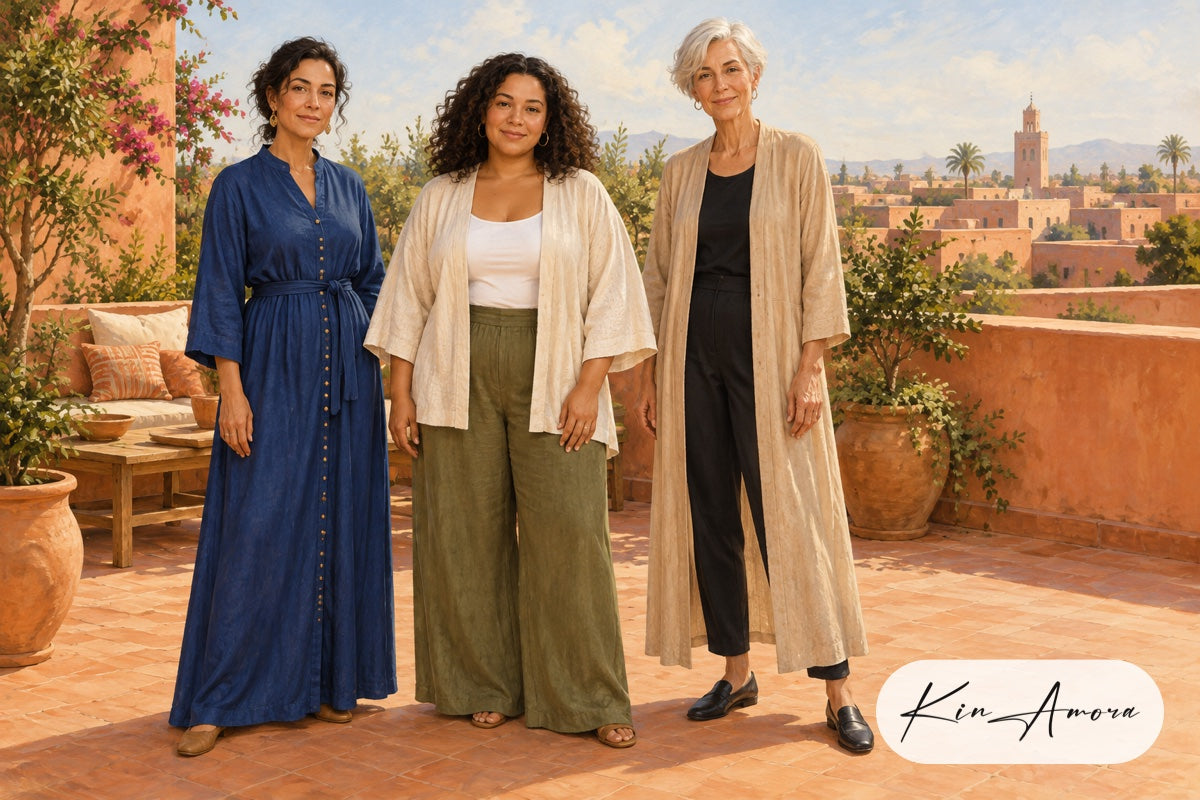
Kin Amora does not sell kaftans. The gowns collection holds long, relaxed dresses that share the kaftan's full length through different cuts, and the 3 below are cut from 60% cotton, 40% rayon and handmade in Morocco.
- The Goddess Gown ($145) is Kin Amora's long dress, with full-length sleeves and pockets at hip level, in One Size Fits Many up to size 10, in Black, White, Olive, Miami Mango or Royal Blue. Tailoring is available on request through the order notes.
- The Desert Dweller Dress ($328) is a double-layered dress worn several ways, with a button at the corner of each shoulder and a top layer worn side to side or cross-body, in One Size Fits All, in White, Olive, Miami Mango, Forest Wash or Turquoise Wash.
- The Seychelles Gown ($179) is a V-neck tank gown with 2 layers, ruched on both sides at the bottom, in One Size Fits All, in White or Tan.
The Goddess Gown suits anyone up to size 10 who wants a sleeved, full-length dress with the kaftan's covered line. The Desert Dweller Dress fits most comfortably at a 24 to 32 inch waist and a height of 5'2" to 6', its page says. These dresses don't suit a guest who needs a tailored kaftan or takchita for a Moroccan wedding, or anyone who wants a buttoned front opening. Browse all the relaxed handmade long dresses and add your waist measurement in the order notes for a tailored fit.