
What does "handmade" actually mean for clothes?
In clothing, "handmade" means a person guided the garment through its construction, not that no machine was used. The FTC's textile labeling guide doesn't define the word. Etsy's Creativity Standards, first announced on July 9, 2024 and revised in June 2025, count items a seller makes by hand, or with their own tools from their own original designs, as "made by a seller."
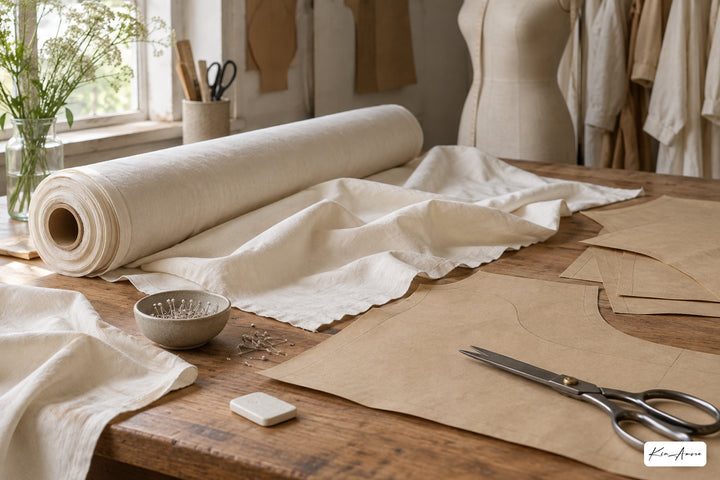
So a skilled sewer usually runs the long seams on a machine and saves hand work for the places it shows: hems, buttonholes, knots, fringe, a facing tacked down inside.
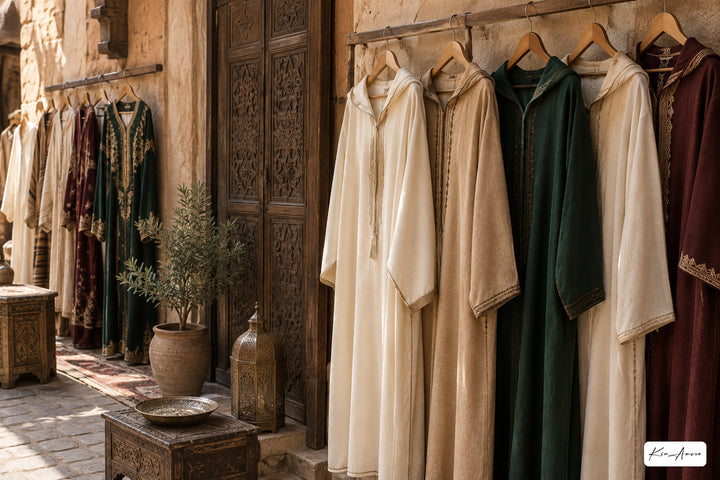
Morocco has its own long tradition of artisan-made clothing, and that's where our clothing comes from: Kin Amora pieces are made from a 60% cotton, 40% rayon blend and are handmade by local artisans in Morocco.
A handmade garment also isn't the same as cloth woven on a hand loom, a separate craft we trace through weaving in Fez.
Handmade vs machine-made clothing compared
Handmade and machine-made clothing differ most in how the work is divided. In a make-through setup, one tailor works from a pattern, cuts, sews and finishes a garment. In the progressive bundle system adopted by most export-oriented factories, cut pieces move in bundles and each operator performs one operation, according to textile engineer Prasanta Sarkar.
| Handmade (make-through) | Machine-made (factory line) | |
|---|---|---|
| Who builds it | One maker or small team, cut to finish | Each operator repeats one operation |
| Inside finish | Serged, or enclosed French and flat-felled seams | Usually serged (overlocked) edges |
| Hand stitching | Hems, buttonholes, knots, fringe | Rare outside premium tailoring |
| Piece-to-piece variation | Small differences in drape and hem points | Near-identical units |
| Speed | Slow, skill-heavy | Fast, since operators specialize |
Each check below looks for evidence that one pair of hands made decisions about your garment.
How to tell if clothing is handmade
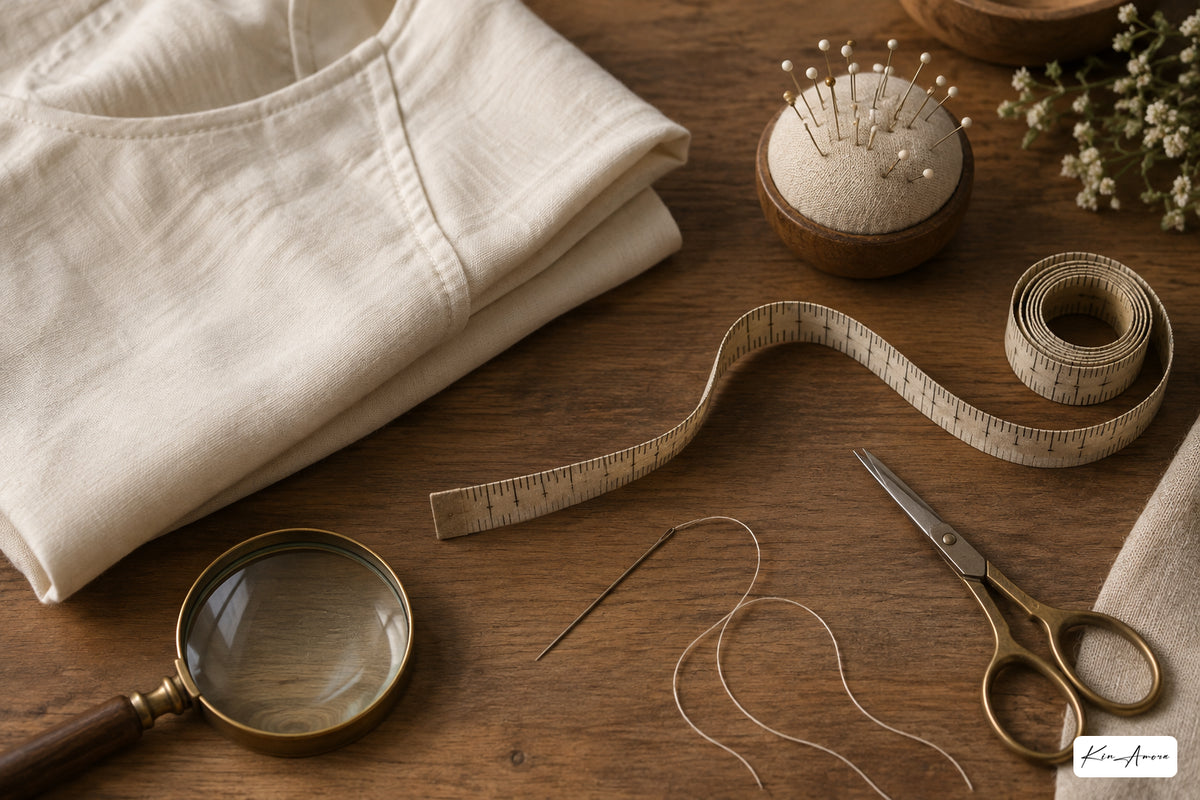
Six checks give you a good read: the label, the inside finish, hand-worked details, small irregularities, how patterns line up at the seams, and how well the maker answers questions. No single sign proves a piece is handmade. Read them together, under good light, with a phone magnifier if you have one.

1. Read the label for who and where, not how
US textile labels must list fiber content, country of origin and the manufacturer or dealer (an RN number can replace the name), per the FTC guide. None of that says how the piece was sewn. A maker's or studio's name on the tag is a better hint than the word "handmade," which is a claim, not a certification.
2. Turn the garment inside out
Serged (overlocked) edges are wrapped in loops of thread, and Grainline Studio's seam-finish guide notes they construct and finish a seam in one pass. A French seam fully encloses the raw edge; a flat-felled seam overlaps the allowances and stitches them down. Enclosed seams take extra minutes, so they hint at slower work. Plenty of small makers serge too, so serging doesn't rule handmade out.
3. Look for hand-worked details
Buttonholes are the classic tell. Thread maker AMANN links hand-sewn buttonholes to bespoke tailoring and singles out the spiral-stitched Milanese buttonhole as hand work. On relaxed pieces without buttons, check fringe: hand-tied knots sit at slightly varied spacing.
4. Expect small irregularities
Compare two of the same item, in a shop or in two product photos. Handmade pointed hems and drape can differ by a fraction of an inch from piece to piece. A hem that dips badly or a seam that puckers is sloppy work, handmade or not.
5. Check how stripes and prints meet
Stripes that line up across a side seam show care at cutting, which is easier when pieces are cut one at a time rather than from a tall stack of layers. Good factories match too, so treat this as supporting evidence.
6. Ask the maker specific questions
Ask who sewed the piece, which steps are done by hand, and whether it can be adjusted. A brand that works this way can answer in specifics; "crafted with love" tells you nothing about construction.
What are the signs of hand-finished seams?
Hand-finished seams show slightly uneven stitch lengths, a single thread rather than two interlocked threads, and knotted or buried thread ends. On hems, look for tiny dots of thread on the outside spaced by eye, not by a machine. Machine stitching repeats the same length at the same tension along the whole seam.
The number of threads is the clearest test. A machine lockstitch joins a top thread with a bobbin thread underneath, so the two sides often look different. On machine embroidery, Mary Corbet of Needle 'n Thread points out that the bobbin thread is often white, leaving white stitching on the back. A hand stitch is one thread going in and out.
Machines sew blind hems too, but they catch the outer fabric at a perfectly regular interval. A hand blind hem wanders a little. Check the hem, neckline facings, armholes and closures, since many handmade garments are machine-sewn at the seams and hand-finished at these edges.
Why is handmade clothing more expensive?
Handmade clothing costs more because labor, a tiny slice of a factory garment's price, takes a much larger share. The Clean Clothes Campaign estimates that production wages scarcely exceed 3% of the retail price for most items, about €3 on a €100 garment. Handmade work needs more skilled hours per piece.

In a make-through setup the maker needs every skill on the garment, and nobody gets faster by repeating one operation all day. Small runs add cost too: fabric and trims bought in smaller quantities cost more per yard, and pattern and sample work is spread over fewer pieces.
Price alone proves nothing, though. The Clean Clothes Campaign notes that the wage share is even smaller for luxury goods, so a high tag can sit on a factory-made piece.
What does small batch mean in fashion?
Small batch means a style is produced in a limited run, then restocked or retired, instead of being made continuously in large factory orders. The term has no fixed number, and no labeling rule makes a brand disclose how many pieces it made. It's only as meaningful as the brand's willingness to tell you.
For a buyer, that means a size or color you like may sell out and not come back in the same form. Small batch and handmade also aren't the same thing: a factory can run a few hundred units of a style, and a handmade label can remake one style for years. Whether either counts as slow fashion is a bigger debate for another day.
Is handmade clothing worth buying?
Handmade clothing is worth it when you'll wear the piece often and the signs above check out. Use a simple rule: if at least three of the six checks point to hand-guided work and the maker answers your questions plainly, the higher price is paying for skilled hours.
Most single pieces at Kin Amora sit between $98 and $165, and you can run every one of these checks on our handmade artisan tops once they're in your hands.
Shop Related Products
Explore the pieces, colours and sizing on the Kin Amora store.

Marra Cowl Neck Top
$155.00 USD
View product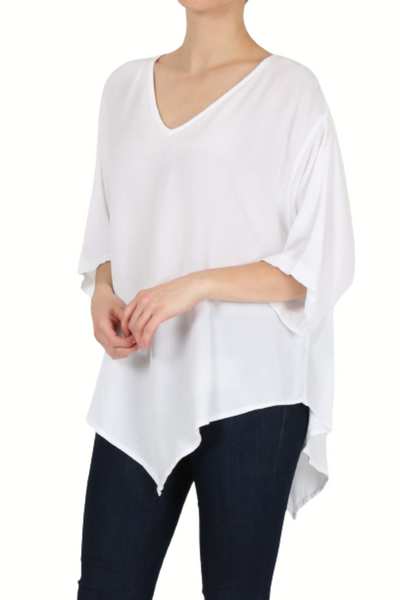
Lisbon Top
$110.00 USD
View product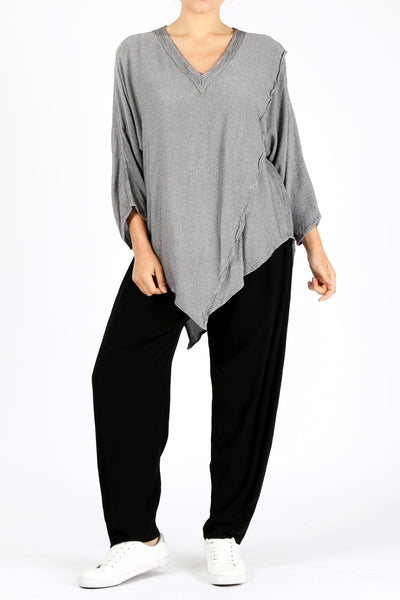
Milan Long Sleeve
$145.00 USD
View productFrequently Asked Questions
Does handmade clothing last longer than machine-made clothing?
Not automatically. Durability depends on the fabric, the seam type and how you care for the piece. A flat-felled seam is built to take stress whichever way it was sewn, while a carelessly finished handmade hem can fail early.
Is "handcrafted" the same as "handmade"?
In practice, yes. The FTC's textile labeling guide doesn't define either word, so brands use them interchangeably. Ask which steps were done by hand, because that answer means more than the label term.
How can I tell if embroidery on a garment is done by hand?
Turn it over. Mary Corbet notes that machine embroidery often shows white bobbin thread on the back and fills shapes with stitches running straight across instead of turning with the shape. She treats these as clues, not proof, since a skilled hand embroiderer can do the same.
Is "handmade" on a clothing label a certification?
No, "handmade" on a clothing label is a claim, not a certification, and the FTC's textile labeling guide has no definition of the word. US labels must list fiber content, country of origin and the manufacturer or dealer, but none of that says how the piece was sewn. A maker's or studio's name on the tag is a better hint than the word itself.
Does a high price mean clothing is handmade?
No, a high price doesn't prove clothing is handmade, because a high tag can sit on a factory-made piece. The Clean Clothes Campaign estimates that production wages scarcely exceed 3% of the retail price for most items, and it notes the wage share is smaller yet for luxury goods. The label, the inside finish and hand-worked details give you a better read than the price.