
What is traditional Moroccan fabric?
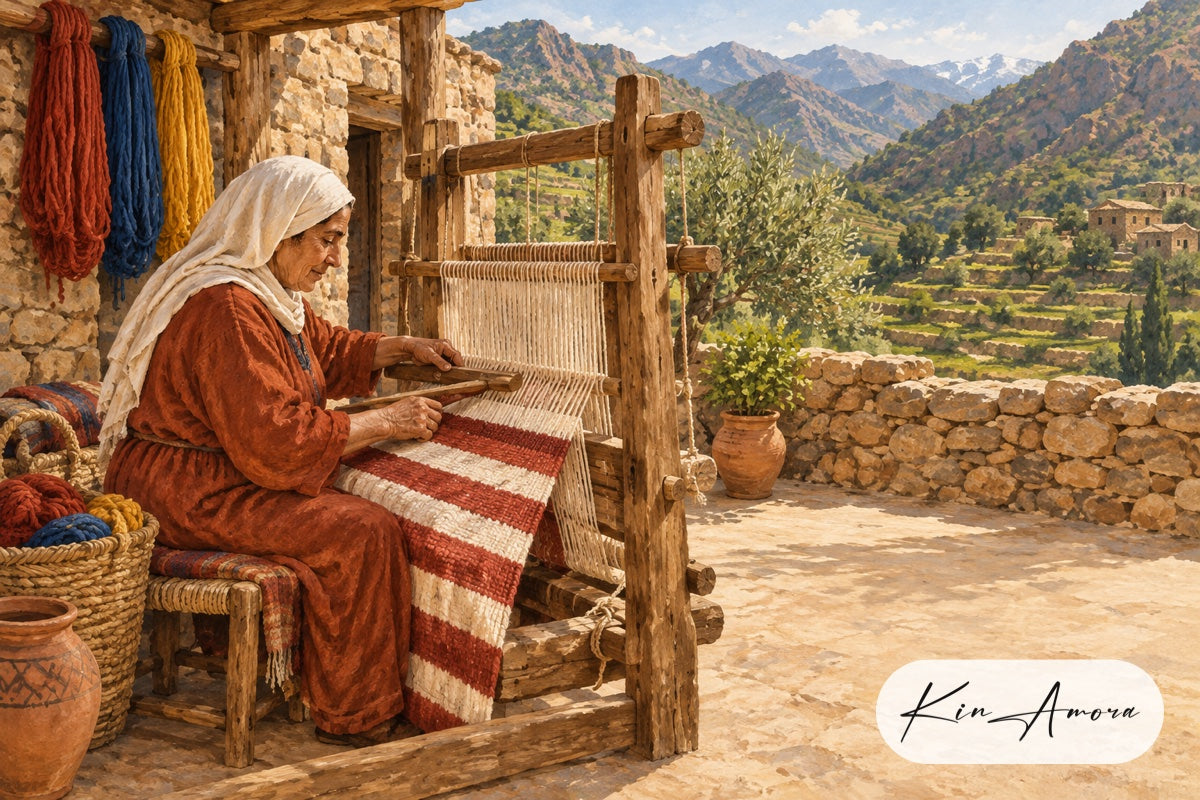
Traditional Moroccan fabric is handmade cloth in wool, cotton, silk or plant fiber, made by weaving, brocade, embroidery or felting. Maison de l'Artisan groups the country's textile crafts into embroidery, weaving and brocade, traditional couture and felting, among others. The agency names wool and cotton for djellabas, silk for ceremonial wear, and wool for warm clothes and covers. Plant fiber enters through sabra, a silky yarn that Maison de l'Artisan describes as spun from aloe fibers. Animal hair enters through the khaima, the tent that women traditionally wove from camel, sheep or goat hair.
Two traditions share the name. Rural Amazigh weaving (Amazigh is the people's own name, often written Berber in English) turns home-spun wool into cloaks, shawls, veils and rugs. City textile centers such as Fez, Rabat, Salé and Tetouan are known for brocade, embroidery and fine djellaba cloth.
What are the main types of traditional Moroccan fabric?
Traditional Moroccan fabric comes in 7 main types, such as handwoven djellaba wool, the handira, brocade and Fez embroidery. The table below sets each type against its fiber, its makers and its use.
| Type | Fiber | Made by and where | Used for |
|---|---|---|---|
| Djellaba cloth | Wool or goat hair; wool with silk | Rural looms; women weavers in Bzou | Djellabas and cloaks |
| Handira | Wool and cotton | Amazigh women, Middle Atlas | Shawls worn for weddings and funerals |
| Henna-painted veil (tadghart) | Wool decorated with cotton | Brides' mothers, Anti-Atlas | Wedding veils |
| Brocade | Silk and metal thread | City workshops, Fez and Tetouan | Belts, caftans, bridal veils |
| Embroidered cloth | Linen or cotton with silk thread | Women in Fez and Rabat | Linens, cushions, bridal sheets |
| Sabra | Aloe fiber yarn | Weavers | Silky woven cloth |
| Felt (lbada) | Sheep wool | Master felters | Fez hats, prayer rugs, saddle rugs |
Wool runs through 4 of the 7 types. The 3 types below carry the most meaning for clothing.
What is handwoven djellaba cloth?
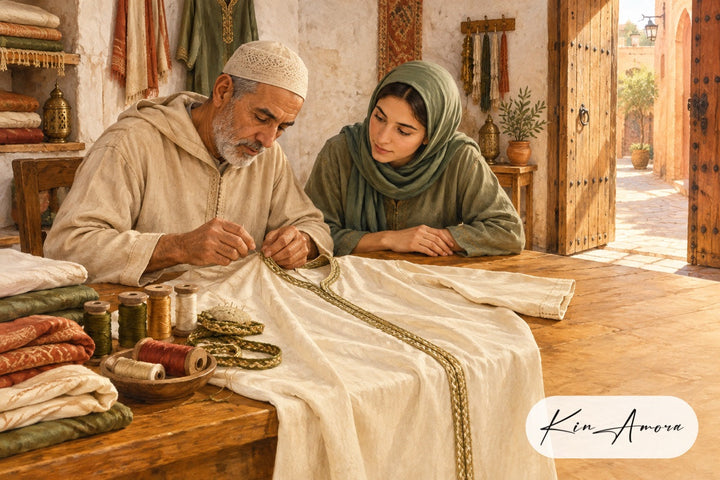
Handwoven djellaba cloth is thick wool or goat hair in russet, brown or black, according to the Encyclopédie berbère (1995). The same entry says the rural djellaba is woven in one piece with its hood and sleeves, and that mountain dialects call it tadjellabit. The Metropolitan Museum of Art holds an early 20th-century djellaba from Morocco or Algeria in wool and silk, 68 inches (172.7 cm) long. In Bzou, women still weave the djellaba bziouia from wool and fine natural silk, and one robe takes 20 days to 4 months, according to Aujourd'hui le Maroc (2024).
What is a handira?
A handira is a wool and cotton shawl woven by Amazigh women in the Middle Atlas, according to the Textile Museum of Canada. The museum's mid-20th-century example alternates wide stripes of undyed ivory wool with red stripes carrying geometric motifs in other colors. Women often wove handiras for occasions from weddings to funeral processions. The museum notes that cochineal, brought from the Canary Islands in the 19th century, spread many shades of red through these pieces.
What is Fez embroidery?
Fez embroidery is a reversible cross-stitch, often considered the most difficult embroidery style, according to Lotus Stack in AramcoWorld (1993). Stack reported that one embroidered wedding bed-sheet could take up to 2 years. The Metropolitan Museum of Art holds an 18th-century towel end from Fez in linen embroidered in silk, and a 19th-century Fez sampler in cotton embroidered in silk.
How is Moroccan fabric still woven by hand?
Moroccan wool fabric is still woven by hand in 7 steps, from sorting the fleece to weaving on the loom, following Maison de l'Artisan's sequence and the dye research of Morocco's National Museum of Weaving and Carpets.
- Sort the wool, a job done by women.
- Wash the wool, boil it and rinse it under running water.
- Comb and bleach the fibers.
- Separate the fibers into long or short wicks, depending on the use.
- Spin the wicks into yarn.
- Dye the yarn with plant or industrial dyes, fixed with an alum mordant for plant dyes.
- Weave the yarn on the loom.
Each step adds time. A single carpet takes 2 to 4 weeks on a small traditional loom, at home or in a workshop, according to an Associated Press report from Taznakht (January 2025). The loom types used in city workshops, and the drazza cloth woven for djellabas in Fez, are covered in the guide to Fez looms and drazza cloth.
Which natural dyes color traditional Moroccan fabric?
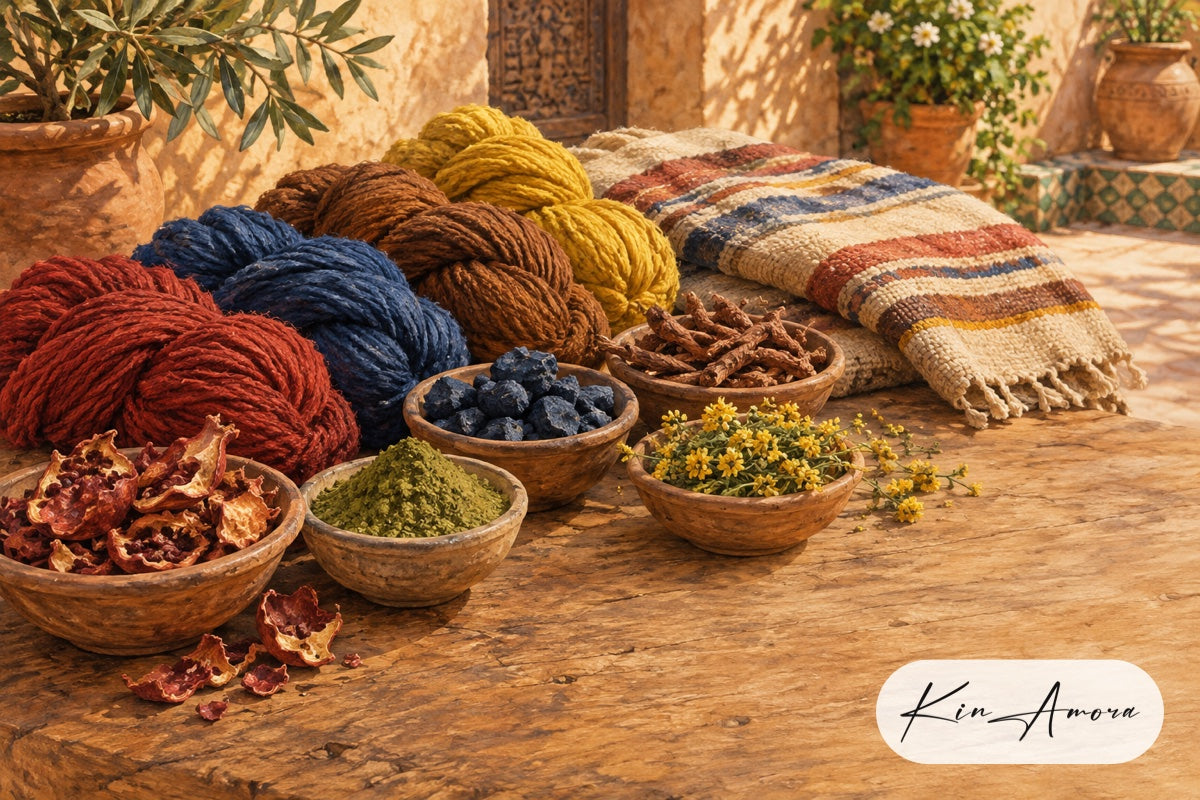
Traditional Moroccan fabric is colored with henna for brown, indigo for blue, pomegranate peel for orange and weld for yellow, according to Khalid Loukid of the National Museum of Weaving and Carpets (Dar Si Said) in Marrakech, writing for ICOM's costume committee. Each region leans on its own plants. The table below follows the dyes Loukid names by color.
| Color | Dye source | Region Loukid names |
|---|---|---|
| Red | Madder root | Haouz of Marrakech; Ait Zineb |
| Yellow and orange | Henna, pomegranate bark, saffron, dyer's broom flowers | High Atlas; Ouarzazate |
| Blue | Indigo and woad | Ouarzazate region |
| Brown | Henna, sumac, oak bark | Draa Valley; Tazenakht |
| Black | Pomegranate leaves with iron from forge slag | Siroua |
Plant dyes need a mordant, usually alum, to bind to the wool. Synthetic aniline dyes spread through Morocco from the late 1880s, and Loukid records that the French protectorate introduced a state seal in 1919 for all-wool carpets colored only with vegetable or animal dyes. Most weavers in Taznakht now use cheaper, faster industrial dyes, according to the Associated Press (2025).
What is Berber clothing made of?
Berber clothing, the dress of Morocco's Amazigh people, is made mostly of wool woven at home, with cotton, silk, henna paint or sequins for ceremonies. Everyday rural dress starts from the wool djellaba and the handira shawl. Wedding cloth carries the most decoration. Loukid describes 3 kinds of Amazigh bridal veil, drawing on Lucien Viola's 2007 catalogue.
- The tadghart of the Anti-Atlas, woven in wool by the bride's mother, decorated with cotton and painted with henna in motifs such as the sun and the khamssa (hand).
- The Ait Abdellah veil of the western Anti-Atlas, half ecru and half dyed dark, with 4 large pompoms.
- The tarredat of the Beni Ouarain in the Middle Atlas, woven in silky wool, resist-dyed in black, painted with henna and sometimes set with mozouna sequins.
These veils show how Amazigh cloth combines weaving, dyeing and painting in one piece.
What did ancient Berber clothing look like?
Ancient Berber clothing is known mostly through later pieces, because the Amazigh textiles in the collections cited here date from before 1900 to the mid-20th century. Those pieces are woven to shape or worn wrapped, such as the djellaba woven in one piece with its hood and the handira shawl. Maison de l'Artisan calls weaving one of the oldest traditions of Moroccan tribes and cities.
Who still weaves Moroccan fabric by hand today?
Rural women, family workshops and cooperatives still weave Moroccan fabric by hand, though cheaper dyes, machine-made goods and middlemen now press on their income. In Taznakht, a large rug sells for an average of 250 dirhams, while rugs sell in Marrakech for up to 10 times their original price, according to the Associated Press (2025). A new exhibition space in Taznakht lets some weavers sell directly. The Textile Museum of Canada notes that handiras are still made, for the makers' own use and for tourist and collector markets, and that production has moved toward workshops and co-operatives.
State programs fund some of that shift. The women's cooperative Nissae Al Khayr in Mzouda, Chichaoua province, has about 10 members who sew and weave carpets, and Morocco's INDH program paid an estimated 171,120 dirhams of its 285,200-dirham project for equipment, according to maroc.ma (October 2025). Ghazouani weaving holds one of Morocco's craft quality labels, according to Secretary of State Lahcen Saâdi (Le360, 2025).
How do Amazigh weaving methods compare with handmade cotton-rayon cloth?
Amazigh weaving and handmade cotton-rayon cloth differ first in fiber, with hand-spun wool on one side and cotton blended with regenerated cellulose on the other. Rayon is a manufactured fiber regenerated from plant cellulose, usually wood pulp, so cotton-rayon yarn is never hand-spun, and the hand steps in a cotton-rayon garment sit at weaving, cutting or sewing. The table below compares the 2 on the attributes that matter to a wearer.
| Attribute | Amazigh handwoven wool | Handmade cotton-rayon garment |
|---|---|---|
| Fiber | Sheep wool, sometimes with cotton or silk | Cotton blended with rayon, 60% and 40% in Kin Amora's cloth |
| Hand steps | Spinning, dyeing and weaving | Cutting, sewing and finishing, sometimes weaving |
| Weight | Thick and warm | Light and soft |
| Drape | Holds its shape | Falls close to the body |
| Typical use | Cloaks, djellabas, shawls, veils | Pants, tops and dresses for warm weather |
Viscose rayon absorbs more moisture than cotton, with a regain of about 13% against about 8.5%. Choose handwoven wool for a winter layer or a piece to keep. Choose a cotton-rayon garment for hot days, travel and regular washing.
How can you tell handwoven Moroccan cloth from machine-woven cloth?
You can tell handwoven Moroccan cloth from machine-woven cloth by uneven yarn, wandering edges and a seller who names the weaver. Look for 4 signs.
- Yarn that thickens and thins along its length, as hand-spun wool does.
- Edges that wander slightly instead of running ruler-straight.
- Small color shifts between dye batches.
- A seller who can name the weaver, the loom and the fiber.
Labels need the same care. Maison de l'Artisan describes sabra as a real aloe-fiber yarn, yet a Lonely Planet writer (2019) reported that the patterned scarves in Marrakech markets are mostly imported from India and that sellers' "cactus silk" claims for them are false. Garment seams are a separate check from the cloth, and the signs of hand-finished seams cover that part.
Is Berber fabric the same as traditional Moroccan fabric?
No, "Berber fabric" in US stores is usually a trade name, not Moroccan cloth. The term is used for looped carpet and for fleece, neither of which comes from Amazigh looms. Traditional Moroccan fabric means the handwoven wool, brocade and embroidery described above, so search for "Amazigh weaving" or "handira" to find it.
How should different buyers choose Moroccan fabric?
Different buyers choose Moroccan fabric best by matching the fiber to the use. Visitors who want a piece to carry home can start with the 6 kinds of handmade cloth from Morocco, from a handwoven wool djellaba to a handira shawl.
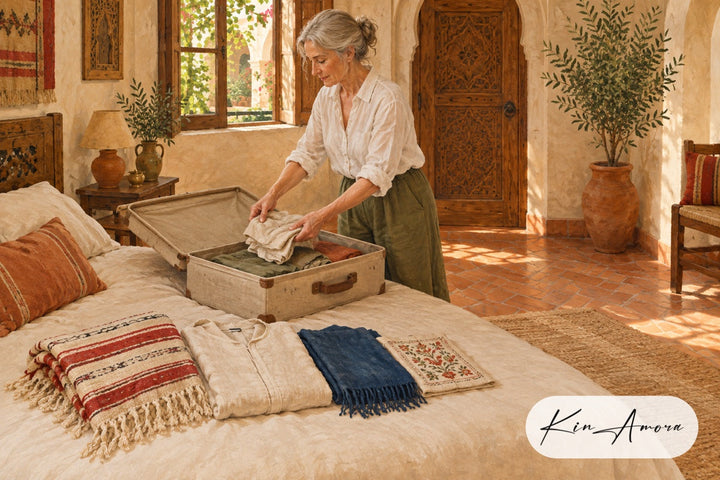
For travelers. Buy from a cooperative or a workshop that names its weavers, and ask how many days the piece took. A handira or a wool shawl folds flat in a suitcase.
For gift buyers. Embroidered linen and small woven pieces carry the craft at a lower price than a carpet. Ask whether the dye is plant-based, because many weavers now use industrial dyes.
For men. A wool djellaba is the traditional cold-weather layer, and a lighter cotton or cotton-rayon piece suits warm months.
Traditional Moroccan fabric at Kin Amora, the Marrakesh Harem Pant and Cabo Fringe Long Sleeve
Kin Amora's clothing is handmade by local artisans in Morocco in a cotton-rayon blend, and two of its Moroccan-made best sellers bring that cloth into relaxed dress. Kin Amora's product pages do not say the cloth is handwoven, so these pieces belong to the cotton-rayon column of the comparison above.
- The Marrakesh Harem Pant costs $145 in One Size Fits Most, in Black, White, Classic Striped or Berry. It is 60% cotton, 40% rayon, with pockets and an elastic waistband, and the waist can be tailored on request.
- The Cabo Fringe Long Sleeve costs $155 in One Size Fits Many, in Berry, Sand or White. It has a loose, poncho-style fit with an asymmetrical drape, fringe along the sides and bottom with woven macrame-style sections, and a round neckline. Its care line reads machine wash cold inside out, then tumble dry or air-dry.
Choose these pieces for warm weather, travel and easy washing. Choose a handwoven wool djellaba or handira from a named cooperative for a winter layer or a piece of Amazigh weaving.