


What handmade cloth should you bring home from Morocco?
The handmade cloth to bring home from Morocco is cloth with a named maker, a stated fiber and a hand step you can see, and 6 pieces meet that test.
- A handwoven djellaba, such as the djellaba bziouia that women weave in Bzou from wool and fine natural silk (Aujourd'hui le Maroc, 2024).
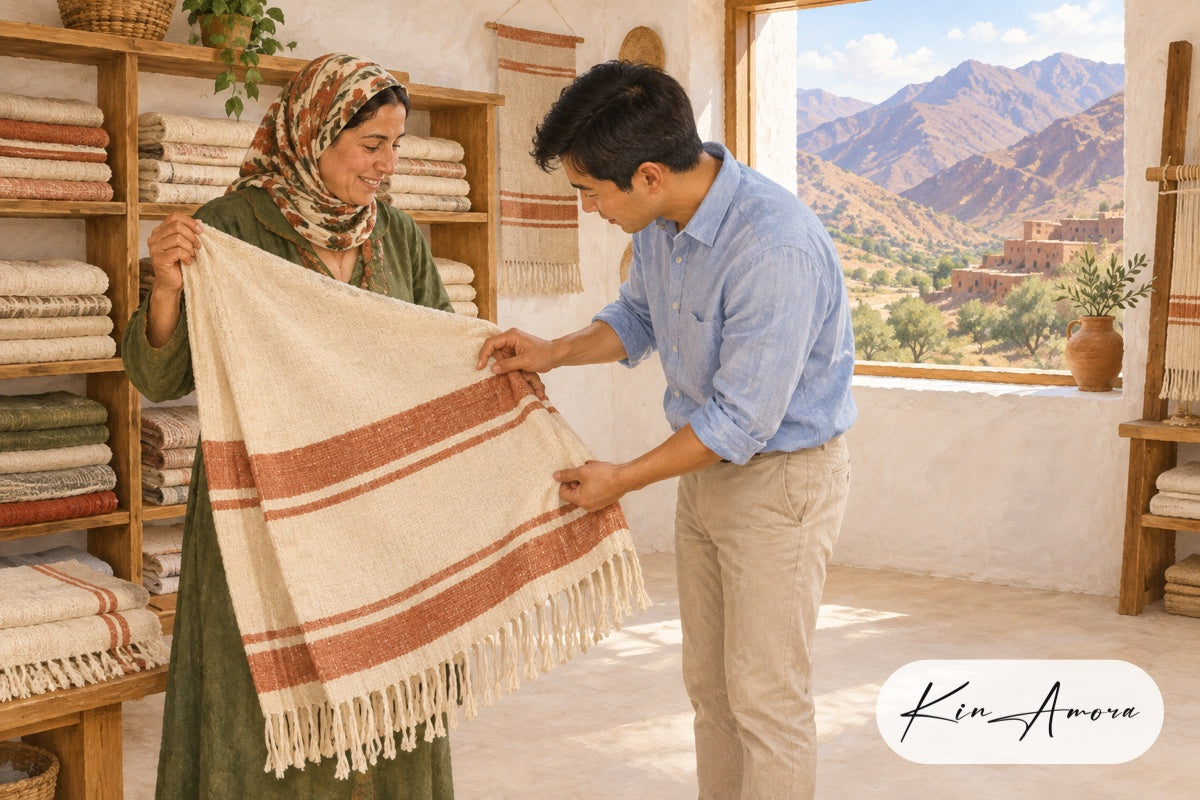
- A handira, the wool and cotton shawl woven by Amazigh women in the Middle Atlas (Textile Museum of Canada).
- Fez embroidery on linen or cotton, a reversible cross-stitch that Lotus Stack called the most difficult embroidery style (AramcoWorld, 1993).
- A kaftan with buttons, braids and embroidery made by hand, the craft UNESCO inscribed as intangible heritage in 2025.
- A plain hand-woven scarf in cotton or wool.
- A sabra piece, woven from a silky yarn that Maison de l'Artisan describes as spun from aloe fibers.
The table below adds the fiber, the source region and a packing note for each piece.
| Piece | Fiber | Where it comes from | Packing note |
|---|---|---|---|
| Djellaba bziouia | Wool and natural silk | Bzou, Azilal province | Folds into a carry-on |
| Handira | Wool and cotton | Middle Atlas | Rolls flat |
| Fez embroidery | Linen or cotton with silk thread | Fez | Lay flat between clothes |
| Kaftan | Silk, brocade, velvet, cotton or linen | City workshops | Fold along the central opening |
| Woven scarf | Cotton or wool | Moroccan looms, or imports | Fits a pocket |
| Sabra cloth | Aloe fiber yarn | Moroccan weavers | Roll to avoid creases |
Two pieces need extra care at the counter. A Lonely Planet guide (2019) reports that the patterned scarves in Marrakech markets are mostly imported from India, and that sellers' "cactus silk" claims for them are false. Each fabric type, from brocade to felt, is set out in the guide to traditional Moroccan fabric types.
What counts as handmade clothing?
Handmade clothing is clothing in which hand work does most of the job, and Morocco writes that test into law. Morocco's Law 50-17 (2020) defines craft as any activity in which manual work remains predominant. Predominant is not total. A caftan can pair machine-woven brocade with buttons, braids and embroidery made by hand, since UNESCO credits separate weavers, tailors and trim makers. Ask which steps were done by hand, and expect a precise answer from a real maker.
Which handmade pieces are worth buying?
The handmade pieces worth buying are the ones you will wear or use often, in a fiber you can care for, from a maker who can name the hours. Four tests sort them.
- Use. A piece worn every week earns its price faster than a piece kept in a drawer.
- Care. Wool and silk need gentle washing, while cotton and linen take more handling.
- Maker. A cooperative or weaver who names the hours, such as 20 days to 4 months for a Bzou djellaba, is selling real work.
- Price. The Bzou cooperative priced its djellabas from 1,500 to 5,000 dirhams by quality in 2024.
A piece that passes all 4 tests is worth its suitcase space.
Where should you buy handmade cloth in Morocco?
You should buy handmade cloth in Morocco from cooperatives, named workshops and fixed-price boutiques, and bargain in the souks only when you can check the piece yourself. The Al Khayr cooperative sells its djellabas at weekly Friday auctions in the Bzou souk and at exhibitions in Morocco, according to Aujourd'hui le Maroc (2024). In Taznakht, a new exhibition space lets some rug weavers sell directly, according to the Associated Press (2025). In Marrakech, fixed-price boutiques line Rue Sidi Abdelaziz, Rue Mouassine and Rue Amsafah, according to Time Out (2026). The checks for a factory-made kaftan and the city's other crafts are covered in the guide to shopping in the Marrakech souks.
How do you bring Moroccan cloth through US customs?
You bring Moroccan cloth through US customs by declaring every purchase and gift and keeping it unwrapped, in 4 steps drawn from US Customs and Border Protection (CBP) guidance last updated in January 2026.
- Keep receipts, because CBP sets the duty-free personal exemption at $200, $800 or $1,600, depending on the countries visited.
- Declare every item, including gifts you bought for others, since CBP requires all gifts to be declared.
- Leave gifts unwrapped, because officers may need to open them during inspection.
- Mail gifts worth up to $100 per recipient per day duty-free, marked "Unsolicited Gift" with their nature and value.
CBP warns that counterfeit or unsafe goods bought from street vendors may have to be surrendered on return, which is one more reason to buy from a named maker.
Which of these cloth pieces will you wear most often?
The cloth piece most travelers wear most often is a plain woven scarf, then a light kaftan or cotton djellaba. The 6 pieces sort by how often they leave the closet.
| Piece | How often it is worn or used | Where it fits |
|---|---|---|
| Woven scarf | Several times a week | Wrap, head cover, light layer |
| Cotton kaftan or djellaba | Weekly in warm months | Home, beach cover-up, travel |
| Wool djellaba | Weekly in cold months | Winter outer layer |
| Silk or brocade kaftan | A few times a year | Weddings and celebrations |
| Handira | Daily as a home textile | Throw or wall piece |
| Fez embroidery | Daily as a home textile | Table or bed linen |
Buy the scarf or the light robe first when space or budget is short, and add the ceremonial kaftan only for a planned occasion.
How do women and men wear these pieces?
Women and men wear most of these pieces the same way, because the djellaba and many modern caftans are cut for both. The Marrakech caftan label New Tangier cuts the same unisex shapes for men and women, according to Africanews (2025).
For women. A cotton kaftan works as a long dress at home and a cover-up at the beach, and a woven scarf covers the hair at a religious site.
For men. A wool djellaba is the cold-weather layer, and a light cotton one goes over trousers in summer.
For gift buyers. A woven scarf or a piece of Fez embroidery carries the craft in a small parcel. Write the maker's name on the card.
For carry-on travelers. Cloth folds flat, so a djellaba and 2 scarves fit where one lantern would not.
Handmade Moroccan sets at Kin Amora, the Lisbon Top x Gypsy Flare Pant Set and Men's Gandora Jacket x Island Pants Set
Kin Amora's clothing is handmade by local artisans in Morocco in a 60% cotton, 40% rayon blend, and its handmade matching sets bring that relaxed cloth home without a trip. These are modern sets cut for everyday wear, not traditional robes.
- The Lisbon Top x Gypsy Flare Pant Set costs $240 in One Size Fits Many or Plus, in Black, Classic Striped, Minnie Striped, Black Grey Minnie Striped, Royal Blue or Hunter Green. The Lisbon Top is a long-sleeved take on the T-shirt with a pointed front and back V-neckline. The Gypsy Flare Pant is Kin Amora's version of the wide leg, with pockets and an elastic waistband, and the waist can be tailored through the order notes.
- The Men's Gandora Jacket x Island Pants Set costs $385 in One Size Fits Many, in Black, Black Grey Striped, White or Classic Grey Striped. The jacket is asymmetrical, shorter in front with a longer drape at the back, and has pockets. The Island Pants are gauzy and full-length, with side pockets and a wide leg slightly gathered at the ankle. The Gandora Jacket is a modern jacket named after the gandora, not a traditional gandoura robe.
Choose a set for warm-weather travel and everyday wear. Choose a Moroccan cooperative's handwoven djellaba or handira instead for a piece woven by a named maker.



