What does artisan goods mean?
Artisan goods means products made in limited quantities by a skilled craftsperson using traditional methods. Merriam-Webster defines an artisan as "a worker who practices a trade or handicraft." The dictionary's second sense covers a person or company that produces something in limited quantities, often with traditional methods. The adjective artisanal describes goods "produced in limited quantities by an artisan through the use of traditional methods," according to Merriam-Webster.
The meaning rests on 3 attributes, which are a skilled maker, hand-led methods and a small run. Remove any one and the word loses its point. A skilled maker on a factory line lacks the small run, and a small run made by a machine's program lacks the hand. Merriam-Webster dates the noun artisan to about 1538 and the adjective artisanal to 1939.
Is it artisan goods or artisanal goods?
Both forms are correct, and artisan goods and artisanal goods mean the same thing. Merriam-Webster notes that artisan is often used before another noun, as in "artisan breads," which is the pattern behind artisan goods. Artisanal goods uses the adjective form of the same word.
What does a Moroccan workshop mean by artisan?
A Moroccan workshop that calls its work artisan is claiming a legal status as well as a skill. Morocco's Law 50-17 on craft activities, promulgated on July 25, 2020, defines craft as any activity in which manual work remains predominant, whether the activity makes products, transforms materials or provides a service. The law sorts craft into 3 categories, which are artistic production, utilitarian production and services such as repair and restoration. Article 3 adds that Moroccan craft products must reflect the original heritage character of one or more elements of Moroccan identity.
Law 50-17 names 4 kinds of craft producer, and each one must join the national crafts register.
| Term in Law 50-17 | Who it covers | Entry condition |
|---|---|---|
| Artisan | A person practicing a craft for themselves or an employer | A diploma from an approved training school, or 3 years of attested practice |
| Maître-artisan (master artisan) | An experienced artisan | 10 years of practice, confirmed by a provincial qualification commission |
| Coopérative d'artisanat (craft cooperative) | A cooperative whose main activity is craft | Formed and run under cooperative law and its own statutes |
| Entreprise d'artisanat (craft enterprise) | A company whose main activity is craft | A head office in Morocco, a trade register entry and production supervised by an artisan or master artisan |
Each registered producer receives one artisan identification number, which no other person may use. In Moroccan workshops, the master craftsman is called the maâlem, the title Morocco's Maison de l'Artisan uses for a master felter.
What are the requirements to become an artisan in Morocco?
The requirements to become an artisan in Morocco are a recognized qualification and a place in the national crafts register, and Law 50-17 sets them out in 4 steps.
- Qualify through a certificate or diploma from an approved public or private training institution, or through an attestation of at least 3 years of actual practice from the amine of the trade, who must answer within 30 days.
- Register on the electronic platform of the national crafts register.
- Receive the artisan identification number, assigned once per person for the main craft practiced.
- Collect the professional card, which Morocco's chambers of crafts issue to registered artisans and master artisans.
The amine is the elected president of a trade's provincial corporation, must be a master artisan, and serves 6 years, renewable once. A master artisan needs 10 years of practice, knowledge of every side of the craft, the ability to supervise a production unit and the ability to teach the skills. The register drops an artisan who stops practicing for more than 3 years, so a valid number signals current work.
Which labels show that a Moroccan product is artisan made?
Two kinds of official sign show that a Moroccan product is artisan made, the national or regional craft label and the craft geographic indication, both created by Law 133-12 of April 27, 2016. The law defines the label as recognition that a product has specific qualities that give it a higher level of quality than similar products, because of how it is produced. The geographic indication names a product from a territory, region or place when its quality or reputation comes mainly from that origin.
Moroccan craft products can carry 3 kinds of official proof.
- An artisan identification number from the national crafts register (Law 50-17).
- A national or regional craft label, backed by a specification of raw materials, methods and a control plan (Law 133-12).
- A craft geographic indication, protected once it is published in Morocco's Bulletin officiel (Law 133-12).
The national label in use is Maroc Fait Main, which has 3 membership levels, and its first certification round was open to 600 production units, from sole artisans to cooperatives, according to Le360 (August 2024). In June 2025, Secretary of State Lahcen Saâdi told Le360 that more than 77 quality labels existed, covering products such as the Moroccan caftan, Fez zellige, Tetouan zellige and Ghazouani weaving.
What are examples of artisan goods?
Examples of artisan goods in Morocco span 172 crafts, according to Saâdi's June 2025 figures in Le360, and Maison de l'Artisan counts weaving among the oldest of them. The 7 examples below show the range.
- Handwoven djellaba cloth, such as the djellaba bziouia that women weave from wool and silk in Bzou, Azilal province (Aujourd'hui le Maroc, 2024).
- Caftans with handmade buttons, braids and embroidery, inscribed by UNESCO in 2025 as intangible cultural heritage.
- Embroidered textiles, a craft handed down from mother to daughter in Fez and Rabat, according to Maison de l'Artisan.
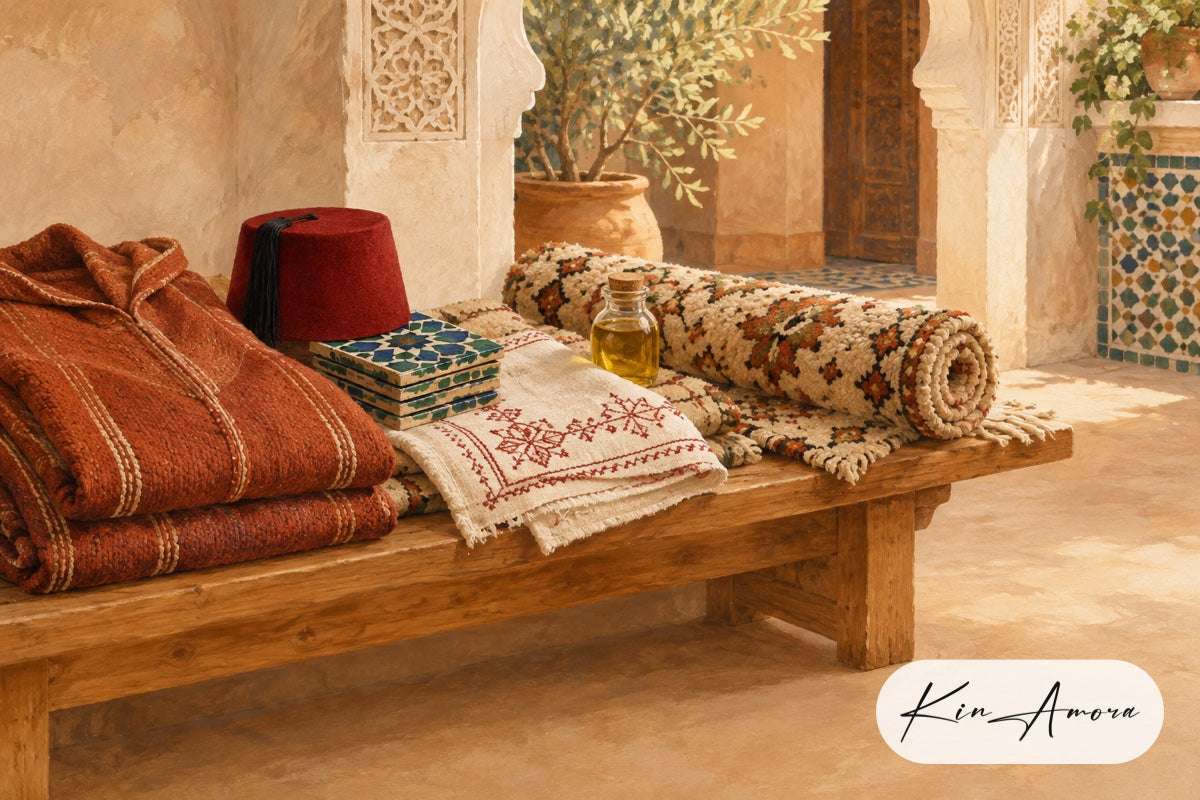
- Knotted wool carpets, which Maison de l'Artisan sorts into city rugs and rural rugs, the rural ones often in bright colors.
- Felted wool caps, including the red fez hat, shaped around a bowl by a master felter.
- Zellige tilework from Fez and Tetouan, both covered by quality labels.
- Argan oil, extracted mainly by rural women in south-west Morocco with a hand mill made by local craftspeople, according to UNESCO (2014).
The first 3 examples are textiles, which is where the word artisan reaches clothing.
Does artisan mean every step is done by hand?
No, artisan does not mean every step is done by hand, because the Moroccan legal test is predominant manual work, not manual work alone. A caftan shows the split. UNESCO's 2025 inscription credits weavers for the brocade, velvet and silk, tailors for the shape, and artisans for the buttons, braids and embroidery. Lotus Stack reported in AramcoWorld (1993) that Fez wedding caftans could already be machine-woven in traditional patterns, while the wedding veil was still woven by hand on a drawloom.
Other pieces stay hand-made from the fleece up. The wool for a djellaba bziouia is washed, combed and carded, women weave the robe at the loom, and one robe takes 20 days to 4 months, according to Aujourd'hui le Maroc (2024). Ask which steps were done by hand, because the answer separates a hand-trimmed piece from one woven by hand from start to finish.
What is an artisan shop?
An artisan shop is a workshop where a maker produces and sells, or a store that sells work by named makers. In Moroccan medinas, workshops cluster by trade. UNESCO describes the 700 hectares of the Marrakech medina as a living town of lanes, souks, fondouks, artisanal activities and traditional trades. Law 50-17 mirrors that layout, with one trade corporation for each craft in each province. A shop that can show the workshop, name the maâlem and give a register number meets the full meaning of the word.
How can you recognize handmade quality in clothing?
You can recognize handmade quality in clothing by hand-finished details, small variations between pieces and a maker who answers specific questions. Moroccan dress adds 3 places to look. On a handmade caftan or djellaba, the buttons are worked in thread by hand, and plastic buttons point to a factory. The braid along a caftan's central opening is sewn on with small stitches, not glued. Hand-spun wool in djellaba cloth varies in thickness along the yarn. The general checks for seams, hems and labels are set out in the six signs of handmade clothing, which apply to any garment.
What is artisan clothing?
Artisan clothing is clothing in which a skilled maker's hand work does most of the job, from weaving the cloth to sewing, embroidering and finishing the garment. A handwoven djellaba, a caftan with hand-made trim and a hand-embroidered tunic all qualify. A label that reads "made in Morocco" names a country, not a method, a point the guide to Moroccan artisan clothing develops with the US label rules. Artisan clothing costs more because the hours sit in each piece, as the 18 to 35 hours per garment at the Marrakech caftan label New Tangier show (Africanews, 2025).
What makes a fashion brand an artisan brand?
A fashion brand earns the word artisan when it names its makers, its workshop city and the steps done by hand. An artisan fashion brand publishes 4 facts.
- The makers, as named people, a cooperative or a team size.
- The workshop city or region.
- The steps done by hand, such as weaving, embroidery or assembly.
- The fiber content, listed by percentage.
A brand that publishes only a mood ("crafted with love," "boho") is selling a style. A Moroccan brand can add a register number or the Maroc Fait Main label as outside proof. Eight Moroccan clothing brands, from Marrakech couture houses to a women's djellaba cooperative in Azilal province, show how a label names its city, its makers and its handwork.
How should different buyers use the word artisan?
Different buyers use the word artisan best by turning it into one specific question.
For travelers in Morocco. Ask the shop for the maker's name and the register number, and ask to see the workshop when it sits behind the shop. Some cooperatives sell at exhibitions and weekly souk auctions, as the Al Khayr djellaba cooperative does in Bzou.
For gift buyers. A handwoven scarf or embroidered linen carries the artisan meaning in a small, packable piece. Ask which steps were done by hand, and write the answer on the gift card.
For online shoppers. Read the listing for the 4 facts above before checkout. A listing with a country, a fiber percentage and named makers is checkable, while "artisan style" is not.
Artisan goods at Kin Amora, the Womens Santorini Pant and Classic Capri
Kin Amora's clothing is handmade by local artisans in Morocco in a 60% cotton, 40% rayon blend, according to its product pages, and two of its handmade best sellers show what that means in relaxed clothing. Measured against the 4 facts above, Kin Amora names the country, the makers as local artisans and the fiber content, and it has not published a workshop city.
- The Womens Santorini Pant costs $120 in Small, Medium, Large and XL, in 12 colors such as Black, Olive, Royal Blue and Lilac. It is Kin Amora's tapered leg, with pockets and an elastic waistband.
- The Classic Capri costs $98 in Black, White and Sand, and $134 in Grey Habba, in One Size Fits Many or Plus. It has a front yoke panel, a 3-button closure with a side opening, pockets and an elastic waistband, and the length falls to the ankle.
Both waists can be tailored on request through the order notes. Choose these pants for travel, yoga and everyday wear. Choose a registered Moroccan cooperative instead for a handwoven djellaba or a caftan with hand-made buttons and braid.